
“Are there things you should not do on the Shikoku Pilgrimage?”
“Is it okay to walk it just like sightseeing?”
“Are there rules regarding clothing and what you carry?”
Hello. I’m Taka, the author of this blog.
I have walked the Shikoku Pilgrimage twice, completing both clockwise and counterclockwise routes.
Both times I completed it in sections, and I have experienced all four seasons—spring, summer, autumn, and winter.
The Shikoku Pilgrimage has its own etiquette and certain prohibited behaviors.
In this article, I will clearly explain the “don’ts” that beginners should know, along with the reasons behind them.
Representative customs and important manners
1. Do not use your pilgrim staff on bridges
It is customary not to place or strike your kongō-zue (pilgrim’s staff) on bridges.
This tradition comes from a legend that Kōbō Daishi (Kūkai) once rested beneath a bridge during his ascetic training. It is believed that he may still be resting there even today. Because of this, pilgrims avoid disturbing that resting place.
Therefore, it is considered important to cross bridges respectfully, without using your staff on them.
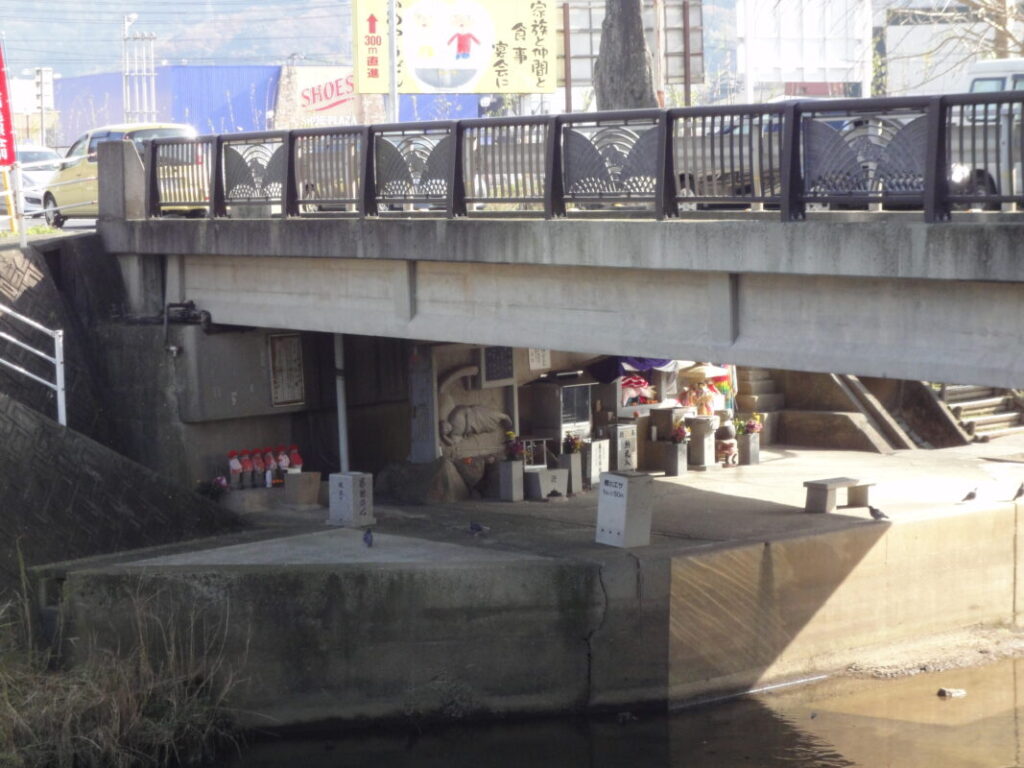
The Legend of Tōyagabashi, Where Kōbō Daishi Is Said to Have Slept Outdoors
Over 1,200 years ago, when Kōbō Daishi (Kūkai) was traveling across Shikoku during his ascetic training, he is said to have visited the Ōzu area, which is present-day Ehime Prefecture.
At that time, the region was still underdeveloped, with very few villages and almost no lodging available. It was also a busy farming season, and he was unable to find a place to stay. As a result, it is said that he spent the night under a small earthen bridge while hungry and without shelter.
The night was extremely cold and felt unbearably long. It is said that “one night felt like ten nights,” which is believed to be the origin of the name “Tōyagabashi” (Ten-Night Bridge).
Tōyagabashi is located along the route between the 43rd temple, Meisekiji, and the 44th temple, Daitsuji, and is known as a place many pilgrims stop by during their journey.
It is also designated as the 8th temple of the Shikoku Bangai (Extra) Pilgrimage, making it an important sacred site on the pilgrimage route.
2. Wash your kongō-zue first when you arrive at your lodging
The kongō-zue (pilgrim’s staff) is regarded as an important sacred item, believed to represent Kōbō Daishi himself.
When you arrive at your lodging, the first thing you should do is clean and purify your staff by removing any dirt accumulated during the day’s walk.
At many lodgings, you will find a bucket of water or a wet towel prepared at the entrance. Use it to carefully wipe the tip of your staff, which has collected dirt throughout your pilgrimage.
This is not merely cleaning. It is also an act of gratitude for being able to complete another day of the journey safely. After cleansing it, place the staff quietly in the designated rack.
3. Do not bring pilgrimage items into impure places
It is generally considered inappropriate to bring pilgrimage items into places regarded as “impure,” such as toilets.
The following items should not be taken inside:
- kongō-zue (pilgrim’s staff)
- sugegasa (pilgrim’s hat)
- sanyabukuro (pilgrim’s shoulder bag)
- juzu (prayer beads)
- wagesa (ceremonial pilgrim’s stole)
All of these are regarded as “Buddhist implements,” and it is important to maintain a sense of purity and respect when handling them.
The “Ten Good Precepts” (Jūzenkai) observed in the Shikoku Pilgrimage
In the Shikoku Pilgrimage, the basic Buddhist ethical guidelines known as the Ten Good Precepts (Jūzenkai) are deeply respected and are considered an important foundation of the journey to the 88 sacred temples of Shikoku.
1. Not killing (No killing of living beings)
To respect all forms of life and avoid harming any living creature unnecessarily.
2. Not stealing
To never take what belongs to others.
3. No sexual misconduct
To respect one partner and avoid adultery or infidelity.
4. No false speech
To avoid lying and speak the truth.
5. No frivolous or exaggerated speech
To refrain from meaningless talk or exaggerated expressions.
6. No harsh speech
To avoid insults and aggressive language.
7. No divisive speech
To avoid double-dealing or words that create conflict between people.
8. No greed
To avoid excessive desire and attachment.
9. No anger or hatred
To remain calm and not be controlled by anger.
10. No wrong views
To avoid distorted perceptions and maintain a correct understanding of reality.
Other manners and things you should not do
Do not use a blade or knife on your kongō-zue
As you continue walking long distances, the tip of your kongō-zue (pilgrim’s staff) may become frayed or splintered.
However, the staff is regarded as a sacred object representing Kōbō Daishi himself. For this reason, using a blade or knife to shave, carve, or modify it is strictly forbidden.
It is important to treat the staff with respect and avoid any form of alteration.
“Modorigane” (ringing the temple bell after worship)
Ringing the temple bell after completing a visit is known as “modorigane”, and it is generally considered a practice to be avoided.
This is because it is believed that ringing the bell after worship may cause the blessings received from the visit to diminish.
The proper etiquette is to ring the temple bell before visiting the main hall.
This is regarded as an important practice for purifying and preparing one’s mind before approaching the sacred space.
However, in some temples, the use of the bell may be restricted due to consideration for nearby residents and noise prevention.
It is important to follow the on-site signs and instructions at each temple.
Do not develop a sense of entitlement
The Shikoku Pilgrimage is a path of ascetic practice, not something meant to receive special treatment.
It is important to walk with humility and a respectful mindset.
Do not disturb local residents
Avoid making loud noises or causing disruptions.
Being considerate toward local communities is an essential part of the pilgrimage spirit.
Do not litter
Any trash generated during the journey must be taken with you.
A strong awareness of protecting nature and the temple environment is required.
Do not make fires when camping outdoors
Making fires in mountains or during wild camping is dangerous.
Due to the risk of wildfires, this practice should be strictly avoided.
Frequently Asked Questions (FAQ)
- QDo I have to wear white clothing on the Shikoku Pilgrimage?
- A
No, it is not mandatory.
On the Shikoku 88-temple pilgrimage, wearing white clothing is optional, and it is perfectly acceptable to walk in regular clothes.
However, wearing white garments makes it easier for others to recognize you as a pilgrim, which can help local people understand your journey and may also reduce unnecessary concern or confusion.
- QIs it okay to eat inside temple grounds?
- A
Yes, it is generally allowed.
However, since the Shikoku 88-temple sites are places of worship, it is important to be considerate of others and eat quietly without disturbing the atmosphere.
Also, please be sure to take all trash with you and leave the temple grounds clean.
- QCan I wear sunglasses during the pilgrimage?
- A
Yes, it is allowed.
Sunglasses are often recommended, especially under strong summer sunlight or along coastal routes where UV exposure is high.
However, it is considered polite to remove them when visiting temple halls as a sign of respect.
- QCan I use a hammock while walking the pilgrimage in the mountains?
- A
Yes, it is allowed.
Using a hammock as a way to rest or even sleep in mountainous areas is generally acceptable as part of your pilgrimage journey.
Summary: Things You Should Not Do on the Shikoku Pilgrimage
The Shikoku Pilgrimage includes several important manners and prohibitions that pilgrims are expected to follow.
However, these are not simply strict rules. They are rooted in deeper meanings such as:
- Respect for Kōbō Daishi
- Consideration for others
- A way to discipline and calm one’s own mind
By understanding and following basic etiquette, even first-time pilgrims can walk the route with greater peace of mind and confidence.
We hope this guide helps you enjoy a safe and meaningful pilgrimage experience.
Related Articles
I have compiled a detailed guide to the Shikoku Pilgrimage for beginners.
What is the Shikoku Pilgrimage? Beginner’s Guide to Your First Sacred Journey in Japan
If you would like to learn how to worship at a Japanese temple, please see this page.
How to Worship at Japanese Temples : Shikoku Pilgrimage Guide
This article provides a complete list of the Shikoku 88 Temple pilgrimage route, including distances, travel times, and temple lodging (shukubo).
Temple List and Full Route
What Is the Purpose of the Shikoku Pilgrimage? Real Experiences from 88 Temples.
Purpose of the Shikoku pilgrimage