
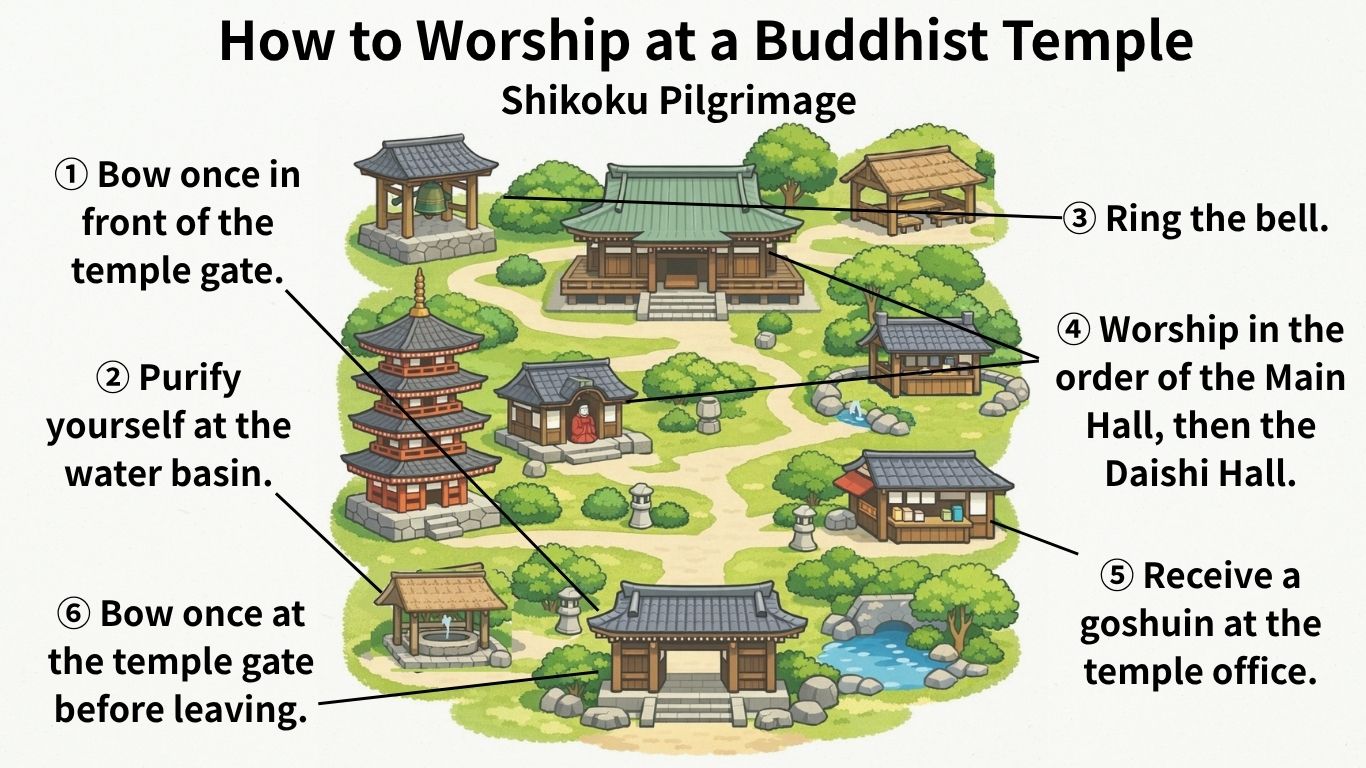
Have you ever felt unsure, wondering, “Am I doing this correctly?” when visiting a temple?
Hello, I’m Taka, the creator of this blog.
I have walked the Shikoku Pilgrimage twice, completing both the clockwise and counterclockwise routes.
For both journeys, I traveled in sections and experienced all four seasons—spring, summer, autumn, and winter.
When visiting a temple for the first time or taking part in the Shikoku Pilgrimage, many people feel confused about the proper order and etiquette. However, once you understand the basic flow, anyone can worship with confidence and respect.
In this article, I will clearly explain the correct way and order to worship at a temple for beginners. From bowing at the temple gate, purification at the water basin, and visiting the Main Hall and Daishi Hall, to the meaning of offering slips, incense, and goshuin stamps, as well as common mistakes to avoid—everything is covered.
By reading this, you’ll be able to visit temples calmly and without confusion.
Correct Temple Worship Method and Order
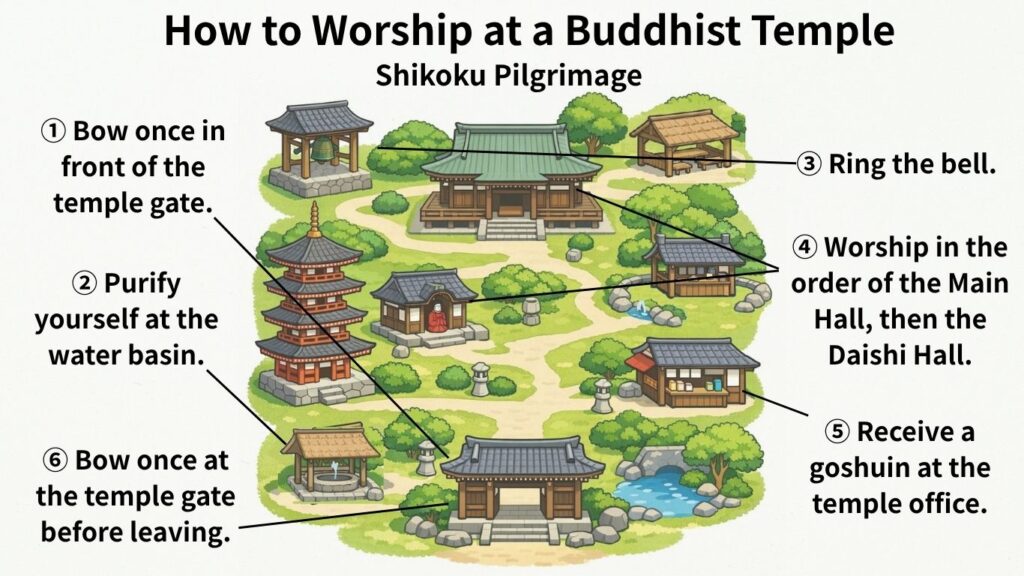
① Bow at the temple gate
Before passing through the temple gate (Sanmon), bow once. The gate is considered the boundary between the secular world and sacred space, so it is important to show respect before entering.
② Purify yourself at the water basin
Cleanse your hands and mouth at the purification fountain (temizuya). This ritual removes impurities and prepares your body and mind before approaching the Main Hall.
Proper Temizu Procedure
Perform the purification ritual in the following order:
- Hold the ladle (hishaku) in your right hand and scoop water.
- Pour water over your left hand to cleanse it.
- Switch the ladle to your left hand and cleanse your right hand.
- Switch it back to your right hand, pour water into your left hand, and rinse your mouth.
Do not put your mouth directly on the ladle. - Finally, hold the ladle upright to let water run down the handle, then return it to its original place.
③ Ring the bell
If you ring the bell, do so before your worship. Ringing it after praying is called a “return bell” (modori-gane) and is generally avoided, as it is believed to send back the blessings you have received.
Also, some temples have time restrictions or prohibit bell ringing, so be sure to follow the local rules.
④ Worship in the order of the Main Hall, then the Daishi Hall
The basic order is “Main Hall → Daishi Hall.” First, offer your prayers to the principal deity in the Main Hall, then visit the Daishi Hall to pay respect to Kobo Daishi.
4-1 Offerings: Name Slips, Candles, Incense, and Donation
At the Main Hall, follow the proper order when making your offerings:
- Place your name slip (osamefuda).
- Light a candle, starting from the upper row.
- Offer incense, placing it from the center.
- Make a monetary offering.
When lighting candles or incense, avoid using someone else’s flame. This is called “borrowing fire” (morai-bi) and is believed to transfer another person’s misfortune to you.
Also, avoid blowing out incense with your mouth, as it is considered improper. Instead, gently wave your hand to extinguish the flame.
4-2 Ring the bell (if provided)
Some temples have a bell placed in front of the Main Hall. Ringing it once before worship helps calm and prepare your mind.
4-3 Chanting and prayer
Finally, put your hands together in prayer and chant sutras or recite a Buddhist invocation. The most important thing is to pray quietly and sincerely. When finished, bow once and leave the Main Hall.
⑤ Receive a goshuin at the temple office
After finishing your worship, go to the temple office (nokyojo) and pay the fee to receive a goshuin (temple stamp). If it is crowded, you can leave your stamp book there first and pick it up later.
⑥ Bow at the temple gate before leaving
When leaving the temple, stop at the gate, bow once, and then exit. Show your gratitude for being able to worship, and leave quietly and respectfully.
Common Mistakes to Avoid
Items such as your pilgrimage stole (wagesa) and prayer beads (juzu) should be removed before entering the restroom. These are considered sacred objects, and bringing them into an unclean place is regarded as disrespectful.
Be sure to take them off before entering and place them in a clean area before use.
Frequently Asked Questions (FAQ)
- QWhat is the difference between a shrine and a temple?
- A
The difference lies in the object of worship and the religion.
Shrines belong to Shinto, Japan’s indigenous religion, and enshrine various deities (kami), such as those of nature and ancestors.
Temples, on the other hand, are Buddhist institutions where people honor Buddha and pray for their ancestors.There are also differences in structures and terminology. Shrines have a torii gate at the entrance and are served by Shinto priests.
Temples feature a sanmon gate and bells, and are attended by Buddhist monks.
- QWhy do we offer money (osaisen)?
- A
Offering money is not a “payment” for having your wishes granted, but a way to express gratitude to the deities or Buddha.
Originally, people offered items such as rice or cloth. In modern times, money has taken their place. In other words, an offering represents your daily gratitude and appreciation for being able to pray.
- QHow much should you offer as osaisen?
- A
There is no fixed amount for osaisen. What matters most is not the money itself, but your feeling of gratitude toward the deities or Buddha.
Some people choose amounts based on wordplay, such as 5 yen (go-en), which sounds like “good connection” in Japanese and is believed to bring good relationships or luck.
- QWhat is the meaning of a goshuin?
- A
A goshuin is a seal or stamp given at temples and shrines as proof of your visit. It is not just a simple stamp, but a record of your pilgrimage and a symbol of your connection with the deity or Buddha.
- QWhat is the rope coming out of the Main Hall?
- A
This rope is believed to be connected to the Buddha enshrined inside the Main Hall. By touching the rope outside, it is considered the same as directly offering prayers to the Buddha.
In other words, it is a “rope for connecting with the Buddha.”
Even if you are unable to enter the Main Hall, you can still form a proper spiritual connection by gently touching this rope and praying.
- QWhy do we ring the temple bell?
- A
Ringing the bell at a temple is believed to announce your presence to the Buddha and help prepare your mind for worship. The sound of the bell is said to purify the heart by removing distracting thoughts and impurities, allowing you to enter prayer with a calm and focused mind.
It is also said that the bell’s resonance helps dispel worldly desires and attachments, making it an important ritual for resetting your state of mind before praying.
In addition, the bell should generally be rung before worship. Ringing it after praying is called a “return bell” and is considered inauspicious, so the correct timing is important.
- QWhat is the meaning of candles and incense?
- A
Candles and incense each have important symbolic meanings.
The flame of a candle represents the “light of wisdom of Buddha,” illuminating darkness and guiding people spiritually. It is also said to represent lighting up one’s own mind and bringing clarity.
On the other hand, the smoke of incense is believed to purify both body and mind. Its fragrance is considered an offering that carries prayers and devotion to Buddha. The rising smoke is also thought to dispel negative energy and purify the sacred space.
- QWhy do we offer name slips (osamefuda) in the Shikoku Pilgrimage?
- A
Osamefuda are offered at temples as proof of having completed a pilgrimage. They function like a “visiting card of prayer,” and pilgrims write their name, address, and wishes before dedicating them at the temple.
This custom originally began as a way for pilgrims to leave evidence of their presence and faith. It also represents a way to form a connection with the temple, expressing gratitude and the wish to complete the pilgrimage safely.
- QWhy are there name slips (fuda) attached in temples?
- A
In the past, wooden pilgrimage name slips were used, and pilgrims would nail them onto temple pillars or other structures.
This is why even today, the act of visiting a temple is sometimes expressed with the word “to strike” or “to post.”
However, in modern times, attaching or nailing name slips is prohibited in most temples in order to protect the buildings and preserve their appearance. Today, osamefuda should always be placed in the designated offering box.
- QWhat is the difference between the Main Hall and the Daishi Hall?
- A
The Main Hall is the central building of the temple, where the principal deity (the main Buddha) is enshrined. It is the most important place of worship, and it is customary to pay respects here first.
The Daishi Hall, on the other hand, enshrines Kobo Daishi (Kukai). In the Shikoku Pilgrimage, he is considered a particularly important figure, and pilgrims believe they are traveling together with him. Therefore, they visit the Daishi Hall to express gratitude and pray for his protection.
- QCan you drink the water at the temizuya (purification basin)?
- A
No, the water at the temizuya is not meant for drinking. It is used for purifying your hands and mouth before worship, and is not intended as drinking water.
- QCan I take photos?
- A
In general, photography is allowed at temples. However, it is not permitted everywhere.
Many temples prohibit photography inside the Main Hall, as well as of sacred statues or hidden Buddhas. If there are any signs indicating “no photography,” you must follow the rules.
- QI don’t understand Buddhist chanting (nenbutsu). What should I do?
- A
It’s not a problem if you don’t understand nenbutsu or sutras. What matters most is not the form, but praying with sincerity.
Simply putting your hands together quietly with a sincere heart is completely enough.
If you would like to chant something, you can say “Namu Daishi Henjo Kongo,” which is a phrase expressing respect for Kobo Daishi, three times.
Summary
Temple worship is not something you need to overthink, but knowing the basic etiquette allows you to face Buddha more respectfully and sincerely.
The basic flow is as follows:
- Bow at the temple gate
- Purify yourself at the water basin
- Ring the bell (if available)
- Worship in order: Main Hall → Daishi Hall
- Receive a goshuin at the temple office
- Bow at the gate before leaving
What matters most is not formality, but a sincere feeling of gratitude. By following the rules and maintaining a calm mind, you can offer your prayers respectfully and peacefully.
Related Articles
I have compiled a detailed guide to the Shikoku Pilgrimage for beginners.
What is the Shikoku Pilgrimage? Beginner’s Guide to Your First Sacred Journey in Japan
This article summarizes things you should not do on the Shikoku Pilgrimage.
Shikoku Pilgrimage Rules & Prohibited Actions: Essential Etiquette for Beginners
This article provides a complete list of the Shikoku 88 Temple pilgrimage route, including distances, travel times, and temple lodging (shukubo).
Temple List and Full Route
What Is the Purpose of the Shikoku Pilgrimage? Real Experiences from 88 Temples.
Purpose of the Shikoku pilgrimage