
Hello, I’m Taka.
In this article, I’ll share my experience from Day 3 of the Shikoku Pilgrimage on foot.
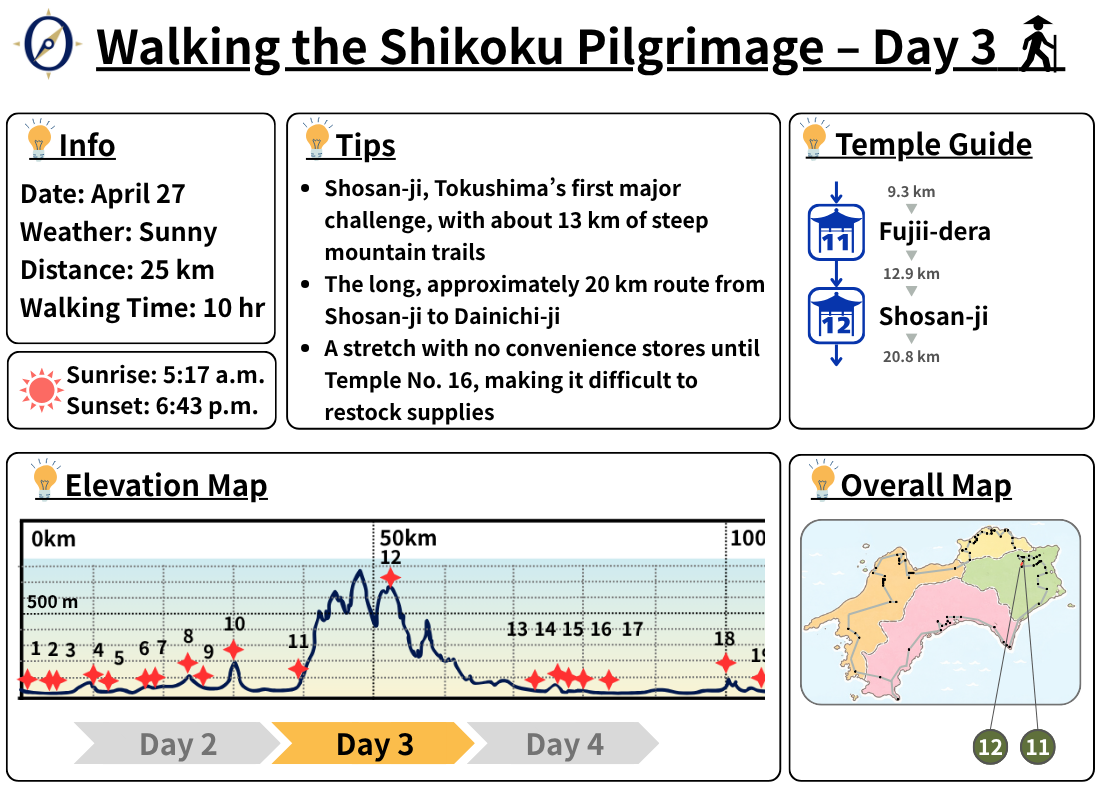
This guide covers the route, difficulty, and key points of Day 3 (from Fujii-dera to Shosan-ji), based on my actual experience.
- How tough is the “Henro Korogashi” (pilgrimage killer)?
- Can beginners handle this route?
- Where should you stay?
If you’re looking for answers to these questions, this article is for you.
- Itinerary
- Day 3 Plan: Temple No.12 Shosan-ji and Overnight Options
- Arrival at Temple No.11 Fujii-dera: Early Morning Prayer
- 7:00 AM — Heading to Temple No.12 Shosan-ji: What Is the First Major Challenge, “Henro Korogashi”?
- Walking the Shosan-ji Trail: The 1,200-Year-Old “Path of Kūkai”
- I arrived at the Hayama Rest Area
- A Surprisingly Walkable Mountain Trail
- 8:30 AM — Arrival at Chodo-an
- About 15 minutes after leaving Chodo-an, the view suddenly opened up
- Encounter with a Trail Runner
- Ryusui-an – Midway Point
- Jōren-an and the Lone Cedar of Sōuchi
- 11:30 AM — The Town from This Morning Is No Longer in Sight
- A Bell Sound? The Temple Is Near — The Final Climb
- Temple No.12 Shosan-ji — Arrival at 12:50 PM
- Heading Toward Tonight’s Accommodation : The Final “Henro Korogashi” Section
- 5:00 PM — Arrival at Amida-dō, Tonight’s Wild Camping Spot
- Temple Information
- Summary
- FAQ: Shosan-ji Approach (Henro Korogashi)
Itinerary
- 6:00Departure
- Kamojima Onsen
- 7:00Temple No. 11, Fujii-dera
- Hayama Rest Area
- Chodo-an
- Ryusui-an
- Jōren-an
- 12:50Temple No. 12, Shosan-ji
- Jōshin-an
- Sōuchi Ohenro Station
- Tamaga Pass
- Kamyama Henro Hut
- 17:00Amida-do
Overnight stay
Day 3 Plan: Temple No.12 Shosan-ji and Overnight Options
April 27 – Sunny. Once again, the weather was on my side.
I left the accommodation at 6:00 a.m. The man in his 70s I had spoken with the night before had already departed ahead of me. The other guests were still asleep, so I quietly got ready, careful not to wake anyone, and slipped out.
Today’s goal is Temple No.12 Shosan-ji, known as the first major challenge of the pilgrimage—the so-called “Henro Korogashi.” I prepared for the possibility of camping along the way, so I stocked up on extra food at a convenience store the day before. Carrying enough for breakfast, dinner, and even the next morning made my pack noticeably heavier, but that was unavoidable.
The pain in my feet had eased considerably compared to yesterday. The hot spring bath and thorough massage seemed to have helped. Still, I couldn’t let my guard down. I decided to take it slow, avoid pushing too hard, and focus on each step forward.
Accommodation Plan from Day 3 Onward
From today onward, I decided not to fix my accommodation in advance.
Instead, I would adjust based on my walking pace and physical condition—without pushing myself, but still aiming to go as far as I reasonably could each day. I planned to choose where to stay depending on the situation at the end of each day.
To stay flexible, I carried a tent and a sleeping bag so I could camp if needed.
At simple rest areas along the route, you can find lists of available options, including camping spots, free pilgrim lodgings (zenkonyado), and budget accommodations. I picked up one of these lists and planned to use it as a reference to decide where to stay each day.
First, I headed toward Temple No.11, Fujii-dera.
Arrival at Temple No.11 Fujii-dera: Early Morning Prayer
In the early morning at Fujii-dera, there were a few visitors and what seemed to be local residents.
“Good morning,” we exchanged brief greetings.
I then made my way to the main hall and quietly put my hands together in prayer.
May I safely make it to Shosan-ji—
I whispered this wish silently in my heart.
7:00 AM — Heading to Temple No.12 Shosan-ji: What Is the First Major Challenge, “Henro Korogashi”?
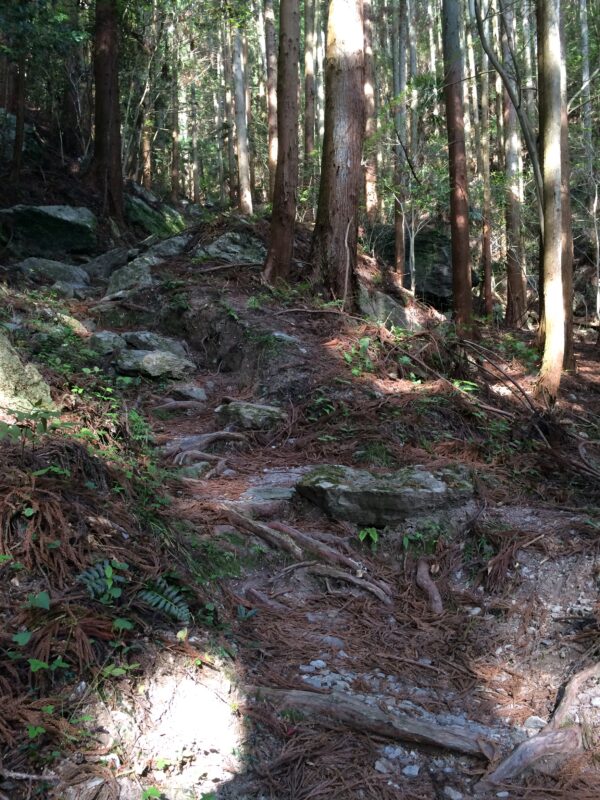
After a light breakfast at Fujii-dera, I finally stepped onto the trail leading to Shosan-ji. The entrance is within the temple grounds, and from here, the true mountain path begins.
The route to Shosan-ji has remained largely unchanged for over 1,200 years, preserving the original form from when the pilgrimage first began. It feels as if you’ve stepped back in time, sensing the presence of those who walked this same path long before.
This is the first full-scale mountain route since starting the walking pilgrimage. Combined with the lingering foot pain typical of the early days, it’s said that quite a few people end up giving up at this point.
For experienced hikers, it might feel like a manageable challenge. But for me—someone with little mountain trekking experience—it was completely unknown territory. The moment I stepped into nature, I felt a quiet tension run through me.
Still, having come this far, turning back was no longer an option.
Without looking behind, I held a small determination in my heart and quietly took my first steps onto the pilgrimage trail.
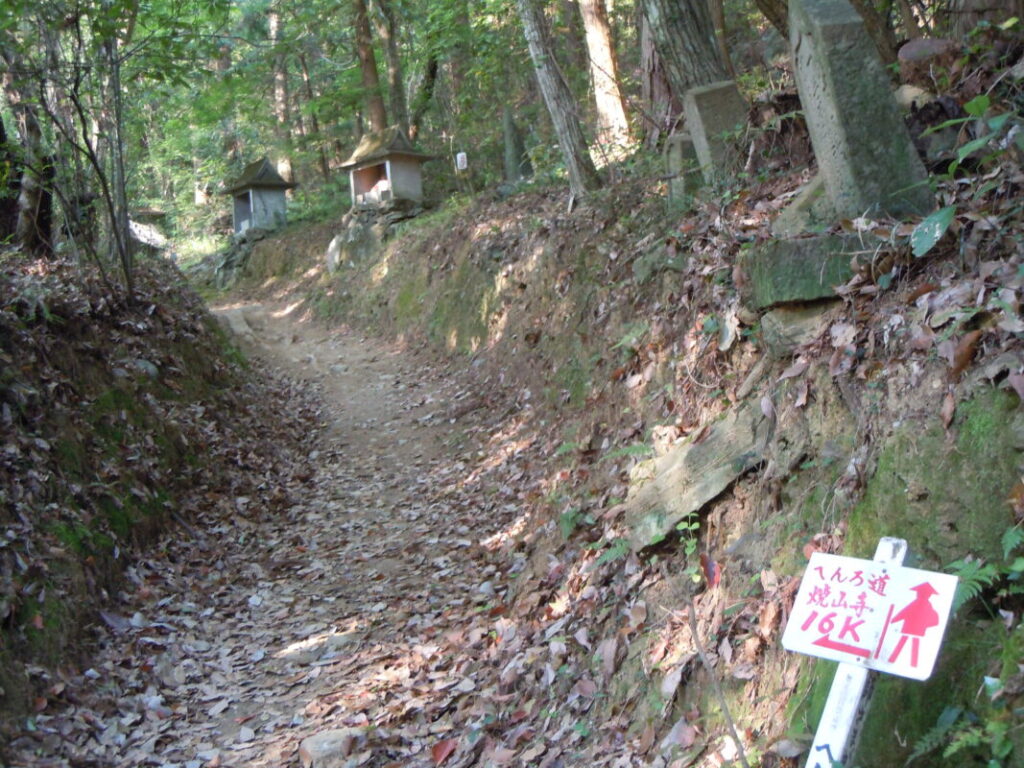
What Is “Henro Korogashi” at Shosan-ji?
- A long stretch of steep mountain trails that significantly drains your stamina
- Called “Henro Korogashi” (“pilgrim killer”) because it’s so tough it can make pilgrims feel like they might collapse or “roll down”
- Considered the first true test of the Shikoku Pilgrimage
Elevation and “Perceived Difficulty” of Shosan-ji
The distance from Fujii-dera to Shosan-ji is about 13 km.
There are a few natural spring water points along the way, but no places to buy food.
Starting from Fujii-dera (about 50 meters above sea level), the elevation gain is roughly 650 meters—but in reality, the trail consists of repeated ascents and descents.
Because of this, the actual “cumulative elevation gain” you’ll climb on foot is approximately 1,000 meters.
The Henro Korogashi to Shosan-ji combines distance, elevation gain, and limited access to supplies, making it the first major challenge of the walking pilgrimage.
That said, if you manage your pace and avoid overexertion, even beginners can successfully complete this route.
Walking the Shosan-ji Trail: The 1,200-Year-Old “Path of Kūkai”
I arrived at the Hayama Rest Area
After climbing about 200 meters in one stretch, I took a breather at the first rest point.
In terms of time, it was only about 15 minutes—but carrying a backpack weighing over 10 kg on a mountain trail for the first time was tougher than I had imagined.
Since my water supply was limited, I avoided drinking too much at once and instead took small sips.
“So this keeps going… this is going to be tough.”
I murmured those words quietly to myself.
Perhaps because I had packed enough food for the next morning, the weight of my backpack was gradually pressing down on my shoulders. The constant swaying with each step was also bothersome, so I became conscious of keeping the pack stable.
I tightened the chest strap a bit more. It secured the backpack firmly against my back, reducing unnecessary movement and making it easier to walk.
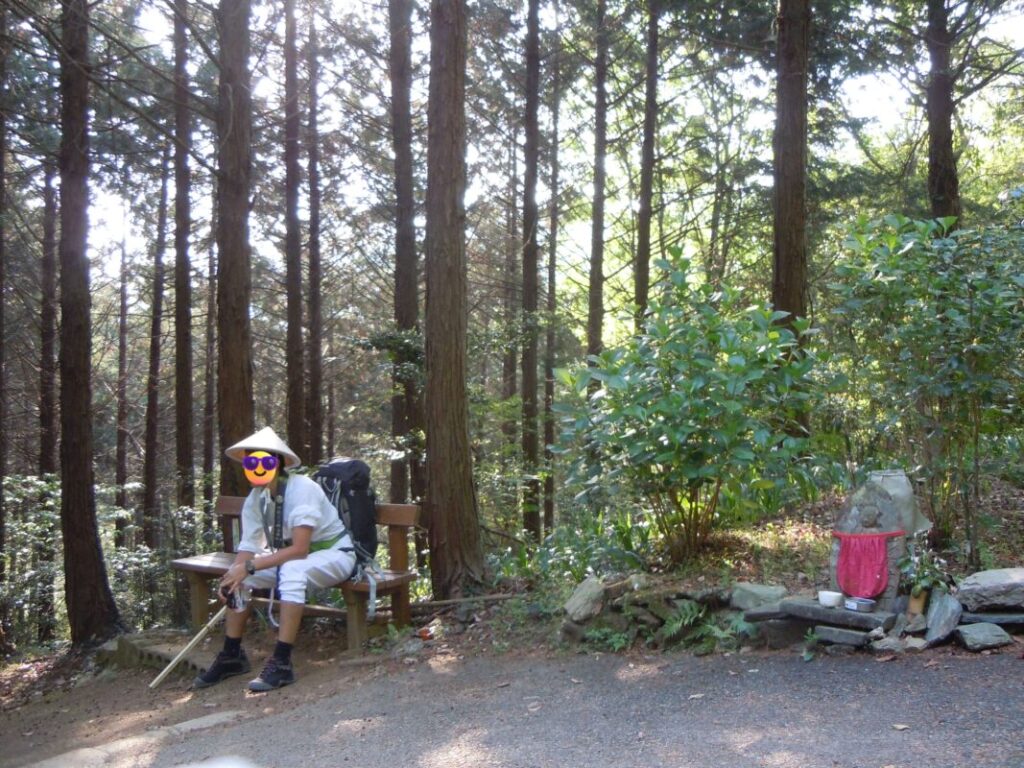
A Surprisingly Walkable Mountain Trail
The pain in my feet wasn’t as bad as I had expected—if anything, it felt easier to walk. It made me realize just how much the hardness of the ground affects the body.
Occasionally, the trail opened into gentle downhill sections. The soft dirt underfoot acted like a cushion, absorbing the impact with each step. The comfort naturally quickened my pace, and my mood felt lighter as well.
That said, one careless step could lead to a slip or injury, so I had to remain cautious at all times.
It truly made me understand how much strain walking on asphalt puts on your feet.
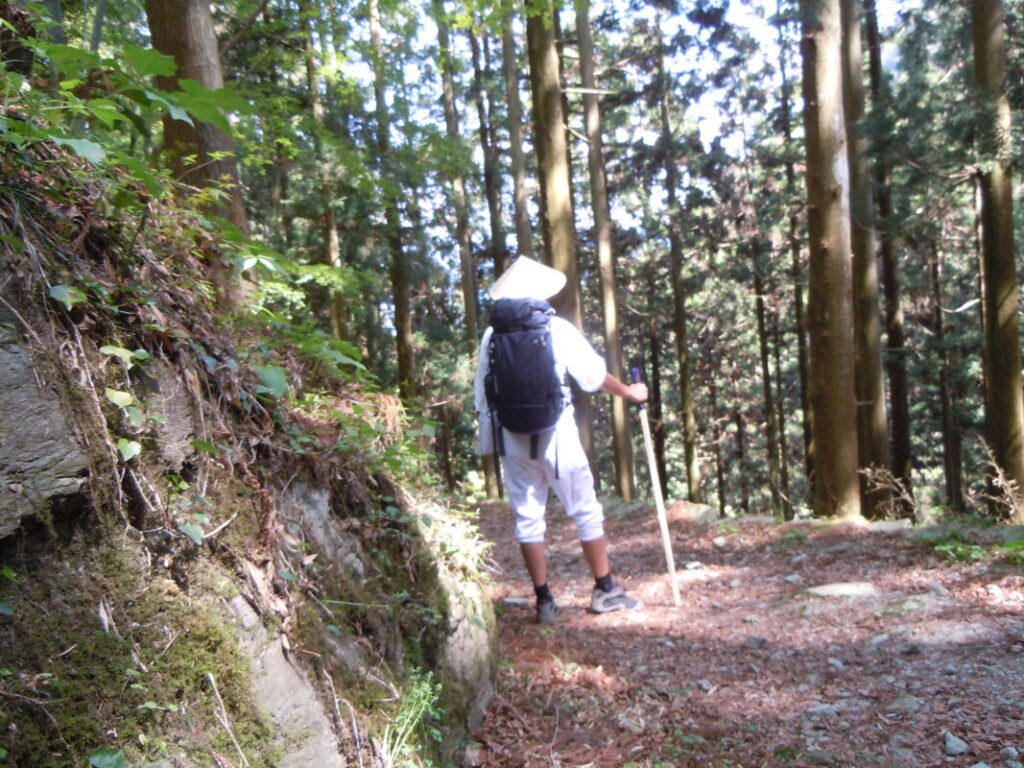
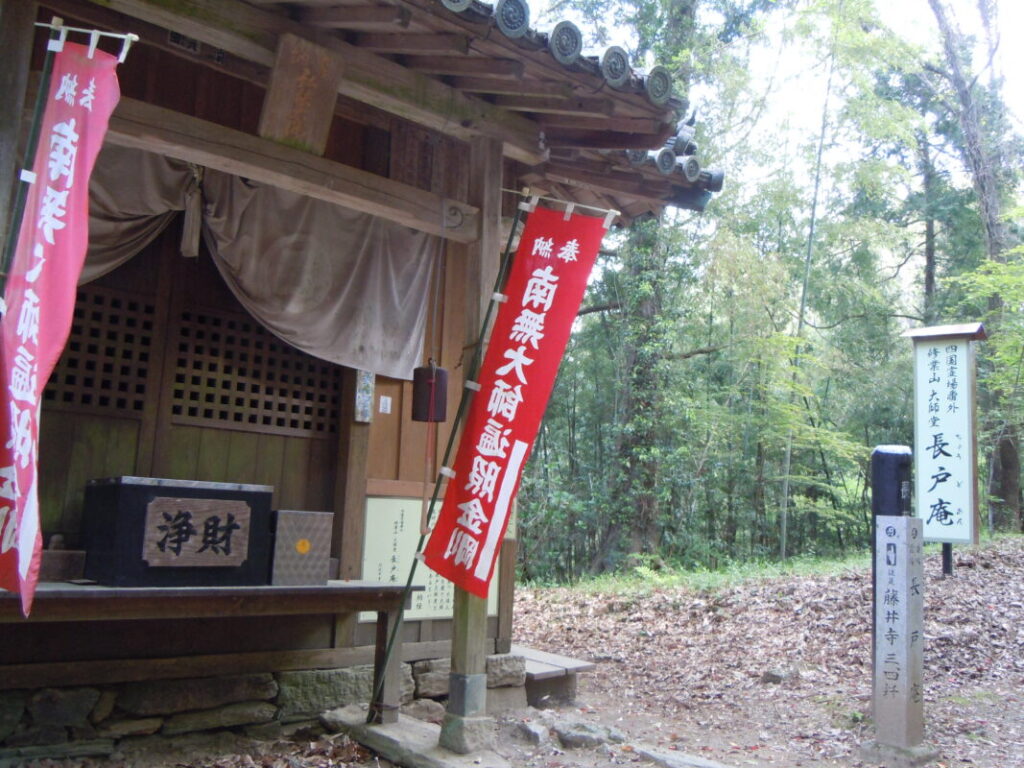
8:30 AM — Arrival at Chodo-an
At 8:30 a.m., I arrived at Chodo-an. The elevation here is about 440 meters, and the distance covered so far is around 3.2 km.
It had been roughly an hour and a half since I started walking—a steady and comfortable pace. I took a short break here.
I’ve been really fortunate with the weather. It made me feel, once again, that starting the pilgrimage in spring was the right choice. For beginners, I would definitely recommend starting in spring.
I completed the pilgrimage in segments across all four seasons—spring, summer, autumn, and winter. Each season has its own unique advantages and challenges, but for a first-time experience, spring offers the best overall balance.
The mountain air was a bit chilly in the early morning, but once I began climbing and sunlight filtered through the trees, my body quickly warmed up—enough to break a sweat. I took off the long-sleeve inner layer I had been wearing under my white pilgrim clothing to regulate my body temperature.
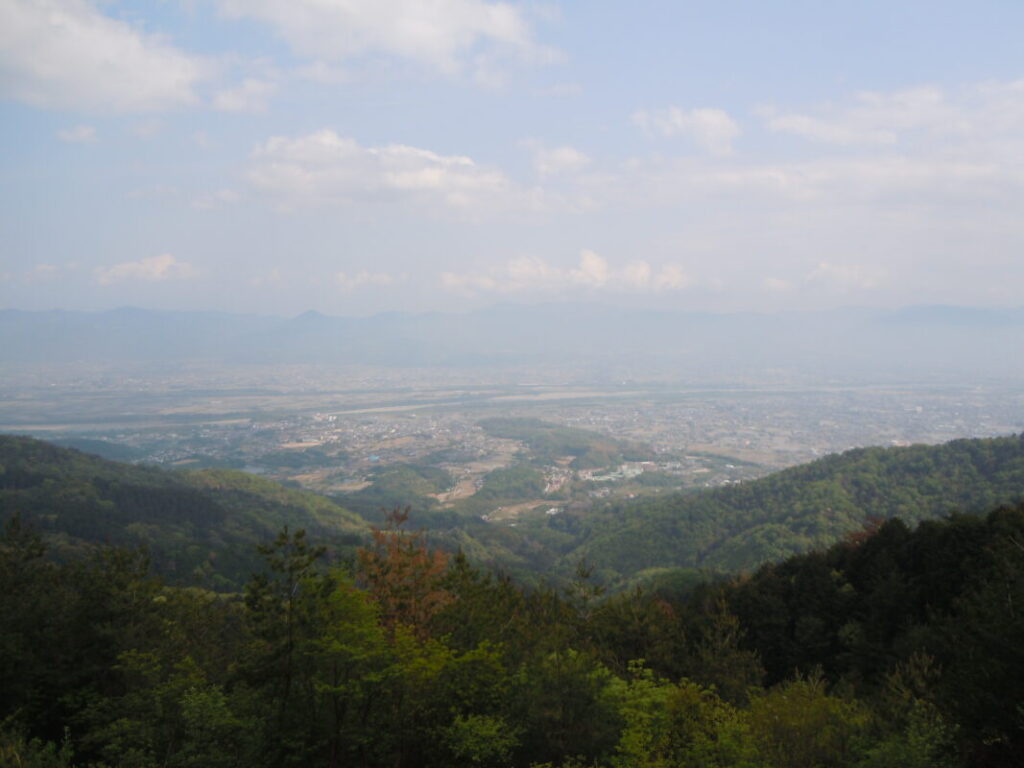
About 15 minutes after leaving Chodo-an, the view suddenly opened up
“Have I already come this deep into the mountains?” I found myself stopping in my tracks.
In the distance, I could see what might have been the Yoshino River I crossed yesterday.
Mountain trails can feel monotonous, with little change in scenery, making it hard to sense how far you’ve progressed. Even so, I was steadily moving forward, getting closer to Shosan-ji.
It was a view that made that progress unmistakably clear.
Encounter with a Trail Runner
I began to hear quick, light footsteps approaching from behind.
The next moment, a man trail running passed me.
“Training in a place like this?” I thought, surprised.
Considering the demanding path I had just come through, it made his effort all the more impressive.
About 30 minutes later, I saw him again—this time running back in the opposite direction. His expression was tense, and his breathing was so heavy it seemed like he might collapse at any moment. Still, as we passed each other, he briefly raised his arm, signaling, “Keep going.”
I nodded slightly in return. “Yeah,” I answered quietly.
On the pilgrimage trail, you truly encounter all kinds of people and experiences.
Ryusui-an – Midway Point
Ryusui-an is located roughly halfway along the route. It has a small hut of about six tatami mats, as well as access to water and a toilet, making it a popular rest stop for pilgrims.
I heard that many pilgrims used to spend the night here, but overnight stays are now generally prohibited for various reasons, except in emergencies.
Jōren-an and the Lone Cedar of Sōuchi
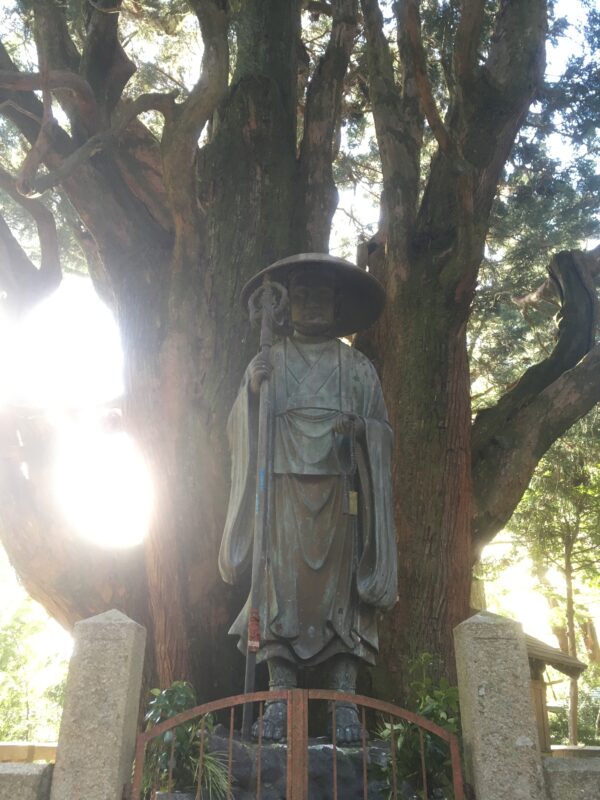
Along the pilgrimage trail leading to Shosan-ji, quietly nestled in the mountains, stand Jōren-an and the “Lone Cedar of Sōuchi.” With few signs of human presence, this spot is enveloped in a particularly mystical atmosphere, even among the many sites along the route.
True to its name, the Lone Cedar is a striking, towering tree that has taken root here over many years. Combined with the deep silence of the surroundings, it creates a distinctly sacred feeling.
Though Jōren-an is a small hall, it serves as a valuable resting point for walking pilgrims.
11:30 AM — The Town from This Morning Is No Longer in Sight
It was now 11:30 a.m.—four and a half hours since I began walking the trail. I wasn’t exactly sure where I was anymore.
The town I had been in just this morning had completely disappeared from view.
All that spread out below me now was a vast expanse of mountains.
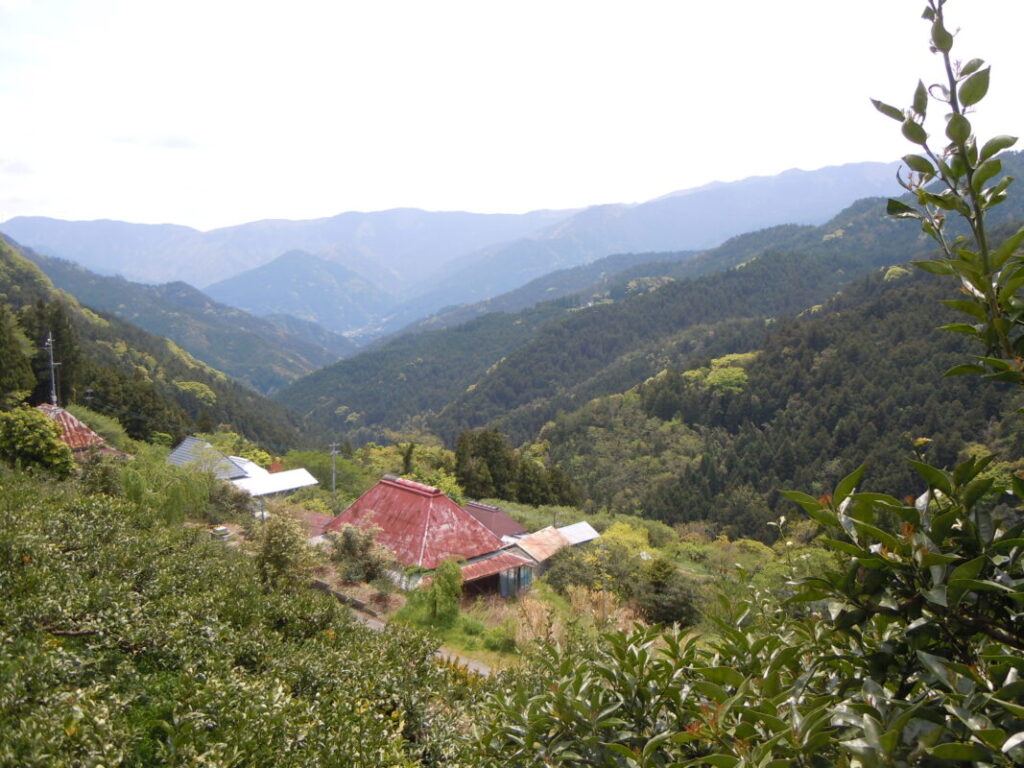
Tokushima Prefecture is well known as a major producer of sudachi.
Perhaps these are sudachi trees.
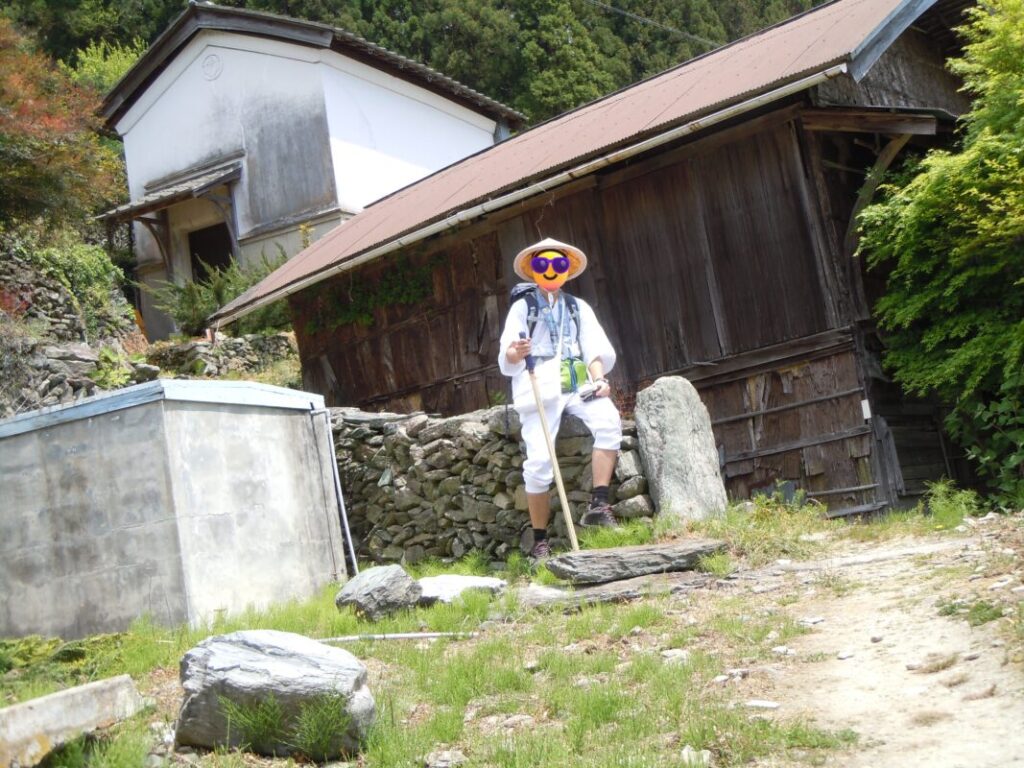
There was a building in the middle of this remote mountain area.
Was it abandoned? I couldn’t sense any sign of people at all.
A Bell Sound? The Temple Is Near — The Final Climb
“How much longer is this going to go on…”
The repeated up-and-down sections continued endlessly. Climb, descend, and climb again. With each cycle, my energy was drained, and fatigue was approaching its limit. Before I knew it, my breathing had become rough.
At that moment—“Gooonnng…” a bell rang out from somewhere in the distance.
The temple is near.
As soon as I thought that, the energy I had been losing suddenly returned.
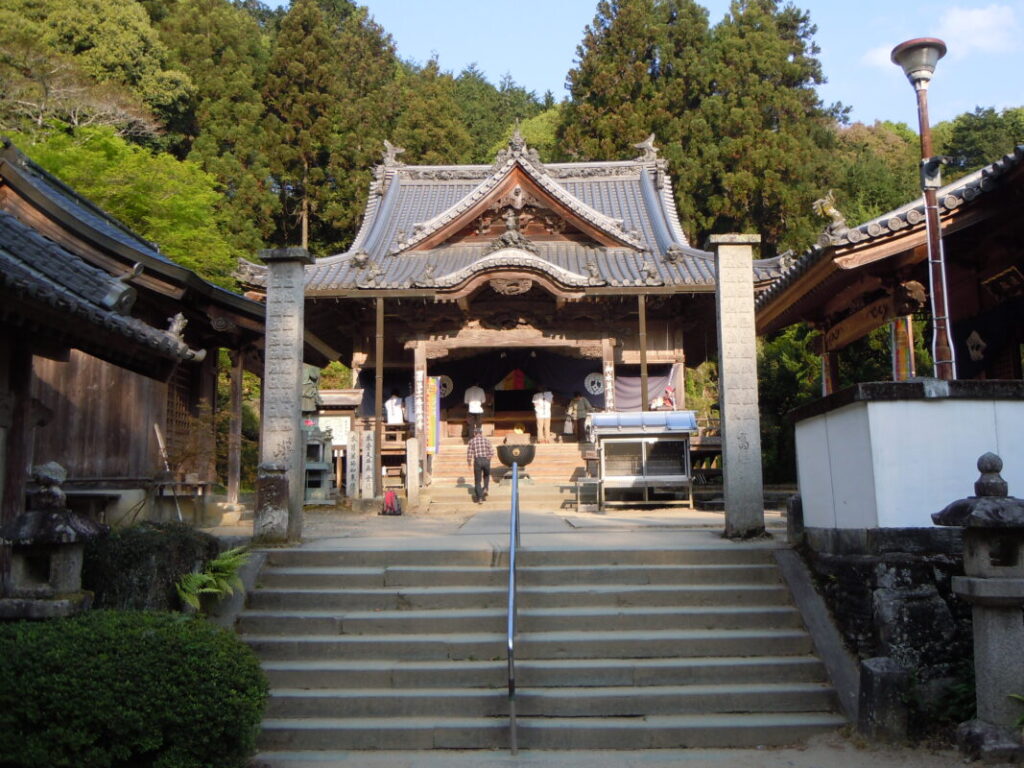
The final obstacle was a steep slope that felt almost like a wall. I managed to climb it step by step, and at last, I arrived at Shosan-ji.
Temple No.12 Shosan-ji — Arrival at 12:50 PM
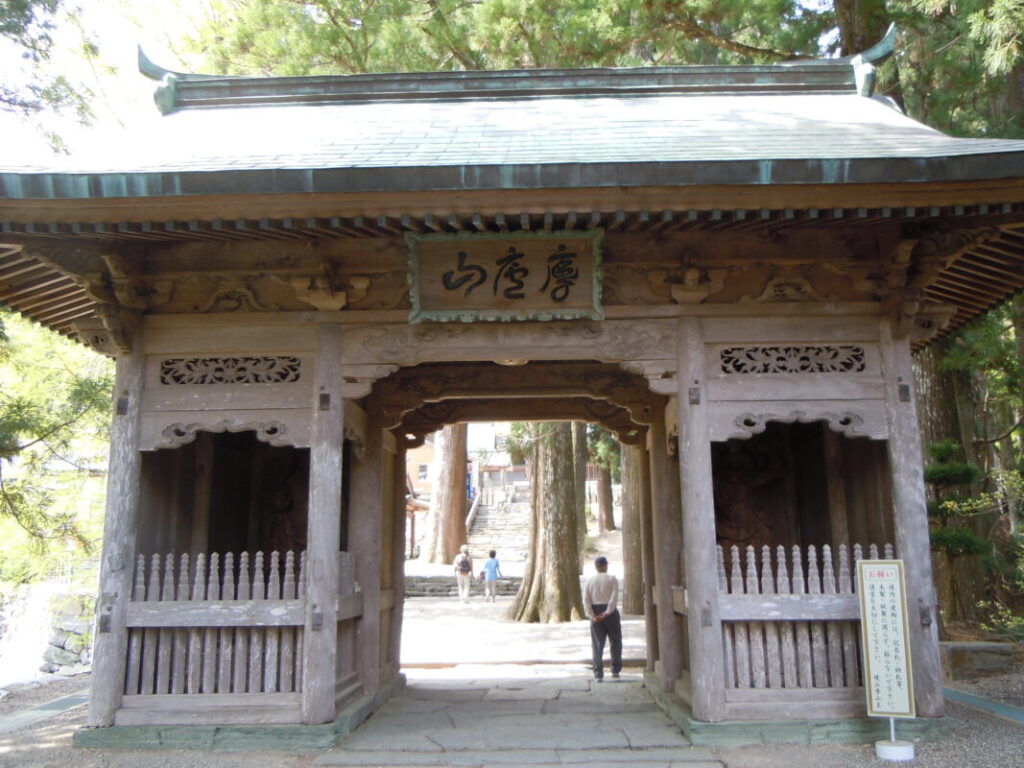
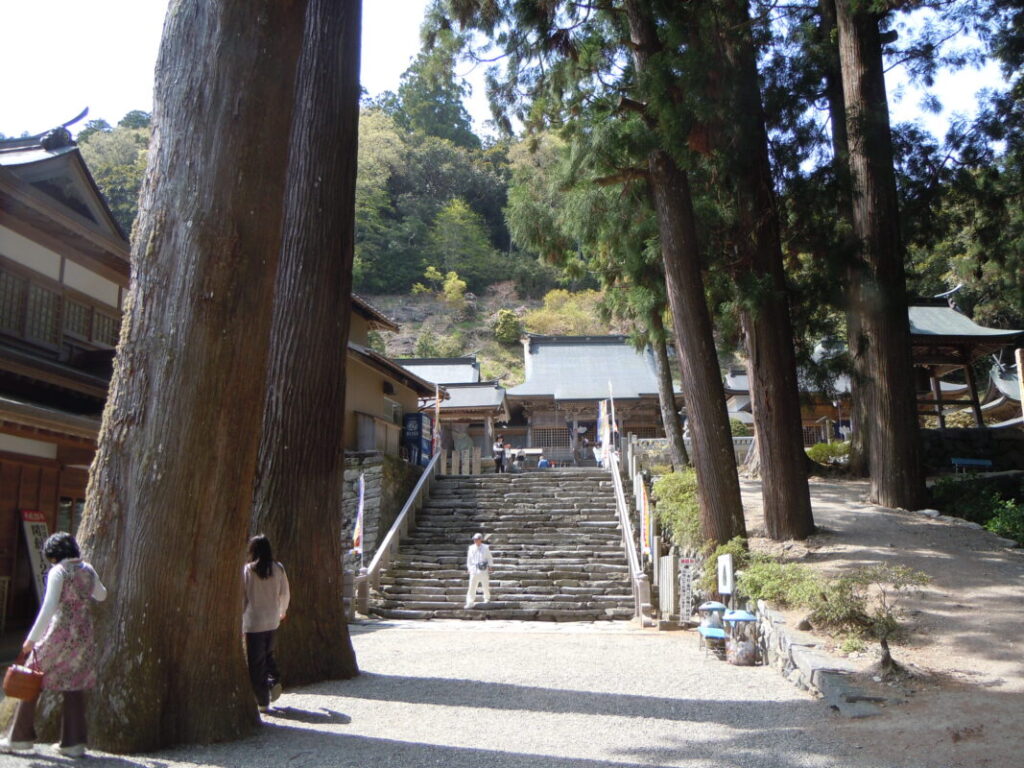
At 12:50 p.m., I arrived at Shosan-ji. It had taken about six hours from Fujii-dera.
There were many visitors in the temple grounds.
Perhaps they had come by car. I could almost feel their surprised gazes, as if asking, “You walked all the way up here?”
I slowly stepped into the precincts.
First, I took off my backpack and sat down on a bench. The tension I had been holding onto finally loosened, and a sense of relief washed over me.
Among the visitors, I noticed several fellow walking pilgrims.
Although their faces showed signs of fatigue, they also carried a look of relief—having overcome the first major challenge of the pilgrimage.
Afterword: Various Pilgrims’ Experiences on the Shosan-ji Trail
As an afterthought, while continuing the walking pilgrimage, I had many opportunities to talk with fellow pilgrims. One topic that often came up was their experience on the Shosan-ji approach.
When discussing how they overcame it, many people surprisingly said, “It wasn’t as bad as I expected.” In fact, some even mentioned that the dirt sections were easier on the feet and made walking more comfortable.
On the other hand, others said that the approach to Temple No.20 Kakurin-ji felt more demanding, while some found the long 70 km coastal route around Cape Muroto leading to Temple No.24 Hotsumisaki-ji to be more mentally exhausting. In short, experiences vary greatly from person to person.
Weather also plays a major role. One pilgrim described walking through heavy rain, which made the experience extremely tough.
It made me realize once again that the same road can feel completely different depending on the conditions and choices made along the way.
1:30 PM — Lunch and Preparation for the Next Destination
When I visited, the restaurant in the temple grounds was open. I ordered a bowl of udon, and its simple, comforting flavor was just what I needed after climbing the mountain trail.
The restaurant at Shosan-ji seems to open irregularly. If you visit and find it open, it is definitely worth stopping by.
There is also a vending machine in the temple grounds, which makes it convenient to replenish your drinks here.
Among the options, I found a canned Calorie Mate drink and decided to buy one out of curiosity. I had no idea at the time that this drink would later end up helping me more than I expected.
It was now 1:30 p.m. I set off again, aiming to get as close as possible to Temple No.13, Dainichi-ji, where I hoped to find a place to stay for the night.
Heading Toward Tonight’s Accommodation : The Final “Henro Korogashi” Section
After leaving Shosan-ji, the trail continued downhill for a while.
Downhill sections are often assumed to be easier than climbs, but in reality they require great caution. With a heavy backpack, the strain on the knees becomes significant.
By using my walking stick effectively and distributing my weight, I carefully reduced the impact with each step, moving forward slowly and steadily.
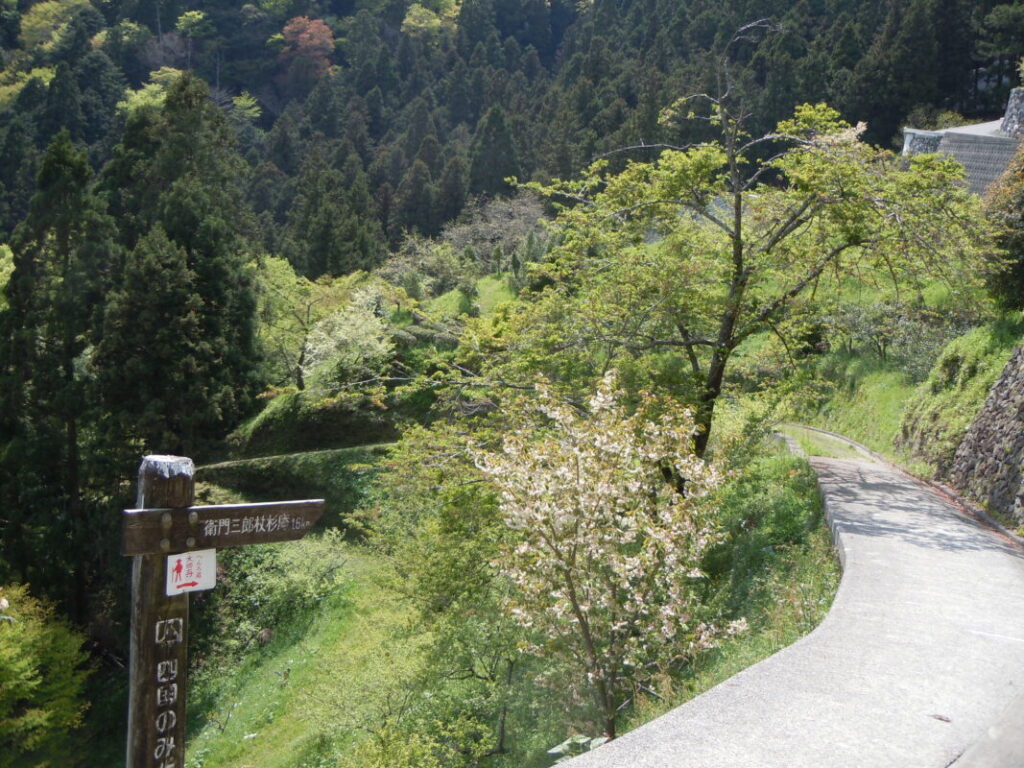
A peaceful downhill stretch continued along the trail.
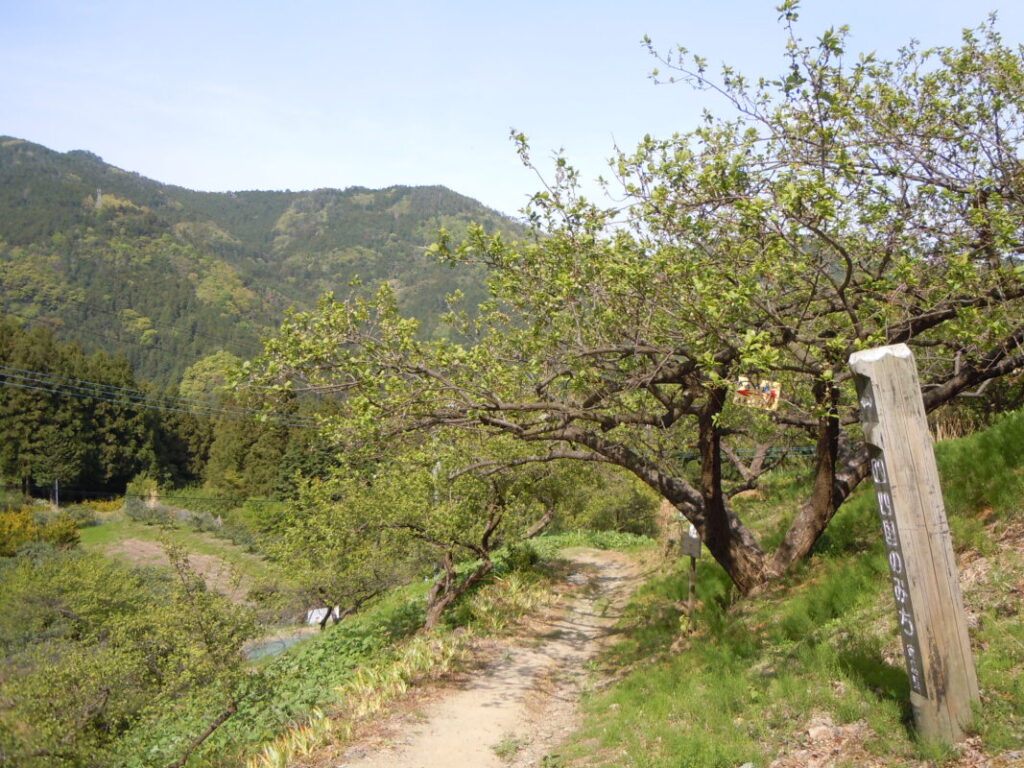
It is also important to keep an eye out for trail signs hidden behind trees.
Jōshin-an
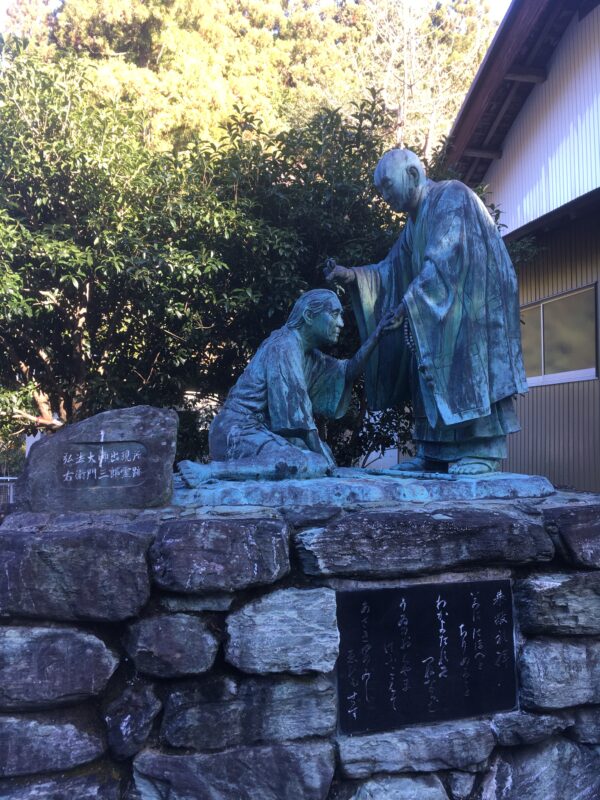
Located about 2 km after descending from Shosan-ji, Jōshin-an is a sacred site associated with the legend of Emon Saburō.
According to tradition from the Heian period, Emon Saburō of Iyo is said to have regretted his disrespect toward Kōbō Daishi and set out on a pilgrimage to seek him. After repeatedly circling Shikoku, on his 21st attempt, he collapsed near Shosan-ji.
It is said that Kōbō Daishi witnessed his final moments and planted the pilgrim’s staff into the ground as a grave marker. This staff then took root and grew into a massive cedar tree.
Continuing the Descent
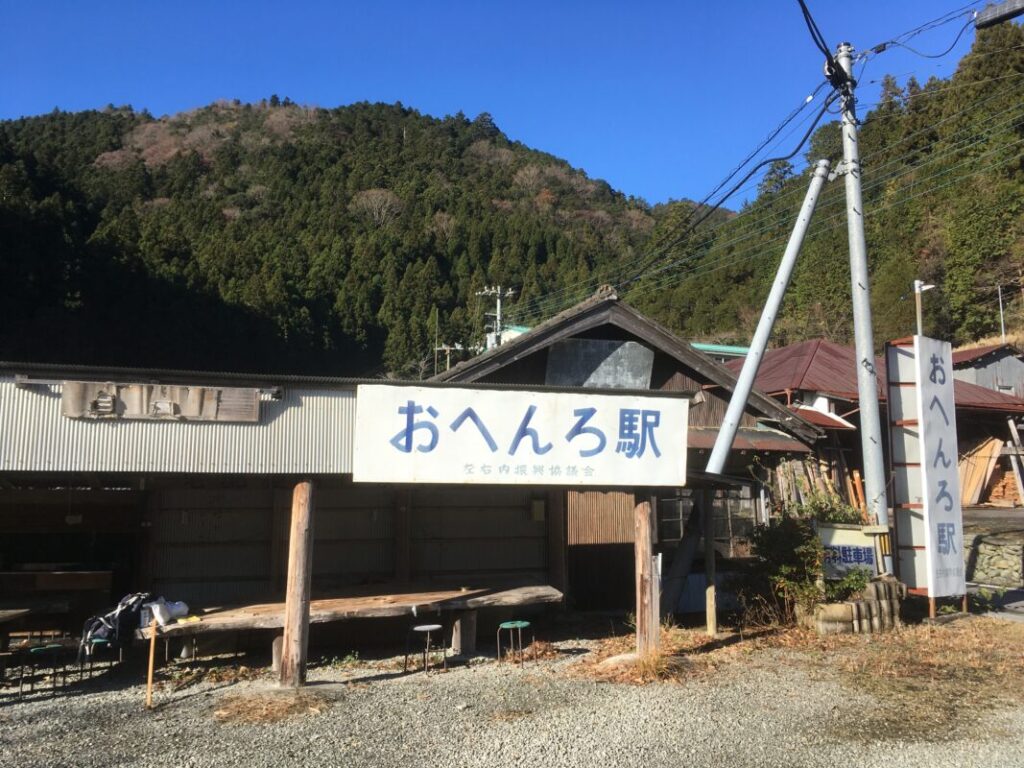
At 3:00 p.m., I arrived at the Sōuchi Ohenro Station. The elevation here is about 240 meters, meaning I had descended roughly 450 meters from Shosan-ji in one continuous stretch.
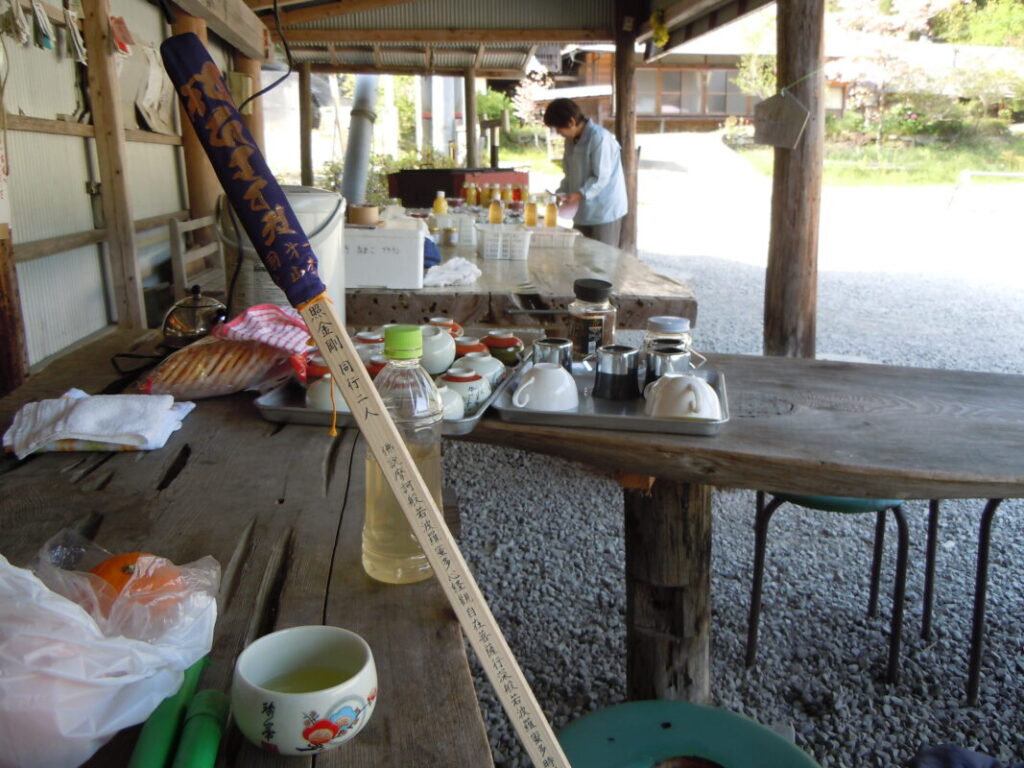
I took a short break here. A local hospitality event was being held, and I was offered tea and mandarin oranges as osettai. The kindness of it all deeply sank into my body after hours of continuous walking.
There are also accommodations in this area, so staying overnight here is a realistic and recommended option. However, I felt I could still walk a bit further, so I decided to continue on my way.
Shosan-ji Trail | Final Challenge: Tamaga Pass
Tamaga Pass sits at an elevation of about 455 meters, requiring a final climb of roughly 200 meters from Sōuchi. Although the distance is only about 2 km, the slope is quite steep and quickly drains your remaining energy.
After walking through mountain trails for more than half a day, this final section feels especially tough. Still, I told myself that once I got past this point, the major difficulties would be over.
With that in mind, I gathered my last bit of strength and climbed step by step until I finally made it over the pass.
Short Break at Kamiyama Henro Hut
At 4:20 p.m., I reached the Kamiyama Henro Hut. The toughest sections were already behind me, and from here on, it was just a matter of heading toward my accommodation for the day.
Kamiyama has a well-maintained henro hut that is suitable even for overnight stays. The view from the higher ground is also excellent, making it an ideal resting point. On a nearby bench, two elderly local women were chatting peacefully.
After exchanging greetings, they kindly told me, “You can stay at that pilgrim hut. Many pilgrims use it.”
I unfolded my map and checked the list of possible overnight spots I had picked up along the way. Staying here crossed my mind, but I felt I could still continue a bit further. I decided I could make it to Amida-do.
With that decision, I set off again.
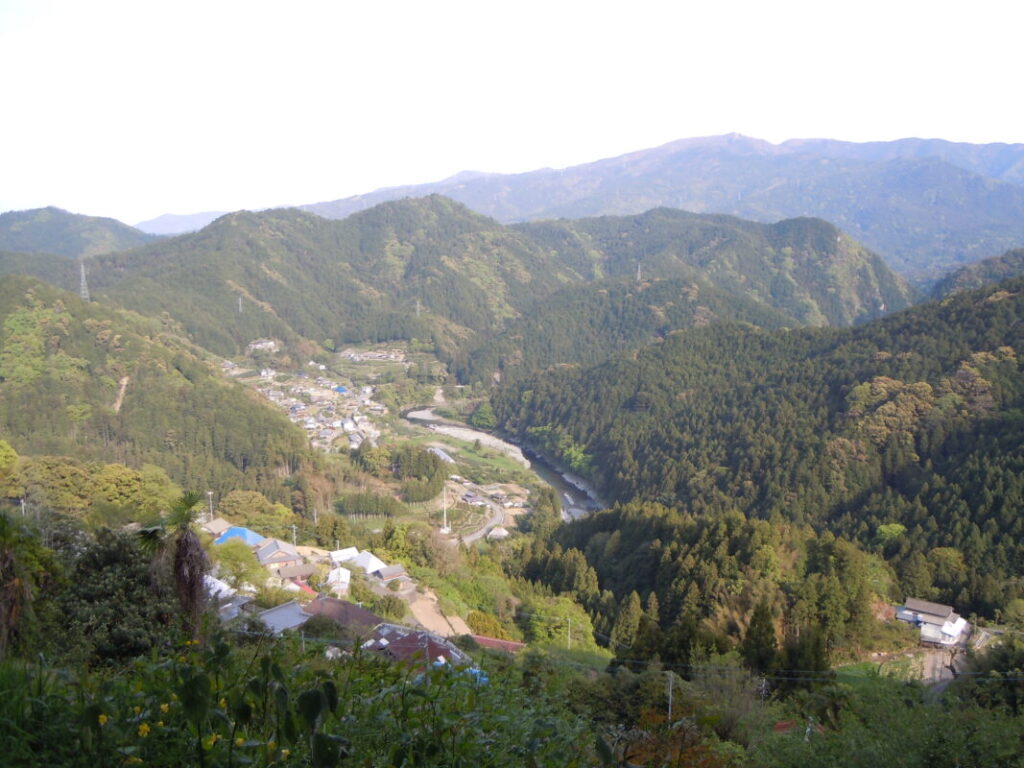
From the Kamiyama area, you can see the Ayukui River flowing below.
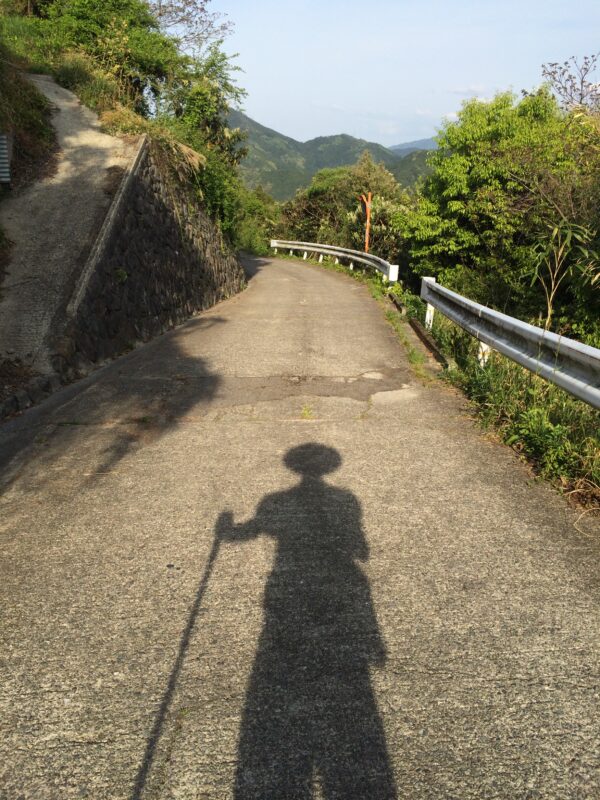
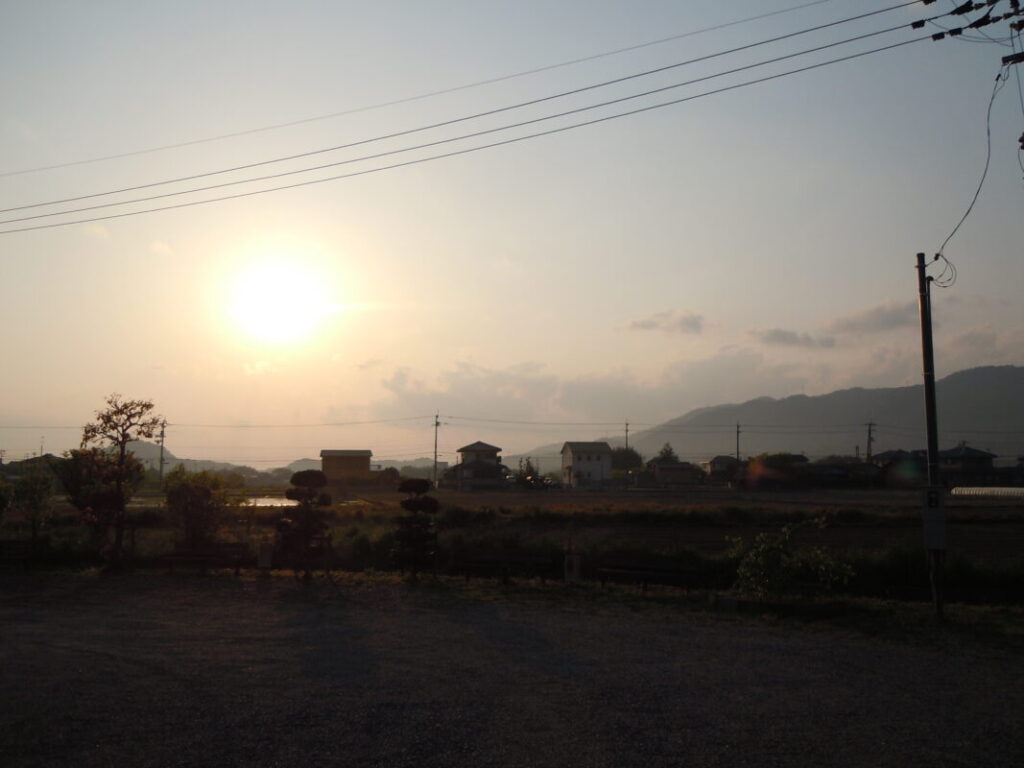
With the setting sun at my back, I pushed on toward my destination before nightfall.
What is Ayukui River?
Ayukui River is a small river in Kamiyama Town, Tokushima Prefecture, part of the Yoshino River system, and is well known to those walking the Shikoku Pilgrimage, especially around the Shosan-ji route.
Its name, meaning “the river where ayu (sweetfish) are eaten,” is said to come from the time when ayu once migrated upstream in large numbers, deeply connecting the river to local life and food culture.
5:00 PM — Arrival at Amida-dō, Tonight’s Wild Camping Spot
Just after 5:00 p.m., I arrived at Amida-dō. My journey for the day had come to a safe end.
I took off my backpack and removed my shoes. My feet were less painful than yesterday, but I could clearly see that they were red and swollen.
This was the first time on this pilgrimage that I set up my tent. Staying under the eaves of the hall meant I could feel secure even in case of sudden rain. It was far more comfortable than sleeping directly on the ground.
I still had some of the food I had bought the day before, so I ate while quietly reflecting on the day’s journey.
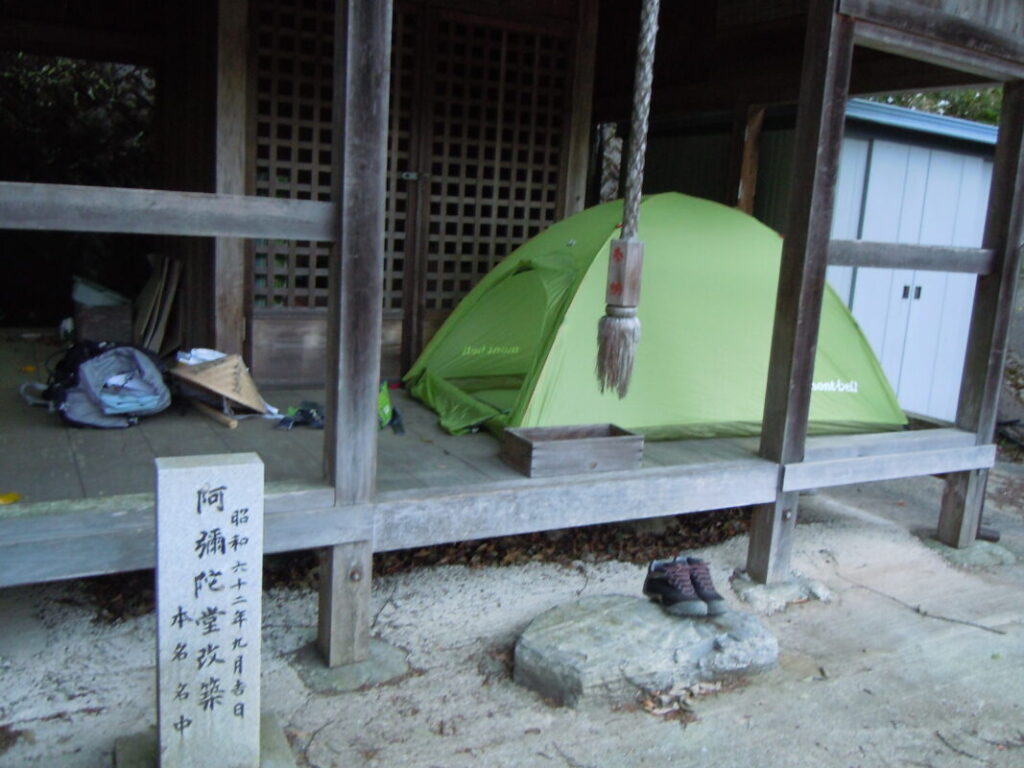
“Dōgyō Ninin” and Osettai Explained by a Local Resident
After a while, an elderly local man happened to pass by while taking a walk. We exchanged greetings.
“You often see pilgrims staying here. Feel free to stay the night,” he kindly said.
I replied with a deep bow, saying, “Thank you very much.”
This was my first real experience of the culture of osettai—the spirit of offering kindness to pilgrims. I began to realize that the pilgrimage is not simply a journey you walk on your own, but also one that you are allowed to walk because of the kindness of others.
“Dōgyō Ninin” — the idea that Kōbō Daishi accompanies each pilgrim — began to feel less like a concept and more like a lived reality. It felt as though the presence of Daishi, the pilgrims, and the local people were all connected in a quiet cycle of support and blessing.
Temple Information
- No. 11
- No. 12
- No. 13
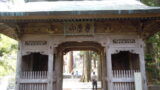
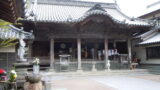
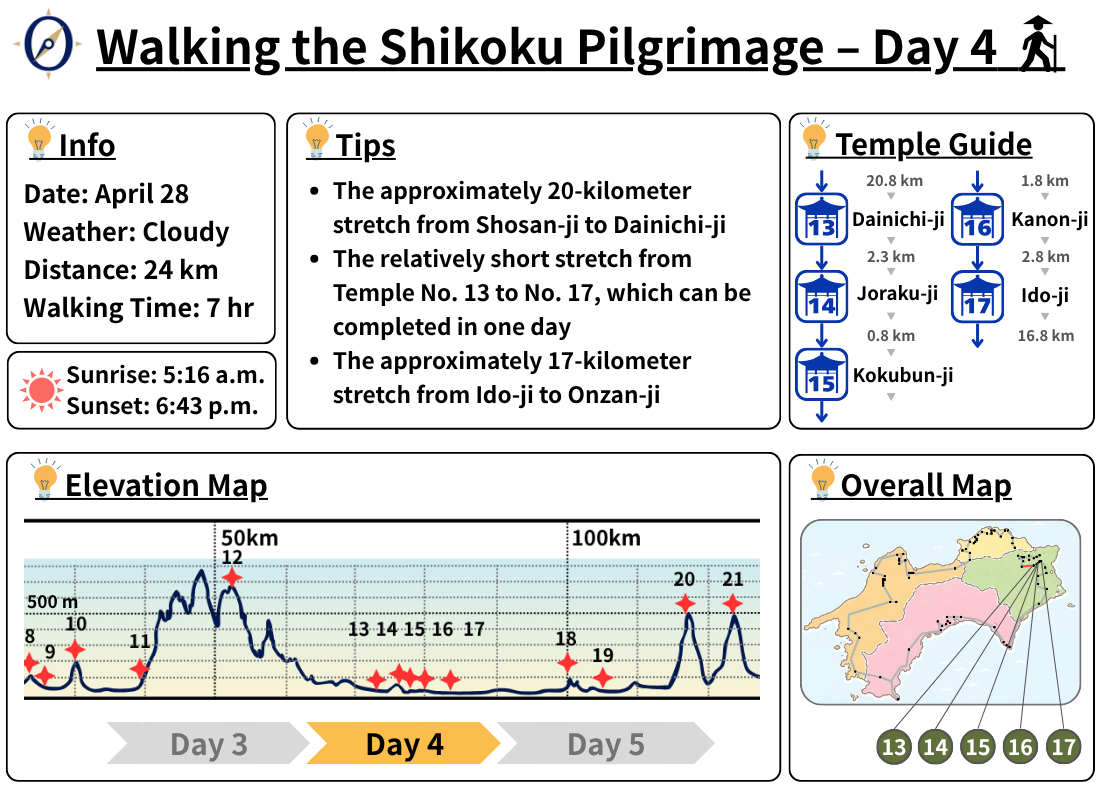
Temple No. 13, Dainichi-ji Guide
Summary
✔ Today’s Route Overview
- Distance: approx. 25 km
- Walking time: approx. 10–11 hours
- Section: Temple No.11 Fujii-dera → Temple No.12 Shosan-ji → Kamiyama area
- Terrain: Mountain route (“Henro Korogashi”)
✔ Difficulty Rating
- Overall difficulty: ★★★★☆ (4/5)
- Physical strain: ★★★★★
- Technical difficulty: ★★☆☆☆ (well-marked paths)
- Mental challenge: ★★★★☆
✔ Key Points of This Route
- The first major mountain challenge of the walking pilgrimage
- Triple burden of distance, elevation gain, and no supply points
- Total cumulative elevation gain: approx. 1,000 m
- Dirt trails are easier on the feet, but caution is still essential
✔ Accommodation Options
Ryusui-an (midpoint, suitable for wild camping)- Shosan-ji temple lodging (advance reservation required)
- Lodgings around Sōuchi area
- Kamiyama Henro Hut / Amida-dō (wild camping spots)
✔ Important Notes
- Bring food in advance (no supply points on the way)
- Carry sufficient water
- Some areas have no mobile signal
- Descents can heavily strain the knees
✔ Gear Checklist
- Water: at least 1.5–2L
- High-calorie trail food
- Trekking shoes
- Rainwear
- Mobile battery pack
- Light source (essential for camping)
Overall Impression
The Shosan-ji route is the first real trial of the Shikoku pilgrimage.
It is not easy, but with proper pacing and preparation, even beginners can complete it.
The experience of overcoming this section will give you great confidence for the rest of the pilgrimage.
FAQ: Shosan-ji Approach (Henro Korogashi)
- QWhat is “Henro Korogashi”?
- A
“Henro Korogashi” refers to some of the most difficult sections of the Shikoku Pilgrimage, where walkers face steep climbs and long mountain trails that significantly drain physical strength. The name literally means “pilgrim tumbler,” and it comes from the idea that the difficulty is so extreme that one might feel like rolling down the mountain.
These sections are typically found at temples such as Shosan-ji, Kakurin-ji, and Taichō-ji, and are considered major trials for walking pilgrims.
- QWhere are the “Henro Korogashi” sections located?
- A
“Henro Korogashi” is not limited to Shosan-ji. There are several challenging sections throughout the Shikoku Pilgrimage that are known for testing pilgrims’ endurance.
- Temple No.12 Shosan-ji: The first major challenge. A combination of long distance and elevation gain that often becomes the first real hurdle for beginners.
- Temples No.20 Kakurin-ji → No.21 Taichō-ji: A physically demanding section with steep climbs and repeated ascents and descents.
- Temple No.24 Hotsumisaki-ji (Cape Muroto route): While not mountainous, the long distance (about 70 km) along the coastline is mentally exhausting.
- Temple No.60 Yokomine-ji: A long, continuous climb that gradually wears down physical strength.
Each section presents a different type of difficulty, but what they all share is that they test both physical endurance and mental strength. Among them, Shosan-ji is often regarded as the “first true trial,” and many pilgrims feel that overcoming it marks the real beginning of the walking pilgrimage.
- QCan I get food along the way?
- A
There are a few natural spring water sources along the route, but no places to purchase food. It is necessary to prepare supplies in advance.
- QIs wild camping possible?
- A
Yes, it is possible. At the midpoint, Ryusui-an has a small hut of about six tatami mats, along with water and toilet facilities.
Many pilgrims use it as an overnight rest point.
- QWhat kind of equipment do I need?
- A
Some sections can be slippery due to moss-covered stone steps and fallen leaves, so trekking shoes are recommended. A walking stick is also helpful for distributing weight and improving stability.
If you plan to camp, it is advisable to bring a sleeping bag, an insulating mat, and a small LED light.
- QAre there toilets on the route?
- A
Yes. There are toilets available at Ryusui-an, located roughly at the midpoint.
- QCan women also walk this route?
- A
Yes. For those who are not confident in their stamina,
it is recommended to split the route and stay overnight at Ryusui-an.
- QAre there any dangerous animals on the trail?
- A
Bears are not present in this area, but wild boars may occasionally be encountered. If you do come across one, avoid provoking it and remain calm. In the unlikely event that it approaches, do not turn your back; instead, hold your walking stick in front of you and keep a safe distance.
Depending on the season, there is also a possibility of encountering vipers (mamushi) or bees. It is important to avoid walking through dense brush and to minimize exposed skin. In particular, wearing shorts is not recommended due to the risk of snake bites.
- QI’m worried about getting lost.
- A
The Shosan-ji approach trail is well maintained by volunteers, and many pilgrims walk it, so there are generally no points where you are likely to get lost. You can safely follow the historic path, which still preserves the atmosphere of a route used over 1,200 years ago.
- QCan I use a smartphone on the trail?
- A
There are areas along the route where mobile reception is not available. It is recommended to prepare in advance by downloading maps and other necessary information so that you can navigate even offline.
- QCan I go to Shosan-ji via the pilgrimage trail by bicycle?
- A
It is strongly not recommended for anyone other than highly experienced cyclists. For most people, it is safer to avoid attempting it by bicycle.
Comments