
Hello, I’m Taka.
In this article, I’ll share my experience from Day 4 of the walking Shikoku pilgrimage.
What you’ll learn in this article:
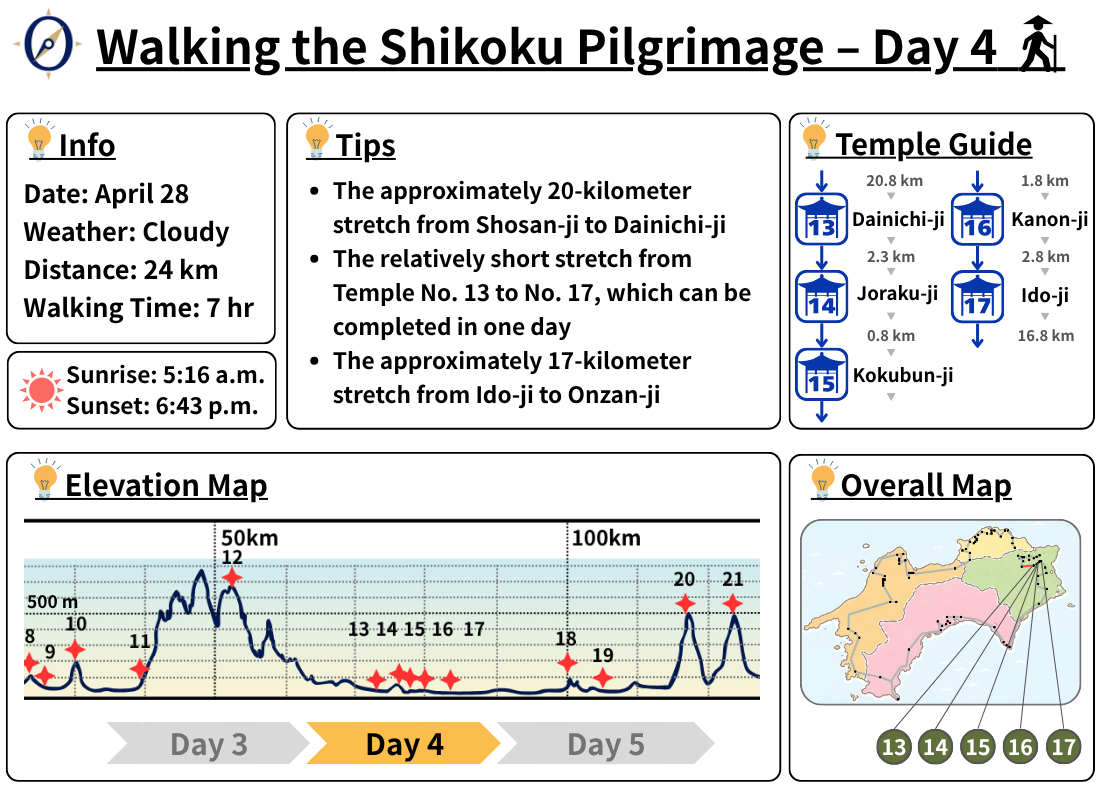
- The route, distance, and time required for Day 4 (Temples 13–17 in Tokushima)
- Highlights and features of each temple (from Dainichiji to Idoji)
- My real walking experience (foot condition, rain, acts of kindness from locals, etc.)
- Route choices and important tips after Idoji (toward Temple 18)
- An honest review of wild camping at Hachiman Onsen (pros and cons)
This guide is based on real experience and is designed to be easy to understand for those planning a walking pilgrimage or feeling unsure about the Day 4 itinerary.
- Itinerary
- Day 4 Plan: Temples 13–17 and Overnight Location
- Route and Time to Temple 13, Dainichiji
- Route to Temple 14, Jorakuji
- Route to Temple 15, Kokubunji
- Heading to Temple 16, Kannonji
- On the Way to Temple 17, Idoji: Lunch and the Start of Steady Rain
- Finishing the Day’s Visits at Idoji: Heading to the Accommodation
- Arrival at Hachiman Onsen: After 5:00 PM
- Temple Information
- Summary : Key Points of Walking Shikoku Pilgrimage Day 4
Itinerary
- 6:00Departure
- Amida-do Hall
- Submersible Bridge
- Oyasuminashi Rest Area
- 9:50Temple No. 13, Dainichi-ji
- 10:50Temple No. 14, Joraku-ji
- 11:30Temple No. 15, Kokubun-ji
- 12:30Temple No. 16, Kanon-ji
- 14:00Temple No. 17, Ido-ji
- Jizogoe area
- 17:00Hachiman Onsen
Overnight stay
Day 4 Plan: Temples 13–17 and Overnight Location
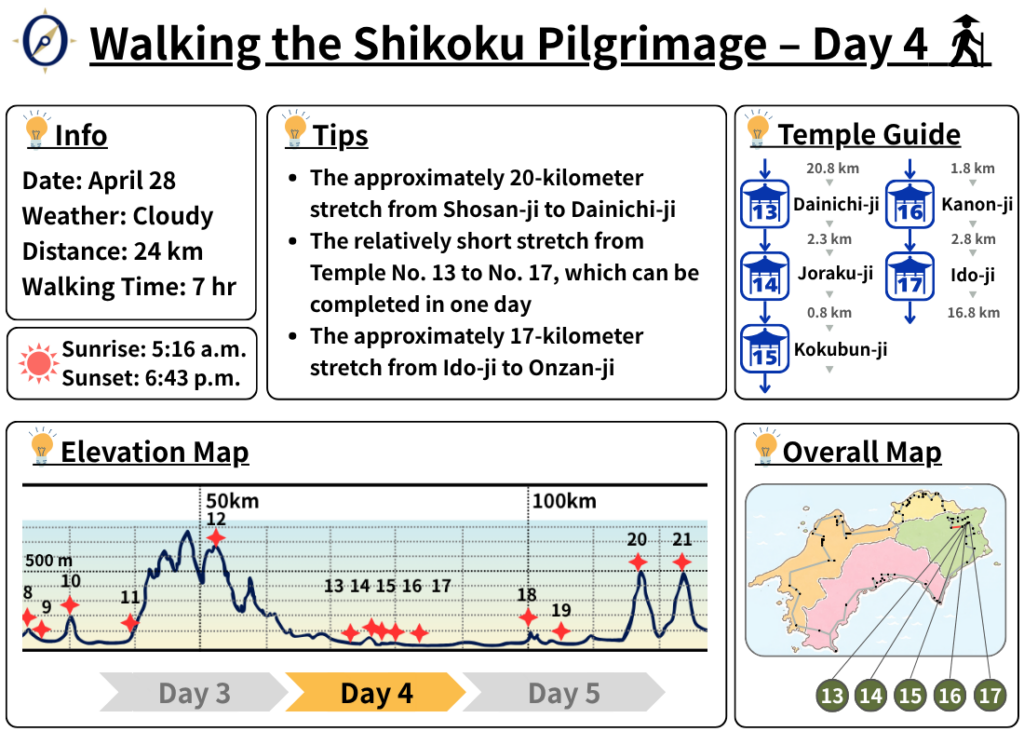
April 28. The weather is cloudy, and there’s a chance of rain today.
The sky is overcast, looking like it could start raining at any moment.
Of course, I’m fully prepared with rain gear.
I’m ready to handle the rain whenever it comes.
After walking mountain trails all day yesterday, I slept very well.
However, my legs are not yet in perfect condition. I need to be careful not to push too hard.
For breakfast, I have the last rice ball I bought yesterday.
Before setting off, I face the small temple hall and put my hands together in prayer.
I quietly express my gratitude for being allowed to stay there overnight.
And then, at 6:00 a.m.,
a new day of the walking pilgrimage begins.
Today’s Route and Accommodation Plan
Today’s route is simple.
First, I head east along the Ayukui River for about 10 km, aiming for Temple 13, Dainichiji.
Thanks to covering a good distance yesterday, I feel mentally at ease today.
Once I reach Dainichiji, I’ll be entering the city area.
Not having to worry about food or accommodation makes things much easier mentally.
Another advantage is that the temples in this area are close to each other.
From Temple 13 to 17, the route is fairly compact, so it should be possible to visit them all in one day if things go well.
However, the challenge lies beyond that.
From Temple 17, Idoji, to Temple 18, Onzanji, it’s about 17 km—a significant jump in distance.
On foot, it would take around five hours.
So, I take out the list of accommodation spots and maps I’ve gathered along the way and start planning.
Considering the route, distances, and the next day’s schedule—
I decide to stay tonight at “Hachiman Onsen,” located beyond Jizogoe Pass.
What Is Hachiman Onsen? My Real Wild Camping Experience
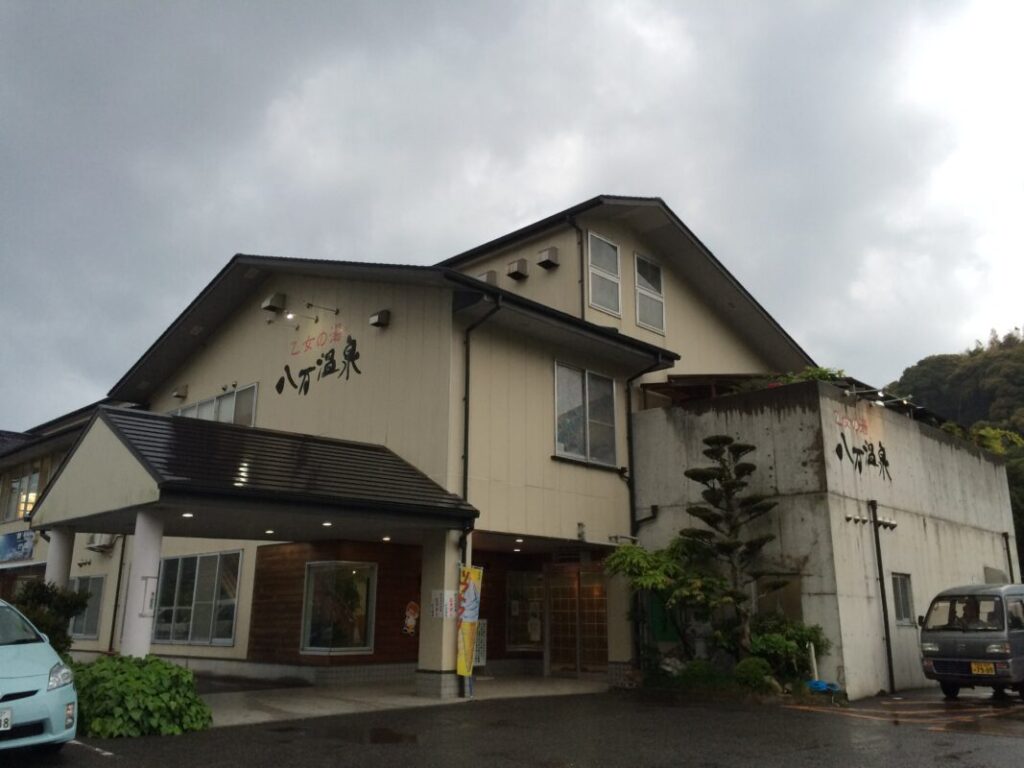
“Hachiman Onsen,” which I chose as my accommodation for the night, is a day-use hot spring facility located at the foot of Mt. Bizan in Tokushima City.
Surrounded by nature in a quiet rural setting, it’s less like a traditional ryokan and more like a local “super sento” used by nearby residents.
The entrance fee is 600 yen—
a very affordable and welcome price for walking pilgrims.
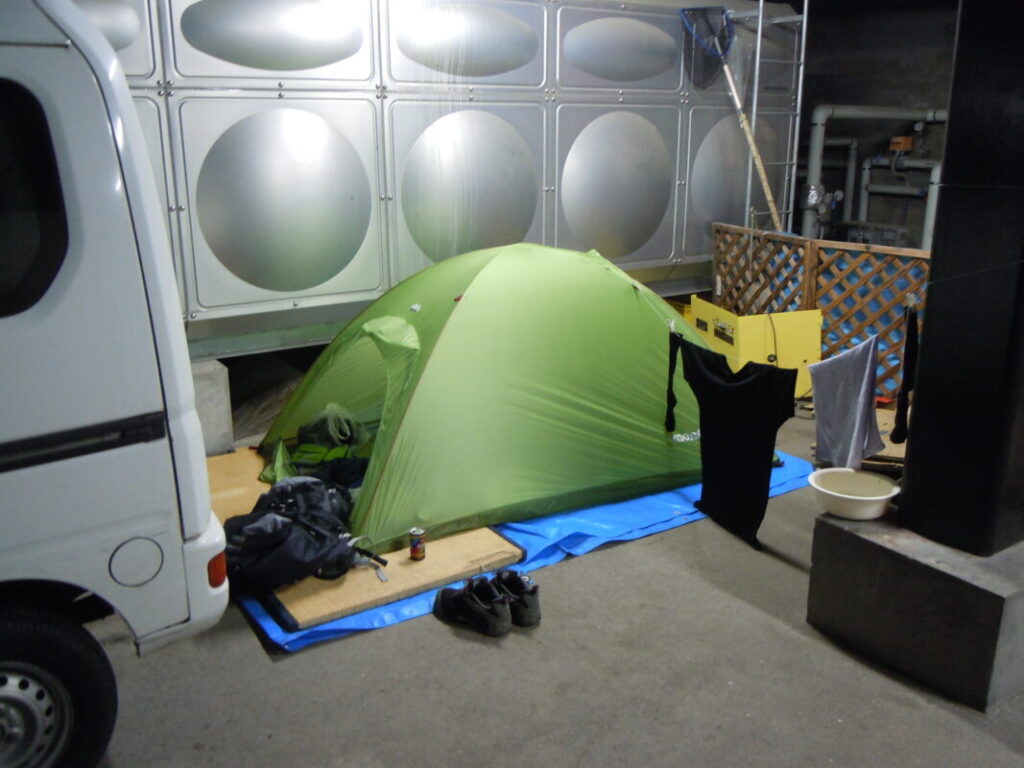
Even better, pilgrims are allowed to camp overnight in a designated storage-like space on the premises.
Ultimately, you need to obtain permission directly from the staff at the facility.
Route and Time to Temple 13, Dainichiji
6:00 a.m. I set off toward Dainichiji.
The road follows the Ayukui River.
In the early morning, the valley is empty and wrapped in silence.
In that stillness, only the sound of my walking stick echoes—clang, clang.
Though simple, the rhythm feels strangely comforting.
The valley path has a gentle slope, putting little strain on my legs.
In contrast to yesterday’s mountain trails, my body moves forward with ease.
Another factor is that I’ve finished all the food I stocked up on yesterday,
making my backpack lighter.
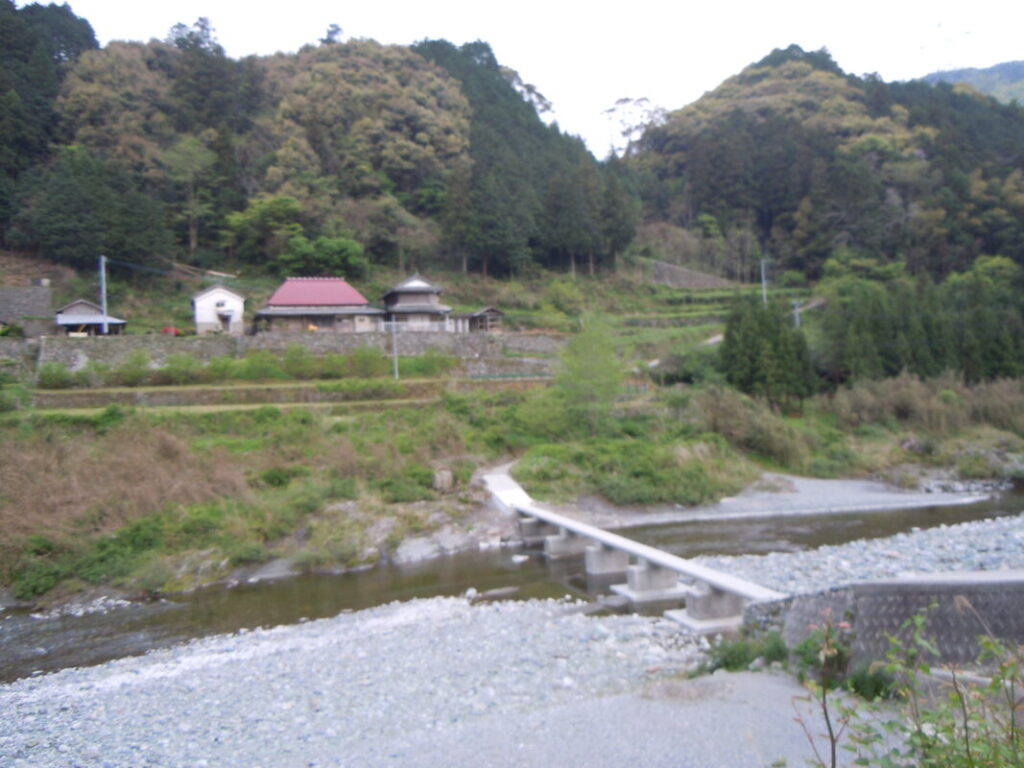
Along the way, I cross a memorable bridge—
a “chinka-bashi” (submersible bridge).
What is a chinka-bashi?
A chinka-bashi (submersible bridge) is a type of bridge designed to be submerged when the river water level rises.
It has no handrails and features a simple structure to minimize resistance to flowing water.
When heavy rain causes the river to swell, the entire bridge goes underwater, which helps prevent it from being washed away.
These bridges are mainly found in the Shikoku region—especially along the Shimanto River in Kochi Prefecture—but they can also be seen in various locations throughout Tokushima.
A Short Break at Oyasuminashi-tei Rest Area
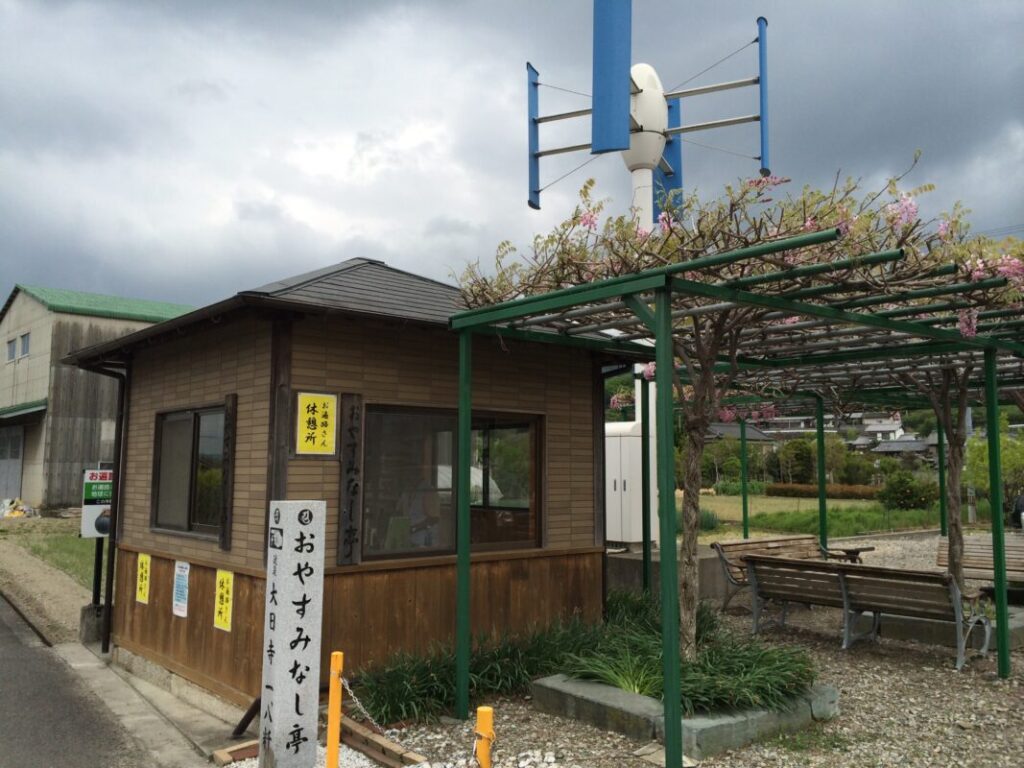
After about two hours of walking, I came across a rest area and decided to take a short break.
I took off my backpack and caught my breath. Just taking the weight off my back made my body feel so much lighter.
A little while later, two local women arrived to clean the rest area.
“Thank you for your hard work, pilgrim.”
Their kind words meant a lot to me. Even a small gesture like this can be a real encouragement when walking the pilgrimage.
They also told me, “There’s a rare pink wisteria trellis behind the rest area. You should take a look.”
I went around back and found a few pink wisteria flowers in bloom.
Oyasuminashi-tei is a sturdy rest area with a door, offering shelter from the wind and rain. However, overnight stays are not allowed, so please keep that in mind.
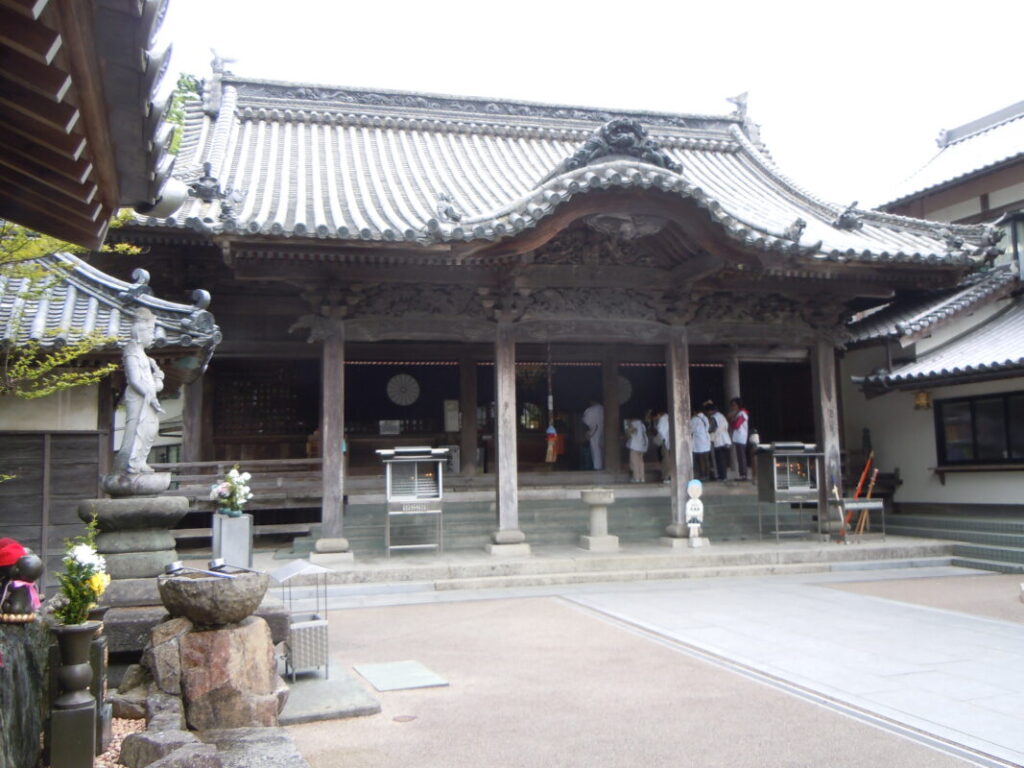
9:50 AM – Arriving at Temple 13, Dainichiji
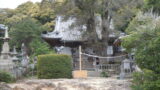
After about 15 minutes of walking from the rest area, Dainichiji suddenly came into view on my left. The Main Hall and Daishi Hall are arranged around the temple grounds, making it easy to visit both.
A group of visitors was waiting in line at the temple office to receive their pilgrimage stamps. Just then, a light rain began to fall.
After finishing my visit, I put a rain cover on my backpack and headed for the next temple.
Route to Temple 14, Jorakuji
From Dainichiji to Jorakuji is about 2.3 km, taking roughly 40 minutes on foot.
Jorakuji is located to the northeast of Dainichiji, and along the way, you cross a bridge over the Ayukui River.
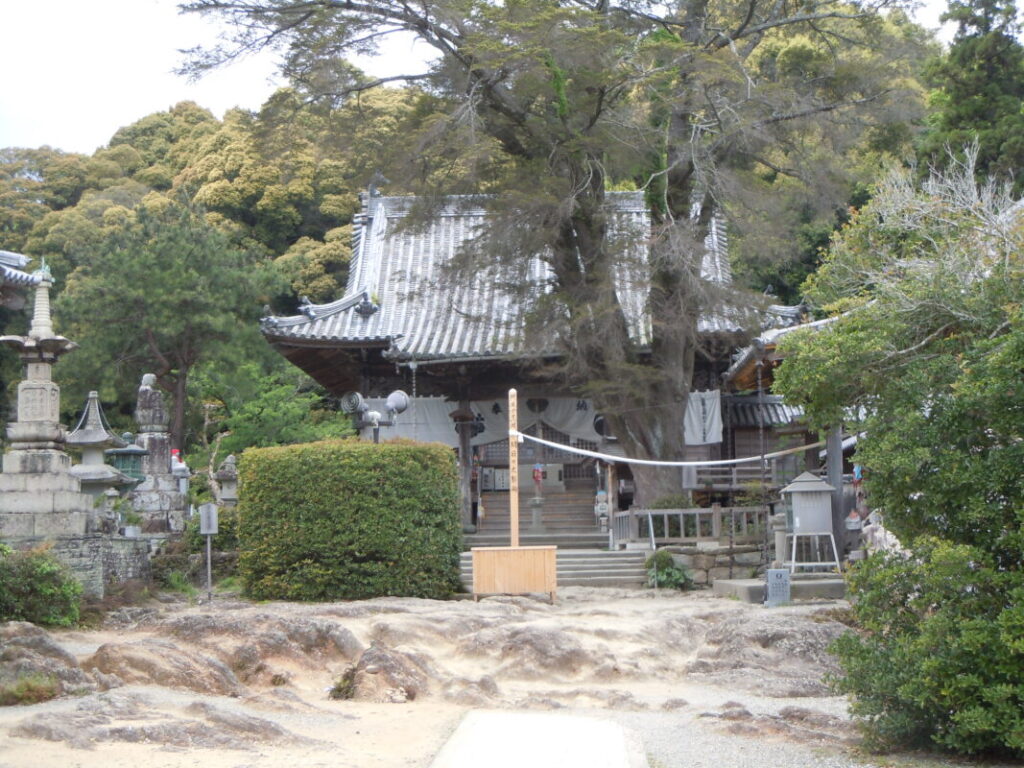
The temple grounds of Jorakuji are known as the “Garden of Flowing Rock” (Ryūsui-gan no Niwa),
featuring exposed bedrock that spreads across the grounds.
This unique landscape sets it apart from other pilgrimage temples.
History of Jorakuji Temple
Jorakuji is the only temple among the Shikoku 88 pilgrimage that enshrines Miroku Bosatsu (Maitreya) as its principal deity. Miroku Bosatsu is regarded as the Buddha of the future, believed to appear in a distant age to save all sentient beings.
According to tradition, when Kobo Daishi (Kukai) was 42 years old and training in this area, he experienced a vision of Miroku Bosatsu’s descent. He then carved the image into a sacred tree and established the temple.
Route to Temple 15, Kokubunji
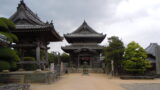
Temple 15, Kokubunji, is about 0.8 km from Jorakuji, a walk of around 15 minutes. The route is simple: just head north.
At the temple, I spotted a few pilgrims I had seen earlier at Jorakuji. Since the two temples are so close, we naturally seemed to be visiting them at a similar pace. We exchanged a brief nod before I headed to the Main Hall.
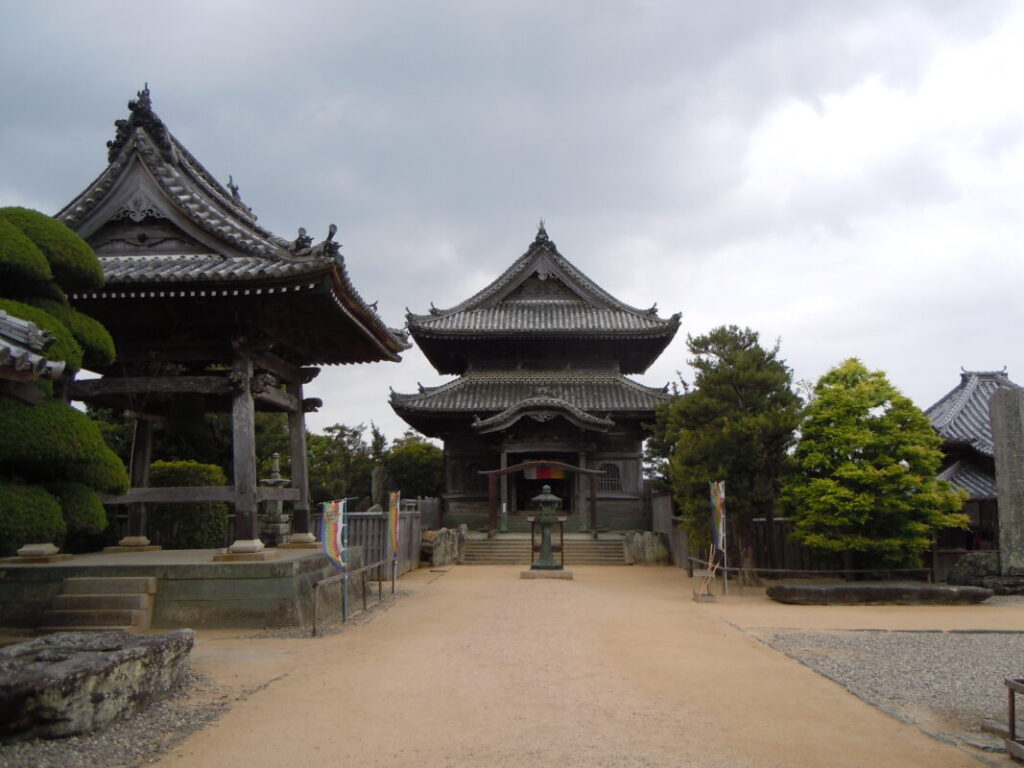
What Is Kokubunji?
Kokubunji refers to a network of provincial temples established across Japan during the Nara period as official state temples.
Their origin dates back to an imperial edict issued in 741 by Emperor Shomu.
At the time, Japan was facing epidemics, famine, and social unrest. In response, Emperor Shomu promoted the idea of “Chingo Kokka” (protecting the nation through Buddhism) and ordered the construction of temples in every province to pray for national stability and the well-being of the people.
As a result, Kokubunji temples were established throughout the country, serving not only as religious centers but also as hubs of politics, culture, and education. They played a key role in spreading Buddhism and stabilizing regional governance.
In the Shikoku pilgrimage, there is a unique feature: each of the four historical provinces of Shikoku has its own Kokubunji included as an official pilgrimage temple.
- Tokushima (Awa Province): Temple No. 15, Kokubunji
- Kochi (Tosa Province): Temple No. 29, Kokubunji
- Ehime (Iyo Province): Temple No. 59, Kokubunji
- Kagawa (Sanuki Province): Temple No. 80, Kokubunji
This shows how the system of state-sponsored Buddhism from the Nara period continues to live on in a different form within today’s pilgrimage culture.
Heading to Temple 16, Kannonji
From Kokubunji to Kannonji is about 1.8 km.
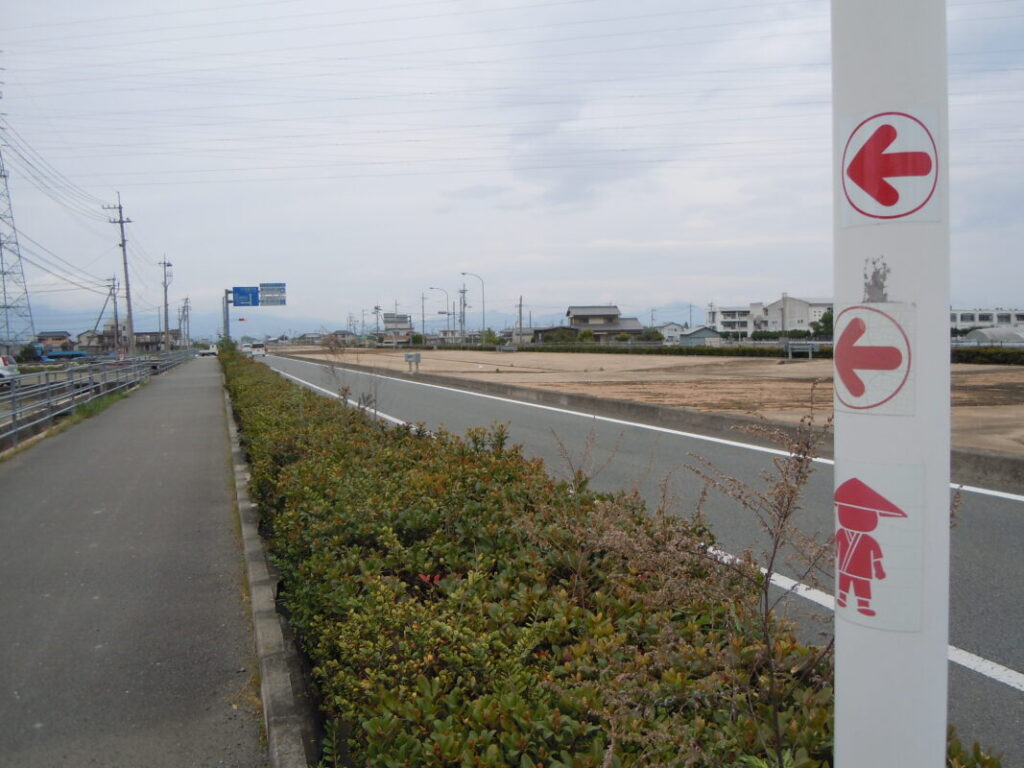
Kannonji is located to the north, and by following National Route 192, you can reach it easily without getting lost.
It’s been a while since I’ve seen such a large, busy road with heavy traffic.
A Sudden Act of Kindness: My First Experience of Osettai
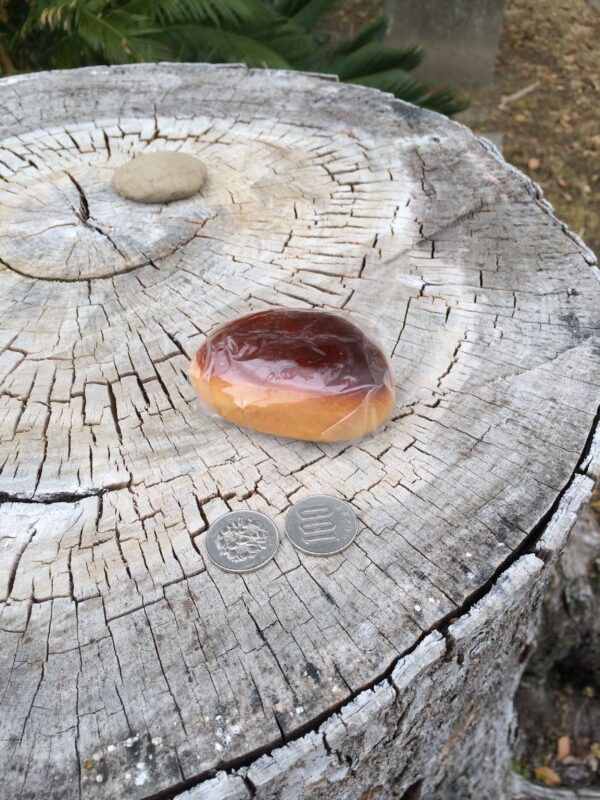
While walking toward Kannonji, an elderly man on a bicycle suddenly stopped in front of me.
“Thank you for your efforts,” he said, offering me a manju (sweet bun) and 200 yen.
Surprised, I accepted it with a sincere “Thank you.”
Up until then, I had experienced prepared forms of osettai—such as those at zenkon-yado (free lodgings for pilgrims) or organized events.
However, this was my first time receiving osettai spontaneously along the way.
“I can’t believe this really happens.”
It felt like a mysterious and almost spiritual experience.
History of Kannonji Temple
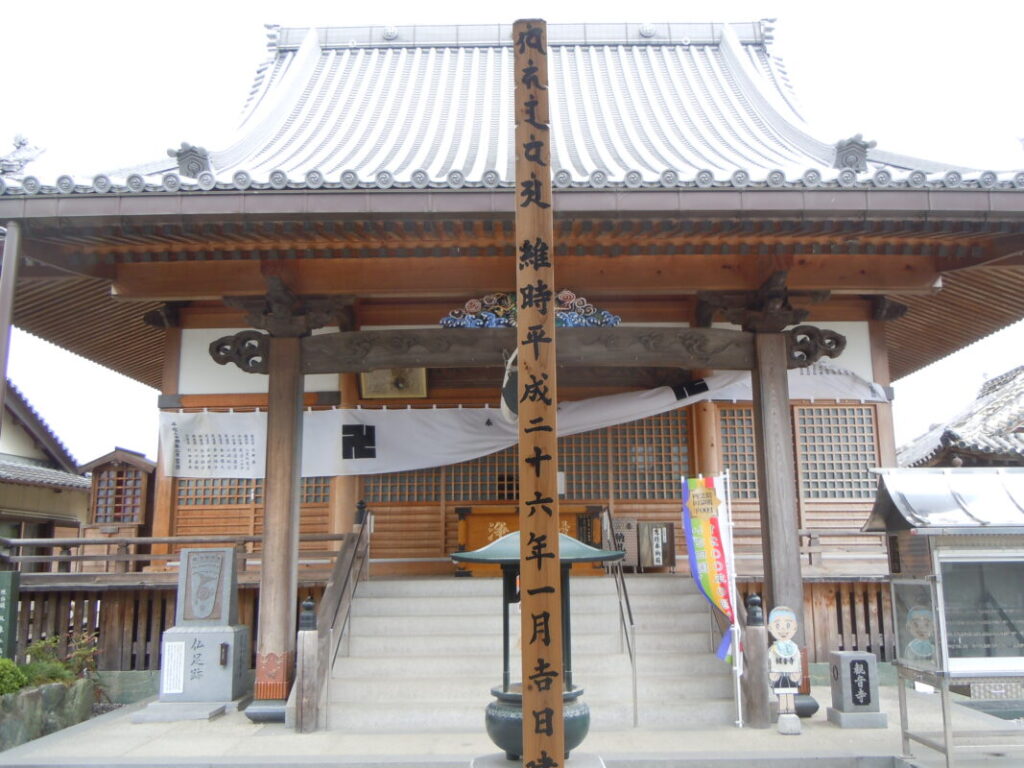
Kannonji is said to have been founded by Kobo Daishi (Kukai), who carved a statue of Senju Kannon (Thousand-Armed Avalokiteshvara) himself and enshrined it as the principal deity. He also created statues of Fudo Myo-o and Bishamonten as attendant deities.
There is also a story from the Taisho era about a blind worshipper who regained their eyesight through the blessings of the principal image.
Kannonji is a temple deeply connected to local culture, with many historical and spiritual stories passed down through generations.
On the Way to Temple 17, Idoji: Lunch and the Start of Steady Rain
It’s now 12:30 p.m. I’ve walked about 15 km today, reaching the halfway point.
Feeling hungry, I decide to stop at a noodle shop near Kannonji for lunch.
For the past three days, most of my meals have been from convenience stores.
It’s been a while since I’ve had a proper hot meal.
And in Shikoku, that means one thing—udon.
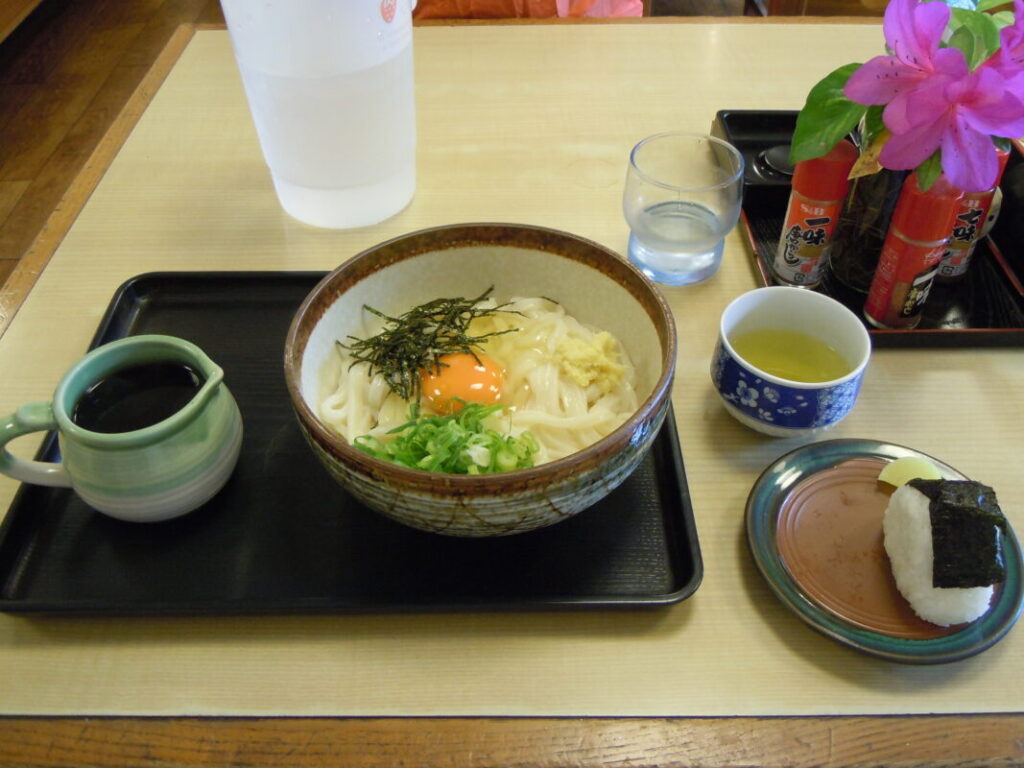
I order a bowl of kamatama udon.
From the very first bite, the difference is clear.
It has a simple yet rich flavor, quite different from the udon I’ve had in other parts of Japan.
First Rain Experience: How to Handle It and What I Learned
After finishing lunch, I start walking again.
The pain in my feet is still there, but I try to reduce the impact by landing on my heels and choosing to walk along the edges, like on top of drainage covers.
Then, the rain finally begins to fall in earnest—my first rain since starting the walking pilgrimage.
I quickly put on my rain gear. My sugegasa (traditional pilgrim hat) has a vinyl cover, so my head stays well protected.
Along the way, I see other pilgrims, each wearing different kinds of colorful rain gear.
Against the gray sky, their bright colors stand out in a memorable way.
History of Idoji Temple
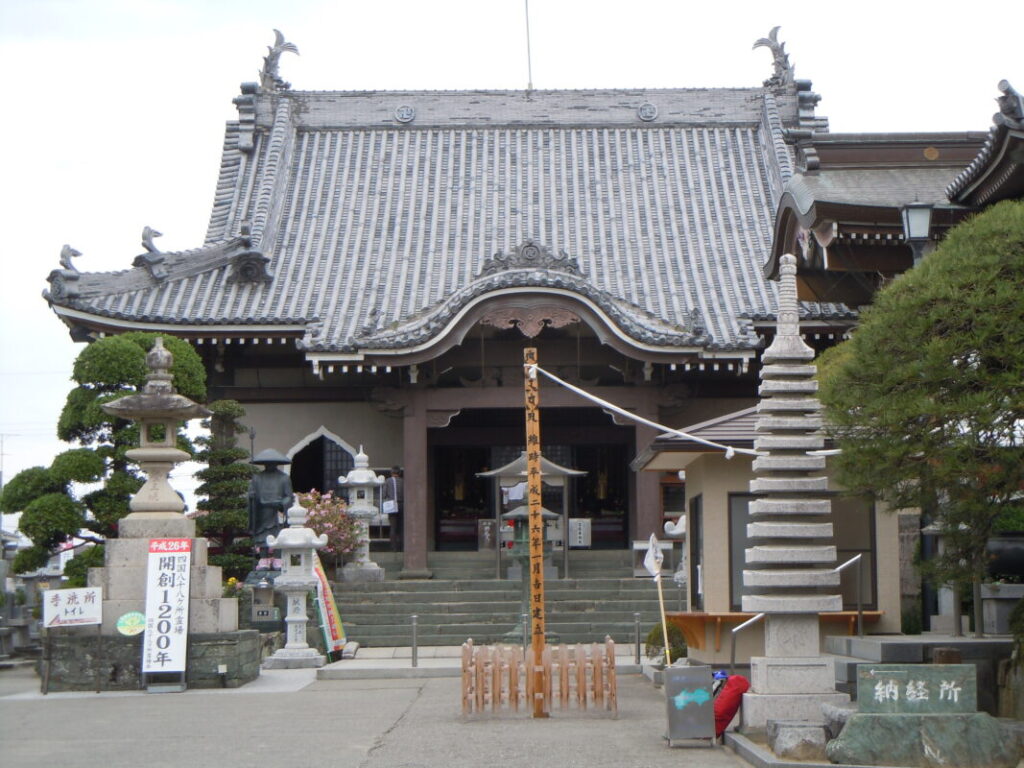
In 815 (Kōnin 6), Kobo Daishi (Kukai) visited this area and carved a statue of Juichimen Kannon (Eleven-Faced Avalokiteshvara). It is also said that he dug a well to provide fresh water for villagers suffering from water shortages. From this, the area came to be known as “Ido Village,” and the temple was named “Idoji.”
Idoji is a historic temple known for its well-related legends and strong connection to Yakushi (Medicine Buddha) worship.
At Idoji, pilgrims can stay at the tsuyado (free lodging hall)
It is available free of charge for pilgrims and has a very good reputation.
Blankets are provided, making it suitable even during colder seasons.
For walking pilgrims, it is definitely one of the most reliable accommodation options.
Finishing the Day’s Visits at Idoji: Heading to the Accommodation
Today’s temple visits end at Idoji at 2:30 p.m.
The next temple, No. 18 Onzanji, is about 17 km away.
There are two main route options for this section.
One is the “Jizogoe Route.”
This is the traditional pilgrimage path, crossing a mountain trail with an elevation of about 150 meters. It offers a more authentic atmosphere and is about 1 km shorter than the city route.
The other option is the route through Tokushima city.
It’s flat and easier to walk, with plenty of accommodations and restaurants, making it a convenient base.
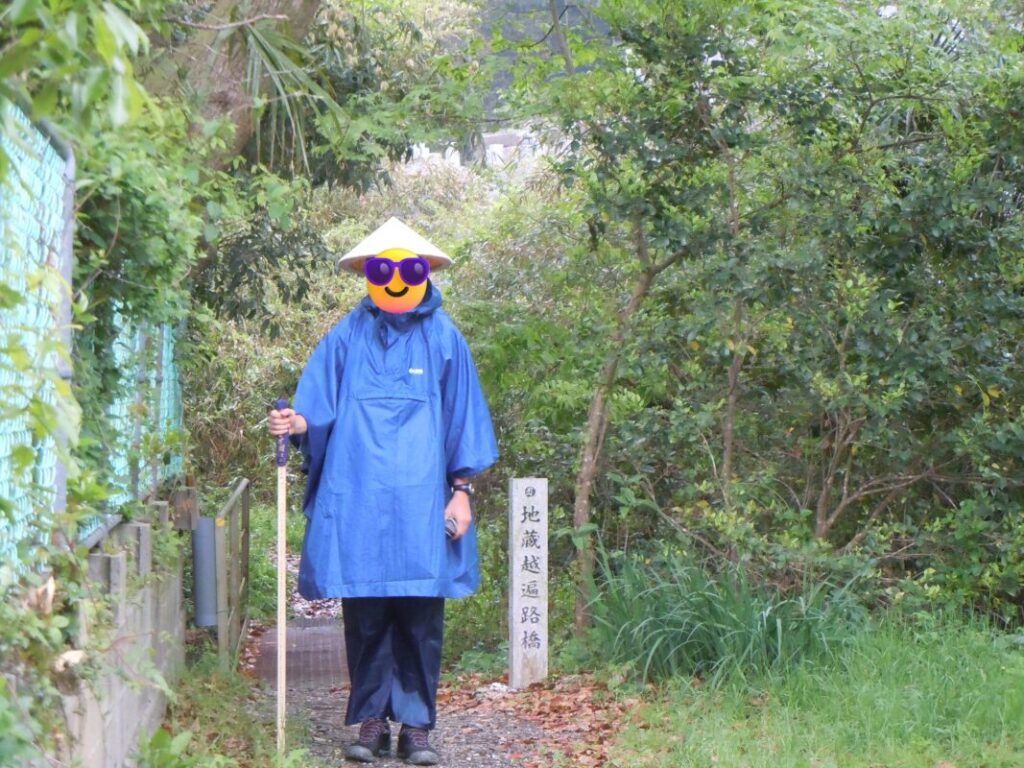
As planned, I decide to head toward Hachiman Onsen via the Jizogoe route.
At 4:00 p.m., I reach the Jizogoe area
With the rain growing heavier and the pain in my feet increasing, my pace has clearly slowed down.
My shoes are waterproof, so a bit of rain isn’t a problem.
But there’s no sign of the rain letting up.
Even so, I keep moving forward, one step at a time, toward today’s destination.
Arrival at Hachiman Onsen: After 5:00 PM
A little after 5:00 p.m., I arrived at Hachiman Onsen.
I folded up my soaking wet rain gear and left it outside, then asked the staff for permission to stay overnight.
Warming Up and Recovering in the Hot Spring
As I soaked in the hot spring, my body, chilled by the rain, quickly began to warm up. I could feel myself slowly recovering.
The soles of my feet were also hurting badly, so I gently massaged them while soaking in the bath. I also tried filling a washbasin with cold water and soaking my feet to cool them down.
After bathing, I rested for a while in the lounge. Having spent the entire previous day in the mountains, it felt strangely comforting to relax indoors under electric lights.
I had curry rice in the dining area before returning to my tent.
A Kind Gesture and the Noise at the Campsite
That day, the staff kindly lent me a tatami mat and a sheet of blue plastic. Placing them under my tent made it much more comfortable, which was a great help to my tired body.
There was one downside, however.
The machinery at the overnight area was much louder than I expected, and the noise continued until nearly closing time, around midnight.
I used earplugs to get to sleep. For anyone sensitive to noise, it might be a rather difficult place to stay.
A Rainy Night Before a Challenging Day
Outside, the rain grew even heavier, pounding down relentlessly.
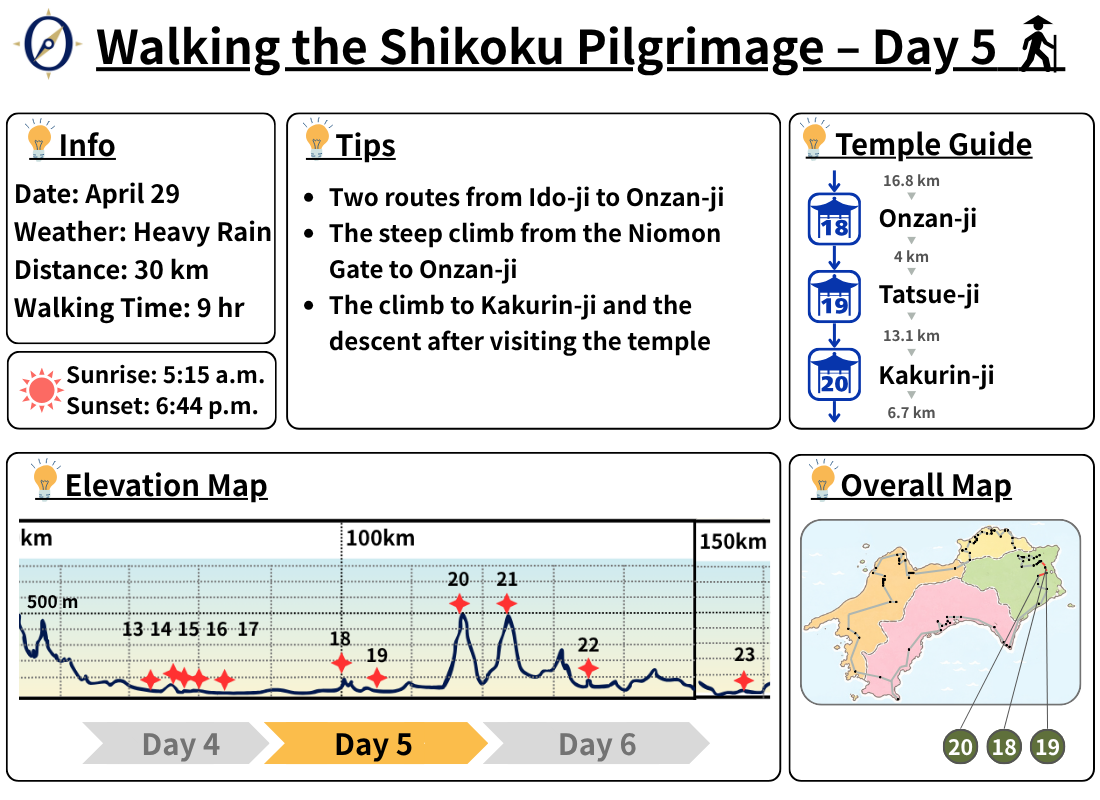
I hoped it would stop by the next morning as I thought about the next day’s route. Waiting ahead were two challenging climbs: Tsurugisan and Tairyuji, both reaching elevations of around 500 meters.
Temple Information
- No. 13
- No. 14
- No. 15
- No. 16
- No. 17
- No. 18
Temple No. 13, Dainichi-ji Guide
Temple No. 15, Kokubun-ji Guide
Summary : Key Points of Walking Shikoku Pilgrimage Day 4
Difficulty Rating for Day 4
- Physical demand: ★★☆☆☆
- Distance: ★★★☆☆
- Risk level: ★☆☆☆☆
- Overall: A relatively easy section even for beginners
Key points
- Temples 13–17 are close together, making them relatively easy to visit
- The route enters urban areas, so food and supplies are easy to obtain
- The section from Idoji to Temple 18 is long, so accommodation planning is important
- Hachiman Onsen allows overnight stay and offers excellent value (but be aware of noise issues)
Day 4 is an important stage for recovery and adjusting mileage.
Rather than pushing forward, it’s best to conserve energy and prepare for the next major challenge—Mount Tsurugi (Kakurinji) and Mount Tairyu (Tairyuji).
Comments