
Hello, I’m Taka, the creator of this blog.
I have completed the Shikoku 88 Temple Pilgrimage twice on foot, both clockwise and counterclockwise.
When walking the Shikoku pilgrimage, choosing the right gear can make a huge difference in comfort and endurance.
The two most important points are keeping your backpack as light as possible and taking proper care of your feet.
In this article, I’ll share the gear that actually worked well for me, along with lessons I learned from my mistakes after completing the pilgrimage twice.
This guide is written for:
- People attempting a walking pilgrimage for the first time
- Pilgrims considering camping or sleeping outdoors
- Anyone unsure about what gear to prepare
- The Most Important Thing in a Walking Pilgrimage: Keep Your Pack Light
- Gear I Actually Used to Complete the Walking Pilgrimage
- My Mistake: Lessons From My First Attempt at a Sectional Pilgrimage
- Important Safety Notes for Walking Pilgrimage Gear
- FAQ: Common Questions About Walking Pilgrimage Gear
- Summary
- Related Articles
The Most Important Thing in a Walking Pilgrimage: Keep Your Pack Light
The single most important thing in a walking pilgrimage is to keep your luggage as light as possible.
Once you start walking, many pilgrims struggle with foot pain and exhaustion. Some even give up before completing the journey.
The main reasons are:
- Walking for long hours every day
- Constantly walking on hard asphalt roads
- Carrying heavy luggage in addition to your own body weight
By reducing the weight of your backpack, you can lessen the strain on your feet with every single step. Even a small difference becomes significant over the course of tens of thousands of steps.
If you want to continue walking comfortably, it is essential to focus on carrying only what you truly need.
Gear I Actually Used to Complete the Walking Pilgrimage
Here, I’ll introduce the gear I personally used during my walking pilgrimage around the Shikoku 88 Temple Pilgrimage. I’ll explain each item by category based on my real experience completing the pilgrimage.
Recommended Backpack for a Walking Pilgrimage
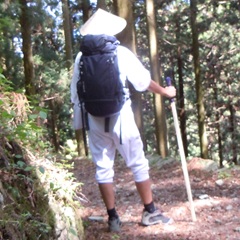
Front view
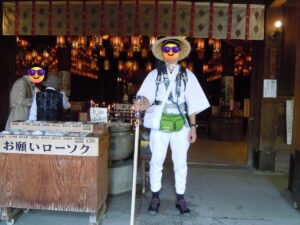
40L backpack gear
| Item | Model | Price | Weight | Comment |
|---|---|---|---|---|
| Backpack | Coleman Mt. Trek Lite 40 (discontinued) | ¥12,000 | 1.3 kg | A 40L backpack is highly recommended for a walking pilgrimage. |
| Waist Pouch | Coleman CBW1011 (discontinued) | ¥2,200 | 0.25 kg | Very convenient for storing small essentials you need quick access to while walking. |
The most important thing when choosing a backpack is finding the right balance in capacity.
If the backpack is too small, you will struggle to fit all your gear inside. On the other hand, if it is too large, you may end up carrying unnecessary items, which only makes your load heavier.
My recommendation is a 40L backpack. I found it to be the perfect size for a walking pilgrimage because it can comfortably hold larger gear such as a tent and sleeping bag without becoming excessively bulky.
I am 180 cm tall, so the backpack may look small in photos. However, it still provided more than enough storage capacity in actual use.
Waist Pouch
A waist pouch is an extremely useful item for a walking pilgrimage.
I used mine to carry essentials such as my smartphone, pocket tissues, and coin purse.
One of the biggest advantages is that you do not need to take off your backpack every time you want to buy a drink from a vending machine. It may seem like a small convenience, but during a long journey, these little things make a huge difference in comfort.
I also kept all of my valuables in the waist pouch so they were always with me. During a walking pilgrimage, there are moments when you may need to leave your backpack unattended, so having your valuables close to your body provides extra peace of mind.
If possible, I recommend choosing a waist pouch with reflective material. It improves visibility during early mornings, evenings, and inside tunnels, helping drivers notice you more easily and making your walk safer.
Essential Clothing and Gear for a Walking Pilgrimage
| Item | Model | Price | Comment |
|---|---|---|---|
| Sedge Hat (Sugasa) | – | ¥3,000 | A regular hat is also acceptable. |
| Sunglasses | – | ¥2,000 | Highly recommended for sun protection. |
| White Pilgrimage Vest | – | ¥2,500 | A chest-type design is recommended. |
| Pilgrimage Staff (Kongozue) | – | ¥2,000 | A symbolic item of the pilgrimage. |
| Shoes | MERRELL Moab Series | ¥20,000 | Trekking shoes are recommended. |
| Insoles | SOFSOLE Series | ¥2,000 | Choose ones with good cushioning. |
| Socks | Okamoto CROSSPRO | ¥1,650 | Provides strong arch support. |
| Rain Gear | – | ¥2,000 | A poncho-style raincoat is recommended. |
Sun Protection for a Walking Pilgrimage | A Hat and Sunglasses Are Essential
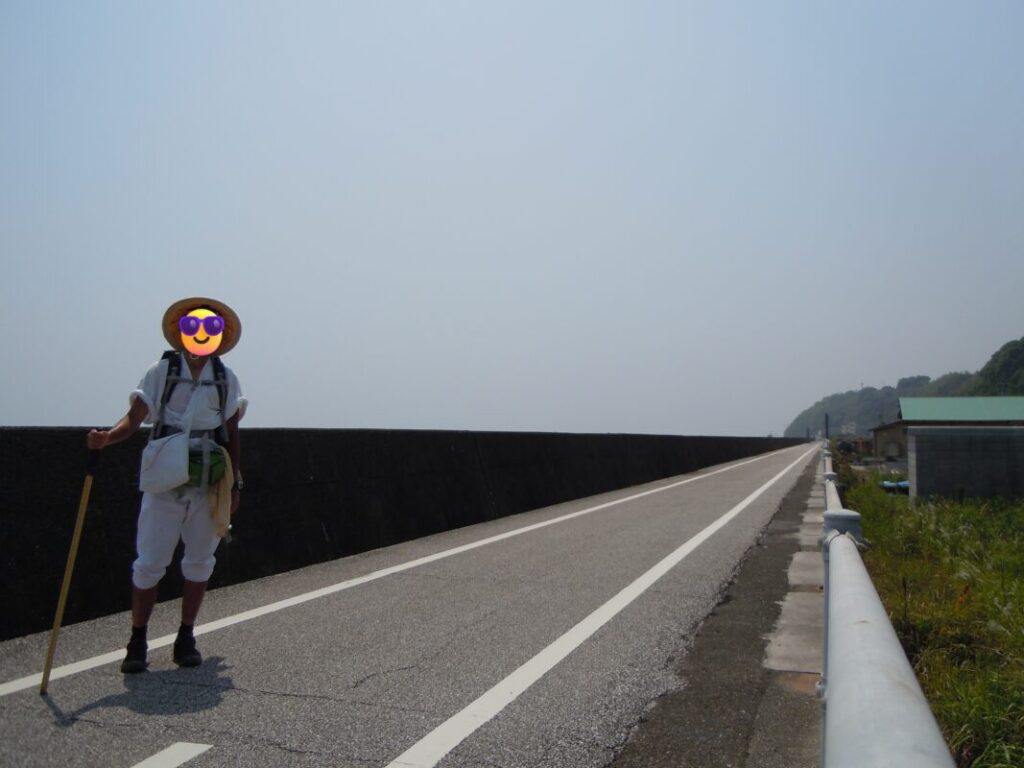
Protection from the sun is extremely important during a walking pilgrimage.
In particular, a hat is almost essential.
If you plan to buy a traditional pilgrimage hat known as a sugasa, I recommend choosing a compact model. Oversized hats tend to catch on your backpack and can become inconvenient while walking.
Sunglasses Help Protect Your Eyes
I personally did not use sunglasses during my pilgrimage, but looking back, I feel that I definitely should have brought them.
This was especially true along the coastal routes in Kochi Prefecture, where the sunlight was intense and the glare reflected from both the asphalt roads and the ocean put a significant strain on my eyes.
Symbols of the Pilgrimage | White Vest and Kongozue Staff
The white pilgrimage vest and the kongozue staff are items that every walking pilgrim should strongly consider bringing.
In particular, the kongozue is not viewed as just an ordinary walking stick. It is traditionally regarded as a representation of Kūkai, making it a deeply symbolic and meaningful item for pilgrims.
These items are also highly practical.
On mountain trails and steep roads, the staff helps distribute pressure away from your legs, reducing fatigue during long-distance walks. I found it especially helpful on downhill sections, where it eased the strain on my knees considerably.
The White Vest Also Identifies You as a Pilgrim
Wearing a white pilgrimage vest and carrying a kongozue staff naturally shows others that you are walking the pilgrimage.
During the journey, local residents may speak to you, encourage you, or offer osettai — acts of kindness and support traditionally given to pilgrims.
There were also times when I needed to rest outdoors or camp overnight. In those situations, dressing like a pilgrim helped people recognize that I was an ohenro-san rather than someone suspicious, which gave me a greater sense of security and peace of mind.
Of course, these items are not absolutely required. However, both practically and spiritually, I feel that the white vest and kongozue help create the true atmosphere and experience of a walking pilgrimage.
The Most Important Gear for a Walking Pilgrimage: Footwear
Among all the equipment used in a walking pilgrimage, footwear is by far the most important.
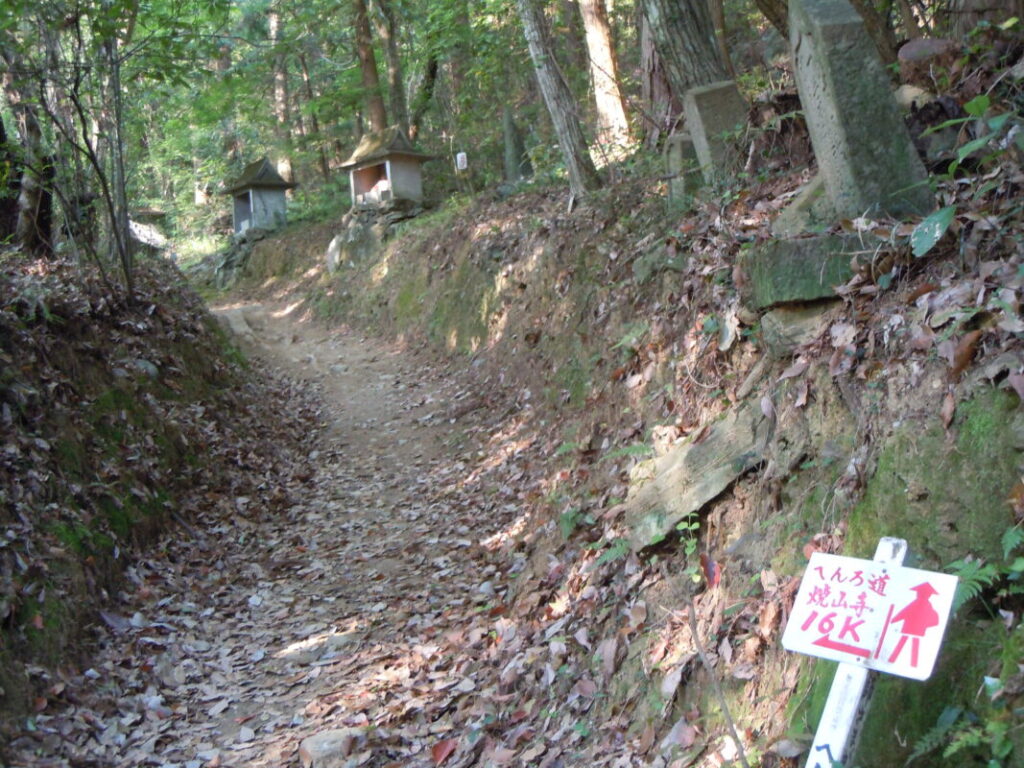
Although much of the pilgrimage route consists of paved asphalt roads, there are also many sections with mountain trails and unpaved paths.
For that reason, I strongly recommend using trekking shoes instead of ordinary sneakers. Trekking shoes provide better support, stability, and protection, which can make a significant difference during long-distance walking.
Socks and Insoles Also Play a Major Role in Reducing Fatigue
One surprisingly important item is your socks. I recommend choosing socks that provide arch support.
During a walking pilgrimage, the strain placed on the soles of your feet becomes extremely significant after many hours of walking each day. I noticed a clear difference in fatigue levels when using supportive socks.
Personally, I found five-toe socks uncomfortable because they felt too restrictive for me.
Insoles are equally important. Choosing insoles with strong cushioning can greatly improve comfort and help reduce stress on your feet during long walks.
Do Not Cut Corners on Footwear
When it comes to a walking pilgrimage, trying to save too much money on your footwear often leads to regret later.
Your shoes, socks, and insoles support your entire body every single day throughout the journey. They are some of the most important pieces of equipment you will carry.
From my experience, investing properly in your footwear is one of the biggest factors in being able to walk comfortably all the way to the end of the pilgrimage.
A Poncho Is the Best Rain Gear for a Walking Pilgrimage
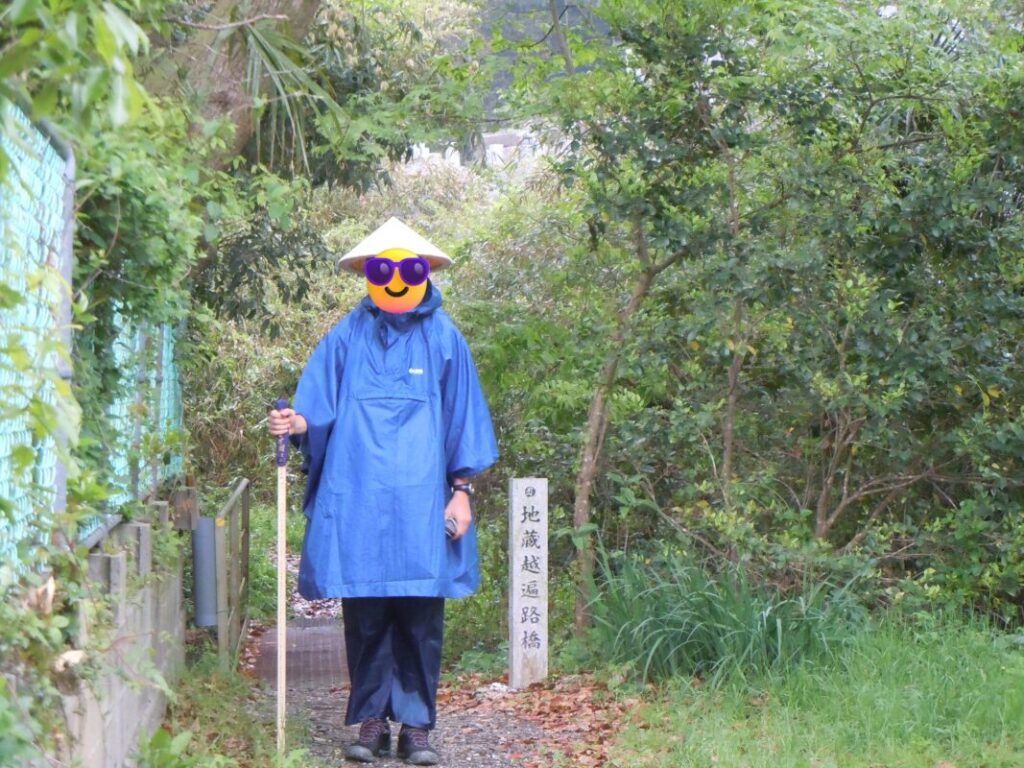
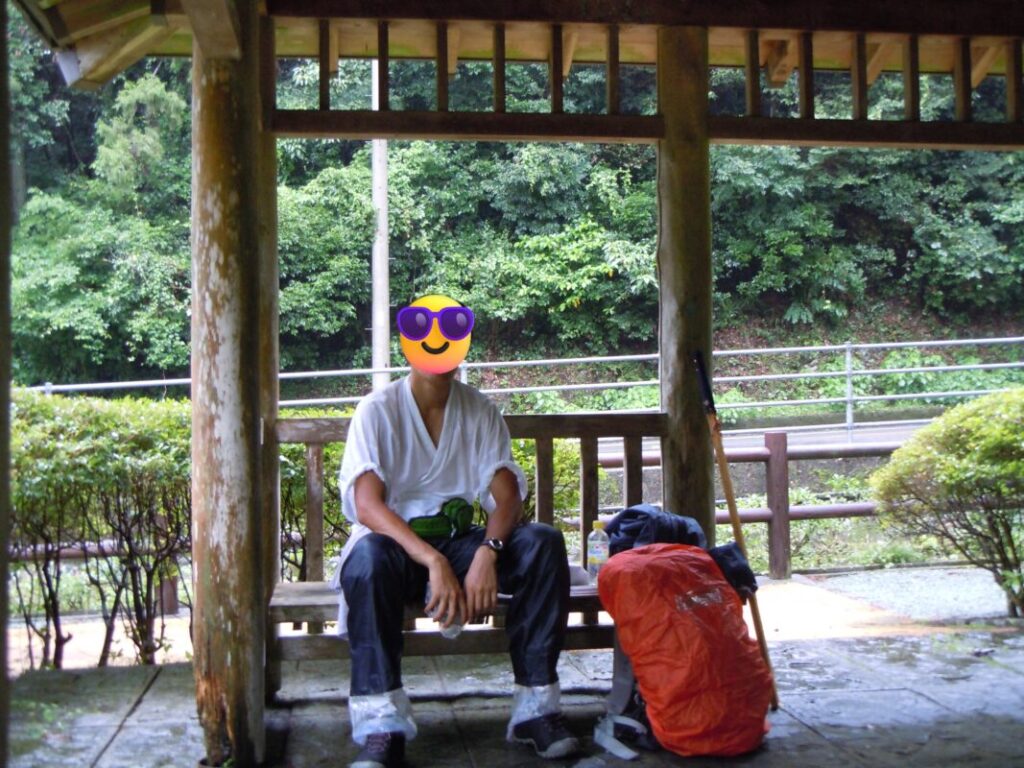
For a walking pilgrimage, I strongly recommend using a poncho-style raincoat.
The biggest advantage is that you can quickly put it on or take it off while still wearing your backpack.
During the pilgrimage, the weather can be unpredictable. Sudden rain showers are common, and the rain may stop again shortly afterward.
With separate jacket-and-pants rain gear, you need to take off your backpack and change clothes every time the weather changes, which becomes quite troublesome during a long journey.
A poncho, on the other hand, can simply be thrown on over your body and backpack within seconds, making it far more convenient and comfortable for walking.
A Poncho Can Cover Your Entire Backpack
Another major advantage of a poncho is that it can protect not only your body, but also your entire backpack.
During a walking pilgrimage, you will likely carry items such as a sleeping bag and spare clothes that absolutely need to stay dry.
By combining a poncho with a backpack rain cover, I was able to walk even in heavy rain without the inside of my backpack getting wet.
Recommended Camping Gear for a Walking Pilgrimage
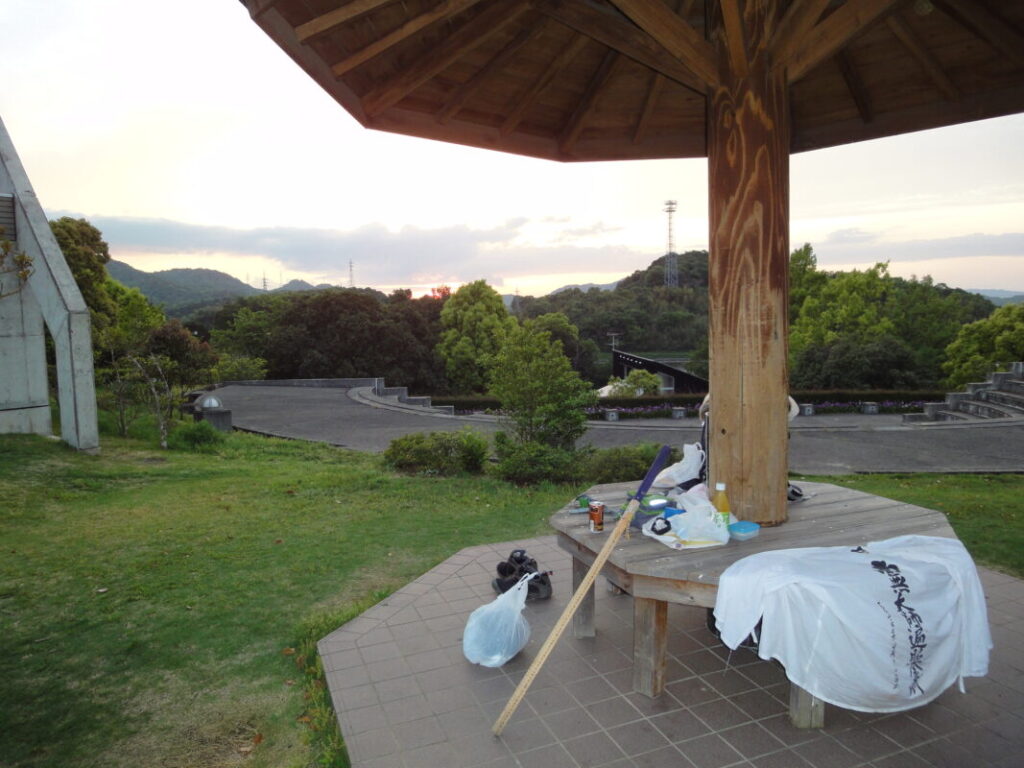
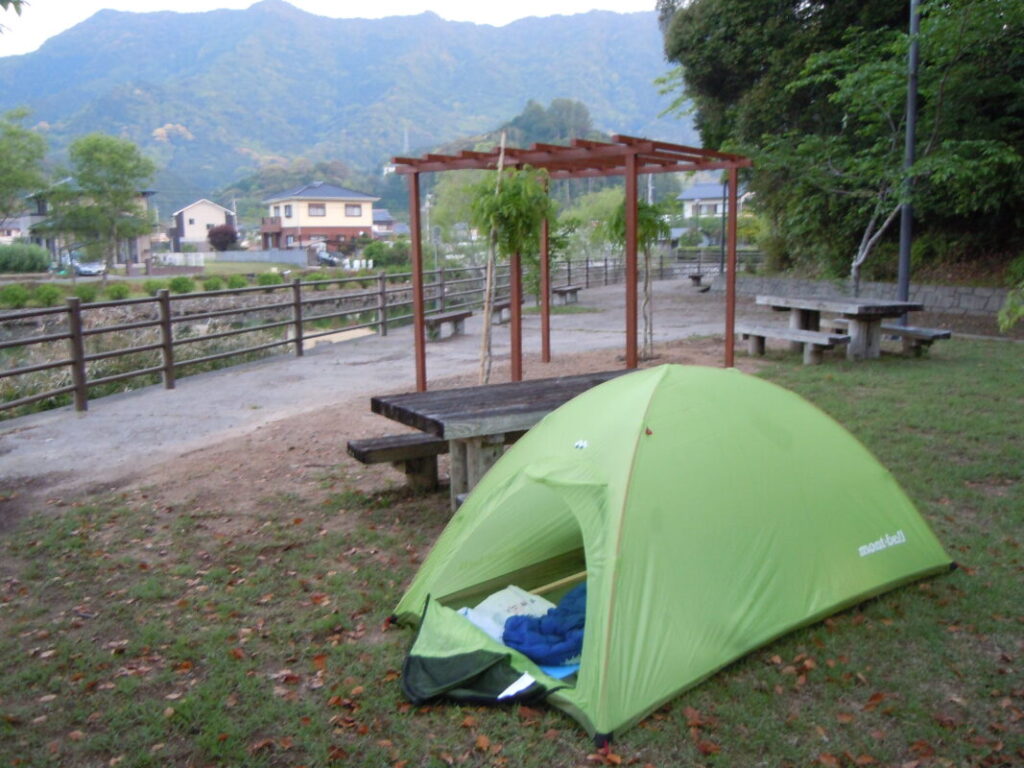
Setting up a tent on the grass in a park
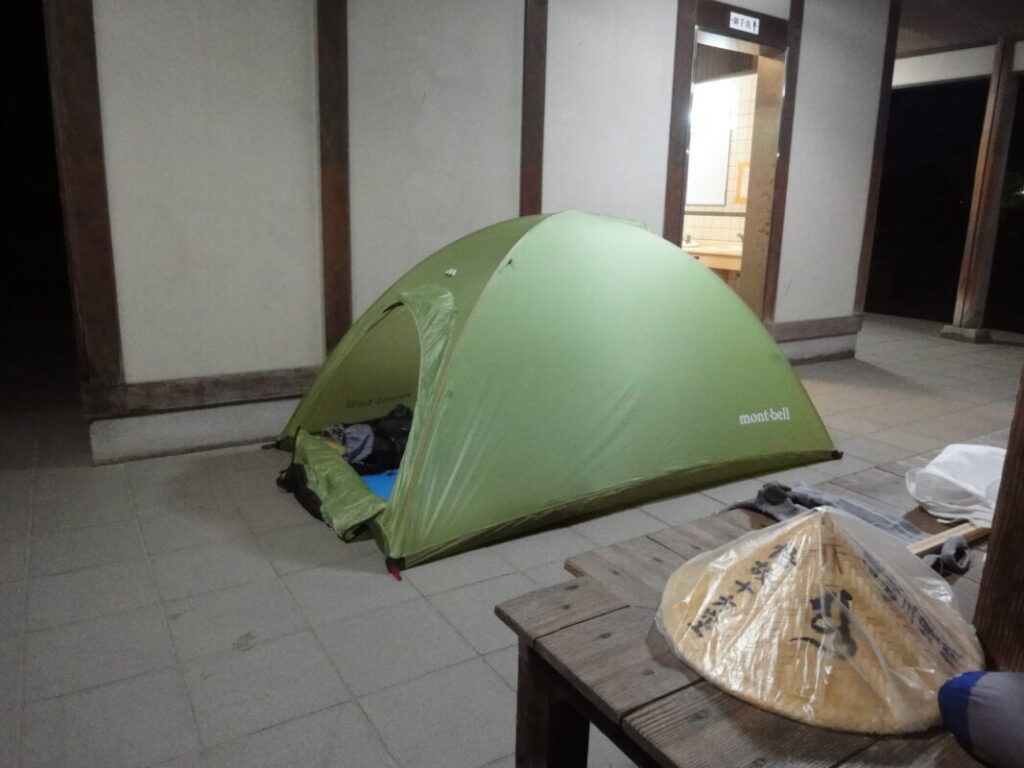
Setting up a tent under the eaves in a park
| Item | Model | Price | Weight | Comment |
|---|---|---|---|---|
| Tent | mont-bell U.L. Dome Shelter 2 | ¥38,000 | 0.9 kg | Prioritizes lightweight performance. |
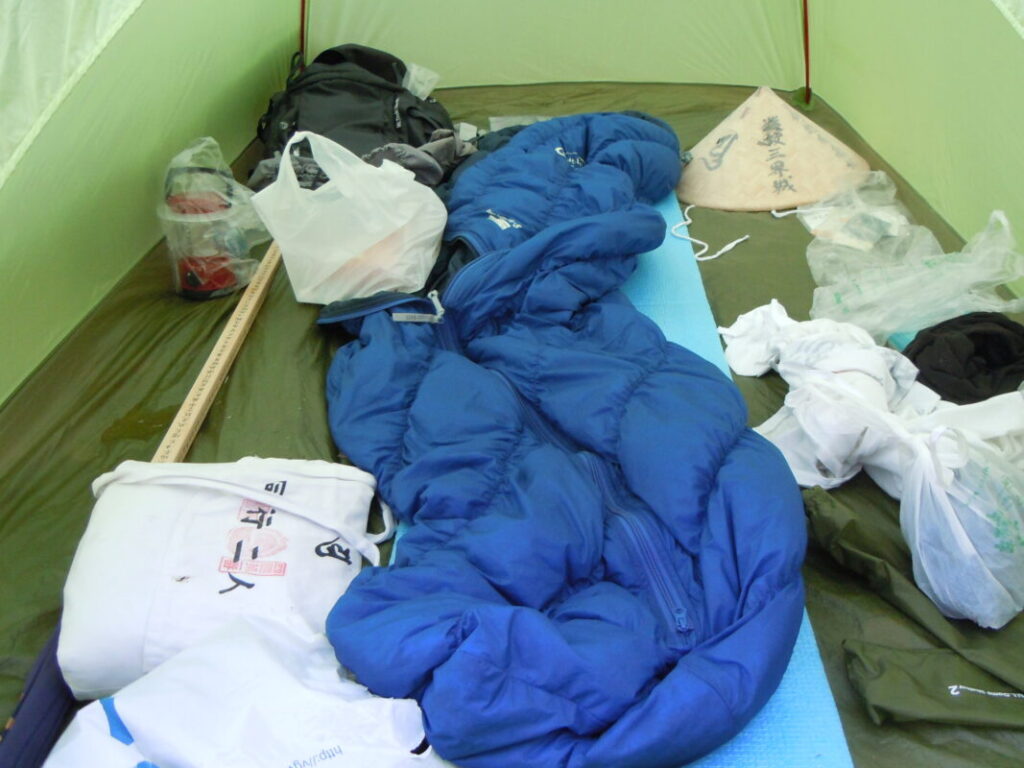
| Sleeping Bag | mont-bell Down Hugger 800 #5 | ¥21,000 | 0.5 kg | Choose according to the season and temperature. |
| Insulating Mat | – | ¥2,000 | 0.1 kg | Helps block cold air from the ground. |
When Choosing a Tent for a Walking Pilgrimage, Weight Matters More Than Performance
The most important factor when choosing a tent for a walking pilgrimage is not maximum performance, but lightweight design.
Unlike serious mountain climbing, a walking pilgrimage rarely requires camping in extremely harsh natural environments.
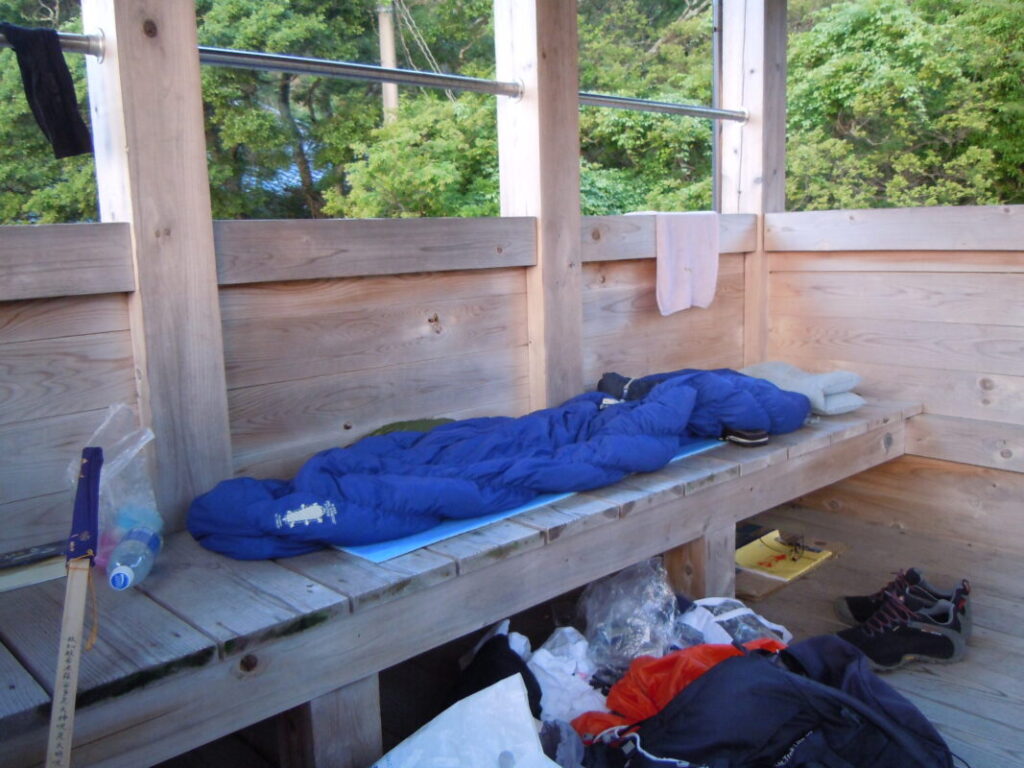
In reality, there are many situations where you can stay in places that provide some protection from wind and rain, such as park shelters or small resting pavilions.
Because of this, I personally felt that there was no need to spend excessive money on a high-end mountaineering tent designed for extreme conditions.
Freestanding Tents Work Especially Well for a Walking Pilgrimage
I personally used a freestanding tent during my pilgrimage.
One of the biggest advantages of a freestanding tent is that it can be set up even on concrete or hard ground where tent stakes cannot be used.
This was extremely convenient during the walking pilgrimage because camping locations are not always grassy areas. In many cases, you may need to stay on hard surfaces or places where driving stakes into the ground is difficult.
Being able to set up your tent almost anywhere is a major advantage on a long journey like this.
Recommended Sleeping Bags for a Walking Pilgrimage
Inside the tent
Sleeping outdoors at a pilgrimage hut
Sleeping bags are rated by their temperature range. Generally, the lower the temperature they can handle, the higher their performance — and the more expensive they become.
The sleeping bag I used had a comfort temperature rating of around 5°C (41°F).
Although many people imagine Shikoku to be warm in spring, the temperature can become surprisingly cold at night. Even so, this level of sleeping bag was more than comfortable enough for a spring walking pilgrimage.
On the other hand, I found it insufficient during winter pilgrimages.
In flat areas, I could manage by wearing extra layers inside the sleeping bag. However, in mountainous regions, the cold became extremely severe, and there were nights when I could barely sleep.
For that reason, if you plan to camp outdoors during a winter pilgrimage, I strongly recommend preparing a high-performance sleeping bag designed for much lower temperatures.
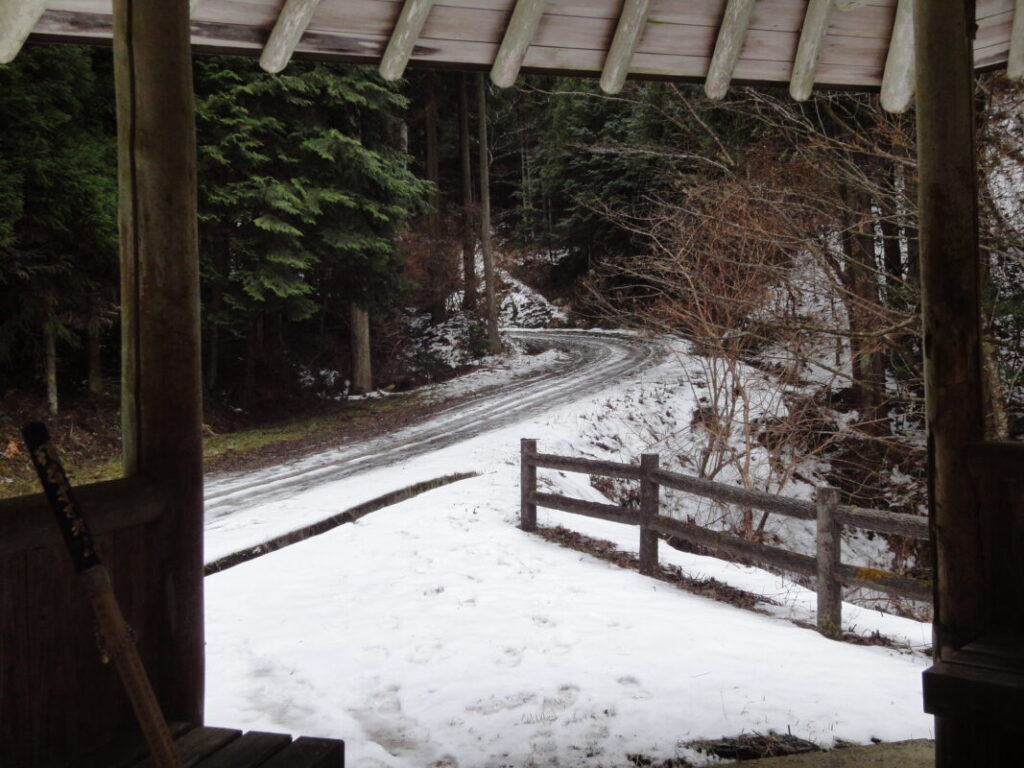
In contrast, summer temperatures were so warm that I did not use a sleeping bag at all.
An Insulating Mat Is Almost Essential
An insulating mat is one of the most essential items for outdoor camping during a walking pilgrimage.
There are two main reasons for this:
- It blocks cold air and ground chill from reaching your body
- It reduces discomfort caused by rocks and uneven ground surfaces
I personally used a simple insulating mat purchased from a home improvement store and cut it to fit my body size.
By folding it compactly, I was also able to store it inside my backpack without much difficulty.
Pilgrimage Worship Items
| Item | Price | Comment |
|---|---|---|
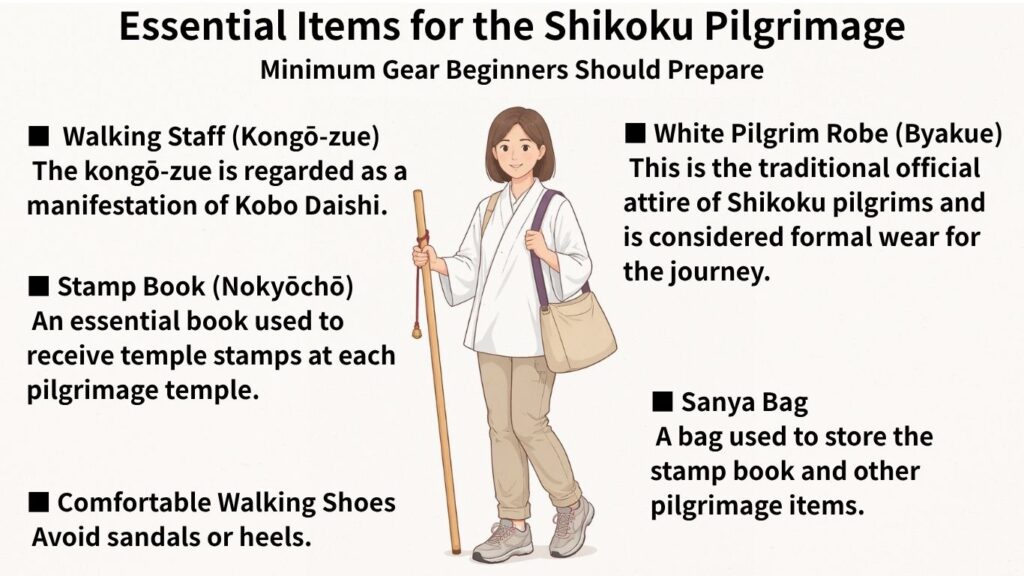
| Nokyocho (Pilgrimage Stamp Book) | ¥2,000 | Essential for collecting temple stamps and calligraphy. |
| Zudabukuro / Pilgrimage Bag | ¥2,000 | Convenient for carrying worship items together. |
| Osamefuda (Pilgrim Name Slips) | ¥100 | Usually sold in sets of 100. |
| Wagesa (Pilgrimage Stole) | ¥2,000 | Optional item. |
| Incense & Candles | ¥2,000 | Purchased as needed during the journey. |
| Lighter | ¥100 | Used for lighting incense and candles. |
You Don’t Need to Carry All Incense and Candles from the Start
During a walking pilgrimage, visiting all 88 temples of Shikoku 88 Temple Pilgrimage means you will eventually need:
- 176 candles (for both the main hall and Daishi hall at each temple)
- 528 incense sticks
However, there is no need to carry all of these from the beginning of your journey.
Both candles and incense can be purchased at each temple along the way, so it is far more practical to restock as needed. This approach significantly reduces your backpack weight.
Candles and Incense Are Heavier Than You Might Expect
When calculated in total weight:
- About 200 candles weigh approximately 400g
- About 500 incense sticks weigh approximately 300g
In other words, if you only carry the minimum necessary amount and restock along the route, you can reduce your load by roughly 500g — about the weight of five rice balls.
For a long-distance walking pilgrimage, even this small reduction can make a noticeable difference in comfort over time.
Other Small Items That Were Useful During the Walking Pilgrimage
Here, I’ll introduce small items that I actually used during my walking pilgrimage and found helpful.
| Item | Comment |
|---|---|
| Smartphone | An essential item in modern pilgrimages. |
| Soap | A compact travel-sized bar is convenient. |
| Toothbrush Set | A travel kit is recommended. |
| Map | Highly recommended, especially as a backup. |
| Sunscreen | Better to have it for sun protection. |
| Earplugs | Useful for improving sleep quality. |
| Valuable Case | A neck-strap type is recommended for safety. |
| Coin Purse | Very convenient for daily small payments. |
| LED Light | Useful for early mornings and nighttime visibility. |
| Item | Comment |
|---|---|
| Wristwatch | Convenient for managing time during long walking days. |
| Insect Repellent | Essential in summer, especially when camping. |
| Pen | Used for filling out osamefuda (pilgrim name slips). |
| Pocket Tissues | Basic emergency supply item. |
| Band-Aids | Useful for treating blisters and minor injuries. |
| Nail Clippers | Helps prevent foot pain and nail issues during long walks. |
| Utility Knife | General-purpose tool for various situations. |
| Compass | Small and lightweight navigation aid. |
| Zip Bags | Useful for waterproof storage and organizing small items. |
Paper Maps Are Surprisingly Useful in a Walking Pilgrimage
While smartphone map apps are very convenient, I strongly recommend carrying a paper map as well.
On pilgrimage routes, especially in mountainous areas, there are places where mobile signals are weak or unavailable. In such situations, a paper map allows you to check your route without depending on network coverage.
It is also a reliable backup in case your phone battery runs out.
For these reasons, it is safer not to rely solely on your smartphone, and to always have a paper map prepared during your journey.
Wristwatches Are Surprisingly Useful
Even though smartphones can tell the time, a wristwatch turned out to be very practical.
During a walking pilgrimage, there are situations where you may turn off your smartphone to save battery. In those moments, a wristwatch allows you to check the time instantly without using your phone.
It also reduces the need to take out your smartphone in the rain, helping to prevent it from getting wet.
Zip Bags Are Handy for Rain Protection
Zip bags are very useful for protecting paper items such as your pilgrimage stamp book and maps.
In particular, the nokyocho (stamp book) is an important record of your journey, so keeping it waterproof provides peace of mind.
Earplugs Are Very Helpful for Camping and Dormitories
Earplugs are another item that proved extremely useful during the pilgrimage.
When camping outdoors, you may be bothered by traffic noise near highways or by insects and frogs in rural areas. In dormitory-style accommodations, they are also effective for blocking out snoring and helping you sleep better.
My Mistake: Lessons From My First Attempt at a Sectional Pilgrimage
I completed the walking pilgrimage in a kugiri-uchi (sectional) style.
I walked the route in five separate trips of about one week each, and eventually reached completion.
However, my first attempt was honestly made with very poor preparation.
In this section, I will share what I learned from my mistakes.
Lighter Than You Think Is Just Right
Many pilgrims I met along the way agreed on one thing:
your backpack should be as light as possible.
In fact, when the load is too heavy, it puts significant strain on your feet, knees, and lower back, and fatigue builds up much faster. Some pilgrims even send unnecessary items home by courier during the journey.
This shows just how much backpack weight affects a walking pilgrimage.
One Set of Spare Clothes Is Enough
One of my biggest mistakes was bringing too many changes of clothes.
I was worried about things like getting dirty or running out of clean clothes, so I packed far more than I actually needed.
In reality, rotating just two sets of clothes was more than enough. By washing them along the way, I had no problems at all. Most of the extra clothes I carried were never used, yet I had to carry them every day.
Even if something gets damaged or worn out, you can always buy replacements locally.
In the end, I learned that a “buy it when you need it” mindset works best for a walking pilgrimage.
I Learned the Hard Way: Problems Caused by Poor Footwear Setup
I chose trekking shoes with mountain trails in mind, so I thought my footwear was well prepared.
However, I did not pay much attention to socks or insoles and used standard, everyday ones. This turned out to be a major mistake.
Arch-Support Socks Make a Big Difference
A walking pilgrimage involves long distances every single day.
As the hours passed, I began to feel my arch losing stability, and each step started to feel heavier, almost like my foot was hitting the ground with a dull impact.
After switching to proper socks with arch support and dedicated insoles, the difference was immediately noticeable. The strain on my feet was clearly reduced.
Looking back, I wish I had started with proper walking-specific socks and insoles from the beginning.
Loose Shoelaces Were Another Mistake
Another problem was that I did not tighten my shoelaces properly.
I kept them slightly loose for convenience, so I could take my shoes on and off more easily. However, this caused my foot to shift inside the shoe while walking, which eventually led to blisters.
Key Lessons Learned
- Use walking-specific socks and insoles from the start
- Always tie your shoelaces firmly
Even these small adjustments can significantly reduce fatigue and prevent injuries during a long walking pilgrimage.
Important Safety Notes for Walking Pilgrimage Gear
In a walking pilgrimage, it is not enough to simply prepare your equipment—you also need to pay attention to safety and waterproofing.
When actually walking the route, I encountered problems that I had not anticipated in advance.
Avoid Exposing Too Much Skin
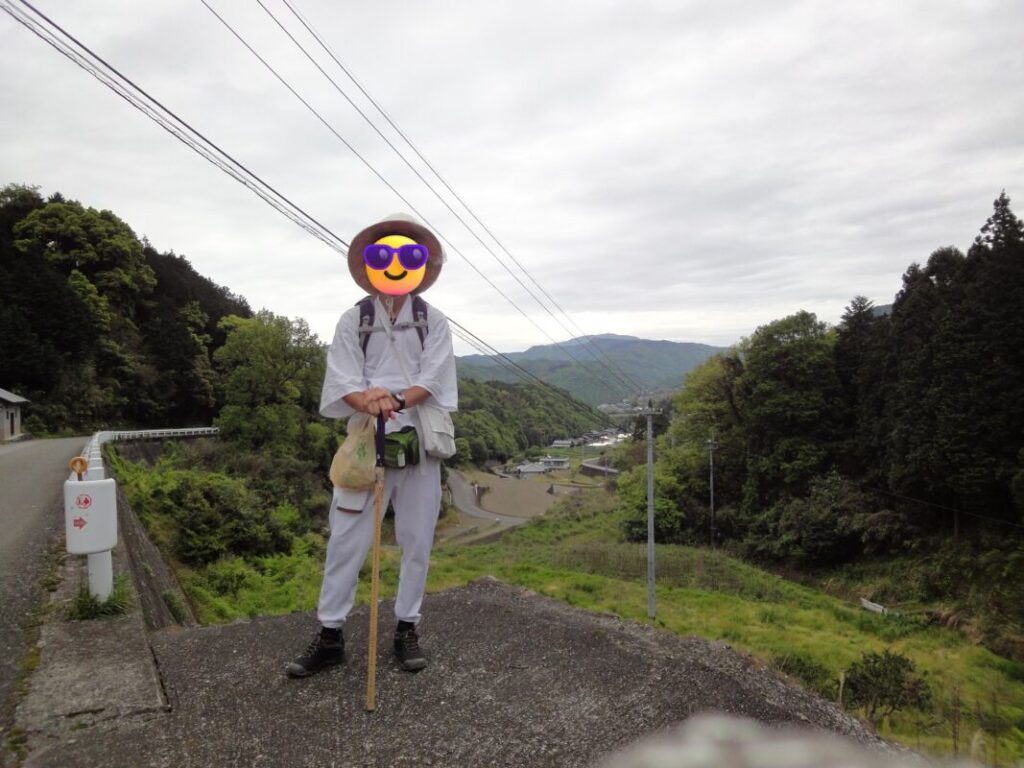
During a walking pilgrimage, it is recommended to wear clothing that covers as much skin as possible, such as long sleeves and long pants.
The pilgrimage routes include mountain paths, where you may encounter potentially dangerous wildlife such as vipers and bees.
I personally came across vipers several times on mountain trails. I also saw a large wasp nest hanging inside a mountain rest shelter.
While summer heat can make this challenging, from a safety perspective it is better to minimize exposed skin as much as possible.
Waterproofing Is Essential
Shikoku is a region with relatively high rainfall, so waterproofing is extremely important during a walking pilgrimage.
In particular, electronic devices such as smartphones and mobile batteries should be stored in waterproof cases for added safety.
Paper items like pilgrimage stamp books (nokyocho) and maps should be kept in plastic bags. Clothing such as underwear and shirts should also be separated into individual waterproof bags.
By organizing your belongings in this way, you can minimize damage even if your backpack gets wet.
Zip bags are lightweight and very easy to use, making them extremely practical for a walking pilgrimage.
Make Smartphone Data Available Offline
In mountainous areas, there are places where mobile signals are weak or completely unavailable.
For this reason, it is highly recommended to save maps and important information for offline use in advance.
Relying on the idea that “I can just check it on the spot” can become a problem when you suddenly find yourself in a no-signal area and cannot access what you need.
In particular, map applications should always be prepared with offline functionality before starting the journey, as this provides a much greater sense of security during a walking pilgrimage.
FAQ: Common Questions About Walking Pilgrimage Gear
- QHow heavy should a walking pilgrimage backpack be?
- A
It depends on the individual, but ideally around 7 kg, and no more than 10 kg. The heavier the backpack, the greater the strain on your feet, knees, and lower back.
- QCan I use regular sneakers for a walking pilgrimage?
- A
Trekking shoes are recommended. Since the route includes mountain paths and unpaved roads, cushioning and stability are very important.
- QDo I need a tent for a walking pilgrimage?
- A
It is not necessary if you plan to stay in accommodations. However, if you intend to camp outdoors or reduce lodging costs, a lightweight tent can be very useful.
- QHow many sets of clothes do I need?
- A
I found that rotating just two sets of clothes was enough. Since you can use laundromats or wash them at accommodations, carrying too many changes is unnecessary.
- QWhich rain gear is better: a rain jacket set or a poncho?
- A
A poncho that can cover your backpack is more convenient for a walking pilgrimage. It is easy to put on and take off, even during sudden rain.
- QDo I need paper maps if I have a smartphone?
- A
Yes, it is still recommended. There are areas with poor mobile reception in mountainous regions, and paper maps are also useful in case your battery runs out.
- QWhat is the most important piece of gear for a walking pilgrimage?
- A
From my experience, footwear is the most important. Choosing proper shoes, socks, and insoles can significantly reduce fatigue and improve comfort throughout the journey.
Summary
From my experience, the most important approach to gear selection for a walking pilgrimage is choosing equipment that does not push you too hard.
In particular, these three points are essential:
- Keep your backpack as light as possible
- Invest properly in your footwear and foot-related gear
- Avoid carrying more than you actually need
During a walking pilgrimage, even small differences in weight or equipment quality can make a significant difference after walking many kilometers.
I personally made several mistakes due to poor preparation at the beginning, but after reviewing and improving my gear, I was able to walk much more comfortably.
I hope this article will be helpful for anyone preparing to take on a walking pilgrimage.
Related Articles
Shikoku Pilgrimage Backpack Packing: How to Reduce Fatigue by Load Balance, Not Weight Alone.
How to pack a backpack
I have compiled a detailed guide to the Shikoku Pilgrimage for beginners.
What is the Shikoku Pilgrimage? Beginner’s Guide to Your First Sacred Journey in Japan
If you would like to learn how to worship at a Japanese temple, please see this page.
How to Worship at Japanese Temples : Shikoku Pilgrimage Guide
This article provides a complete list of the Shikoku 88 Temple pilgrimage route, including distances, travel times, and temple lodging (shukubo).
Temple List and Full Route
What Is a Kongozue? The Sacred Walking Staff of the Shikoku Pilgrimage.
Pilgrimage Staff