“How many days does the Shikoku Pilgrimage take by car?”
“Can you complete it in 10 days?”
Hello, I’m Taka, the creator of this blog.
I have completed the Shikoku 88 Temple Pilgrimage twice on foot, both clockwise and counterclockwise routes.
To get straight to the point: yes, it is possible to complete the Shikoku 88 Temple Pilgrimage in 10 days by car.
However, careful route planning and time management are essential.
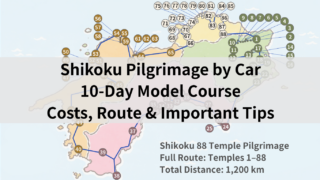
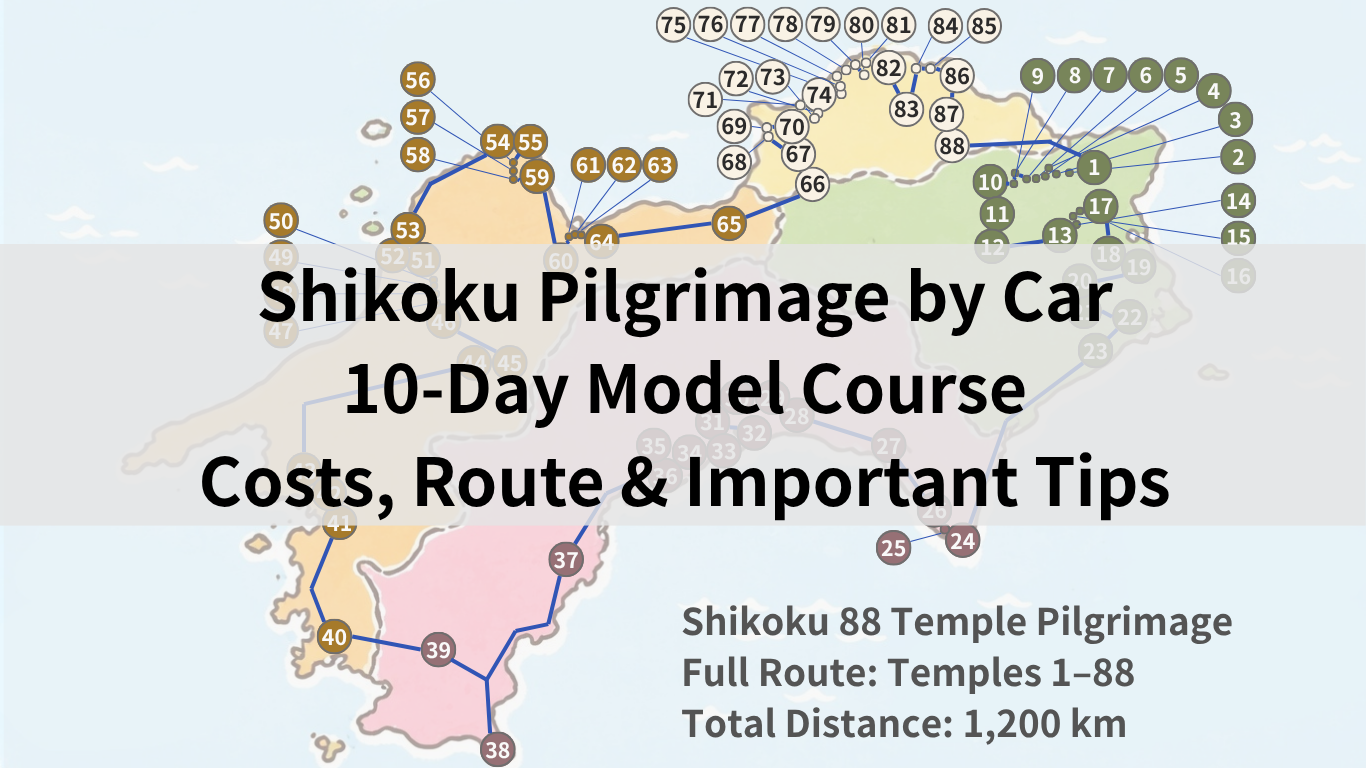
In this article, I’ll introduce a 10-day driving plan for visiting all 88 temples of the Shikoku 88 Temple Pilgrimage.
Article Summary
- Duration: 10 days
- Distance: Approx. 1,200 km (746 miles)
- Cost: Approx. ¥180,000
- Average temples per day: Around 10
- Time required: 10–12 hours per day (driving + temple visits)
- Difficulty: Suitable even for beginners (traveling by car is relatively manageable)
Is It Possible to Complete the Shikoku Pilgrimage by Car in 10 Days? Conclusion and Required Time
Completing the Shikoku 88 Temple Pilgrimage by car in 10 days is absolutely possible.
When traveling by car, you will typically drive around 40–300 km (25–186 miles) per day while visiting an average of 8–13 temples. Including both driving and temple visits, the estimated time required is approximately 10–12 hours per day.
In the 10-day sample itinerary introduced here, the route is planned around the temple office hours (8:00 a.m.–5:00 p.m.) while maximizing travel efficiency.
10-Day Sample Itinerary
| Day | Temples | Driving Distance | Estimated Time | Departure | Check-in | Suggested Overnight Area |
|---|---|---|---|---|---|---|
| Day 1 | Temples 1–11 | 40 km | 10 hrs | 7:30 | 18:00 | Tokushima City |
| Day 2 | Temples 12–19 | 60 km | 11 hrs | 6:30 | 18:00 | Tokushima / Anan |
| Day 3 | Temples 20–26 | 140 km | 10 hrs | 7:30 | 18:00 | Kochi / Muroto |
| Day 4 | Temples 27–34 | 100 km | 10 hrs | 7:00 | 18:00 | Kochi City |
| Day 5 | Temples 35–40 | 300 km | 12 hrs | 7:30 | 19:00 | Ehime / Uwajima |
| Day 6 | Temples 41–50 | 130 km | 10 hrs | 7:30 | 18:00 | Ehime / Matsuyama |
| Day 7 | Temples 51–59 | 100 km | 10 hrs | 7:30 | 18:00 | Ehime / Imabari |
| Day 8 | Temples 60–70 | 110 km | 10 hrs | 7:00 | 18:00 | Kagawa / Kanonji |
| Day 9 | Temples 71–83 | 60 km | 10 hrs | 7:30 | 18:00 | Kagawa / Takamatsu |
| Day 10 | Temples 84–88 | 90 km | 6 hrs | 7:30 | – | – |
Why Completing the Shikoku 88 Temple Pilgrimage in 10 Days by Car Is Possible
The reason a 10-day pilgrimage by car is achievable is that driving dramatically reduces travel time between temples compared with walking.
Walking pilgrims may spend more than 40 days completing the full route, but traveling by car allows you to cover long distances in much less time.
Tokushima and Kagawa Prefectures, in particular, have temples located relatively close to one another, making it easier to visit multiple sites in a single day. On the other hand, Kochi has greater distances between temples, while Ehime includes several mountain-area temples, meaning daily difficulty varies.
To travel efficiently, the key points are:
- Schedule long-distance driving during the early morning or evening
- Focus your temple visits within the official stamp office hours
What Is the Shortest Time Needed to Complete the Shikoku 88 Temple Pilgrimage by Car?
If you travel by car, it is possible to complete the Shikoku 88 Temple Pilgrimage in as little as 7–8 days.
However, the shortest schedule requires visiting approximately 12–15 temples per day while also covering long driving distances, making it a very demanding itinerary.
As a general guideline:
- Fastest schedule: 7–8 days
- Standard schedule: 10 days
- Relaxed schedule: 12–14 days
If this is your first time doing the pilgrimage by car, it is generally more realistic to allow around 10 days rather than trying to complete it in the shortest possible time.
Average Number of Temple Visits and Driving Distance per Day
For a car pilgrimage, visiting around 10 temples per day is generally a comfortable pace.
Each temple visit—including prayers at the Main Hall, Daishi Hall, and receiving a temple stamp—usually takes about 20–30 minutes.
If you visit 10 temples in a day, you will spend approximately 3–5 hours on temple activities alone. Once driving time and meal breaks are added, it is common to be active from early morning until evening.
Typical daily estimates:
- Temple visits: approximately 8–13 temples
- Driving distance: approximately 40–300 km
- Total time required: approximately 10–12 hours
- Departure time: around 6:30–7:30 a.m.
Difficulty Check for Beginners
Compared with a walking pilgrimage, a car pilgrimage is generally beginner-friendly.
Physical demands are relatively low, and walking distances are minimal, so most people with no everyday mobility issues can complete the route.
However, you should be cautious if any of the following apply:
Difficulty Checklist
□ You are uncomfortable with long hours of driving
□ Leaving at 6–7 a.m. is difficult for you
□ You feel uneasy driving on mountain roads or narrow roads
□ Being active for around 10 hours every day feels difficult
If only one or two items apply, it is usually manageable. However, if several apply to you, extending the trip to around 12–14 days instead of 10 days may create a more comfortable experience.
Traveling safely and at a manageable pace is the most important part of enjoying the pilgrimage.
- Why Completing the Shikoku 88 Temple Pilgrimage in 10 Days by Car Is Possible
- What Is the Shortest Time Needed to Complete the Shikoku 88 Temple Pilgrimage by Car?
- Average Number of Temple Visits and Driving Distance per Day
- Difficulty Check for Beginners
- Tokushima Edition: 10-Day Pilgrimage by Car – Shikoku Ohenro Itinerary
- Kochi Edition: 10-Day Pilgrimage by Car – Shikoku Ohenro Itinerary
- Ehime Edition: 10-Day Pilgrimage by Car – Shikoku Ohenro Itinerary
- Kagawa Edition: 10-Day Pilgrimage by Car – Shikoku Ohenro Itinerary
- Shikoku Pilgrimage by Car: What You Should Know to Travel Efficiently
- Preparation: Essential Items Beginners Should Have
- Budget (10-day estimate)
- Important Notes
- FAQ (Frequently Asked Questions)
- Summary
- Related Article
Tokushima Edition: 10-Day Pilgrimage by Car – Shikoku Ohenro Itinerary
- Day 1
- Day 2
- Day 3
Best Day 1 Schedule (Time Allocation)
- 7:00Breakfast & prep
- 8:00Temple 1: Ryozenji
30 min worship + 30 min prep + 5 min travel
- 9:05Temple 2: Gokurakuji
30 min worship + 10 min travel
- 9:45Temple 3: Konsenji
30 min worship + 15 min travel
- 10:30Temple 4: Dainichiji
30 min worship + 10 min travel
- 11:10Temple 5: Jizoji
30 min worship + 15 min travel
- 11:55Temple 6: Anrakuji
30 min worship + 5 min travel
- 12:30Lunch
- 13:00Temple 7: Jurakuji
30 min worship + 10 min travel
- 13:40Temple 8: Kumadaniji
30 min worship + 10 min travel
- 14:20Temple 9: Horinji
30 min worship + 15 min travel
- 15:05Temple 10: Kirihataji
30 min worship + 35 min travel
- 16:10Temple 11: Fujiidera
30 min worship
- 16:40Finish
Best Day 2 Schedule (Time Allocation)
- 6:30Breakfast & Departure
1 hr 30 min travel
- 8:00Temple 12: Shosanji
30 min worship + 1 hr travel
- 9:30Temple 13: Dainichiji
30 min worship + 10 min travel
- 10:10Temple 14: Jorakuji
30 min worship + 5 min travel
- 10:45Temple 15: Kokubunji
30 min worship + 10 min travel
- 11:25Temple 16: Kannonji
30 min worship + 20 min travel
- 12:15Lunch
- 13:00Temple 17: Idoji
30 min worship + 1 hr travel
- 14:30Temple 18: Onzanji
30 min worship + 15 min travel
- 15:15Temple 19: Tatsueji
30 min worship
- 15:45Finish
Best Day 3 Schedule (Time Allocation)
- 7:30Breakfast & Departure
30 min travel
- 8:00Temple 20: Kakurinji
30 min worship + 20 min travel
- 9:00Ropeway
10 min (round trip: 2,600 yen)
- 9:10Temple 21: Tairyuji
30 min worship + 25 min travel
- 10:05Temple 22: Byodoji
30 min worship + 30 min travel
- 11:05Temple 23: Yakuoji
30 min worship + 2 hr travel
- 12:00Lunch
- 14:30Temple 24: Hotsumisakiji
30 min worship + 15 min travel
- 15:15Temple 25: Shinshoji
30 min worship + 15 min travel
- 16:30Temple 26: Kongochōji
30 min worship
- 17:00Finish
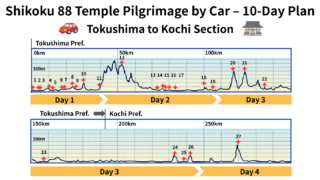
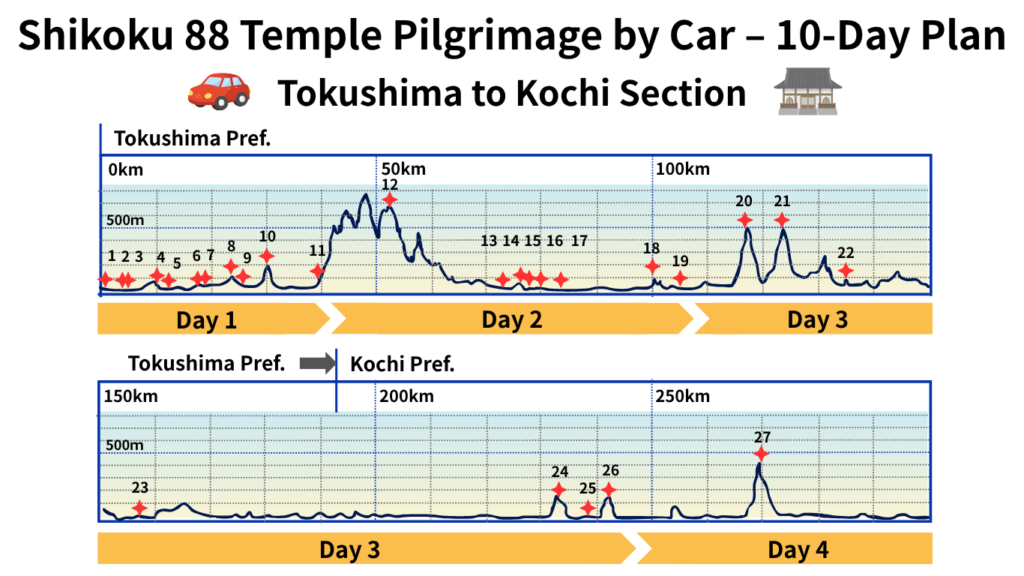
Tokushima Prefecture has temples numbered from the 1st to the 23rd temple, with a total travel distance of approximately 230 km. By car, it is possible to complete the pilgrimage efficiently in about 2–3 days.
One of the key features of Tokushima is that the temples are relatively close to each other and are grouped by area. This allows pilgrims to visit multiple temples in a single day, making it possible to progress smoothly depending on the plan.
A detailed 3-day route for touring Tokushima Prefecture and important points to keep in mind are explained in the article below.
Kochi Edition: 10-Day Pilgrimage by Car – Shikoku Ohenro Itinerary
- Day 4
- Day 5
Best Day 4 Schedule (Time Allocation)
- 7:00Breakfast & Departure
1 hr travel
- 8:00Temple 27: Konomineji
30 min worship + 1 hr travel
- 9:30Temple 28: Dainichiji
30 min worship + 20 min travel
- 10:20Temple 29: Kokubunji
30 min worship + 30 min travel
- 11:20Temple 30: Zenrakuji
30 min worship + 30 min travel
- 12:00Lunch
- 13:00Temple 31: Chikurinji
30 min worship + 20 min travel
- 13:50Temple 32: Zenjibuji
30 min worship + 30 min travel
- 14:50Temple 33: Sekkeiji
30 min worship + 20 min travel
- 15:40Temple 34: Tanemaji
30 min worship
- 16:10Finish
Best Day 5 Schedule (Time Allocation)
- 7:30Breakfast & Departure
30 min travel
- 8:00Temple 35: Kiyotakiji
30 min worship + 50 min travel
- 9:20Temple 36: Shoryuji
30 min worship + 1 hr 30 min travel
- 11:20Temple 37: Iwamotoji
30 min worship + 2 hr travel
- 12:00Lunch
- 13:50Temple 38: Kongofukuji
30 min worship + 1 hr 30 min travel
- 15:50Temple 39: Enkoji
30 min worship + 40 min travel
- 17:00Temple 40: Kanjizaiji
30 min worship
- 17:30Finish
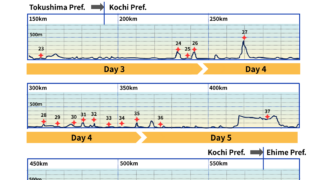
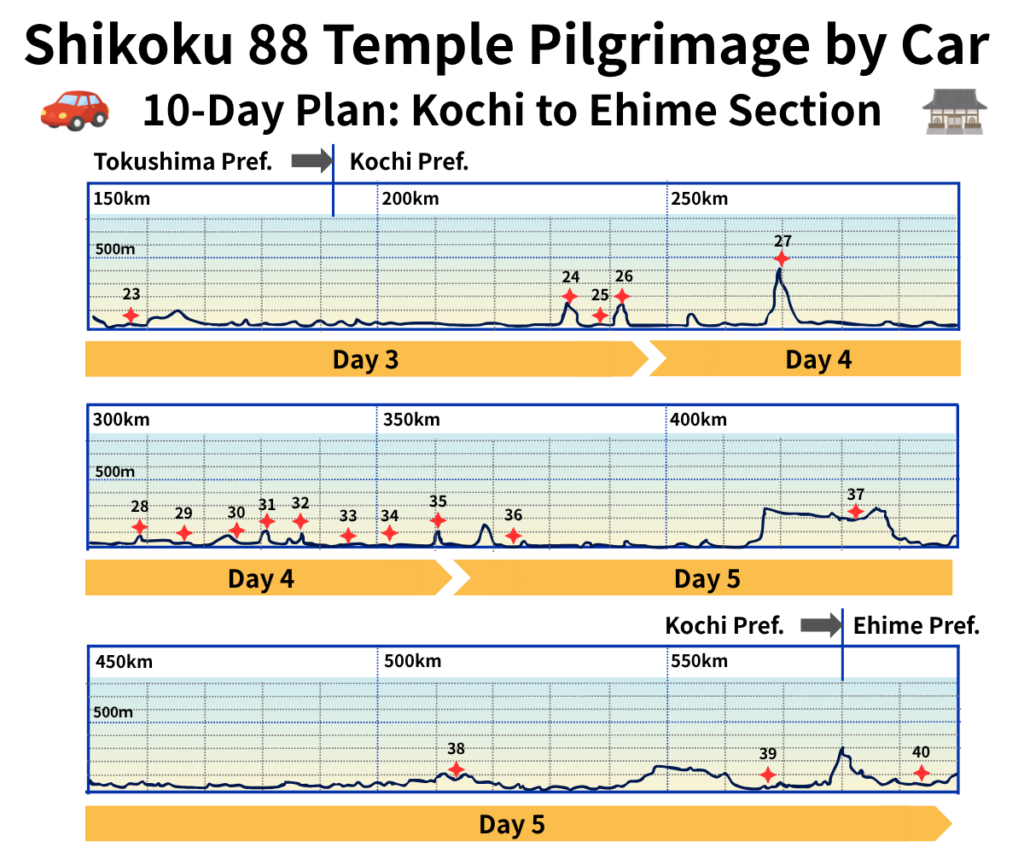
Kochi Prefecture includes temples No. 24 to No. 39, with a total travel distance of approximately 390 km. By car, it is possible to complete the pilgrimage efficiently in about 2–3 days.
However, Kochi is characterized by long distances between temples, with many sections requiring extended driving time. When planning, it is important to consider not only the time spent at each temple but also the travel time between them.
In particular, Temple No. 38, Kongōfuku-ji, is located at Cape Ashizuri, which requires a significant amount of travel time to reach. During peak seasons such as Golden Week and Obon, traffic restrictions may be implemented, and both roads and parking areas can become congested. As a result, increased visitor numbers may lead to longer waiting times for temple visits as well.
A detailed 3-day route for touring Kochi Prefecture and important points to keep in mind are explained in the article below.
Ehime Edition: 10-Day Pilgrimage by Car – Shikoku Ohenro Itinerary
- Day 6
- Day 7
- Day 8
Best Day 6 Schedule (Time Allocation)
- 7:30Breakfast & Departure
30 min travel
- 8:00Temple 41: Ryukoji
30 min worship + 10 min travel
- 8:40Temple 42: Butsumokuji
30 min worship + 30 min travel
- 9:40Temple 43: Meisekiji
30 min worship + 1 hr travel
- 12:00Lunch
- 12:10Temple 44: Daihoji
30 min worship + 20 min travel
- 13:00Temple 45: Iwayaji
30 min worship + 1 hr travel
- 14:30Temple 46: Joruriji
30 min worship + 5 min travel
- 15:05Temple 47: Yasakaji
30 min worship + 10 min travel
- 15:45Temple 48: Sairinji
30 min worship + 10 min travel
- 16:25Temple 49: Jodoji
30 min worship + 5 min travel
- 17:00Temple 50: Hantaji
30 min worship
- 17:30Finish
Best Day 7 Schedule (Time Allocation)
- 7:30Breakfast & Departure
30 min travel
- 8:00Temple 51: Ishiteji
30 min worship + 30 min travel
- 9:00Temple 52: Taisanji
30 min worship + 10 min travel
- 9:40Temple 53: Enmyoji
30 min worship + 1 hr travel
- 11:10Temple 54: Enmeiji
30 min worship + 15 min travel
- 11:55Temple 55: Nankobo
30 min worship + 15 min travel
- 12:30Lunch
- 13:00Temple 56: Taisanji
30 min worship + 10 min travel
- 13:40Temple 57: Eifukuji
30 min worship + 20 min travel
- 14:30Temple 58: Senyuji
30 min worship + 30 min travel
- 15:30Temple 59: Kokubunji
30 min worship
- 16:00Finish
Best Day 8 Schedule (Time Allocation)
- 7:00Breakfast & Departure
1 hr travel
- 8:00Temple 60: Yokomineji
30 min worship + 35 min travel
- 9:05Temple 61: Koenji
30 min worship + 5 min travel
- 9:40Temple 62: Hojyuji
30 min worship + 5 min travel
- 10:15Temple 63: Kichijoji
30 min worship + 10 min travel
- 10:55Temple 64: Maegamiji
30 min worship + 1 hr travel
- 12:00Lunch
- 13:00Temple 65: Sankakuji
30 min worship + 30 min travel
- 14:00Temple 66: Unpenji
30 min worship + 50 min travel
- 15:20Temple 67: Daikōji
30 min worship +20 min travel
- 16:10Temple 68: Jinnein & Temple 69: Kannonji
30 min worship + 10 min travel
- 16:50Temple 70: Motoyamaji
30 min worship
- 17:20Finish
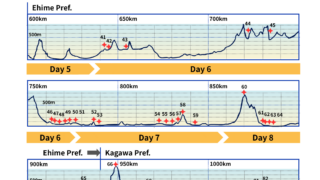
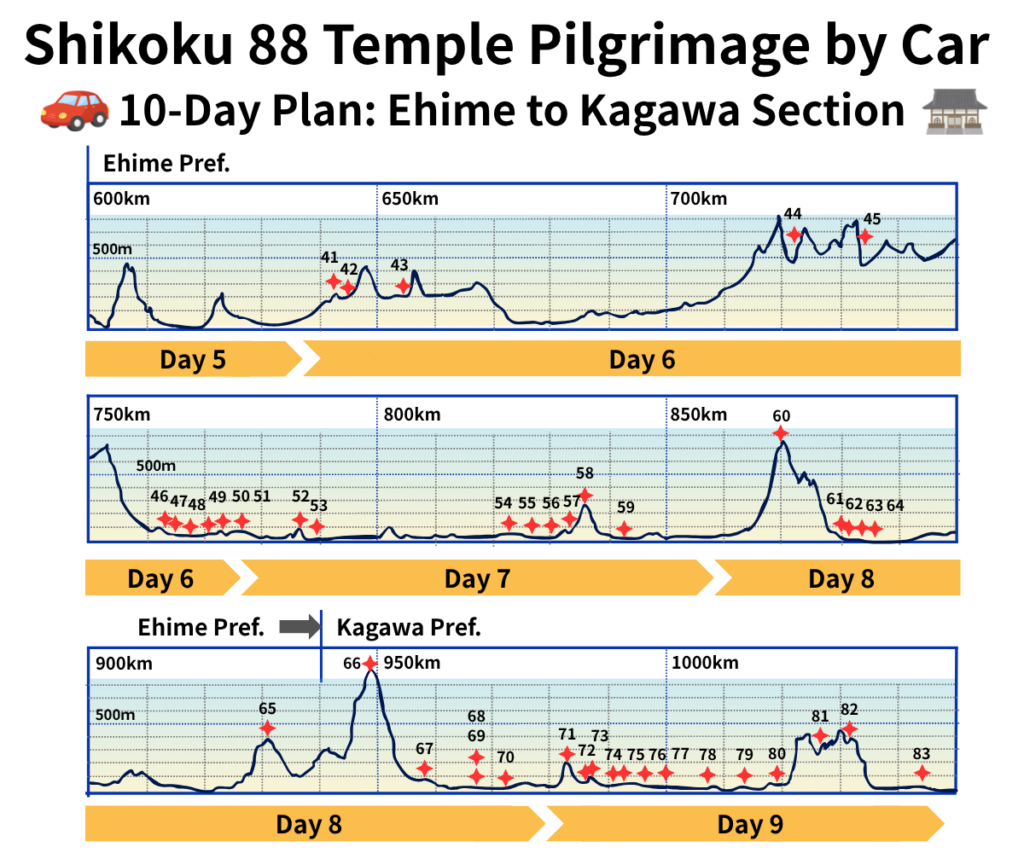
Ehime Prefecture includes temples No. 40 to No. 65, with a total travel distance of approximately 360 km. By car, it is possible to complete the pilgrimage efficiently in about 3–4 days.
Ehime is characterized by a mix of long-distance sections between temples and areas where multiple temples can be visited in close succession. By organizing daily routes effectively, it is possible to proceed in a smooth and efficient manner.
In particular, Temple No. 44, Dainichi-ji (Daibō-ji), and Temple No. 45, Iwaya-ji, are located in mountainous areas, so attention should be paid to weather conditions and road status when visiting.
For accommodation, the area around Matsuyama City is recommended. It offers a wide range of hotels and restaurants, making it a convenient base for travel during the pilgrimage.
A detailed 3-day route for touring Ehime Prefecture and important points to keep in mind are explained in the article below.
Kagawa Edition: 10-Day Pilgrimage by Car – Shikoku Ohenro Itinerary
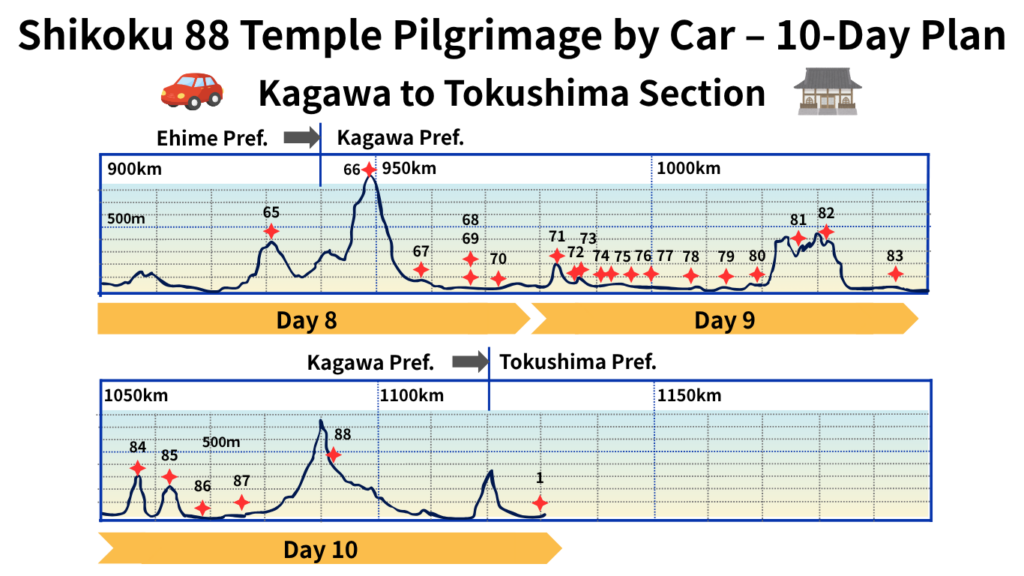
- Day 9
- Day 10
Best Day 9 Schedule (Time Allocation)
- 7:30Breakfast & Departure
30 min travel
- 8:00Temple 71: Iyadaniji
30 min worship + 10 min travel
- 8:40Temple 72: Mandaraji
30 min worship + 1 min travel
- 9:10Temple 73: Shusshakaji
30 min worship + 5 min travel
- 9:45Temple 74: Kōyama-ji
30 min worship + 5 min travel
- 10:20Temple 75: Zentsuji
30 min worship + 10 min travel
- 11:00Temple 76: Konkōji
30 min worship + 10 min travel
- 11:40Temple 77: Dōryūji
30 min worship + 15 min travel
- 12:10Lunch
- 12:30Temple 78: Gōshōji
30 min worship + 15 min travel
- 13:15Temple 79: Tennōji
30 min worship + 15 min travel
- 14:00Temple 80: Kokubunji
30 min worship + 30 min travel
- 15:00Temple 81: Shiromineji
30 min worship + 15 min travel
- 15:45Temple 82: Negoroji
30 min worship + 30 min travel
- 16:45Temple 83: Ichinomiyaji
30 min worship
- 17:15Finish
Best Day 10 Schedule (Time Allocation)
- 7:30Breakfast & Departure
30 min travel
- 8:00Temple 84: Yashimaji
30 min worship + 15 min travel
- 8:45Temple 85: Yakuriji
30 min worship + 15 min travel
- 9:30Temple 86: Shidoji
30 min worship + 15 min travel
- 10:15Temple 87: Nagaoji
30 min worship + 40 min travel
- 11:25Temple 88: Okuboji
30 min worship + 45 min travel
- 12:00Lunch
- 13:00Temple 1: Ryozenji
30 min worship
- 13:30Finish
Kagawa Prefecture includes temples No. 66 to No. 88, with a total travel distance of approximately 150 km. By car, it is possible to complete the pilgrimage efficiently in about 2–3 days.
Although the overall distance is relatively short, Kagawa is characterized by a high concentration of temples. This often results in schedules where multiple temples are visited in a single day, which can feel physically demanding, but it serves as the final stage toward completing the pilgrimage. Careful planning is important to maintain a steady pace.
In particular, Temple No. 75, Zentsū-ji, is known as the birthplace of Kūkai (Kōbō Daishi). It also offers temple lodging (shukubō), making it a highly recommended place to stay and a meaningful location to conclude the pilgrimage.
A detailed 3-day route for touring Kagawa Prefecture and important points to keep in mind are explained in the article below.
Shikoku Pilgrimage by Car: What You Should Know to Travel Efficiently
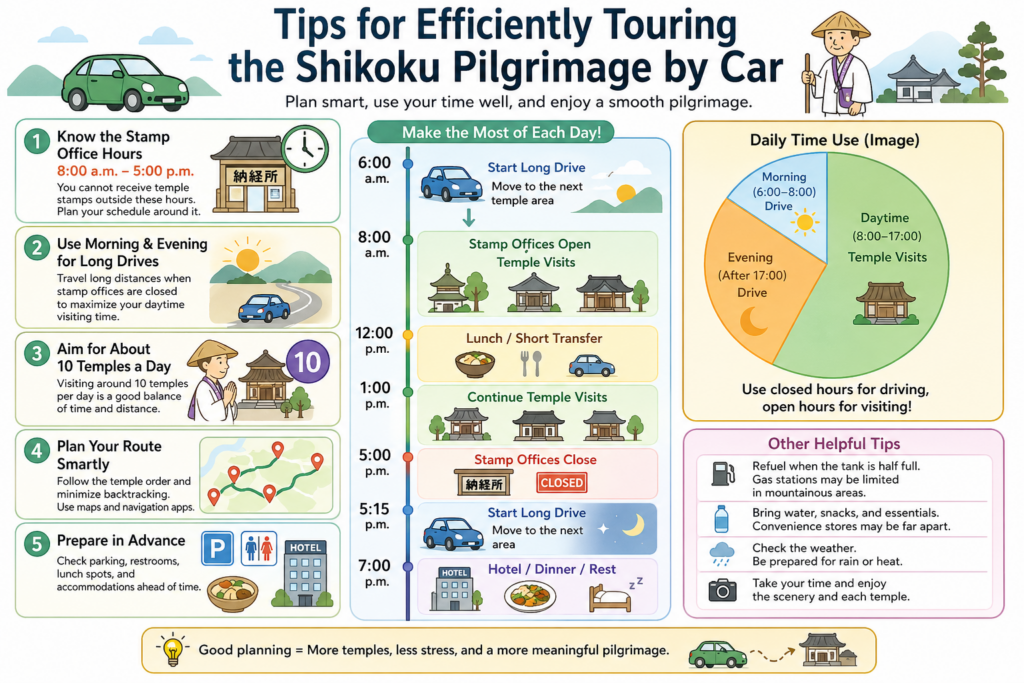
Stamp Office Hours Are Generally 8:00 a.m. to 5:00 p.m.
The temple stamp offices are usually open from 8:00 a.m. to 5:00 p.m., giving you about 9 hours each day. Outside these hours, you normally cannot receive temple stamps, so this should be your top priority when planning your schedule.
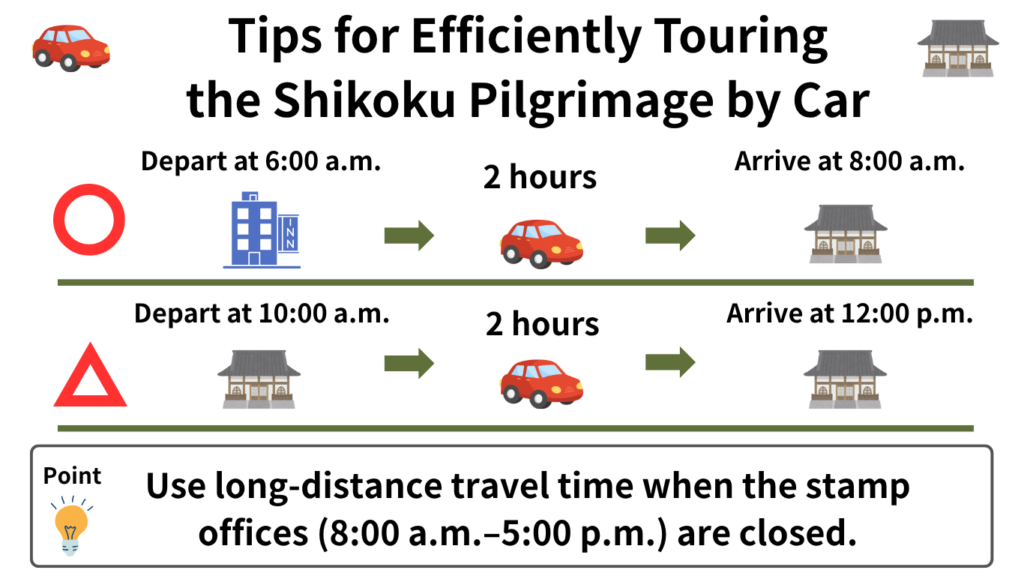
The key to traveling efficiently is to use the time when stamp offices are closed for long-distance driving between temple areas. By making smart use of the early morning and evening hours, you can maximize your daytime hours for temple visits.
Allow About 30 Minutes per Temple Visit
Each temple on the Shikoku 88 Temple Pilgrimage usually has both a Main Hall and a Daishi Hall, and it is customary to pay respects at both. If you plan to visit properly and without rushing, it is wise to allow around 30 minutes per temple.
With this in mind, when considering both driving time and visiting time, a realistic daily limit is around 10 temples per day at a comfortable pace.
For a full guide on how to worship at the temples, please see this article.
Temple Worship Method
Temples That Tend to Take More Time During a Car Pilgrimage
Even when traveling around the Shikoku 88 Temple Pilgrimage by car, not every temple can be visited at the same pace. Some temples require driving on mountain roads or walking from parking areas, which can take more time than expected.
If this is your first car pilgrimage, be especially careful with the following temples, as they can easily cause schedule delays.
Temples That Often Require Extra Time
Temple No. 12 – Shosanji Temple
The mountain road section is long and contains many curves, so driving can take longer than expected. If it is your first time driving the route, allowing extra time is recommended.
Temple No. 21 – Tairyuji Temple
The ropeway route is commonly used to reach this temple. Including waiting time and travel time, the overall visit may take longer than a typical temple stop.
Temple No. 44 – Daihoji Temple
Located in the Kuma Kogen mountain area, reaching this temple involves driving through mountainous terrain. During winter, road conditions may require additional caution.
Temple No. 45 – Iwayaji Temple
There is a walking section from the parking area to the Main Hall. Since the route includes many stone steps, visits here often take longer.
Temple No. 60 – Yokomineji Temple
This temple is known as one of the more challenging stops for car pilgrims. Access may involve using a dedicated road, and conditions can vary depending on the season and weather.
Temple No. 71 – Iyadaniji Temple
Visitors need to climb stone steps to reach the Main Hall.
On days that include these temples, avoid overloading your schedule with assumptions like, “We can probably fit in one or two more temples.”
If this is your first pilgrimage by car, a schedule with extra flexibility will allow you to travel more comfortably and with less stress.
Travel Times May Increase During Busy Seasons
During peak travel periods such as Golden Week (Late April to early May) and Obon (Mid-August), you may encounter group tour buses and larger crowds, which can lead to waiting times at temple stamp offices. It is best to allow extra time in your schedule and travel with flexibility.
Preparation: Essential Items Beginners Should Have
Before starting the pilgrimage, beginners should prepare at least the following basic items.
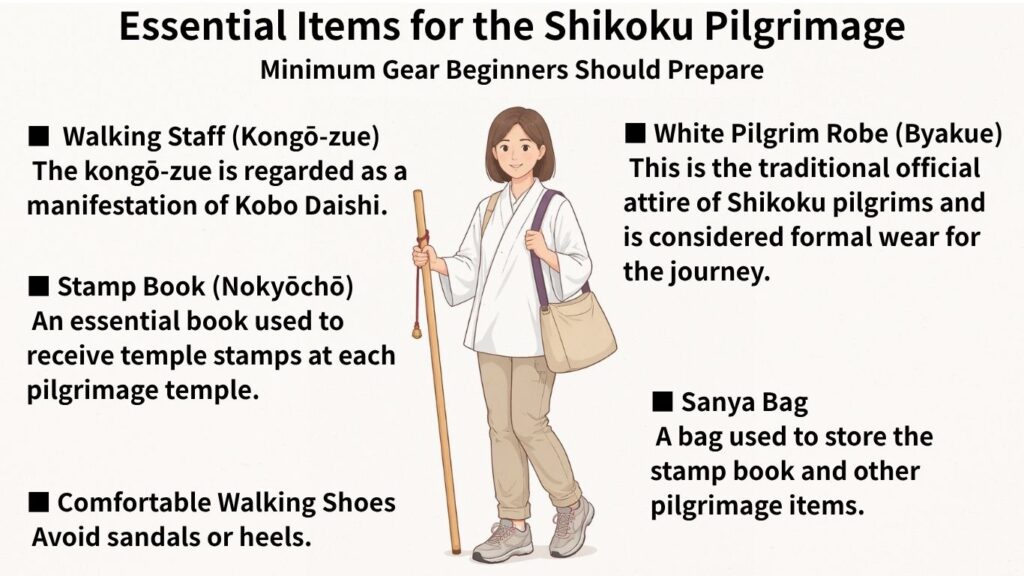
For more details, I’ve summarized everything in this article.
Guide for Beginners
Basically, you can purchase all the essential pilgrimage items at Ryōzenji Temple, the first temple of the pilgrimage route.
In addition, necessary supplies are also sold at other temples, so there is no need to buy everything in advance. You can simply purchase additional items as needed while continuing your journey.
Preparation for Rain
An umbrella is essential.
In particular, if you encounter heavy rain at mountain temples, your shoes may get completely soaked. It is reassuring to have spare socks and newspaper on hand to help dry your shoes.
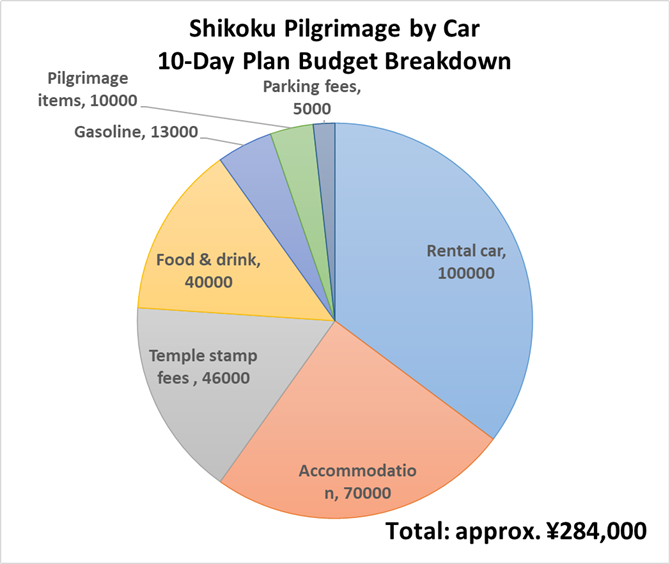
Budget (10-day estimate)
- Accommodation: approx. ¥70,000 (¥7,000 × 10 nights)
- Food & drink: approx. ¥40,000 (¥4,000 × 10 days)
- Temple stamp fees (nokyo): approx. ¥46,000 (¥500 × 88 temples + ¥2,000 for the stamp book)
- Pilgrimage items: approx. ¥10,000
- Gasoline: approx. ¥13,000 (approx. 1,200 km / 15 km per liter, assuming ¥160 per liter)
- Parking fees: approx. ¥5,000
- Rental car (10 days): approx. ¥100,000
Total: approx. ¥284,000
Note: Transportation costs to and from the area are not included.
Important Notes
Allow plenty of time for your schedule.
When your visit overlaps with groups of pilgrims, it may take longer than expected to complete temple visits and receive stamp calligraphy (nokyo).
Plans may not always go as scheduled, but it is important to stay flexible. Adopting a mindset such as “If I can’t finish today, I’ll continue tomorrow” helps ensure a safer and less stressful pilgrimage.
Be prepared for weather-related disruptions
Rain can make roads and temple grounds slippery and may also slow down travel times. Always be cautious and adjust your schedule when weather conditions change.
In winter, there is also a risk of snow and icy roads, especially in mountainous areas. Checking the weather forecast in advance and preparing appropriate equipment is essential for a safe journey.
Related Article
Shikoku Ohenro in the Rain: How Often It Rains, What to Expect, and What Gear You Need
FAQ (Frequently Asked Questions)
- QDo I have to visit the temples in order from No.1?
- A
No, it is not necessary to follow the strict order.
If you prioritize efficiency, it is possible to shorten the route by about 1–2 days through careful planning. Choose a route that best fits your schedule and mode of travel.
- QDo I have to complete the pilgrimage in one trip?
- A
No, it does not have to be completed in a single journey.
A complete one-time pilgrimage is called “tōshi-uchi” (through pilgrimage), while completing it in multiple trips is called “kugiri-uchi” (segment pilgrimage). Both are accepted ways of completing the Shikoku pilgrimage, so choose the method that suits your schedule and physical condition.
- QWhat is the best season for the pilgrimage?
- A
Spring and autumn are recommended due to mild weather, making travel more comfortable.
Winter requires caution, as mountain areas may experience snow and icy roads.
During peak holiday seasons such as Golden Week and Obon, congestion can occur, leading to longer travel and waiting times.
Typhoon season also requires attention, as Shikoku can be affected by heavy rain and strong winds. Always check the weather forecast in advance and plan accordingly.
- QCan people with weak legs still complete the pilgrimage?
- A
Yes, it is possible as long as you are able to manage daily activities.
Some temples include steep slopes or stairs, so using a walking stick and wearing comfortable walking shoes is recommended for safety and comfort.
- QIs it possible to stay overnight in a car?
- A
Yes, it is possible.
There are many roadside stations (michi-no-eki) throughout Shikoku, and some travelers use them for overnight stays while completing the pilgrimage.
- QShould I use expressways when doing the Shikoku 88 Temple Pilgrimage by car?
- A
They are not required, but using expressways for long-distance sections is more efficient. In particular, routes such as the Kochi–Ehime section involve long driving distances, so expressways can help reduce travel time.
- QDo I need ETC?
- A
It is not required, but it is highly recommended for convenience. Since you may use expressways frequently, ETC can save time at toll gates and make driving smoother.
- QCan I complete the pilgrimage with a kei car (small Japanese car)?
- A
Yes, a kei car is perfectly suitable for the pilgrimage. Since some roads are narrow or located in mountainous areas, a compact vehicle can actually be easier to drive in certain situations.
- QShould I book accommodations in advance?
- A
During normal periods, it may still be possible to find accommodations on the same day. However, advance reservations are recommended during busy travel seasons such as Golden Week, Obon holidays, and long weekends.
- QIs it possible to complete the 10-day pilgrimage using only car camping?
- A
Yes, it is possible. Some travelers complete the route while using roadside stations and other facilities. However, be sure to check each location’s rules and etiquette beforehand.
- QCan elderly people do the pilgrimage by car?
- A
Yes. Compared with walking pilgrimages, traveling by car places much less physical strain on the body, making it possible for older travelers as well. However, some temples have stairs and steep slopes.
- QDo I need winter tires during the winter season?
- A
Snow and icy road conditions can occur in mountainous areas. If you plan to travel during winter, checking road and weather conditions in advance is recommended.
Summary
A pilgrimage by car can be completed comfortably within 10 days, depending on how the schedule is planned.
The key points are as follows:
- Prioritize the opening hours of temple stamp offices (8:00–17:00)
- Schedule long-distance driving for early morning or evening
- Aim to visit around 10 temples per day
It is important to build a flexible itinerary and avoid overloading your schedule. Keeping a mindset such as “If I can’t finish today, I’ll continue tomorrow” will lead to a safer and more comfortable pilgrimage experience.
If you are planning to start the pilgrimage, please use this itinerary as a reference.
Related Article
This article provides a complete overview of the Shikoku 88 Temple pilgrimage routes, including distances, travel times, and temple lodging (shukubō).
Temple List and Full Route
Best Roadside Stations for the Shikoku Pilgrimage: Wi-Fi, Hot Springs & EV Support.
Best roadside stations for Shikoku pilgrims