
If you are planning to begin the Shikoku 88 Temple Pilgrimage, you may have questions such as: “Do I need prayer beads?”, “What kind should I buy?”, and “How do I use them at temples?”
Prayer beads, known as nenju in Japanese, are an important Buddhist item used during prayers and worship on the pilgrimage. However, the different types of beads and the proper ways to use them may be confusing for first-time pilgrims.
In this article, we explain what prayer beads are, the different types available, when they are used at temples, and the basics of how to hold and use them, making it easy for first-time pilgrims to understand.
- 1. What Are Prayer Beads?
- 2. Do You Need Prayer Beads for the Shikoku Pilgrimage?
- 3. What Are the Different Types of Prayer Beads?
- 4. Are There Rules for the Length and Number of Prayer Beads?
- 5. When Do You Use Prayer Beads at Temples?
- 6. How to Hold Prayer Beads
- 7. Where Can You Buy Prayer Beads?
- 8. Can You Do the Shikoku Pilgrimage Without Prayer Beads?
- Conclusion
- Related Articles
1. What Are Prayer Beads?
Prayer beads, known as nenju in Japanese, are Buddhist items used when praying to the Buddha or chanting sutras. They are also commonly called juzu.
Traditional prayer beads consist of many small beads strung together. In Buddhism, they are used during prayer and worship, and their design and use vary depending on the Buddhist sect.
On the Shikoku 88 Temple Pilgrimage, many pilgrims use prayer beads in the style associated with Shingon Buddhism. This is closely related to the pilgrimage’s connection with Kobo Daishi (Kukai), the Buddhist monk who founded Shingon Buddhism in Japan.
However, not all 88 temples belong to the Shingon sect. If you already have prayer beads associated with your own Buddhist tradition, you may be able to use them as well.
2. Do You Need Prayer Beads for the Shikoku Pilgrimage?
Prayer beads are an important item used during worship on the Shikoku Pilgrimage and are considered one of the traditional pilgrimage essentials.
However, this does not mean that first-time pilgrims must purchase every item before setting out.
People prepare for and undertake the pilgrimage in different ways, and some complete it without carrying prayer beads.
I personally completed the pilgrimage without using prayer beads.
So, if you are planning your own pilgrimage, there is no need to worry too much if you do not have a set of beads. However, if you would like to follow traditional Buddhist worship practices, bringing prayer beads is a good idea.
3. What Are the Different Types of Prayer Beads?
Prayer beads come in various shapes and styles. If you are buying your first set, it helps to understand the following main types.
Formal Prayer Beads (Honshiki Nenju)
Formal prayer beads are designed according to the traditions of a particular Buddhist sect.
They vary in the number of beads, the shape of the tassels, and their overall design. On the Shikoku Pilgrimage, prayer beads associated with Shingon Buddhism are commonly used.
If you are planning to buy prayer beads for your pilgrimage, look for products specifically described as being for the Shikoku 88 Temple Pilgrimage or for Shingon Buddhism.
Simplified Prayer Beads (Ryaku-shiki Nenju)
Simplified prayer beads have a relatively simple design and are generally easier to use regardless of Buddhist sect.
They are usually less elaborate than formal prayer beads, making them a convenient option for beginners.
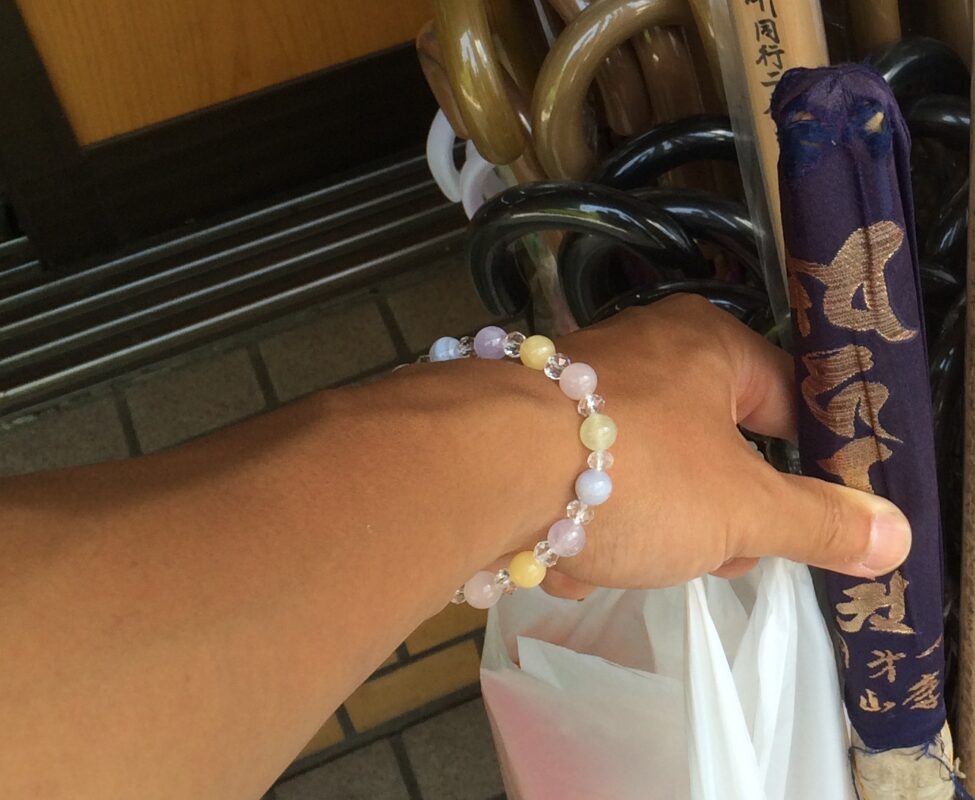
Bracelet-Style Prayer Beads
Some prayer beads are designed to be worn around the wrist like a bracelet.
They are compact and easy to carry, although some are sold primarily as accessories. Not every bracelet-style set is suitable as a substitute for traditional prayer beads, so check whether they are appropriate for Buddhist worship if you intend to use them during your pilgrimage.
The photo shows a bracelet-style set of prayer beads I received when visiting Mount Koya. It was a commemorative gift given as part of a special offering during the 1,200th anniversary celebrations of the founding of the Shikoku 88 Temple Pilgrimage.
4. Are There Rules for the Length and Number of Prayer Beads?
Prayer beads come in different sizes, including longer strands designed to be held over the hands and shorter versions that are easier to handle.
Traditional Buddhist prayer beads are often associated with a set of 108 beads. The number 108 comes from the Buddhist concept of 108 earthly desires or worldly passions.
Prayer beads are also available in a wide range of colors and materials, including wood and natural stones.
If this is your first pilgrimage, you do not need to worry too much about the color or material. Choose a set that feels comfortable in your hands, is easy to carry, and is suitable for use during worship.
5. When Do You Use Prayer Beads at Temples?
Prayer beads are mainly used when joining your hands in prayer or chanting sutras at a temple’s Main Hall (Hondo) or Daishi Hall (Daishido).
At the temples of the Shikoku 88 Temple Pilgrimage, pilgrims generally pay their respects at both halls.
Praying at the Main Hall
At the Main Hall, you pay your respects to the principal Buddha or Buddhist deity enshrined at the temple.
A typical order of worship is as follows:
- Offer candles and incense in the designated area in front of the Main Hall.
- Place your pilgrimage name slip (osamefuda) in the designated box.
- Make an offering of money.
- Hold your prayer beads, join your hands, and pay your respects.
- If you wish to chant sutras, recite them using a Buddhist sutra book.
Prayer beads are particularly used when joining your hands in prayer and chanting sutras. The specific rituals may vary depending on the Buddhist sect and the temple.
Praying at the Daishi Hall
At the Daishi Hall, pilgrims pay their respects to Kobo Daishi (Kukai).
The general procedure is similar to that at the Main Hall. You can hold your prayer beads while joining your hands in prayer and chant sutras if you wish.
Remember that on the Shikoku Pilgrimage, it is customary to visit both the Main Hall and the Daishi Hall at each temple.
6. How to Hold Prayer Beads
On the Shikoku Pilgrimage, a commonly recommended practice is to place the prayer beads over your left hand when joining your hands in prayer.
Here are a few basic points to keep in mind when using prayer beads:
- When joining your hands in prayer, place the beads over your left hand.
- When chanting sutras, hold the beads securely to avoid dropping them.
- When not in use, keep them carefully stored in a prayer bead pouch or similar case.
- Avoid wearing prayer beads around your neck.
With prayer beads used in Shingon Buddhism, some traditions involve placing the beads over both hands or rubbing them together while chanting sutras. However, specific practices can vary, so it is best to follow the instructions provided with your prayer beads or the guidance given by the temple.
If you are unsure how to hold your prayer beads, you can observe other pilgrims or ask someone at the temple for guidance.
7. Where Can You Buy Prayer Beads?
Prayer beads are available at Buddhist supply stores, shops specializing in pilgrimage items, and online retailers.
If you want to purchase items specifically for the Shikoku Pilgrimage, you can also look for pilgrimage supply shops or visit Ryozenji Temple, the first temple of the Shikoku 88 Temple Pilgrimage.
Before buying prayer beads, consider the following:
- Whether they are suitable for the Shikoku 88 Temple Pilgrimage
- Whether they are designed for Shingon Buddhism
- Whether the length feels comfortable in your hands
- Whether you need a pouch to carry and protect them
If you already own prayer beads associated with your Buddhist tradition, check whether you can use them before purchasing a new set.
8. Can You Do the Shikoku Pilgrimage Without Prayer Beads?
Carrying prayer beads is part of the traditional way of worshipping on the Shikoku Pilgrimage. However, some first-time pilgrims visit the temples without purchasing every traditional pilgrimage item.
I personally completed the pilgrimage without using prayer beads.
Based on my experience, I would encourage future pilgrims not to become too focused on acquiring every item before they begin.
You may choose to carry prayer beads and learn the traditional Buddhist rituals as you travel. Alternatively, you can start by simply standing quietly and joining your hands in prayer at each temple.
What matters most is showing respect when visiting each temple, following its rules, and being considerate of other visitors.
Conclusion
Prayer beads are Buddhist items used when joining your hands in prayer and chanting sutras during the Shikoku 88 Temple Pilgrimage. Beads associated with Shingon Buddhism are commonly used, but their design and use vary depending on the Buddhist tradition and the type of beads.
If you plan to buy prayer beads, choose a set suitable for the Shikoku Pilgrimage and learn the basics of how to hold them.
However, not having prayer beads should not stop you from beginning your pilgrimage. Prepare in a way that suits you, and enjoy visiting the 88 sacred temples of Shikoku.
Related Articles
I have compiled a detailed guide to the Shikoku Pilgrimage for beginners.
What is the Shikoku Pilgrimage? Beginner’s Guide to Your First Sacred Journey in Japan
How to Worship at Japanese Temples : Shikoku Pilgrimage Guide.
Temple Worship Method


Comments