
- Which Sections of the Shikoku Pilgrimage Are Truly the Toughest?
- Data and Methodology
- Three Types of Pilgrimage Sections Identified by K-means Analysis
- Top 3 Mountain Sections by the Numbers
- An Unexpected Insight from the Data
- Planning a More Efficient Pilgrimage Based on the Findings
- Conclusion
- Related Articles
Which Sections of the Shikoku Pilgrimage Are Truly the Toughest?
An Analysis Based on Distance and Elevation Data
Hello, I’m Taka, the author of this blog.
I have completed the Shikoku 88-Temple Pilgrimage twice on foot, both in the traditional clockwise direction and in reverse.
When talking with fellow pilgrims, I often hear comments such as:
- “The climb to Temple 12, Shosanji, is the toughest.”
- “The section around Cape Muroto is exhausting because of its length.”
- “Paved roads can be more tiring than mountain trails.”
However, most of these opinions are based on personal experience, and there are few objective criteria for evaluating the difficulty of each section.
To address this, I collected data for every segment between temples on the Shikoku pilgrimage, focusing on:
- The distance to the next temple
- The total elevation gain within the segment
Using these data points, I applied K-means clustering, a machine-learning technique, to analyze the route objectively.
In this article, I classify the pilgrimage sections by difficulty based on the two measurable indicators—distance and elevation gain—and explore the question:
Which sections of the Shikoku Pilgrimage are truly the most challenging?
Let’s find out what the data reveals.
Article Summary
- The 88 sections of the Shikoku Pilgrimage can be classified into three categories: Standard Sections, Mountain Sections, and Long-Distance Sections.
- The routes leading to Shosanji Temple, Tairyuji Temple, and Okuboji Temple were identified as particularly demanding mountain sections with steep elevation gain.
- Many of the most challenging long-distance sections were concentrated around Cape Muroto and Cape Ashizuri.
- Approximately 77% of the entire pilgrimage route consists of standard sections, indicating that most stages are of moderate difficulty.
Data and Methodology
For this analysis, I examined each section of the Shikoku 88-Temple Pilgrimage, measuring the route from one temple to the next using the following two indicators:
- Travel distance (km)
- Total elevation gain (m)
The data were collected using Google Maps and cover all 88 pilgrimage sections.
To analyze the data, I used K-means clustering, a machine-learning technique that automatically groups data points with similar characteristics.
In this study, each section was classified based on its distance and elevation gain, allowing sections with similar physical demands to be grouped together and compared objectively.
Three Types of Pilgrimage Sections Identified by K-means Analysis
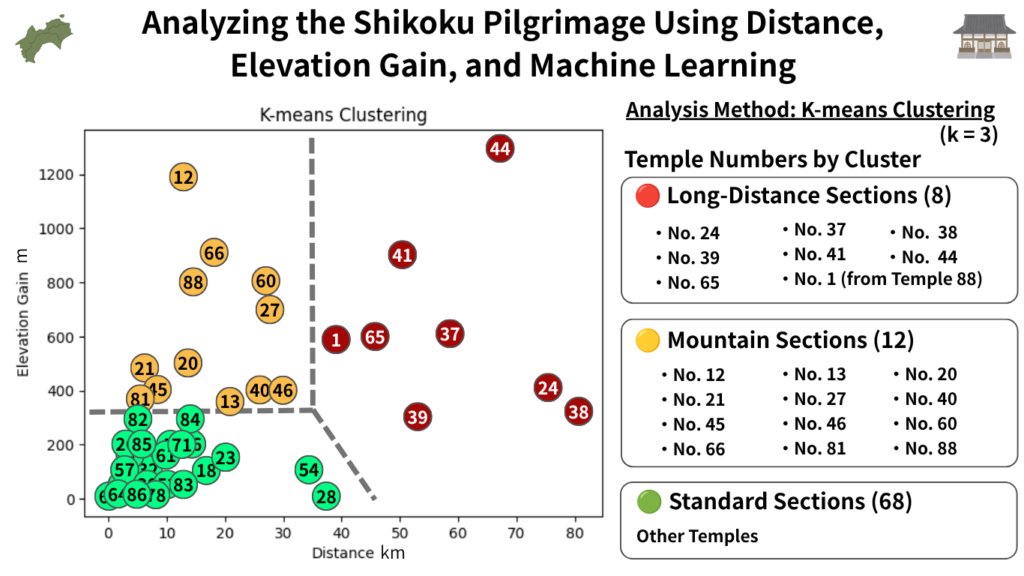
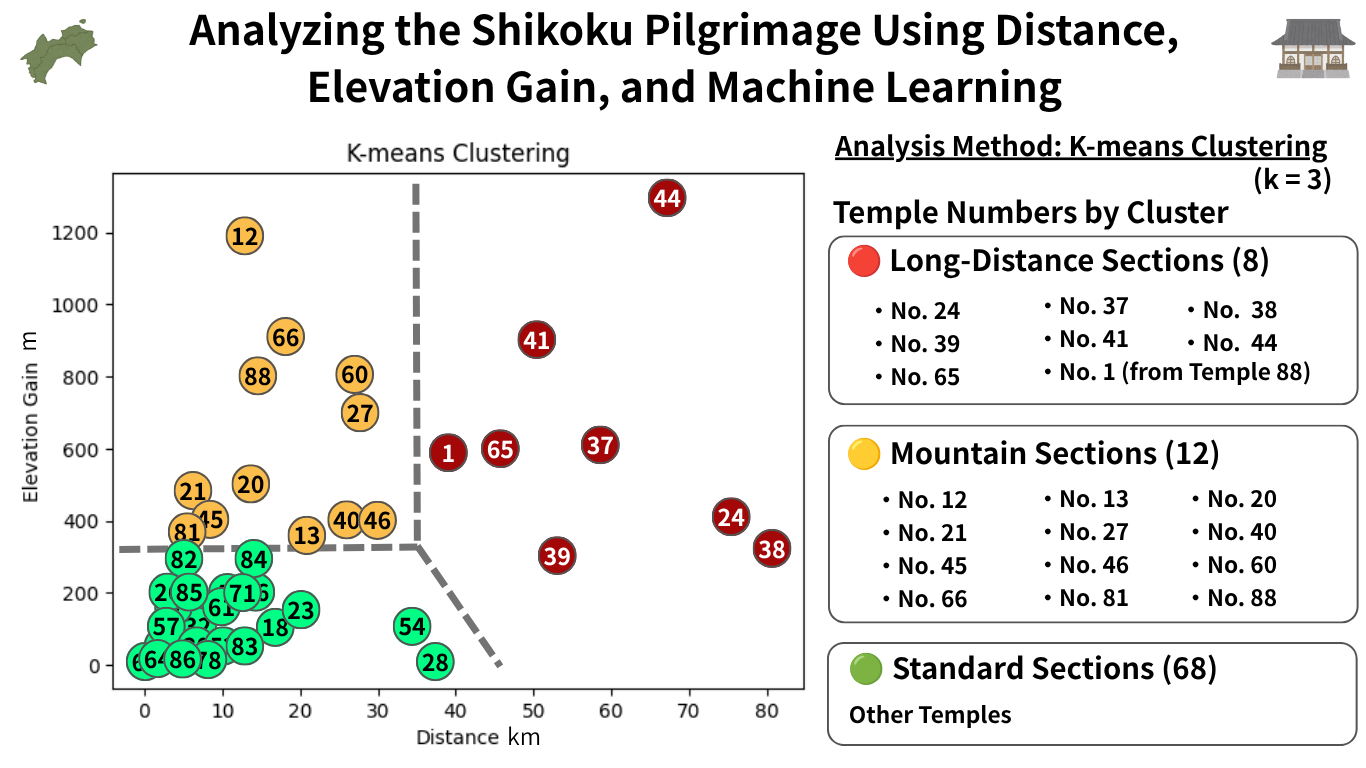
Using distance and elevation gain data, I applied K-means clustering to the 88 sections of the Shikoku Pilgrimage. The analysis revealed that the route can be divided into three distinct groups.
Interestingly, the sections were not simply categorized as “easy,” “moderate,” and “difficult.” Instead, they formed three groups with different characteristics:
- Standard Sections
- Mountain Sections
- Long-Distance Sections
The characteristics of each group are summarized in the table below.
| Metric | Standard Sections | Mountain Sections | Long-Distance Sections |
|---|---|---|---|
| Number of Sections | 68 | 12 | 8 |
| Average Distance | 6.4 km | 17.6 km | 58.6 km |
| Distance Range | 0–38 km | 6–28 km | 40–80 km |
| Average Elevation Gain | 61 m | 620 m | 625 m |
| Elevation Gain per Kilometer | 9.5 m/km | 35.2 m/km | 10.7 m/km |
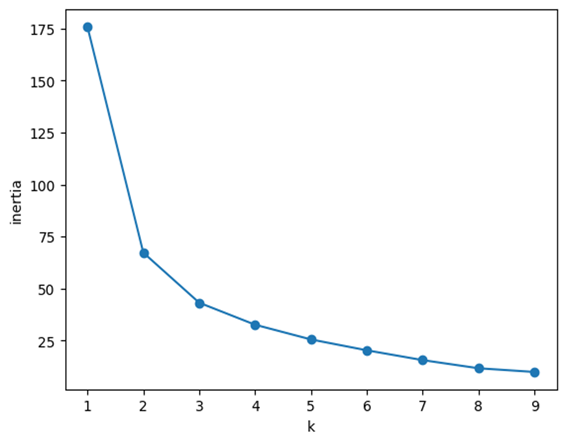
Although this study classifies the pilgrimage route into three clusters, the validity of this classification was verified using the Elbow Method, a common technique for determining the optimal number of clusters in K-means analysis.
A detailed explanation of the methodology and validation process is provided in a separate article.
🟢 Characteristics of Standard Sections
- Average distance: Approximately 6.4 km
- Number of sections: 68
- Share of total route: About 77%
These sections are characterized by relatively short distances and modest elevation gain. The majority of the Shikoku Pilgrimage falls into this category.
They can be considered the typical temple-to-temple walking sections that most pilgrims encounter throughout the journey.
🟡 Characteristics of Mountain Sections
- Average distance: Approximately 17.6 km
- Number of sections: 12
- Share of total route: About 14%
While these sections are not exceptionally long, they involve substantial elevation gain.
As a result, they tend to be more physically demanding than their distance alone would suggest. These are the sections where pilgrims experience the classic challenges of the Shikoku route, with steep climbs and sustained uphill walking contributing significantly to fatigue.
・No. 12 Shosanji
・No. 20 Kakurinji
・No. 27 Konomineji
・No. 45 Iwayaji
・No. 60 Yokomineji
・No. 81 Shiromineji
・No. 13 Dainichiji
・No. 21 Tairyuji
・No. 40 Kanjizaiji
・No. 46 Joruriji
・No. 66 Unpenji
・No. 88 Okuboji
🔴 Characteristics of Long-Distance Sections
- Average distance: Approximately 58.6 km
- Number of sections: 8
- Share of total route: About 9%
These sections are characterized by exceptionally long distances, often combined with a moderate amount of elevation gain.
For most walking pilgrims, completing these sections in a single day is difficult or impractical. As a result, they require careful planning and are among the most important sections to consider when designing a pilgrimage itinerary.
・No. 24 Hotsumisakiji
・No. 38 Kongofukuji
・No. 41 Ryukoji
・No. 65 Sankakuji
・No. 37 Iwamotoji
・No. 39 Enkoji
・No. 44 Daihoji
・No. 1 Ryozenji (from Temple 88)
Top 3 Mountain Sections by the Numbers
In this analysis, 12 sections were classified as Mountain Sections based on their distance and total elevation gain.
To identify the most demanding climbs, I focused on elevation gain per kilometer—referred to here as the average gradient—which serves as an indicator of how steep and physically challenging a section is.
The following are the three highest-ranked mountain sections based on this metric.
1st Place: Shosanji (Temple 11 → Temple 12)
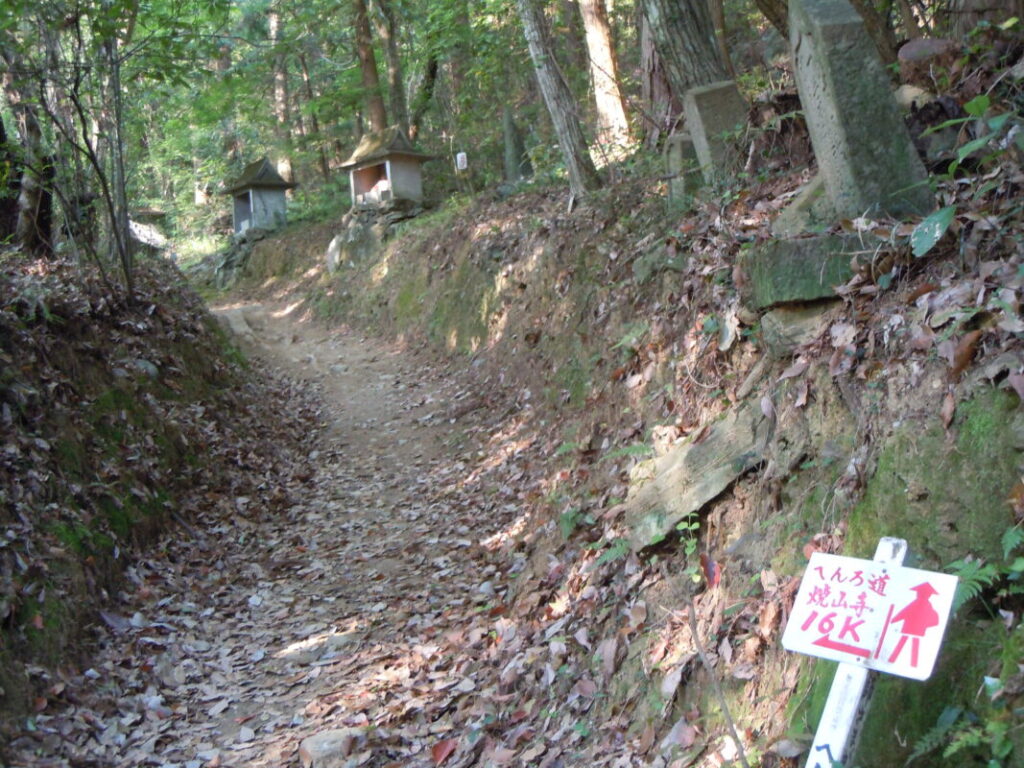
Average Gradient: 93 m/km
The steepest mountain section identified in the analysis was the route to Shosanji Temple.
Although the distance itself is not exceptionally long, pilgrims must overcome a significant elevation gain within a relatively short span. As a result, it is widely regarded as the most challenging section in the early stages of the pilgrimage.
Its reputation as one of the classic “Henro Korogashi” (“Pilgrim Killers”) is strongly supported by the data.
2nd Place: Tairyuji (Temple 20 → Temple 21)
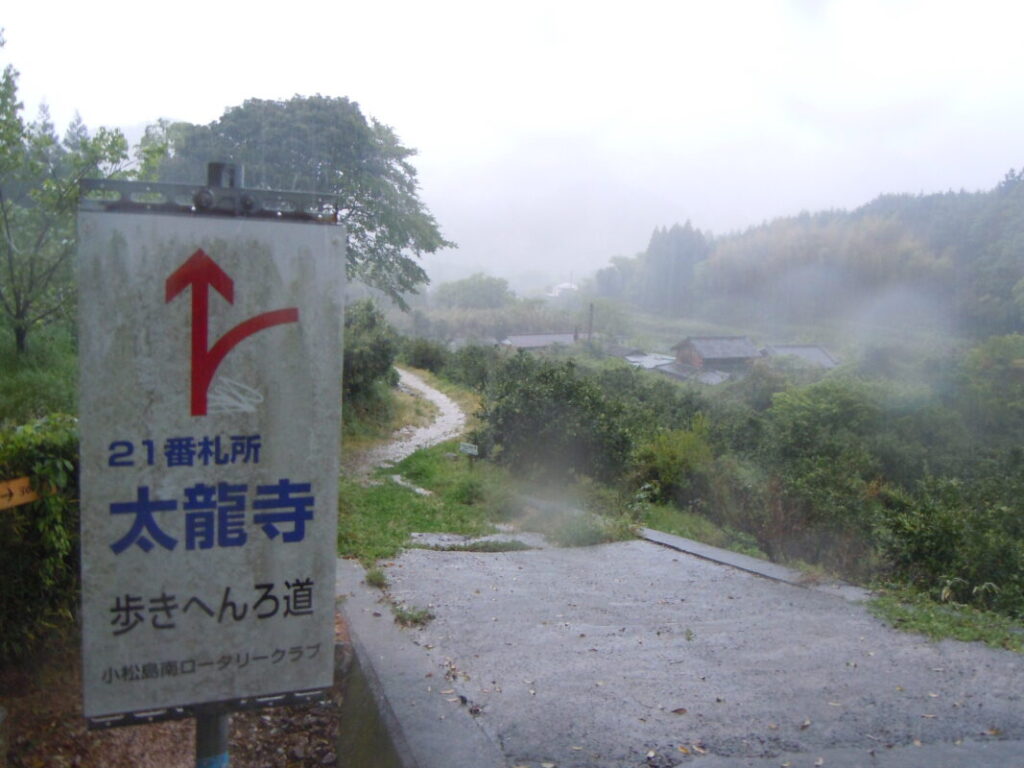
Average Gradient: 75 m/km
The route to Tairyuji Temple ranked second.
Long recognized as one of the pilgrimage’s major challenges, Tairyuji is often referred to as the “Koya-san of the West.” The climb is steep and physically demanding, making the section feel much harder than its distance alone would suggest.
3rd Place: Unpenji (Temple 65 → Temple 66)
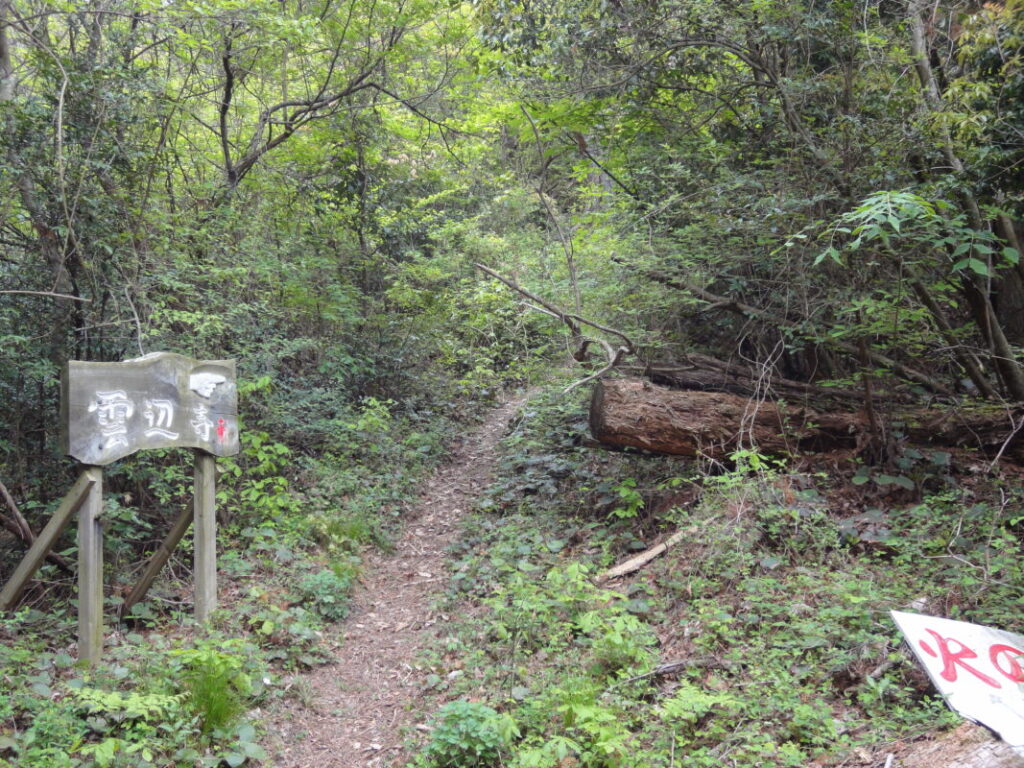
Average Gradient: 50 m/km
In third place is Unpenji, located at an elevation of 900 meters and known as the highest temple among the 88 pilgrimage sites. Since the route beyond Temple No. 65, Sankakuji, continues through mountain roads, it is important to prepare in advance in the urban area of Shikokuchuo at the foot of the mountain.
Extra: Okuboji (Temple 87 → Temple 88)
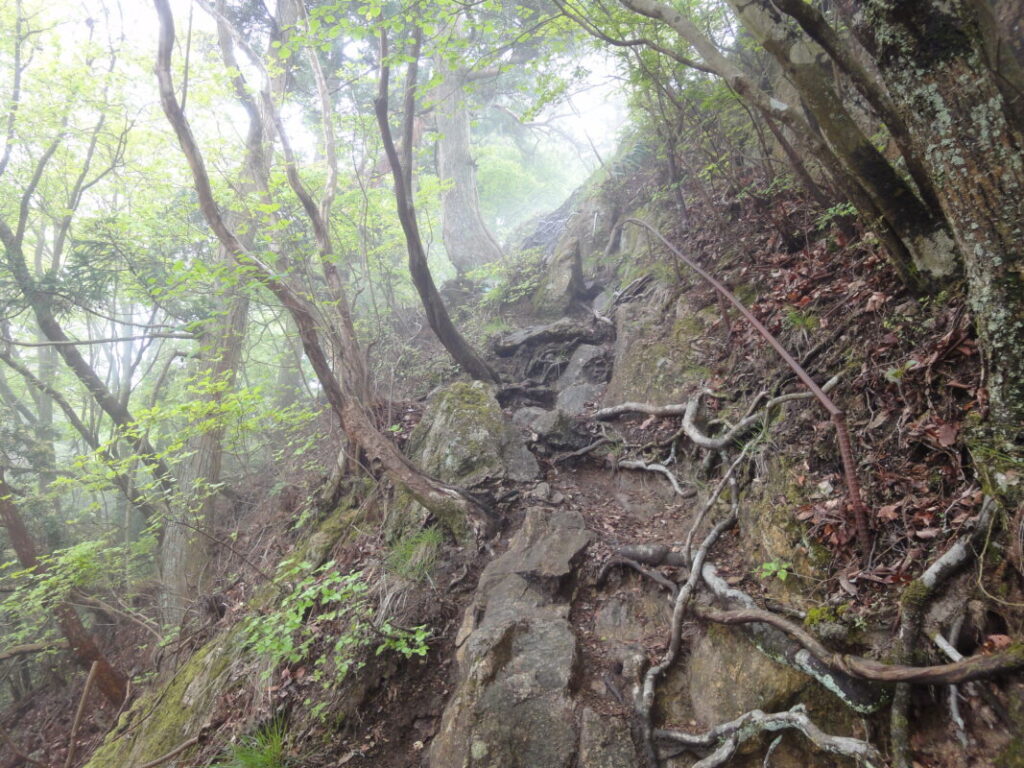
Average Gradient: 53 m/km
If you choose the traditional route, the road leading to Okuboji is also considered one of the more challenging mountain sections due to its steep and demanding terrain. However, since there is also a paved route available, I decided to rewrite it as a special mention this time.
Although it marks the completion of the journey, reaching Okuboji is far from easy. Pilgrims must tackle a substantial climb while already carrying the accumulated fatigue of the preceding stages. The data confirm that this section remains one of the most physically demanding on the entire route.
What the Top-Ranked Sections Have in Common
One interesting finding is that many of the highest-ranked sections have long been recognized by walking pilgrims as particularly difficult.
The rankings continue with Unpenji Temple in fourth place (50 m/km) and Iwayaji Temple in fifth place (48 m/km), both of which are also well known among experienced pilgrims for their challenging ascents.
This analysis relied solely on objective measures—distance and elevation gain—yet the results closely match the experiences and perceptions of many pilgrims. In other words, the sections traditionally regarded as the toughest are, in fact, supported by the data.
An Unexpected Insight from the Data
The Toughest Sections Make Up Less Than a Quarter of the Route
One of the most interesting findings from this analysis is that truly demanding sections are less common than many people might expect.
Of the 88 pilgrimage sections, approximately 77% were classified as Standard Sections.
In contrast:
- Mountain Sections: 14%
- Long-Distance Sections: 9%
In other words, the Shikoku Pilgrimage is not a continuous series of grueling challenges. Most of the route consists of relatively manageable sections, while a limited number of mountain and long-distance segments account for much of the pilgrimage’s reputation for difficulty.
This suggests that the overall challenge of the pilgrimage is shaped not by constant hardship, but by several particularly demanding sections that stand out from an otherwise moderate route.
Two Distinct Types of Difficulty Revealed by the Data
One of the most interesting findings of this analysis is that challenging sections do not all share the same characteristics.
The average elevation gain of the Mountain Sections was 620 m, while the Long-Distance Sections averaged 625 m—almost identical values. However, their average distances were dramatically different: 17.6 km for Mountain Sections versus 58.6 km for Long-Distance Sections.
This suggests that the difficulty of the Shikoku Pilgrimage can be broadly divided into two distinct types.
1. The Mountain Type
Represented by sections leading to Shosanji Temple and Tairyuji Temple, this type is characterized by steep ascents.
Even when the distance is relatively short, the continuous climbing places a significant physical demand on pilgrims and can quickly lead to fatigue.
2. The Long-Distance Type
Found in areas around Cape Muroto and Cape Ashizuri, this type is defined by extended walking distances.
Although elevation changes are generally less severe, pilgrims must keep walking for many hours, creating a different challenge involving endurance, leg fatigue, and time management.
Not All “Difficult Sections” Are Difficult for the Same Reason
The term “challenging pilgrimage section” is often used as a catch-all description. However, the data show that the sources of difficulty vary considerably.
The hardship of climbing steep mountain paths is fundamentally different from the challenge of covering extremely long distances. Each requires a different strategy, preparation, and pacing approach. Understanding this distinction can help pilgrims plan more effectively and better prepare for the specific demands of each section.
Planning a More Efficient Pilgrimage Based on the Findings
This analysis found that approximately 77% of the 88 pilgrimage sections fall into the Standard Section category, while Long-Distance Sections account for only about 9% of the route.
Based on these findings, one practical approach for walking pilgrims may be to use public transportation only for the long-distance sections while walking the rest of the route.
Long-distance sections require significantly more travel time because of the large distances between temples. In contrast, most standard sections are relatively short and can be completed comfortably on foot.
As a result, this hybrid approach may be particularly suitable for pilgrims who:
- Want to experience the atmosphere of the pilgrimage route as much as possible
- Do not have enough time to complete the entire pilgrimage on foot
- Wish to reduce the number of overnight stays and overall travel expenses
For these pilgrims, using public transportation on the long-distance sections while walking the remaining stages can provide a good balance between authentic pilgrimage experience and practical efficiency. It allows them to enjoy much of the traditional walking route without the substantial time commitment required for a fully walking pilgrimage.
Conclusion
This analysis revealed several key insights about the Shikoku Pilgrimage:
- The 88 pilgrimage sections can be classified into three categories: Standard Sections, Mountain Sections, and Long-Distance Sections.
- Approximately 77% of all sections belong to the Standard Section category.
- Mountain Sections and Long-Distance Sections represent two distinct types of difficulty, each posing different challenges to pilgrims.
- The physical demands of the pilgrimage are not evenly distributed; instead, much of the difficulty is concentrated in a relatively small number of sections.
- Identifying the Long-Distance Sections in advance can help pilgrims create a more efficient and realistic pilgrimage plan.
Overall, the analysis shows that the reputation of the Shikoku Pilgrimage as a demanding journey is shaped less by the route as a whole and more by a limited number of particularly challenging sections. Understanding where these sections are located can help pilgrims better prepare for the journey and tailor their itinerary to their available time, fitness level, and travel goals.
Determining the Number of Clusters (Elbow Method)
To determine the appropriate number of clusters for the analysis, I evaluated the results using the Elbow Method.
The Elbow Method examines how the within-cluster variance decreases as the number of clusters (k) increases. The optimal number of clusters is typically identified at the point where further increases in k produce only marginal improvements.
As shown in the elbow plot, the rate of improvement begins to level off at k = 3, indicating that adding more clusters provides limited additional explanatory value.
Therefore, three clusters were selected as the most appropriate classification, leading to the identification of the following section types:
- Standard Sections
- Mountain Sections
- Long-Distance Sections
The elbow plot supporting this decision is shown below.
Related Articles
This article provides a complete list of the Shikoku 88 Temple pilgrimage route, including distances, travel times, and temple lodging (shukubo).
Temple List and Full Route

Comments
I’m not sure if the route you chose for analysis for the section from Temple 87 Nagaoji to Temple 88 Okuboji should have been included. Is that actually the most used route between those two temples? I’ve walked all three routes between those temples and my impression is that it is less used than the route that follows the road.
Thank you for your comment. For the route to Temple 88, I chose it because it is considered the most traditional route. However, as you pointed out, if the analysis is intended to reflect the experience of the majority of pilgrims, it may have been more appropriate to use the route that is most commonly taken in practice. I’ll consider revising the article in the future. Thank you again for your valuable feedback.