
- How Much Does the Shikoku Pilgrimage Cost?
- Breakdown of Shikoku Pilgrimage Costs
- Walking Pilgrimage Costs
- Cycling Pilgrimage Costs
- Car Pilgrimage Costs
- Cost of a Public Transportation Pilgrimage
- Accommodation-Based Cost Comparison
- Temple Stamp (Nokyo) Fees
- How to Reduce Shikoku Pilgrimage Costs
- Shikoku Pilgrimage Cost Simulator
- Frequently Asked Questions About Shikoku Pilgrimage Costs
- Summary
- Related Articles
How Much Does the Shikoku Pilgrimage Cost?
One of the most common questions people ask is, “How much does it cost to complete the Shikoku Pilgrimage?”
The answer varies greatly depending on your pilgrimage style.
The Shikoku 88 Temple Pilgrimage covers more than 1,200 km (750 miles) in total. Your transportation method—whether walking, cycling, driving, or using public transportation—has a significant impact on both the time required and the overall cost.
Accommodation choices also affect your budget. Staying primarily in guesthouses or minshuku, using business hotels, or taking advantage of free lodging options and camping can lead to very different expenses.
For this reason, it is impossible to give a single answer such as “the pilgrimage costs X yen.”
If you would like to estimate your own budget right away, try the Shikoku Pilgrimage Cost Calculator in this article. It allows you to quickly estimate expenses for walking, cycling, or driving pilgrimages.
First, let’s look at the typical cost ranges for each pilgrimage style.
Quick Cost Guide for the Shikoku Pilgrimage
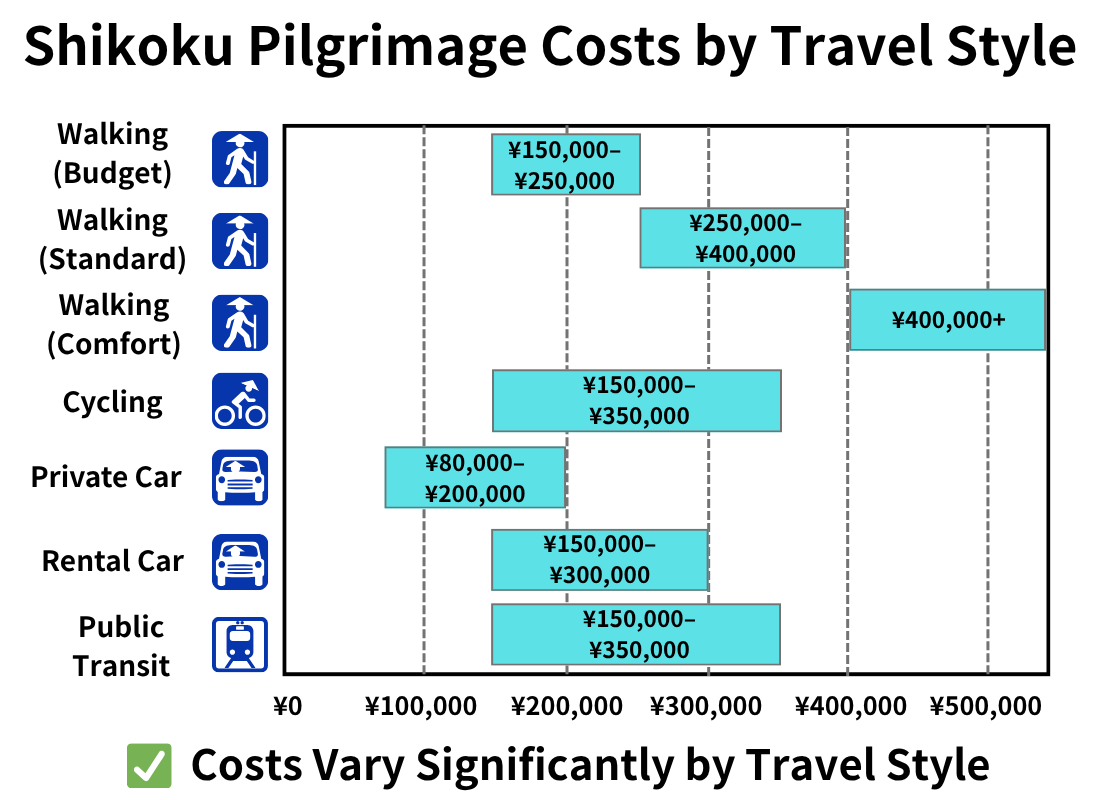
| Pilgrimage Style | Estimated Duration | Estimated Cost |
|---|---|---|
| Walking (Budget) | 40–50 days | ¥150,000–¥250,000 |
| Walking (Standard) | 40–50 days | ¥250,000–¥400,000 |
| Walking (Comfort) | 40–50 days | ¥400,000+ |
| Cycling | 15–30 days | ¥150,000–¥350,000 |
| Private Car | 10–14 days | ¥80,000–¥200,000 |
| Rental Car | 10–14 days | ¥150,000–¥300,000 |
| Public Transportation | 15–30 days | ¥150,000–¥350,000 |
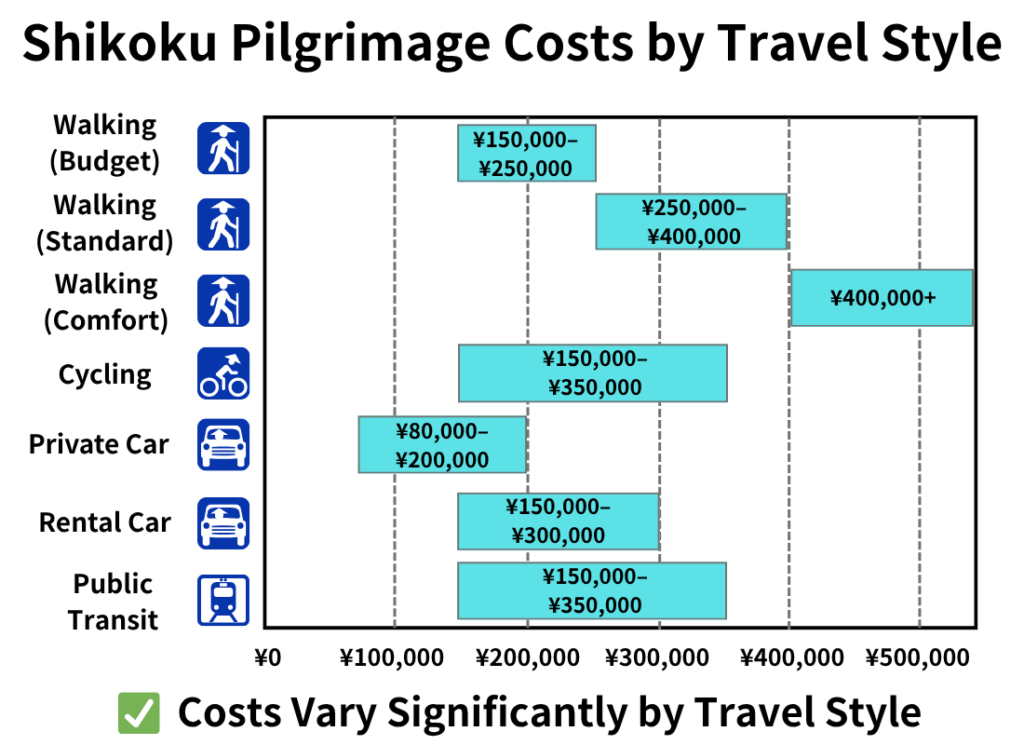
These figures are only rough estimates, but in general, traveling by private car tends to be the most cost-effective option. In contrast, walking pilgrims usually face higher overall expenses because of the greater number of nights spent on the road.
However, even a walking pilgrimage can be completed on a relatively small budget by making use of free accommodation, temple lodgings, kindness from local residents (osettai), and camping where appropriate.
On the other hand, a car pilgrimage can become quite expensive if you stay in hotels every night and frequently use expressways. As a result, the total cost of the pilgrimage depends as much on your travel style and accommodation choices as on your mode of transportation.
Transportation Method and Length of Stay Have the Biggest Impact on Cost
Many factors influence the total cost of the Shikoku Pilgrimage, but the two most important are:
1. Transportation Method
Even though all pilgrims visit the same 88 temples, the time required and transportation expenses vary significantly depending on how they travel.
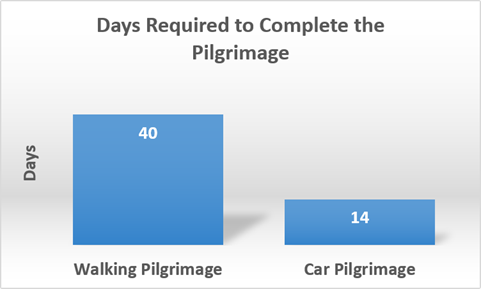
For example, a walking pilgrimage typically takes 40 days or more, while a car pilgrimage can often be completed in about two weeks.
Walking pilgrims spend very little on transportation, but they usually need many more nights of accommodation.
By contrast, car pilgrims can reduce the number of overnight stays, but they must pay for expenses such as fuel, expressway tolls, and, in some cases, rental car fees.
In simple terms:
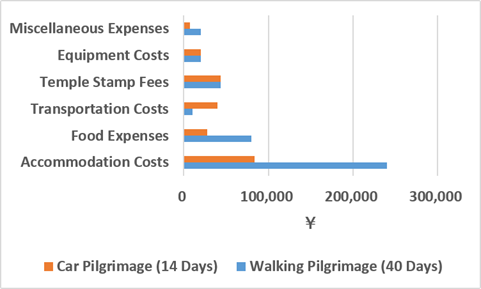
- Walking Pilgrimage: Lower transportation costs, higher accommodation costs
- Car Pilgrimage: Lower accommodation costs, higher transportation costs
This trade-off is one of the main factors that determines the overall budget for the pilgrimage.
2. Number of Overnight Stays
In fact, accommodation is often the largest expense of the entire pilgrimage.
For example, if you stay at lodging that costs ¥6,000 per night for 40 nights, the total accommodation cost would be:
¥6,000 × 40 nights = ¥240,000
In some cases, accommodation expenses alone can exceed the total cost of a car pilgrimage.
On the other hand, costs can be reduced significantly by:
- Staying at free pilgrim lodgings (zenkonyado)
- Combining the journey with camping
- Sleeping in your vehicle during a car pilgrimage
Using these methods, it may be possible to reduce expenses by tens or even hundreds of thousands of yen.
For this reason, when planning your pilgrimage budget, it is often more practical to focus first on how many nights you will stay and what type of accommodation you will use, rather than simply calculating how many days the pilgrimage will take.
What I Learned About Pilgrimage Costs After Completing the Route Twice on Foot
I have completed the Shikoku 88 Temple Pilgrimage twice on foot—once in the traditional order and once in reverse order.
Based on that experience, I believe that the biggest factor affecting the overall cost of a pilgrimage is not the method of transportation, but rather your accommodation style.
Among the pilgrims I met, some kept their expenses very low by making use of free pilgrim lodgings (zenkonyado) and camping, while others preferred a more comfortable journey by staying mainly in guesthouses and hotels. Even among walking pilgrims, it is not unusual for the total cost to differ by more than ¥100,000 depending on accommodation choices.
On the other hand, some expenses are relatively consistent for most pilgrims. For example, temple stamp fees (nokyo fees) are nearly the same for everyone, and food expenses generally do not vary as dramatically.
From my experience, the three factors that have the greatest impact on your budget are:
- Accommodation costs
- Length of the pilgrimage
- Equipment and gear purchases
For that reason, there is no single answer to the question, “How much money do I need for a walking pilgrimage?”
The best approach is to first decide what kind of pilgrimage experience you want—budget-focused, standard, or comfort-oriented—and then estimate your expenses based on that style.
If you would like to see a real-world example, be sure to check the section “My Actual Accommodation Costs During a Walking Pilgrimage” later in this article.
Breakdown of Shikoku Pilgrimage Costs
The total cost of the Shikoku Pilgrimage varies greatly from person to person. However, when expenses are broken down, they can generally be divided into the following seven categories:
- Initial Costs
- Accommodation Costs
- Food Expenses
- Temple Stamp Fees (Nokyo Fees)
- Transportation Costs
- Bathing, Laundry, and Miscellaneous Expenses
- Emergency Fund
Depending on how much you spend in each category, the total cost of the pilgrimage can range from under ¥200,000 to well over ¥500,000.
Let’s take a closer look at the typical costs for each category.
Initial Costs
Before starting the Shikoku Pilgrimage, you will need to budget for some initial expenses.
This is especially important for a walking pilgrimage, where proper equipment is essential for safely covering long distances.
Typical gear costs are shown below:
| Equipment | Estimated Cost |
|---|---|
| Walking Shoes / Hiking Boots | ¥8,000–¥25,000 |
| Backpack | ¥10,000–¥20,000 |
| Rainwear | ¥3,000–¥10,000 |
| Portable Battery Pack | ¥2,000–¥10,000 |
| Hat and Clothing | ¥3,000–¥15,000 |
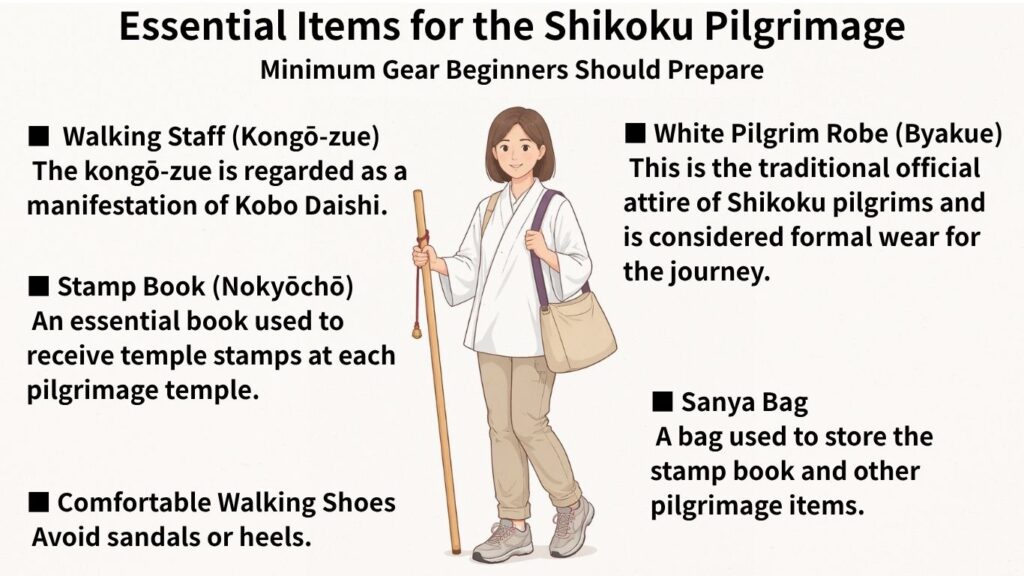
If you plan to use traditional pilgrimage items, you should also budget for the following:
| Pilgrimage Items | Estimated Cost |
|---|---|
| Nokyocho (Temple Stamp Book) | ¥2,000–¥3,000 |
| Byakue (White Pilgrim Vest) | ¥2,000–¥3,000 |
| Wagesa (Pilgrim Stole) | ¥1,000–¥3,000 |
| Kongozue (Pilgrim Staff) | ¥2,000–¥3,000 |
| Osamefuda (Pilgrim Name Slips) | Several Hundred Yen+ |
If you already own hiking or travel gear, your initial costs may be less than ¥10,000.
However, if you need to purchase everything from scratch, it is wise to budget several tens of thousands of yen for initial expenses before beginning the pilgrimage.
Accommodation Costs
Accommodation is typically the largest expense of the Shikoku Pilgrimage.
For a walking pilgrimage, which usually requires 40 to 50 nights on the road, accommodation costs can have a major impact on the overall budget.
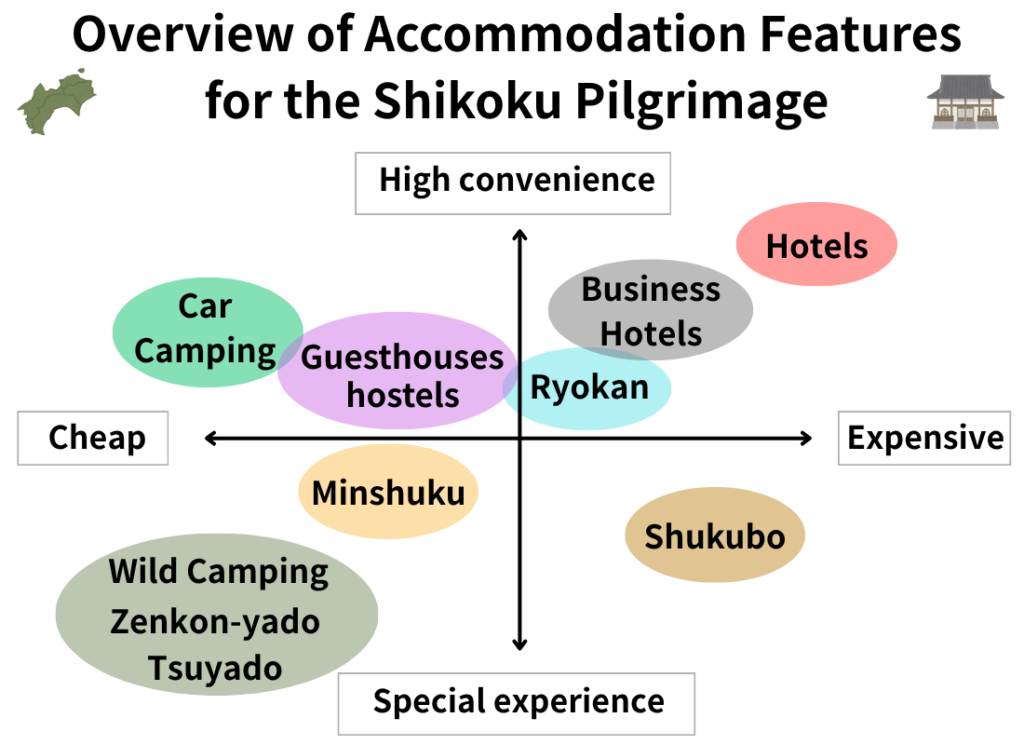
Typical accommodation costs are as follows:
| Accommodation Type | Cost per Night |
|---|---|
| Camping / Sleeping in a Vehicle | ¥0 |
| Free Pilgrim Lodging (Zenkonyado) / Tsuyado | ¥0–Several Hundred Yen |
| Minshuku (Japanese Guesthouse) / Guesthouse | ¥5,000–¥8,000 |
| Business Hotel / Ryokan | ¥5,000–¥10,000 |
| Shukubo (Temple Lodging) | ¥6,000–¥10,000 |
| Hotel | ¥10,000–¥20,000 |
For example, if you stay at accommodation costing ¥7,000 per night for 40 nights, the total would be:
¥7,000 × 40 nights = ¥280,000
As you can see, accommodation alone can account for a large portion of your pilgrimage expenses.
If your goal is to reduce the overall cost of the pilgrimage, reviewing your accommodation choices is usually the most effective place to start.
Food Expenses
Food is a daily expense during the pilgrimage, but it generally does not vary as much as accommodation costs.
Typical daily food expenses are as follows:
| Meal Style | Cost per Day |
|---|---|
| Mainly Self-Catering | ¥1,000–¥1,500 |
| Mainly Convenience Store Meals | ¥1,500–¥2,500 |
| Mainly Dining Out | ¥2,500–¥4,000 |
Walking pilgrims spend much of their time outdoors and often burn far more energy than expected.
While it may be tempting to cut food costs in order to save money, eating too little can lead to fatigue, poor recovery, and even injuries. For that reason, it is important to make sure you consume enough calories and nutrients throughout the journey.
Temple Stamp Fees (Nokyo Fees)
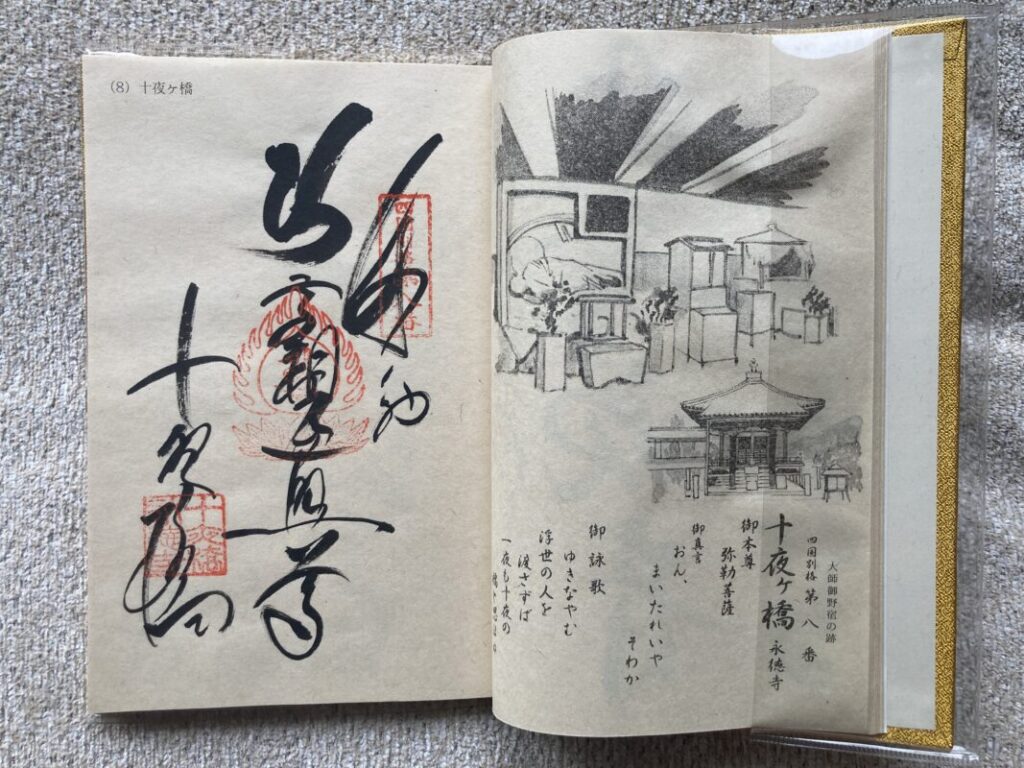
If you plan to collect temple stamps (nokyo) during your pilgrimage, you should include nokyo fees in your budget.
Although the fees may change over time, receiving temple stamps at all 88 temples can add up to tens of thousands of yen.
Whether or not to collect temple stamps is entirely a personal choice. However, many pilgrims carry a nokyocho (temple stamp book) as a record of their journey.
The total cost also depends on where you choose to receive the stamps, such as:
- Nokyocho (Temple Stamp Book)
- Byakue (White Pilgrim Vest)
- Kakejiku (Pilgrimage Scroll)
Because the fees vary depending on the item being stamped, the overall cost can differ significantly from one pilgrim to another.
If you intend to collect temple stamps throughout the pilgrimage, it is a good idea to set aside a dedicated budget for nokyo fees in advance.
Transportation Costs
Transportation expenses vary significantly depending on your pilgrimage style.
Even for a walking pilgrimage, transportation costs may include:
- Round-trip travel between your home and Shikoku
- Transportation during a segmented pilgrimage (kugiri-uchi), where the route is completed in multiple stages
- Travel to Mount Koya for the traditional concluding visit after completing the pilgrimage
For a car pilgrimage, common transportation expenses include:
- Fuel costs
- Expressway tolls
- Parking fees
- Rental car fees
Pilgrims traveling by bicycle or public transportation should also budget for expenses such as:
- Bicycle transport fees (rinko)
- Train fares
- Bus fares
Transportation is one of the expense categories that varies the most depending on how you choose to complete the pilgrimage. Careful planning of your travel method can have a major impact on your overall budget.
Bathing, Laundry, and Miscellaneous Expenses
One category that is often overlooked is the collection of small day-to-day expenses that arise during the pilgrimage.
Examples include:
- Coin laundry fees
- Laundry detergent
- Bathing facilities and public baths
- Drinks and beverages
- Snacks and energy foods
- Bandages, blister pads, and athletic tape
Although each expense may only cost a few hundred yen, they can add up quickly over a long pilgrimage of 40 days or more, sometimes totaling tens of thousands of yen.
This is especially true for walking pilgrims, who often spend more on laundry and beverages due to the physical demands of the journey. As a result, it is important to include these everyday expenses when planning your overall pilgrimage budget.
Emergency Fund
Unexpected expenses are not uncommon during the Shikoku Pilgrimage.
For example, you may need to cover costs related to:
- Damaged or worn-out equipment
- Additional nights of accommodation due to bad weather
- Extra lodging expenses caused by illness or injury
- Unplanned use of public transportation
For walking pilgrims in particular, things do not always go according to plan. Delays, route changes, and unforeseen circumstances are all part of a long-distance pilgrimage.
For this reason, it is wise to set aside an emergency fund of approximately ¥30,000–¥50,000 in addition to your estimated budget.
This is especially important for first-time pilgrims. Having a financial buffer can provide peace of mind and help you deal with unexpected situations without disrupting your journey.
Walking Pilgrimage Costs
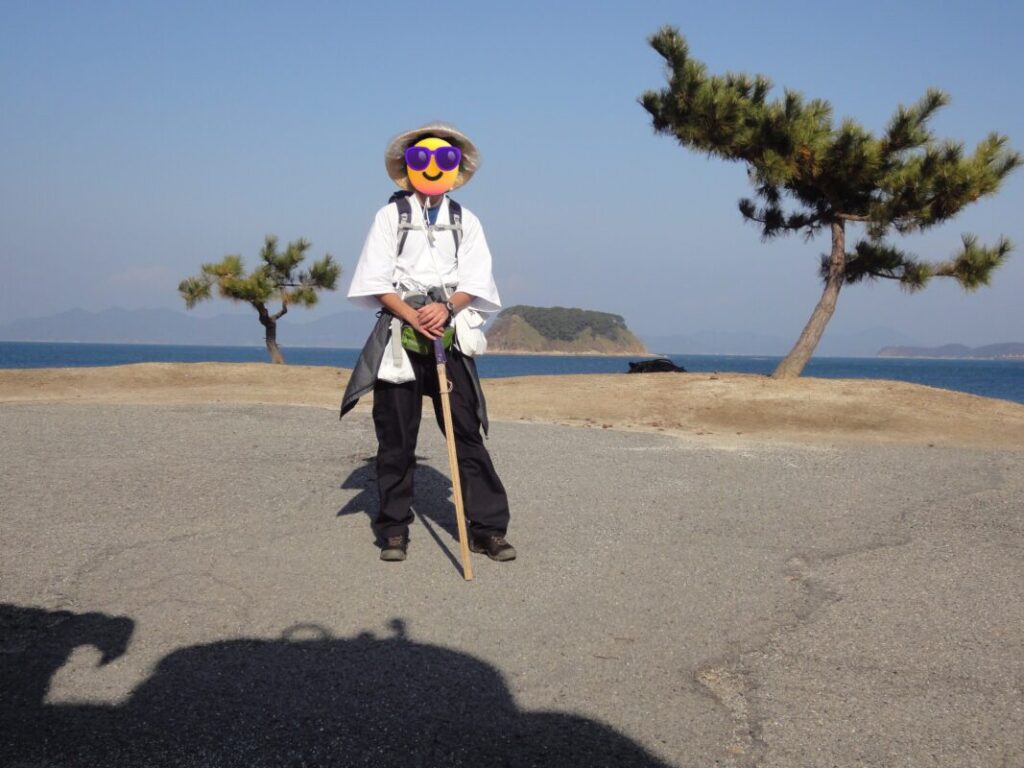
A walking pilgrimage is the most physically demanding and time-consuming way to complete the Shikoku 88 Temple Pilgrimage.
At the same time, it allows pilgrims to experience Shikoku at a slower pace, offering countless opportunities for personal reflection, cultural encounters, and unexpected discoveries. As a result, an increasing number of people from both Japan and overseas choose to undertake the pilgrimage on foot.
The total cost of a walking pilgrimage varies greatly depending on your accommodation style, but a typical budget ranges from ¥150,000 to ¥500,000.
In the following sections, we will look at estimated budgets for different pilgrimage styles, from budget-conscious travel to more comfortable options.
Average Budget for a Walking Pilgrimage
A typical walking pilgrimage takes approximately 40 to 50 days to complete.
Because of the large number of nights spent on the road, accommodation and food expenses accumulate over time, making walking pilgrimages one of the more expensive pilgrimage styles.
| Style | Estimated Duration | Estimated Cost |
|---|---|---|
| Budget Style | 40–50 Days | ¥150,000–¥250,000 |
| Standard Style | 40–50 Days | ¥250,000–¥400,000 |
| Comfort Style | 40–50 Days | ¥400,000+ |
Note: Initial equipment costs and round-trip transportation to and from Shikoku are not included.
Actual expenses can vary significantly depending on your walking pace, accommodation choices, and overall travel style. These figures should be considered general estimates rather than fixed costs.
Budget Style (Camping and Free Pilgrim Lodgings)
If your goal is to complete the walking pilgrimage as inexpensively as possible, you can reduce costs by making use of camping and free pilgrim lodgings (zenkonyado).
Typical expenses are as follows:
| Expense Category | Estimated Cost |
|---|---|
| Accommodation | ¥0–¥50,000 |
| Food | ¥50,000–¥100,000 |
| Temple Stamp Fees | Several Tens of Thousands of Yen |
| Miscellaneous Expenses | ¥10,000–¥30,000 |
| Total | Approximately ¥150,000–¥250,000 |
Because accommodation costs are kept to a minimum, the overall budget can be significantly reduced.
However, you should also consider several challenges:
- Additional gear such as a tent and sleeping bag may be required.
- You are more vulnerable to weather conditions.
- The physical demands of the pilgrimage can be greater.
For pilgrims who prioritize minimizing costs and are comfortable with a more rugged travel style, this can be one of the most economical ways to complete the Shikoku Pilgrimage.
Standard Style (Staying Mainly at Minshuku and Ryokan)
The most common approach today is to complete the pilgrimage while staying at minshuku (Japanese guesthouses) and ryokan (traditional inns).
Because you can get proper rest each day, this style is generally considered one of the most practical and beginner-friendly ways to undertake the pilgrimage.
Typical expenses are as follows:
| Expense Category | Estimated Cost |
|---|---|
| Accommodation | ¥200,000–¥300,000 |
| Food | ¥60,000–¥100,000 |
| Temple Stamp Fees | Several Tens of Thousands of Yen |
| Miscellaneous Expenses | ¥20,000–¥50,000 |
| Total | Approximately ¥250,000–¥400,000 |
Since accommodation accounts for the largest share of the budget, it is usually the single most important factor affecting the total cost of a walking pilgrimage.
Comfort Style (Staying Mainly at Hotels)
For pilgrims who prioritize comfort, staying primarily at business hotels and city hotels is another option.
Having a private room and access to modern facilities can make it easier to recover from daily fatigue, but the added comfort comes at a higher cost.
Typical expenses are as follows:
| Expense Category | Estimated Cost |
|---|---|
| Accommodation | ¥250,000–¥400,000+ |
| Food | ¥80,000–¥120,000 |
| Temple Stamp Fees | Several Tens of Thousands of Yen |
| Miscellaneous Expenses | ¥30,000–¥50,000 |
| Total | ¥400,000+ |
Accommodation costs can be even higher during peak travel seasons or in popular tourist areas.
This style is best suited for pilgrims who value comfort and convenience more than minimizing expenses. It allows for a more relaxed and physically manageable pilgrimage experience, especially on a long journey of 40 to 50 days.
Common Expenses That Are Easy to Overlook on a Walking Pilgrimage
People planning their first walking pilgrimage often focus mainly on accommodation and food costs.
However, once you begin walking, a number of smaller expenses can add up quickly, including:
- Drinks and beverages
- Snacks and energy foods
- Coin laundry fees
- Bathing facility fees
- Replacement shoes or insoles
- Rainwear or umbrellas
- Mobile battery accessories and charging equipment
- Consumable items such as athletic tape and bandages
During the summer months in particular, beverage costs alone can be much higher than many pilgrims expect.
Based on my experience of completing the walking pilgrimage twice, I believe it is important to budget not only for accommodation and food, but also for these everyday expenses that accumulate over the course of the journey.
For this reason, it is a good idea to set aside an additional emergency fund of approximately ¥30,000–¥50,000 beyond your estimated budget. Having a financial buffer can help you deal with unexpected expenses without added stress during the pilgrimage.
Cycling Pilgrimage Costs
A cycling pilgrimage offers a balance between the slower pace of a walking pilgrimage and the convenience of a car pilgrimage.
Compared with walking, it allows you to complete the route in a much shorter period of time. At the same time, it provides more opportunities to enjoy the scenery, local culture, and interactions with people along the route than traveling by car.
Although a reasonable level of fitness is required, the greater daily travel distance means that most cyclists can complete the pilgrimage in approximately 15 to 30 days.
The total cost varies depending on your accommodation style and whether you already own a suitable bicycle and equipment. As a general guideline, a cycling pilgrimage typically costs between ¥150,000 and ¥350,000.
Bringing Your Own Bicycle
If you use your own bicycle, such as a road bike or hybrid bike, you can avoid bicycle rental fees.
For pilgrims who already own suitable cycling equipment, the initial costs can be kept relatively low.
Typical expenses are as follows:
| Expense Category | Estimated Cost |
|---|---|
| Accommodation | ¥70,000–¥200,000 |
| Food | ¥30,000–¥80,000 |
| Temple Stamp Fees | Several Tens of Thousands of Yen |
| Bicycle Maintenance | Several Thousand Yen–¥10,000 |
| Miscellaneous Expenses | ¥10,000–¥30,000 |
| Total | Approximately ¥150,000–¥300,000 |
One advantage of a cycling pilgrimage is that the shorter travel time generally results in fewer overnight stays, making it easier to keep overall costs lower than a walking pilgrimage.
However, you may also need to budget for additional transportation expenses, such as:
- Bicycle transport fees (rinko)
- Shipping costs for sending your bicycle to and from Shikoku
These costs vary depending on your starting location and transportation method.
Using a Rental Bicycle
If you do not own a bicycle, you can complete the pilgrimage using a rental bicycle or rental sports bike.
In recent years, services offering road bikes and other sports bicycles have become more widely available. However, the added convenience comes with higher costs.
Typical expenses are as follows:
| Expense Category | Estimated Cost |
|---|---|
| Bicycle Rental | Several Tens of Thousands to Over ¥100,000 |
| Accommodation | ¥70,000–¥200,000 |
| Food | ¥30,000–¥80,000 |
| Temple Stamp Fees | Several Tens of Thousands of Yen |
| Miscellaneous Expenses | ¥10,000–¥30,000 |
| Total | Approximately ¥200,000–¥350,000 |
Because the bicycle is rented for an extended period, the rental fee can become one of the largest expenses in your budget.
It is important to check rental rates in advance, as the total cost will increase the longer your pilgrimage takes to complete.
Expenses Unique to a Cycling Pilgrimage
A cycling pilgrimage involves several costs that are not typically encountered on walking or car pilgrimages.
Common examples include:
- Puncture repair kits
- Spare inner tubes
- Tire replacements
- Brake pad replacements
- Chain maintenance supplies
- Helmet
- Cycling clothing
- Bicycle travel bag (rinko bag)
- Bicycle shipping and transportation fees
In addition, many temples on the Shikoku 88 Temple route are located in mountainous areas or at the top of steep climbs.
Long ascents are especially common in southern Tokushima, the Nanyo region of Ehime, and parts of Kochi Prefecture, where the physical demands can be greater than many cyclists expect.
As a result, unexpected expenses may arise, such as:
- Additional accommodation due to fatigue or delays
- Use of public transportation
- Bicycle repairs at local bike shops
When planning a cycling pilgrimage, it is wise to budget an additional ¥10,000–¥30,000 as an emergency fund on top of your normal expenses.
While a cycling pilgrimage can usually be completed in less time than a walking pilgrimage, it is important to remember that bicycle maintenance costs and repair expenses are unique factors that can affect your overall budget.
Car Pilgrimage Costs
A car pilgrimage is the fastest way to complete the Shikoku 88 Temple Pilgrimage.
While a walking pilgrimage typically requires 40 days or more, most pilgrims can complete the route by car in approximately 10 to 14 days.
Because the journey takes much less time, accommodation costs are generally lower, which often results in a lower overall budget compared with a walking pilgrimage.
However, car pilgrims must also budget for expenses that are unique to traveling by vehicle, including:
- Fuel costs
- Expressway tolls
- Parking fees
- Rental car fees (if applicable)
As a result, the total cost of a car pilgrimage depends largely on your transportation choices, travel schedule, and accommodation style. While it can be one of the most cost-effective pilgrimage methods, vehicle-related expenses should not be overlooked.
Using Your Own Car
If you use your own vehicle, one of the biggest advantages is that you do not need to pay rental car fees.
Typical expenses are as follows:
| Expense Category | Estimated Cost |
|---|---|
| Fuel | ¥10,000–¥30,000 |
| Expressway Tolls | ¥10,000–¥30,000 |
| Accommodation | ¥30,000–¥100,000 |
| Food | ¥20,000–¥50,000 |
| Temple Stamp Fees | Several Tens of Thousands of Yen |
| Miscellaneous Expenses | ¥10,000–¥30,000 |
| Total | Approximately ¥80,000–¥200,000 |
Actual costs will vary depending on the length of your pilgrimage and your accommodation choices, but traveling with your own car is generally one of the most cost-effective ways to complete the Shikoku Pilgrimage.
Using a Rental Car
If you are traveling to Shikoku from a distant location or do not have access to your own vehicle, using a rental car may be the most practical option.
Because rental fees are added to the budget, the overall cost is generally higher than traveling with your own car.
Typical expenses are as follows:
| Expense Category | Estimated Cost |
|---|---|
| Rental Car | ¥50,000–¥150,000 |
| Fuel | ¥10,000–¥30,000 |
| Expressway Tolls | ¥10,000–¥30,000 |
| Accommodation | ¥30,000–¥100,000 |
| Food | ¥20,000–¥50,000 |
| Temple Stamp Fees | Several Tens of Thousands of Yen |
| Miscellaneous Expenses | ¥10,000–¥30,000 |
| Total | Approximately ¥150,000–¥300,000 |
As rental costs increase with the length of the pilgrimage, careful trip planning is important.
Keeping your itinerary efficient can help reduce rental expenses and significantly affect the overall cost of your pilgrimage.
Estimated Fuel Costs
When visiting all 88 temples of the Shikoku Pilgrimage, the total driving distance is typically around 1,300 to 1,600 km.
The actual distance varies depending on your starting point and detours, but even traveling only between temples involves a considerable amount of driving.
For example:
- Driving distance: 1,500 km
- Fuel efficiency: 15 km/L
- Fuel price: ¥170/L
The calculation would be:
1,500 km ÷ 15 km/L × ¥170
= approximately ¥17,000
While actual fuel costs vary depending on the vehicle type and fuel efficiency, a reasonable estimate for gasoline expenses is generally ¥10,000 to ¥30,000.
Estimated Expressway Tolls
For a car pilgrimage, whether or not you use expressways has a significant impact on total transportation costs.
Using expressways more frequently can reduce travel time between temples, but it also increases toll expenses.
On the other hand, relying mainly on local roads helps keep costs down, although it results in longer travel times.
As a general guideline:
- Local roads only: around ¥1,000–¥10,000
- Mixed use of expressways and local roads: ¥10,000–¥30,000
If efficiency is your priority, expressways are very useful. However, it is important to balance time savings with overall travel costs when planning your pilgrimage route.
Toll Roads, Ropeways, and Other Transportation Fees
In addition to fuel costs and expressway tolls, a car pilgrimage may also involve certain special transportation expenses at specific temples.
A well-known example is the ropeway to Temple 21, Tairyu-ji area access.
Located at an altitude of approximately 600 meters, many pilgrims use the Tairyu-ji Ropeway even when traveling by car.
Another example is Temple 60, Yokomine-ji, where part of the access road is a paid mountain road, requiring a toll fee.
In some cases, certain temples or regions may also request parking cooperation fees or road maintenance contributions.
While these costs are relatively small compared to accommodation or transportation expenses, they are often overlooked when planning a budget.
For car pilgrimages, it is helpful to group these expenses together as “transport-related costs,” including:
- Fuel costs
- Expressway tolls
- Ropeway fees
- Paid road access fees
As a general guideline, setting aside an additional ¥1,000–¥10,000 as a buffer is usually sufficient to cover these miscellaneous transportation-related expenses.
Cost of a Public Transportation Pilgrimage
It is also possible to complete the Shikoku Pilgrimage using public transportation such as trains and buses, without a car.
This option is often chosen by people who:
- Do not have a driver’s license
- Do not feel comfortable driving
- Do not have enough time for a full walking pilgrimage
However, since many of the 88 temples are located in mountainous areas or regions with limited public transport access, transportation costs can be higher than expected.
In addition, pilgrims must carefully check timetables and manage transfers between trains and buses, which can make the journey more time-consuming. As a result, the total pilgrimage duration may also become longer than initially planned.
Overall, while public transportation offers flexibility without driving, it requires careful planning and can still lead to significant travel expenses.
Rail and Bus–Based Pilgrimage
When traveling mainly by train and local buses, transportation costs become the primary component of the overall budget.
Typical expenses are as follows:
| Expense Category | Estimated Cost |
|---|---|
| Transportation | ¥50,000–¥150,000 |
| Accommodation | ¥50,000–¥150,000 |
| Food | ¥30,000–¥80,000 |
| Temple Stamp Fees | Several Tens of Thousands of Yen |
| Miscellaneous Expenses | ¥10,000–¥30,000 |
| Total | Approximately ¥150,000–¥350,000 |
In some cases, the nearest train station or bus stop is still several kilometers away from a temple, requiring additional walking.
In regions such as Kochi Prefecture and southern Ehime Prefecture, public transportation services may be infrequent, making timetable planning essential.
While this travel style is less efficient than a car pilgrimage in terms of mobility, it eliminates the stress of driving and allows for relatively flexible itinerary planning.
Walking + Public Transportation Hybrid
In recent years, a hybrid style that combines walking pilgrimage routes with occasional use of public transportation has become increasingly common.
This approach is often used in situations such as:
- Skipping particularly difficult or time-consuming sections
- Traveling during severe weather conditions
In such cases, transportation costs are added, but the overall budget remains closer to that of a walking pilgrimage.
Typical expenses are as follows:
| Expense Category | Estimated Cost |
|---|---|
| Transportation | ¥10,000–¥50,000 |
| Accommodation | ¥100,000–¥300,000 |
| Food | ¥50,000–¥100,000 |
| Temple Stamp Fees | Several Tens of Thousands of Yen |
| Miscellaneous Expenses | ¥20,000–¥50,000 |
| Total | Approximately ¥200,000–¥400,000 |
During my own walking pilgrimages, I also encountered many pilgrims who used buses or trains due to approaching typhoons or health issues.
Rather than insisting on walking at all costs, it is important to use public transportation when necessary to ensure safety and maintain a sustainable pilgrimage pace.
Accommodation-Based Cost Comparison
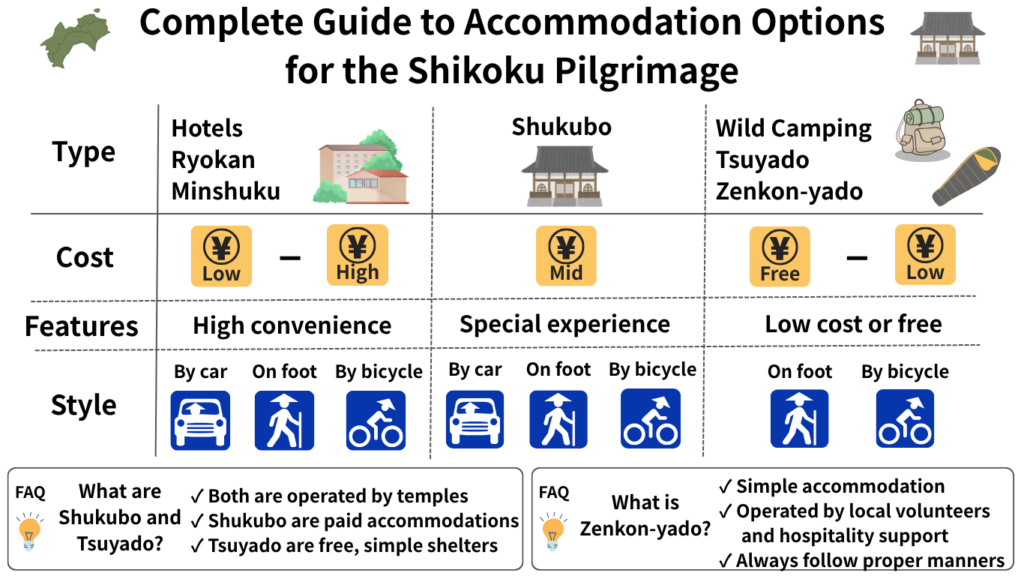
When it comes to the overall cost of the Shikoku Pilgrimage, accommodation expenses have a much greater impact than transportation methods.
Even within the same 40-day walking pilgrimage, the total budget can vary significantly depending on the lodging style. For example, the difference between a pilgrimage based on camping and one based on hotels can easily exceed ¥200,000.
Let’s take a look at the approximate costs based on different accommodation styles.
¥0–¥500 per Night (Camping / Free Pilgrim Lodgings)
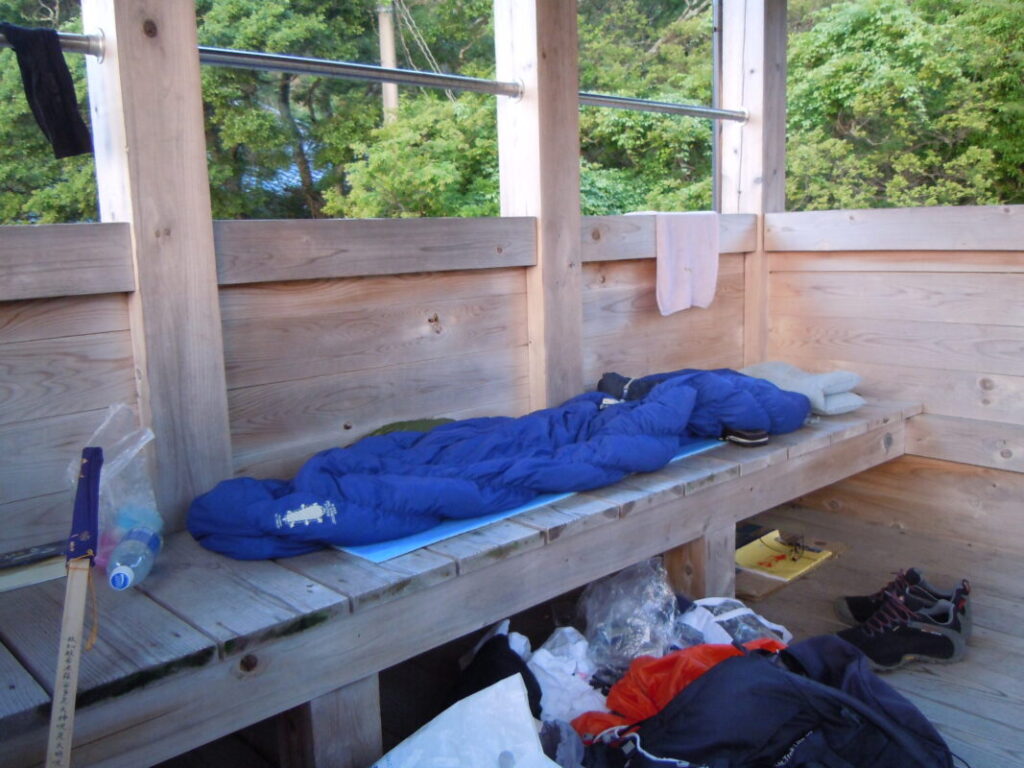
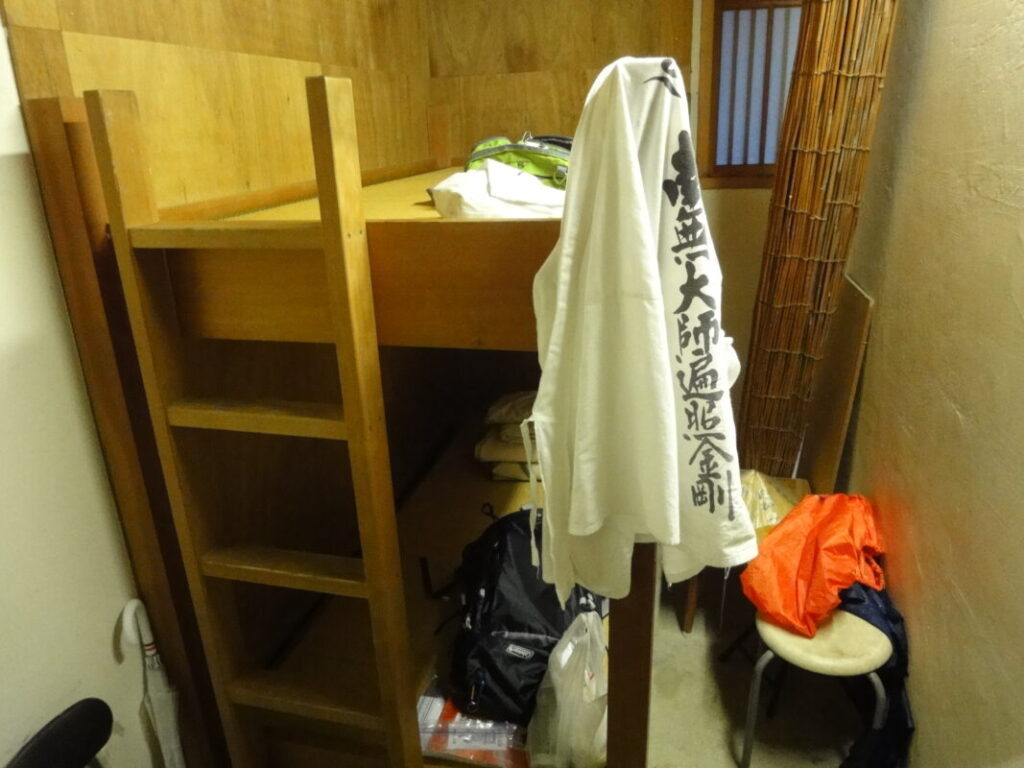
A style suited for those who want to minimize costs as much as possible.
By combining camping and free pilgrim lodgings, accommodation expenses can be significantly reduced.
| Expense Category | Estimated Cost |
|---|---|
| Accommodation | ¥0–¥50,000 |
| Food | ¥50,000–¥100,000 |
| Other Expenses | ¥50,000–¥100,000 |
| Total | Approximately ¥150,000–¥250,000 |
However, there are some drawbacks to this style:
- Highly dependent on weather conditions
- It may be difficult to get sufficient rest
- Requires equipment such as a tent and sleeping gear
This option is best suited for experienced pilgrims who are comfortable with a more self-sufficient and flexible travel style.
¥5,000–¥7,000 per Night (Minshuku / Budget Lodging)
This is the most common accommodation style and is widely used by first-time pilgrims.
Staying at minshuku (Japanese guesthouses) or budget pilgrim inns—often with meals included—provides a good balance between comfort and cost.
| Expense Category | Estimated Cost |
|---|---|
| Accommodation | ¥200,000–¥300,000 |
| Food | ¥40,000–¥80,000 |
| Other Expenses | ¥50,000–¥100,000 |
| Total | Approximately ¥250,000–¥400,000 |
Many walking pilgrims fall within this budget range.
This style offers enough comfort to recover each day while still keeping overall costs relatively manageable, making it one of the most realistic options for most pilgrims.
¥8,000–¥10,000 per Night (Business Hotels / Ryokan)
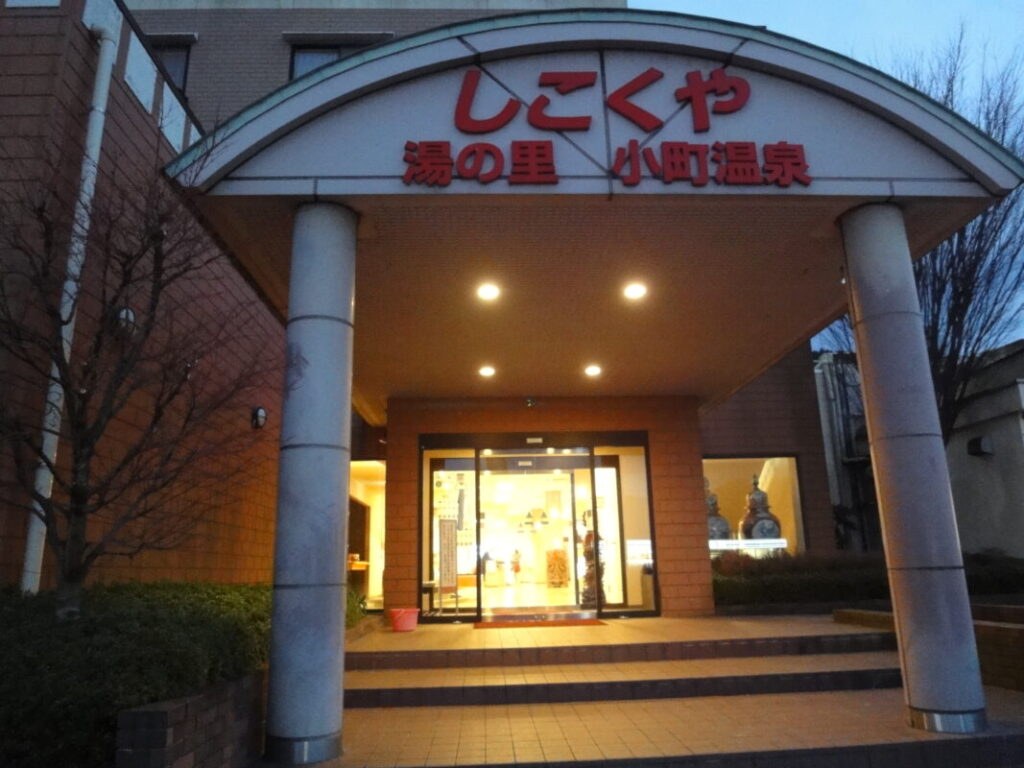
A style suited for pilgrims who prioritize comfort and recovery during the journey
Choosing private rooms and higher-quality meals often places accommodation costs in this price range.
| Expense Category | Estimated Cost |
|---|---|
| Accommodation | ¥300,000–¥400,000 |
| Food | ¥40,000–¥80,000 |
| Other Expenses | ¥50,000–¥100,000 |
| Total | Approximately ¥350,000–¥500,000 |
While accommodation costs are higher, this style offers significant advantages in terms of fatigue recovery, privacy, and overall comfort throughout the pilgrimage.
¥10,000+ per Night (Hotel-Based Stay)
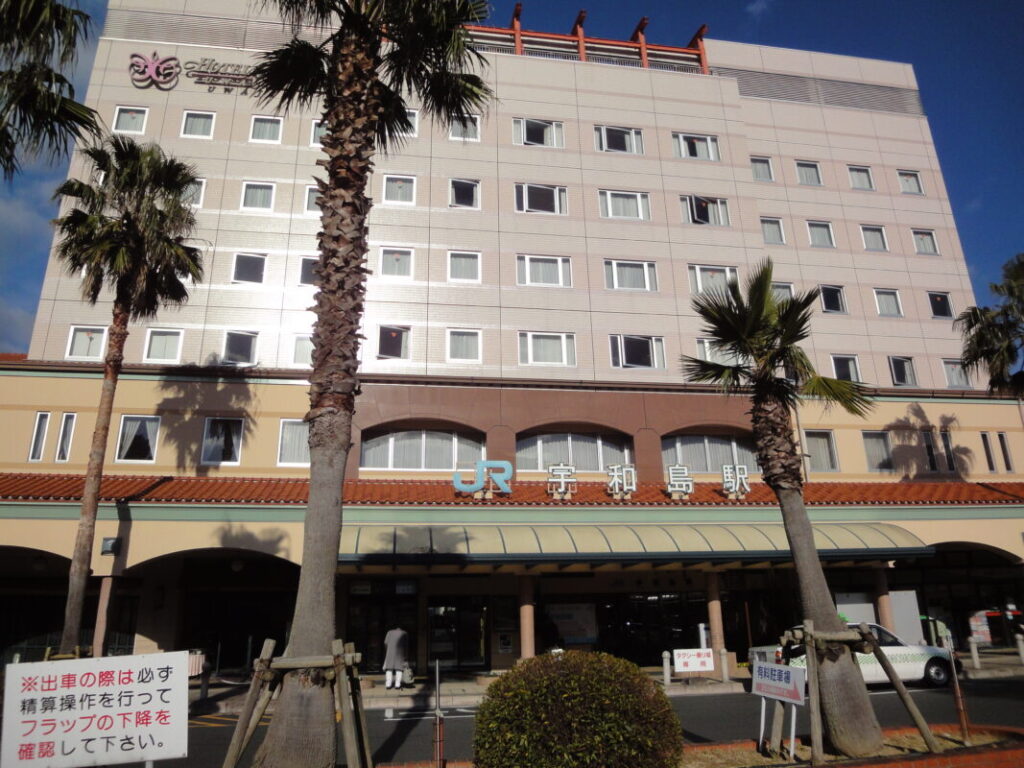
A hotel-centered style used in walking, car, and public transportation pilgrimages
This option is chosen by pilgrims who prioritize maximum comfort and convenience during their journey.
| Expense Category | Estimated Cost |
|---|---|
| Accommodation | ¥400,000+ |
| Food | ¥50,000–¥100,000 |
| Other Expenses | ¥50,000–¥100,000 |
| Total | ¥500,000+ |
While this style offers the highest level of comfort, it also requires a significantly larger budget. Careful financial planning is essential to support a hotel-based pilgrimage over an extended period.
Actual Accommodation Costs from My Walking Pilgrimage
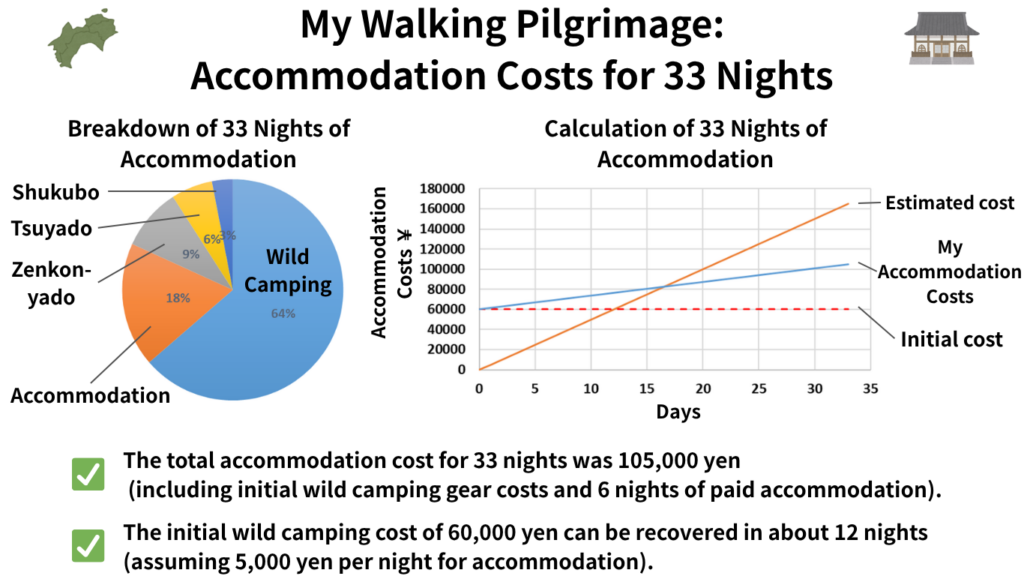
I completed my first Shikoku walking pilgrimage in 34 days, staying for 33 nights.
The breakdown of those 33 nights was as follows:
- Camping: 21 nights
- Paid accommodation: 6 nights
- Free pilgrim lodgings (zenkonyado): 3 nights
- Temple lodging (tsuyado): 2 nights
- Shukubo (temple stay): 1 night
The total cost for the 6 paid lodging nights and the 1 shukubo night was approximately ¥45,000.
In addition, I spent about ¥60,000 on camping equipment such as a tent and sleeping bag as initial costs.
Total accommodation-related cost:
Approximately ¥105,000
If I had stayed in standard accommodation for all 33 nights at ¥5,000 per night, the cost would have been:
¥5,000 × 33 nights = ¥165,000
By using camping and free lodgings, I was able to significantly reduce my accommodation expenses.
However, camping requires preparation, proper gear, and the ability to deal with weather conditions, so it is not suitable for everyone.
Ultimately, pilgrimage costs are not determined by whether you walk or travel by other means, but by which accommodation style you choose.
Temple Stamp (Nokyo) Fees
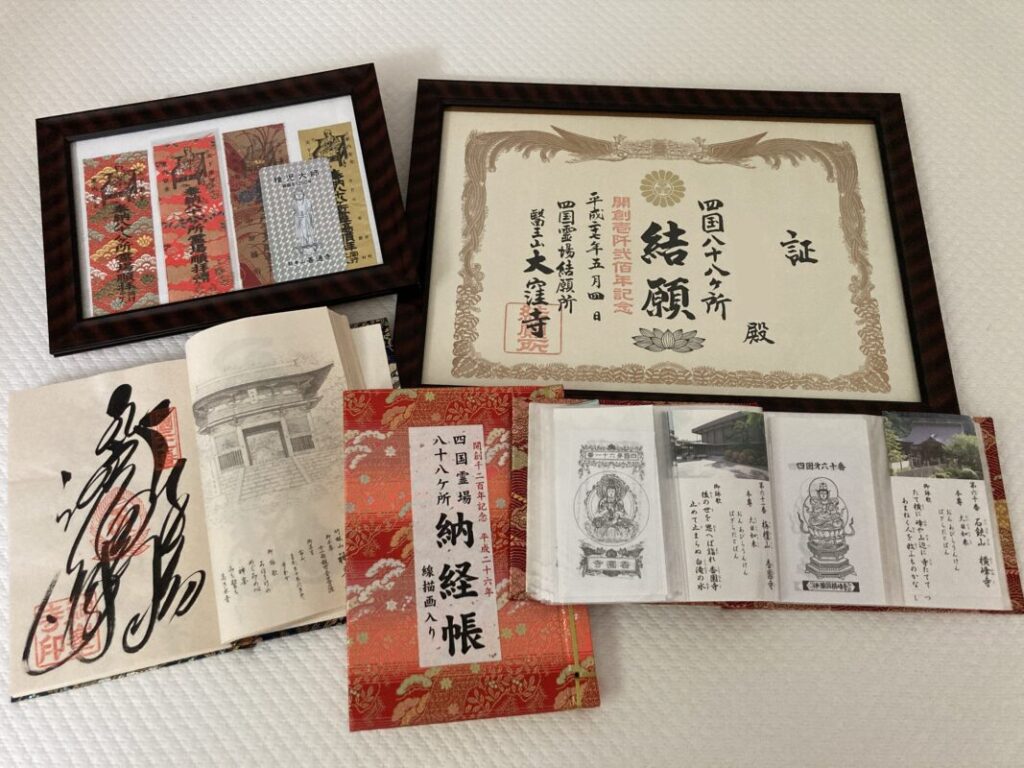
When planning the cost of a Shikoku pilgrimage, temple stamp fees (nokyo fees) are an important expense that should not be overlooked.
Nokyo refers to the process of receiving a handwritten calligraphy and red seal at each temple as proof of pilgrimage. This is typically recorded in items such as a stamp book (nokyocho), white pilgrim robes (hakui), or a scroll (kakejiku).
The fee for each temple used to be around ¥300 per temple, but it was revised in April 2024 to ¥500 per temple.
As a result, pilgrims today need to include this updated cost when planning their budget.
For the full 88 temples, the total stamp fee alone becomes a significant part of the overall pilgrimage expenses.
If You Receive Stamps at All 88 Temples
If you choose to receive a stamp in your nōkyōchō (stamp book) at all 88 temples of the Shikoku Pilgrimage:
- Nōkyō fee per temple: ¥500
- 88 temples total: ¥44,000
In addition, many pilgrims visit Kōyasan Okunoin after completing the pilgrimage as a way of expressing gratitude.
If you also receive a stamp there, you should budget an additional around ¥500.
In total:
The estimated cost for stamping all 88 temples is approximately:
¥45,000
While accommodation costs often receive the most attention in walking pilgrimages, temple stamp fees are also a significant expense and should not be underestimated when planning your budget.
Costs for Omigake, Kakejiku, and Nokyocho
The cost of temple stamp (nokyo) offerings varies depending on the item you choose to receive stamps on.
Current standard nokyo fees per temple are as follows:
| Item | Fee per Temple |
|---|---|
| Nokyocho (stamp book) | ¥500 |
| Hakui (white pilgrim robe) | ¥300 |
| Kakejiku (hanging scroll) | ¥700 |
In addition, the items themselves also require an initial purchase cost:
| Item | Estimated Cost |
|---|---|
| Nokyocho | ¥2,000–¥3,000 |
| Hakui | ¥2,000–¥4,000 |
| Kakejiku | ¥10,000+ |
A completed kakejiku (scroll) becomes a valuable commemorative item, but it is also the most expensive option among the three.
For first-time pilgrims, most people choose the nokyocho (stamp book) as their primary option due to its simplicity and lower overall cost.
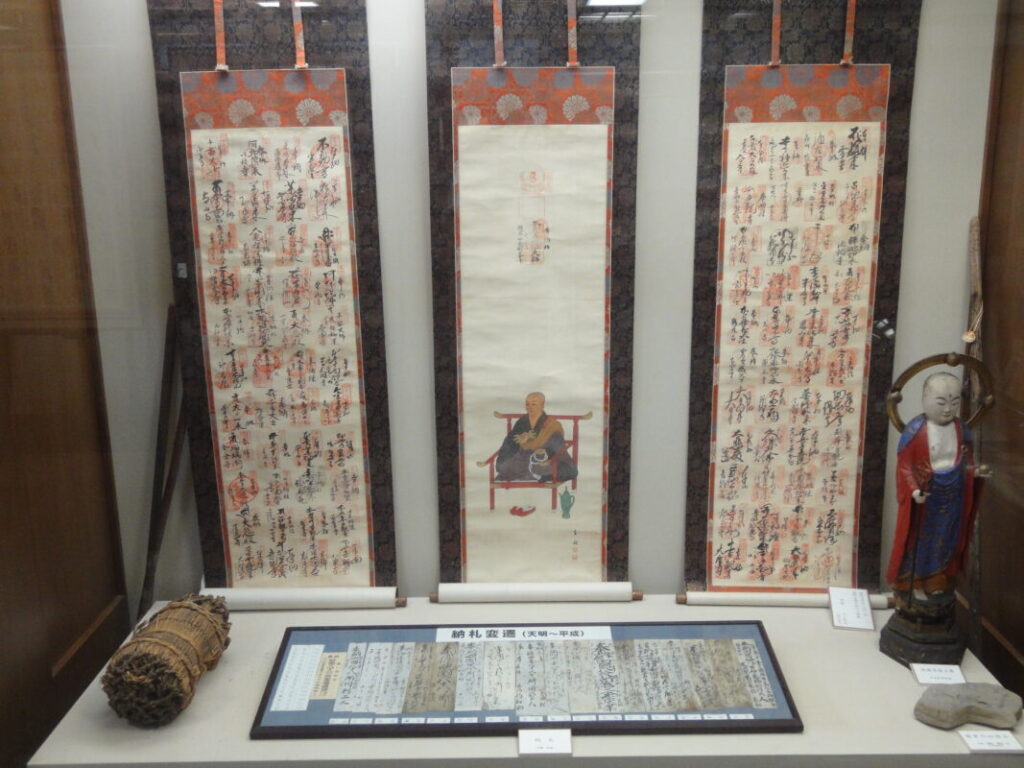
Cost Difference When You Do Not Receive Temple Stamps
Receiving temple stamps (nokyo) is not mandatory.
Some pilgrims choose to visit each temple and offer prayers without receiving stamps.
For example, if you receive stamps at all 88 temples using a nokyocho (stamp book), the total cost is approximately ¥44,000. If you do not receive stamps, this expense is completely eliminated.
Therefore, if your goal is:
- To minimize overall costs
- To focus only on the act of pilgrimage itself
then choosing not to receive stamps is a valid option.
On the other hand, a nokyocho serves as a personal record of the pilgrimage and remains a meaningful keepsake after completion.
During my own walking pilgrimage, many of the pilgrims I met also carried a stamp book, and for many of them it was considered an important part of the experience and a treasured memory of the journey.
Ultimately, the decision comes down to whether you prioritize cost savings or the value of keeping a physical record of your pilgrimage.
It is best to choose based not only on budget considerations, but also on your personal approach to the pilgrimage itself.
How to Reduce Shikoku Pilgrimage Costs
The cost of the Shikoku Pilgrimage varies greatly depending on your travel style, but it is possible to significantly reduce expenses with some planning and adjustments.
This is especially true for walking pilgrimages, where reviewing accommodation choices and equipment can lead to savings of tens of thousands of yen.
Based on my experience completing the walking pilgrimage twice, here are some practical ways to reduce overall costs.
Reducing Accommodation Costs
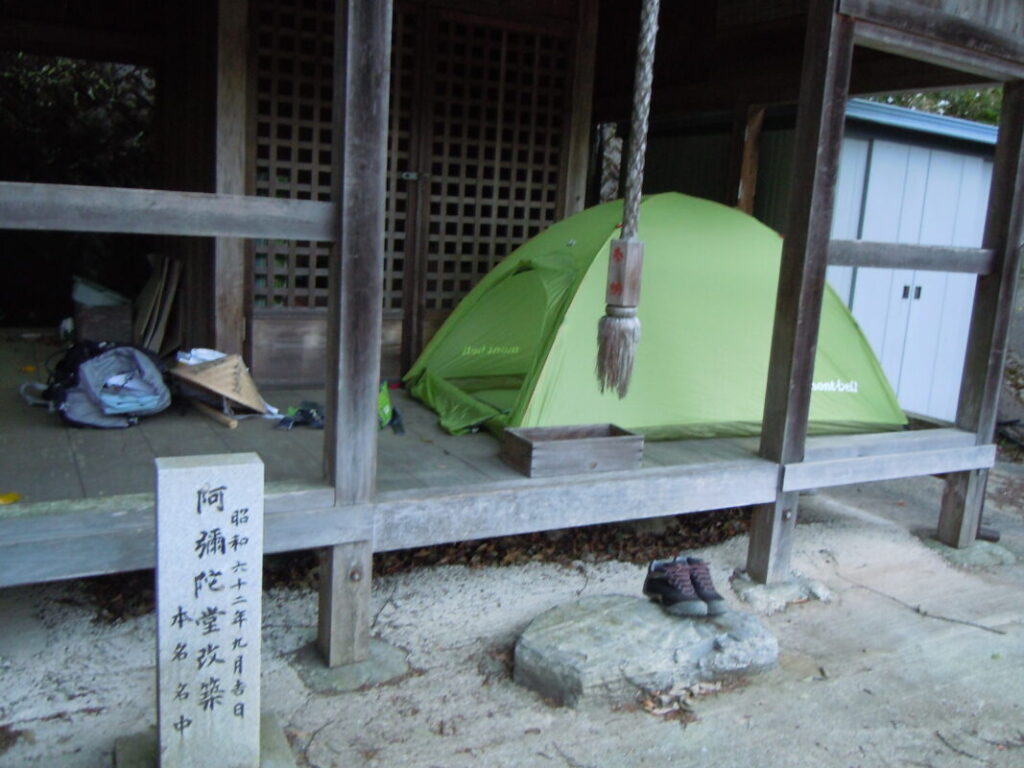
Accommodation is the largest expense in the Shikoku Pilgrimage.
Therefore, if you want to reduce your budget, the first place to review is your lodging costs.
For example, you can:
- Use free pilgrim lodgings (zenkonyado)
- Stay at pilgrim huts (henro koya) and camp
- Mix minshuku (guesthouses) and hotels depending on the situation
- Adjust your walking distance to reduce the number of overnight stays
Even saving just ¥2,000 per night can result in a difference of ¥80,000 over 40 nights.
Compared with reducing food expenses, adjusting accommodation choices is usually the most effective way to lower overall pilgrimage costs.
Reducing Food Costs
Food expenses can also be reduced with some planning.
However, during a walking pilgrimage, it is not uncommon to walk 20–30 km or more per day. Cutting food intake too aggressively can lead to fatigue and poor physical condition.
If you want to save money safely, consider:
- Using convenience store meals and prepared foods
- Buying food at supermarkets
- Choosing accommodation plans that include meals
Food costs should not be reduced too much. Maintaining sufficient nutrition and energy is more important than strict cost-cutting during the pilgrimage.
Expensive Gear Is Not Always Necessary
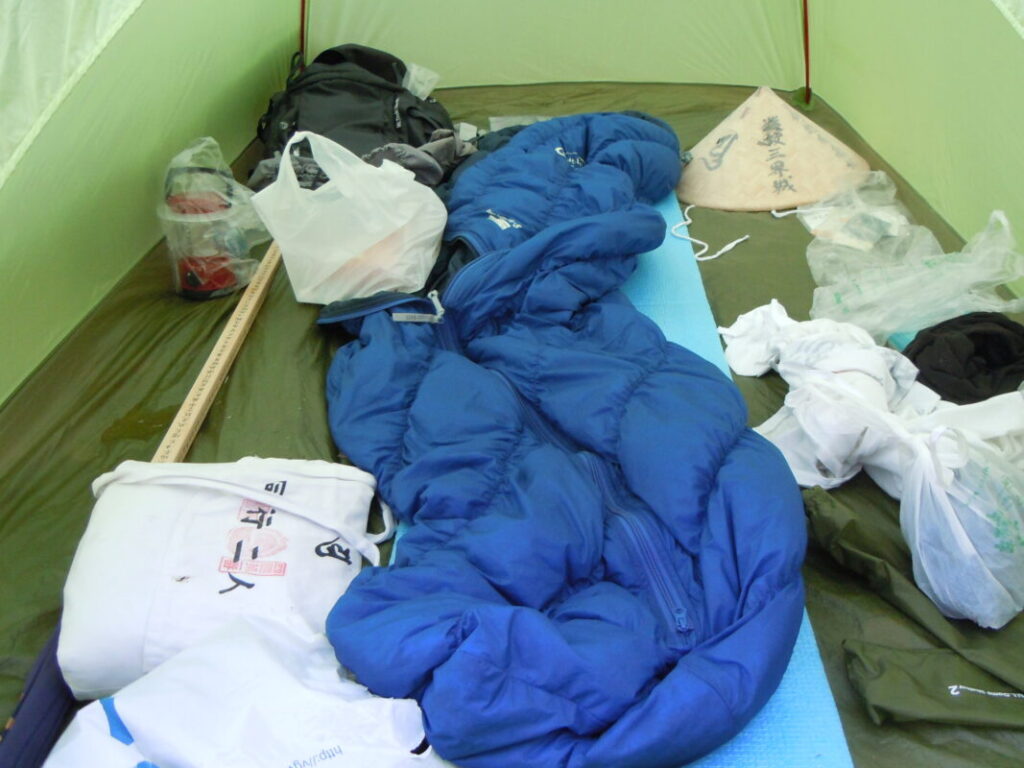
At first, many people assume that they must prepare expensive hiking or mountaineering gear for the Shikoku Pilgrimage.
However, the pilgrimage route is not exclusively mountainous terrain.
While there are challenging mountain temples such as Mt. Shōsan-ji (Temple 12) and Yokomine-ji (Temple 60), most of the route consists of flat plains, urban areas, and paved roads. In fact, the majority of temples are located below 1,000 meters above sea level.
For this reason, specialized high-end mountaineering equipment is not strictly necessary.
During my own walking pilgrimage, I met many pilgrims who completed the journey using:
- Standard walking or running shoes
- Basic commercially available rain gear
- No walking staff
A good approach is to start with what you already own and only purchase what is truly necessary.
However, the situation changes if you plan to camp or sleep outdoors during winter.
Even in Shikoku, temperatures in mountainous areas can drop below freezing, and cold waves can make conditions harsh.
If you plan winter camping or outdoor sleeping, it is important to invest in:
- Sleeping bag thermal rating (comfort temperature)
- Insulation performance of your sleeping mat
- Proper cold-weather clothing
In these cases, investing in quality gear is essential for safety and comfort.
Shikoku Pilgrimage Cost Simulator
As explained so far, the total cost of a Shikoku Pilgrimage varies greatly depending on your travel style.
Whether you choose walking or driving, whether you stay in guesthouses or camp outdoors, whether you receive temple stamps, and whether you need to purchase new equipment—all of these factors significantly affect your overall budget.
To help make this easier to understand, we have created a simple “Shikoku Pilgrimage Cost Simulator” that allows you to estimate your total expenses.
Please select the conditions that best match your planned pilgrimage style and check your estimated budget.
Select Conditions to Calculate Your Estimated Cost
By choosing the options below, you can automatically calculate an approximate cost for your pilgrimage.
Shikoku Pilgrimage Cost Simulator
How to Read the Results
The simulator displays estimated costs for each of the following categories:
- Initial costs
- Accommodation costs
- Food costs
- Temple stamp (nokyo) fees
- Transportation costs
- Miscellaneous expenses
- Total cost
Please note that all values are approximate.
Actual expenses may vary depending on:
- Choice of accommodation
- Meal preferences
- Season of travel
- Whether or not you purchase additional gear
For this reason, it is recommended to prepare an additional buffer of a few tens of thousands of yen beyond the displayed estimate to ensure a safer and more flexible budget plan.
Model Cases
For reference, here are several example pilgrimage budgets based on different travel styles:
Walking Pilgrimage (Budget Type)
- Camping and free pilgrim lodgings (zenkonyado)
- Temple stamps included
- Equipment purchase included
- Duration: 45 days
- Estimated total cost: Approx. ¥200,000
Walking Pilgrimage (Standard Type)
- Minshuku (guesthouses) as the main accommodation
- Temple stamps included
- Equipment purchase included
- Duration: 45 days
- Estimated total cost: Approx. ¥350,000
Car Pilgrimage (Own Vehicle)
- Includes accommodation
- Temple stamps included
- Duration: 12 days
- Estimated total cost: Approx. ¥150,000
Car Pilgrimage (Rental Car)
- Hotel-based accommodation
- Temple stamps included
- Duration: 12 days
- Estimated total cost: Approx. ¥250,000
Frequently Asked Questions About Shikoku Pilgrimage Costs
- QCan I complete the pilgrimage on ¥100,000?
- A
Yes, but it depends on your travel style.
For walking pilgrimages, some people complete the journey within the ¥100,000 range by using camping or free pilgrim lodgings (zenkonyado) and already owning necessary equipment.
However, if you stay at minshuku or hotels, it is generally more common for costs to exceed ¥200,000.
For car pilgrimages, shorter travel times may also allow some cases to be completed around ¥100,000.
- QWhat is the average cost of a walking pilgrimage?
- A
Approximately ¥150,000–¥400,000.
Accommodation is the largest expense, and total costs vary greatly depending on whether you use camping/free lodgings or stay in guesthouses and hotels.
From my own experience completing the walking pilgrimage twice, accommodation style has a much greater impact on total cost than transportation method.
- QHow much can I save if I do not receive temple stamps?
- A
About ¥40,000 or more.
Receiving stamps in a nokyocho at all 88 temples costs approximately ¥44,000.
If you choose not to receive stamps, you can eliminate this expense entirely.
However, many pilgrims value the nokyocho as a record of their journey, so it is worth considering whether you want the experience and keepsake in addition to the cost.
- QHow many days does a car pilgrimage take?
- A
About 10–14 days.
A full circuit is typically completed in about 10 days using expressways efficiently.
If you include sightseeing or slower travel, most people plan for around two weeks.
For section-based pilgrimages, the duration varies depending on how the route is divided.
- QWhat is the biggest expense in the pilgrimage?
- A
Accommodation costs in most cases.
For example, staying at a ¥6,000 per night lodging for 40 nights results in ¥240,000 in accommodation alone.
Therefore, if you want to reduce overall costs, the most effective approach is to review your accommodation style first.
- QHow much can I save by using camping or free lodgings?
- A
Often more than ¥100,000 in total.
Compared with staying in minshuku, using camping or free pilgrim lodgings can significantly reduce total expenses.
However, camping also involves risks such as weather conditions and safety concerns, and free lodgings are not always guaranteed.
It is important to balance cost savings with safety and physical endurance when planning your pilgrimage.
- QWhen do pilgrimage expenses need to be paid?
- A
Expenses are usually paid as you go.
Accommodation, meals, and temple stamp fees are typically paid on-site during the journey.
In contrast, equipment such as shoes, backpacks, and pilgrim gear is purchased before departure.
For budgeting purposes, it is helpful to separate costs into:
- Initial setup costs (before departure)
- Daily travel expenses (during the pilgrimage)
Summary
The cost of the Shikoku Pilgrimage varies significantly depending not only on the mode of travel—such as walking, cycling, or driving—but also on your accommodation style.
In particular, accommodation expenses are the single largest factor influencing the total budget.
- Walking pilgrimage (budget style): ¥150,000–¥250,000
- Walking pilgrimage (standard style): ¥250,000–¥400,000
- Walking pilgrimage (comfort style): ¥400,000+
- Cycling pilgrimage: ¥150,000–¥350,000
- Car pilgrimage (own vehicle): ¥80,000–¥200,000
- Car pilgrimage (rental car): ¥150,000–¥300,000
- Public transportation pilgrimage: ¥150,000–¥350,000
There is no single “correct” budget for the pilgrimage.
What matters most is planning a budget that matches your personal travel style and priorities.
If you would like to estimate your own costs, please try the Shikoku Pilgrimage Cost Simulator included in this article.
Related Articles
This article provides a complete list of the Shikoku 88 Temple pilgrimage route, including distances, travel times, and temple lodging (shukubo).
Temple List and Full Route
Essential Gear for Walking the Shikoku Pilgrimage: Complete Packing List.
Essential Gear for the Shikoku Pilgrimage
A detailed guide to accommodation options on the Shikoku Pilgrimage, including costs and how to choose the right place to stay.
Shikoku Pilgrimage Accommodation Guide
I have compiled a detailed guide to the Shikoku Pilgrimage for beginners.
What is the Shikoku Pilgrimage? Beginner’s Guide to Your First Sacred Journey in Japan
Shikoku Pilgrimage by Car: 10-Day Route, Cost & Essential Tips.
Shikoku Pilgrimage by Car