
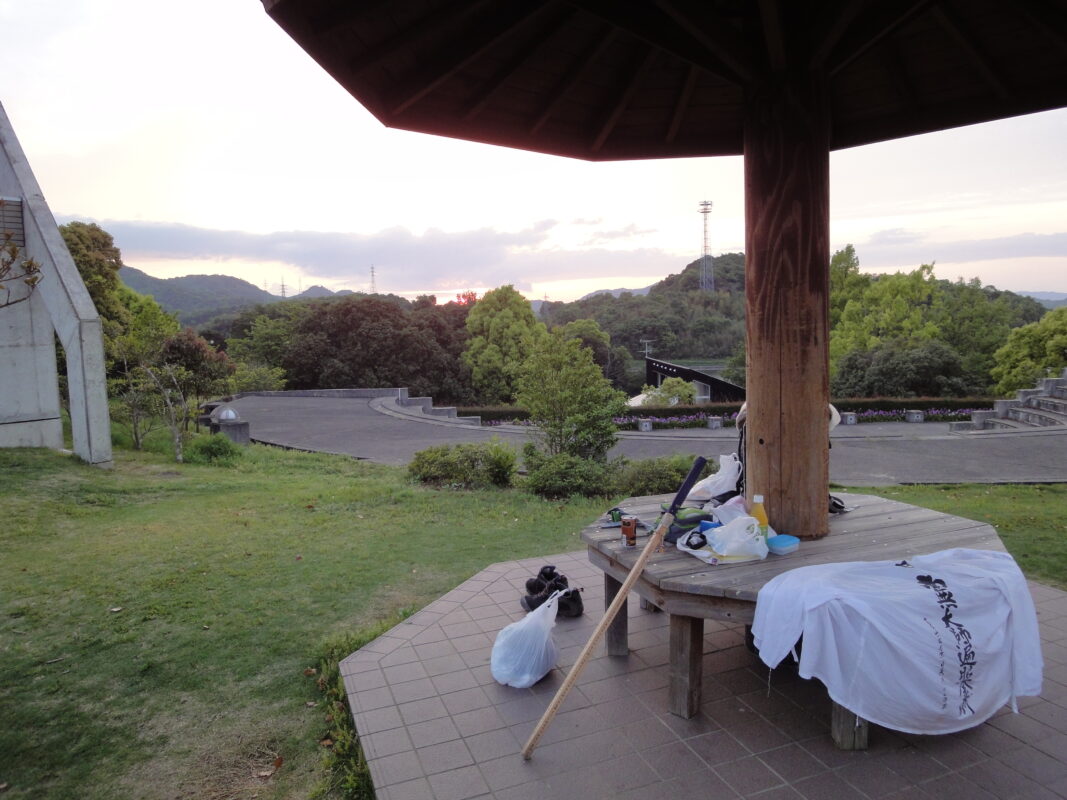
Many people think that walking the Shikoku pilgrimage becomes easier if you simply reduce the weight of your backpack. However, it is not just about weight. Even with the same load, the way you pack your backpack can greatly affect how tired you feel. Based on my experience of walking all the way to the final temple, I have summarized a packing method that reduces fatigue.
- Walking the Shikoku Pilgrimage: Reducing Pack Weight Alone Is Not Enough to Prevent Fatigue
- Why backpack balance matters in walking the Shikoku pilgrimage
- The key factor in walking the Shikoku pilgrimage is backpack balance
- Why a waist pouch is useful in walking the Shikoku pilgrimage
- Walking Shikoku Pilgrimage | Ideal Backpack Packing for Reducing Fatigue
- Results of changing how I packed my backpack during section walks
- Frequently Asked Questions (FAQ)
- Conclusion
- Related Articles
Walking the Shikoku Pilgrimage: Reducing Pack Weight Alone Is Not Enough to Prevent Fatigue
When you look into walking the Shikoku pilgrimage, you often come across the advice that “you should reduce your pack weight.”
Of course, reducing weight is important.
In fact, when I first did a section walk, I was able to ease the physical burden quite a bit by cutting down my luggage.
However, after walking all the way to the final temple, what I truly realized was that “simply making it lighter is not enough.”
Fatigue is not determined only by the total weight of your pack.
Even with the same weight, the way you distribute items inside your backpack can significantly change the strain on your body.
Why backpack balance matters in walking the Shikoku pilgrimage
When walking, the body does not simply move forward. It constantly and unconsciously adjusts balance in all directions—front, back, left, and right.
If the center of gravity of your backpack is off, these compensatory movements increase.
For example, if the load is too far away from your back, or unevenly shifted to one side, your body has to keep correcting that tilt.
Even though each adjustment is small, walking the pilgrimage means repeating tens of thousands of steps.
As a result, this leads to:
- unnecessary energy consumption
- misalignment in stride and foot placement
- increased strain on the legs and lower back
The key factor in walking the Shikoku pilgrimage is backpack balance
Fatigue is not determined only by the total weight of your load.
Even with the same 8 kg, the physical strain changes depending on where the items are placed inside your backpack.
The reason is related to the moment around the center of gravity (torque).
Why keeping heavy items close to your body reduces fatigue
The idea is simple.
The farther a heavy object is from your body, the greater the force that pulls and destabilizes you.
Rotational force (moment) is expressed as:
weight × distance
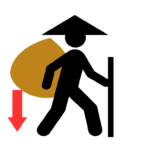
In other words, even with the same 1 kg load, the impact changes depending on distance:
- 5 cm from the body
- 25 cm from the body
These differences significantly affect the physical burden.
Even with the same 8 kg, fatigue changes depending on how you pack it
For example, let’s assume a total backpack weight of 8 kg.
A: Random packing
| Item | Weight | Distance from body |
|---|---|---|
| Water | 1 kg | 25 cm |
| Tent | 1 kg | 20 cm |
| Clothes | 1 kg | 15 cm |
| Others | 5 kg | 15 cm |
Scroll for more
Total moment
= 1×25 + 1×20 + 1×15 + 5×15
= 135
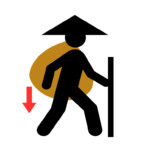
B: Balanced packing (center of gravity considered)
| Item | Weight | Distance from body |
|---|---|---|
| Water | 1 kg | 10 cm |
| Tent | 1 kg | 10 cm |
| Clothes | 1 kg | 8 cm |
| Others | 5 kg | 12 cm |
Scroll for more
Total moment
= 1×10 + 1×10 + 1×8 + 5×12
= 88
Result:
A = 135
B = 88
→ about 35% reduction
Even though the total weight is the same (8 kg), the rotational force acting on the body is significantly reduced.
This is one of the reasons why “the same weight can feel very different in terms of fatigue.”
Why a waist pouch is useful in walking the Shikoku pilgrimage
An interesting example is the waist pouch.
Let’s say you carry 500 g of trail food.
A: Stored in the upper part of the backpack
Position: about 20 cm behind the body
Moment:
0.5 × 20 = 10
This creates a force that pulls your body backward.
B: Stored in a waist pouch
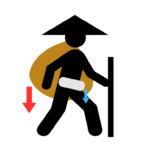
Position: about 10 cm in front of the body
Moment:
0.5 × (−10) = −5
The value becomes negative because it is placed in front of the body.
In other words, it partially cancels out the backward moment.
Visual image (side view)
A: Top of backpack
      500 g
        ●
        │
     [Body]
← pulled backward
B: Waist pouch
[Body]   │
   ●
 500 g

← forward position offsets backward moment
Of course, this does not mean “the more you put in front, the better.”
If you overdo front loading, it can cause other problems:
- Restricts hip movement
- Causes swaying
- Interferes with body rotation while walking
However, for around 500 g of items such as rice balls or trail food:
- easier access for eating
- fewer times opening the backpack
- partial cancellation of backward moment
From this perspective, a waist pouch is a very rational choice in walking the Shikoku pilgrimage.
Walking Shikoku Pilgrimage | Ideal Backpack Packing for Reducing Fatigue
In the Shikoku pilgrimage, it becomes easier to organize your backpack if you consider not only weight, but also shape and frequency of use.
For example, tents and sleeping bags are often long cylindrical shapes, and placing them in the center of the back takes up a lot of space.
On the other hand, water and food are heavy, but they are frequently taken out during the walk.
Therefore, in practice, it is more realistic to think in terms of three factors:
weight, shape, and usage frequency
Packing list example
| Item | Weight (approx.) | Recommended placement | Reason |
|---|---|---|---|
| Tent | 1 kg | Either side pocket (balanced with opposite side) | Long shape, easy to store |
| Sleeping bag | 500 g | Opposite side pocket | Balances the tent |
| Clothes (2 days) | 1 kg | Center near the back | Heavy, rarely taken out |
| Raincoat | 400 g | Bottom / lower back | Only used in rain |
| Toiletries | 300 g | Bottom | Low usage frequency |
| Pilgrimage supplies (stamp book etc.) | 500 g | Upper part | Taken out at each temple |
| Water (500 ml × 2) | 1 kg | Side pockets | Balanced left/right, easy access |
| Food / trail snacks | 500 g | Upper part / waist pouch | Used while walking |
Scroll for more
Lower section | Low-frequency items
The bottom of the backpack is for items that are used infrequently.
- Toiletries
- Raincoat
- Some clothing
Soft or light items are also useful here, as they help fill gaps inside the pack.
Back-center area | Heavy items first
This is the most important area.
- Clothing
- Heavy small items
- Tent fabric
The heavier the item, the closer it should be to your body. This reduces body sway.
On sections with fewer temple stops, even pilgrimage notebooks can be placed here effectively.
Upper section | Quick-access items
Items used during the walk should be placed at the top.
- Trail snacks
- Pilgrimage supplies
In walking pilgrimages, being able to access items quickly is very important.
Side pockets | Balance left and right
The key point here is to avoid left-right weight imbalance.
- Water bottles (500 ml × 2)
- Tent poles / sleeping bag components
Waist pouch | Items used while walking
If you use a waist pouch, it is useful for items you want to access immediately:
- Trail snacks
- Coins / small wallet
- Smartphone
- Tissues
Keeping a small coin wallet here is especially convenient, as it allows you to use vending machines or make small payments without taking off your backpack.
Results of changing how I packed my backpack during section walks
My first Shikoku pilgrimage section walk in Tokushima: poor preparation led to foot pain
During my first section walk in Tokushima, I was simply not well prepared.
I packed in anything that seemed necessary and placed items randomly wherever there was space in the backpack.
At the time, I thought, “It’s heavy, but there’s no choice.”
However, once I started walking, I began to feel pain in my feet, and the level of fatigue was far beyond what I expected.
I also developed blisters.
Back then, I thought it was simply because I wasn’t used to walking long distances, but looking back now, I believe the way I carried my load was also a major factor.
I reduced weight and also improved how I packed my gear
On my next section walk, I first reviewed my gear.
I removed items I was carrying “just in case” and kept only what was truly necessary.
But the change was not only about reducing weight.
I also focused on how I packed:
- Heavier items closer to the back
- Reduced left-right weight imbalance
- Frequently used items placed on the top or sides
- Trail food placed in a waist pouch
In other words, I began to consciously manage the center of gravity of the backpack.
After adjusting packing, fatigue changed significantly
The result was clearly different.
Of course, part of this improvement may have come from getting used to walking and building physical strength.
However, the difference in fatigue was too large to be explained by that alone.
During my first Tokushima walk, I developed foot pain and blisters.
After revising how I packed my backpack, I no longer experienced foot pain.
I also no longer developed blisters.
Personally, I originally thought that walking the Shikoku pilgrimage was mainly a matter of physical endurance.
But after completing the pilgrimage, I realized that not only fitness, but also how you carry your load plays a major role.
Even with the same total weight, how you pack your backpack can dramatically change how easy it is to walk.
Frequently Asked Questions (FAQ)
- QHow heavy should a backpack be for walking the Shikoku pilgrimage?
- A
It depends on your physical strength and accommodation style, but most people keep it around 7–10 kg.
However, not only weight but also keeping heavy items close to the body is important for reducing fatigue.
- QWhere should heavy items be placed in a Shikoku pilgrimage backpack?
- A
Heavy items such as clothes are best placed in the center area close to your back.
The farther the load is from your body, the greater the body sway, which can lead to faster fatigue.
- QWhat should be placed in the side pockets of a pilgrimage backpack?
- A
Items used during the walk, such as water, should be placed evenly on both sides.
A large left-right imbalance can disrupt walking balance.
- QIs a waist pouch necessary for walking the Shikoku pilgrimage?
- A
It is not essential, but it is very useful for carrying frequently used items such as trail food, a smartphone, or a small wallet.
It also reduces the number of times you need to take off your backpack.
- QIs there an ideal way to pack a backpack for less fatigue during the pilgrimage?
- A
Yes. A recommended method is to place heavy items closer to your back, and store frequently used items in the upper section or side areas.
Even with the same total weight, how the load is distributed can significantly change how easy it is to walk.
Conclusion
In the Shikoku pilgrimage, it is important not only to reduce backpack weight, but also to keep heavy items close to your body.
From my own experience, I felt significantly less fatigue after I started paying attention to how I packed my backpack, compared to when I was only focused on reducing weight.
Even with the same 8 kg load, walking comfort can change greatly depending on how the weight is distributed.
If you are planning to walk the pilgrimage, I recommend taking a moment before departure to review the position of items inside your backpack.
Related Articles
Essential Gear for Walking the Shikoku Pilgrimage: Complete Packing List.
Essential Gear for the Shikoku Pilgrimage