
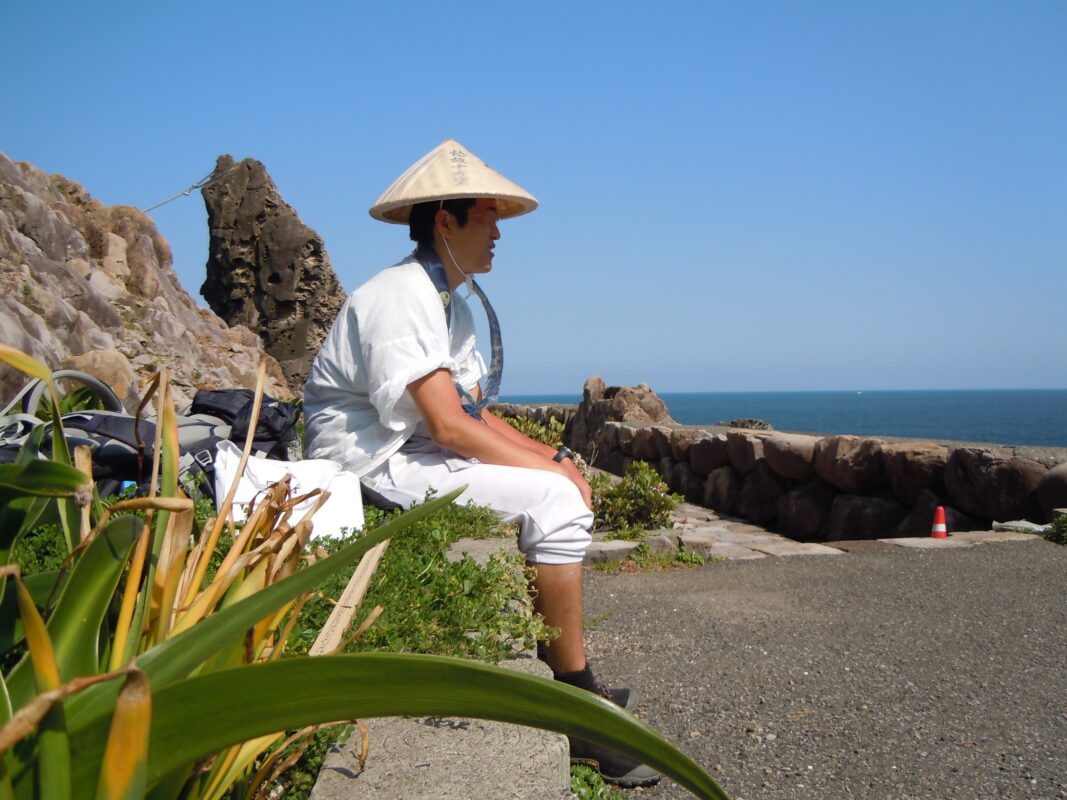
An Ohenro-san is a person who travels around the Shikoku 88-temple pilgrimage route in Japan.
In simple terms, it refers to someone who completes the pilgrimage of the 88 Buddhist temples across Shikoku.
In many cases, people also view this journey as a “life journey,” walking the path as a way of reflecting on their own lives.
In the past, the pilgrimage was mainly associated with religious practice and ascetic training. However, today more and more people join the pilgrimage for a variety of reasons, such as wanting to “walk it at least once in their lifetime,” “reflect on themselves,” or “experience the nature and culture of Shikoku.”
There are no strict rules about how to complete the pilgrimage. While some people walk the entire route on foot—known as “walking pilgrims”—others travel by car, bus, or bicycle. One of the attractions of the Ohenro pilgrimage is that people can choose the method that best suits them.
- Basic Meaning of Ohenro (Shikoku Pilgrimage)
- The Origins of the Ohenro Pilgrimage
- What Do You Actually Do on the Ohenro Pilgrimage?
- What I Felt After Completing the Ohenro Pilgrimage Twice (Forward and Reverse)
- Differences I Felt Between the Forward and Reverse Pilgrimage
- Estimated Time and Cost Required for the Ohenro Pilgrimage
- What Beginners Should Know Before Starting the Ohenro Pilgrimage
- Frequently Asked Questions (FAQ)
- Summary
- Related Articles
Basic Meaning of Ohenro (Shikoku Pilgrimage)
The term “Ohenro” refers to the pilgrimage of visiting the 88 sacred temples (fudasho) of Shikoku, Japan. A person who undertakes this journey is called an “Ohenro-san” (pilgrim).
Unlike a simple sightseeing trip to temples, the Ohenro pilgrimage has traditionally been associated with religious devotion and ascetic practice.
However, in modern times, people join the pilgrimage for a wide variety of reasons beyond religious purposes, such as:
- wanting to reflect on themselves
- praying for wishes or making vows
- memorial prayers for the deceased
- seeking health or a sense of accomplishment
- simply wanting to walk across Shikoku
Each pilgrim has their own personal motivation for undertaking the journey.
Personally, I have completed the pilgrimage twice on foot, including both the forward route (jun-uchi) and the reverse route (gyaku-uchi). Before walking it, I strongly associated the pilgrimage with simply “visiting temples.” However, in reality, what left the greatest impression on me was not the temples themselves, but the time spent reflecting inward and the encounters with other people along the way.
For a summary of the various motivations of pilgrims I met during my journey, see the following article:
What Is the Purpose of the Shikoku Pilgrimage? Real Experiences from 88 Temples
Relationship with the Shikoku 88-Temple Pilgrimage
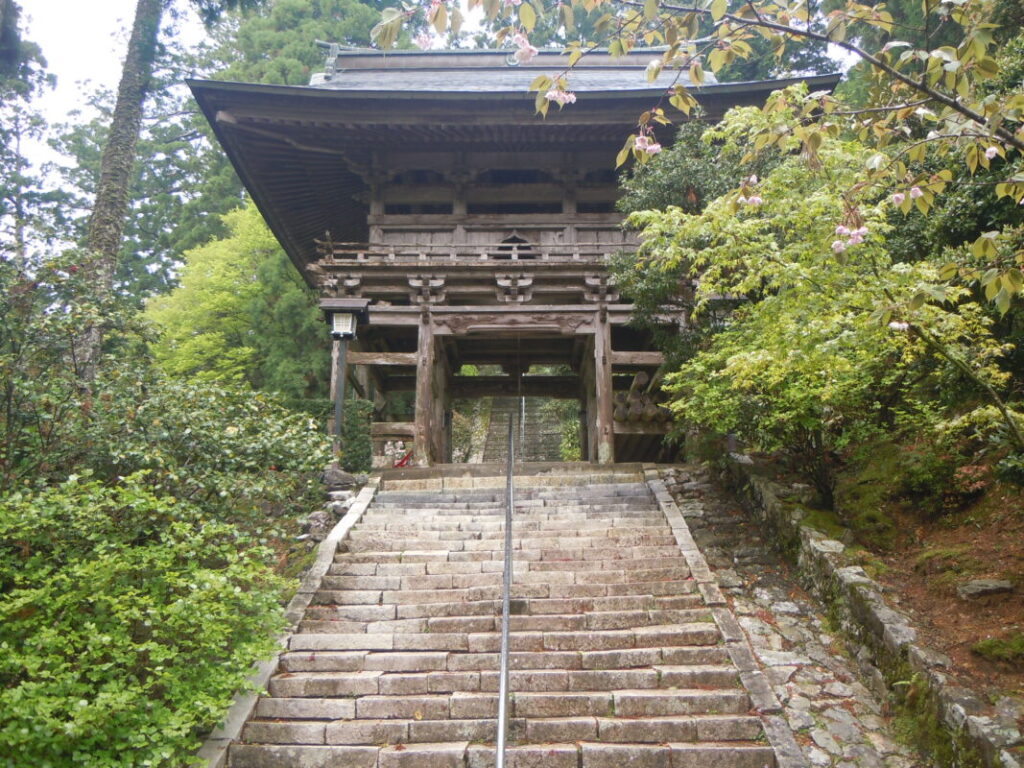
The Shikoku 88-temple pilgrimage refers to 88 Buddhist temples located across the four prefectures of Shikoku, Japan.
These temples are traditionally divided into four stages of the spiritual journey:
- Tokushima Prefecture: The “place of awakening” (Dojo of Awakening)
- Kochi Prefecture: The “place of ascetic training” (Dojo of Discipline)
- Ehime Prefecture: The “place of enlightenment” (Dojo of Enlightenment)
- Kagawa Prefecture: The “place of nirvana” (Dojo of Nirvana)
During the pilgrimage, travelers visit all 88 temples. However, there is no strict rule that the journey must begin at Temple No. 1.
One common style is the “forward pilgrimage” (jun-uchi), where pilgrims travel from Temple No. 1 to Temple No. 88. Another is the “reverse pilgrimage” (gyaku-uchi), which goes in the opposite direction—from Temple No. 88 back to Temple No. 1.
There are also various other ways to complete the route, and pilgrims are free to choose the style that best suits their purpose and circumstances.
Why Are Pilgrims Called “Ohenro-san”?
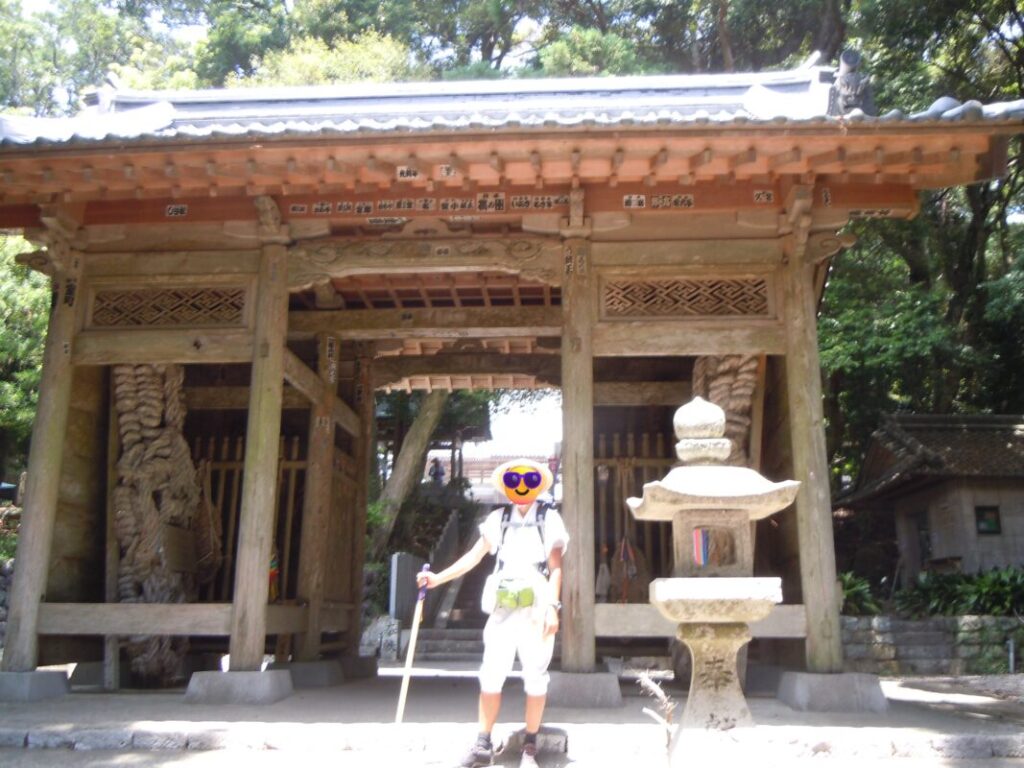
The word “henro” refers to the act of traveling around and walking through a wide area, especially as part of a pilgrimage.
By adding the honorific suffix “-san”, which expresses respect and familiarity, the term “Ohenro-san” became widely used to refer to pilgrims on the Shikoku pilgrimage.
Even today in Shikoku, it is common for local people to encourage walking pilgrims by saying things like, “Good luck, Ohenro-san!”
Another important aspect of Ohenro culture is a tradition called “Osettai.” This refers to the practice of local people offering food, drinks, or words of encouragement to pilgrims free of charge.
While walking the pilgrimage route, it is not unusual to hear kind words such as “Take care” or “You’re almost there.”
In this way, the Ohenro pilgrimage is not only a journey of visiting temples, but also a journey filled with human connection and kindness along the way.
The Origins of the Ohenro Pilgrimage
Today, the Ohenro pilgrimage is widely known as a journey to visit the Shikoku 88-temple pilgrimage route. However, its origins go back many centuries and have a long historical background.
The Ohenro pilgrimage was not originally a form of tourism. It began as a religious practice and an ascetic journey rooted in Buddhist faith.
Over time, the form of the pilgrimage has gradually changed while being passed down through generations. In modern times, it is no longer limited to religious devotion alone. Many people now walk the pilgrimage as a way to seek self-discovery or to mark important turning points in their lives.
The Relationship Between Kūkai and the Ohenro Pilgrimage
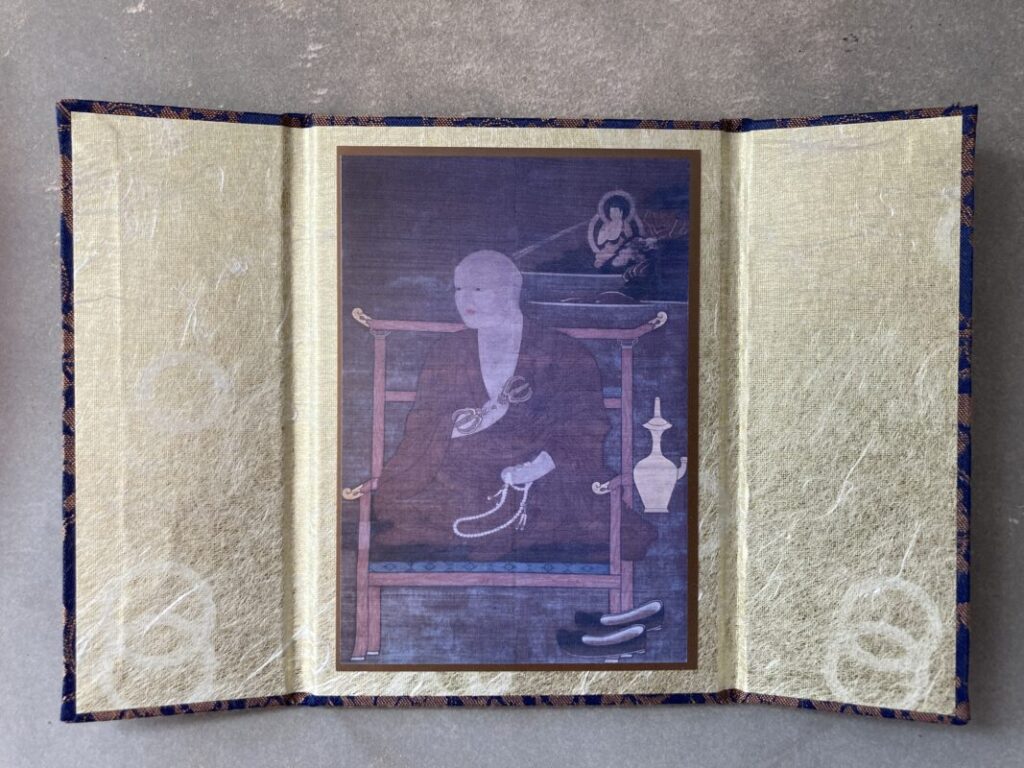
When discussing the Ohenro pilgrimage, one historical figure who cannot be left out is Kūkai, widely known as Kōbō Daishi.
Kūkai was a Buddhist monk born in the Heian period and is known as the founder of Shingon Buddhism. There are many legends that he practiced ascetic training in Shikoku, and places associated with him can be found throughout the island.
There is no definitive historical record proving that Kūkai himself established all 88 temples of the Shikoku pilgrimage in their current form. However, over a long period of history, the pilgrimage gradually developed into a route that is closely connected to places associated with him.
For this reason, devotion to Kōbō Daishi remains deeply rooted in the Ohenro tradition even today.
When pilgrims visit each temple, it is not simply an act of touring temples. It is also understood as a journey of tracing the footsteps of Kōbō Daishi.
The History of the Shikoku Pilgrimage
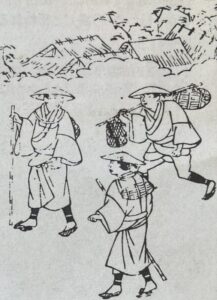
The Shikoku pilgrimage gradually took shape in a form similar to what we see today around the Edo period in Japan.
At that time, there were no modern means of transportation, and most pilgrims traveled entirely on foot. Roads were not well developed, so the journey was considered far more difficult and demanding than it is today.
Despite these hardships, people continued to walk the pilgrimage route for various personal reasons, including:
- prayers for recovery from illness
- memorial prayers for family members
- ascetic training
- wishes and prayers for life goals
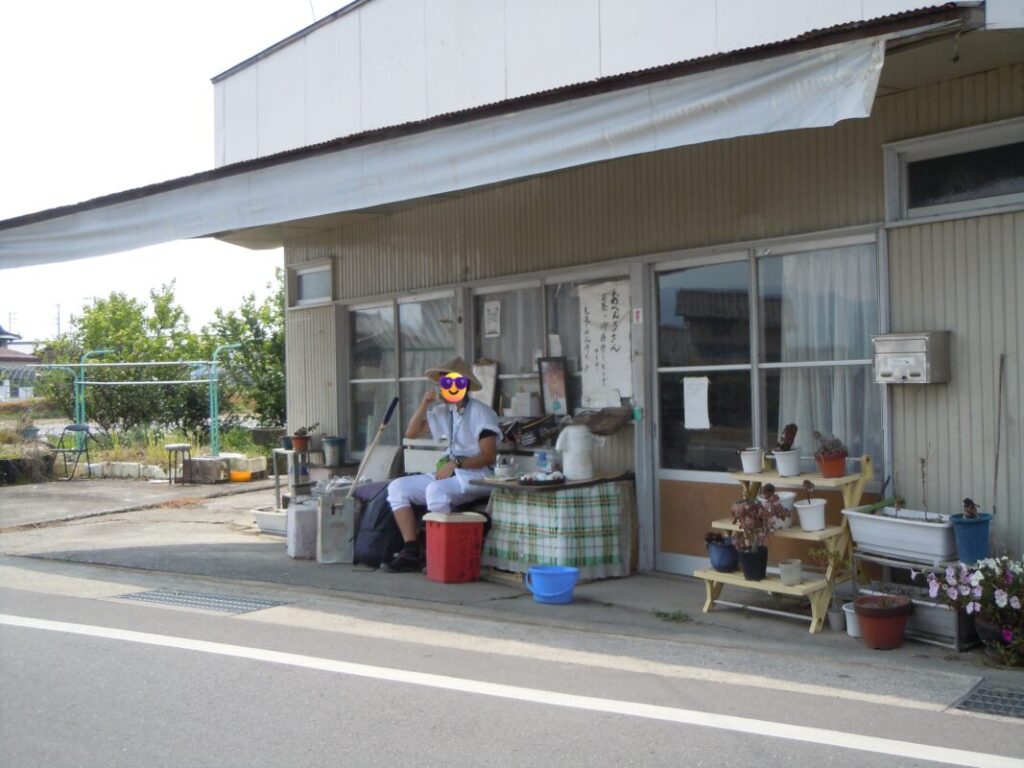
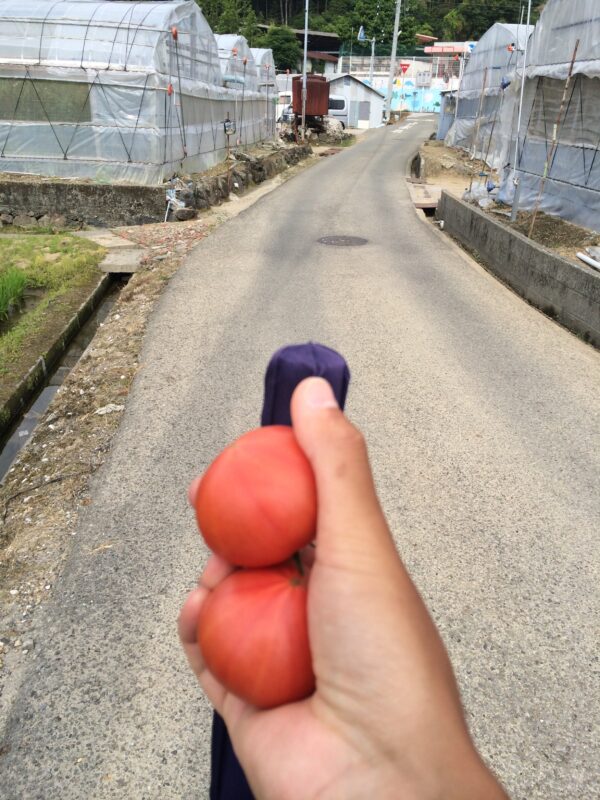
During this time, the culture of “Osettai” also became deeply rooted in the regions of Shikoku. This tradition involves local people offering food, drinks, lodging, or other forms of support to pilgrims.
Even today, this culture remains alive in many parts of Shikoku.
When I personally walked the pilgrimage route, I was also given drinks and words of encouragement by local people. In that moment, I truly felt that “Osettai,” which I had only known as history, is still a living tradition today.
Osettai tea offering in Tokushima
Osettai tomatoes received in Kochi
The Meaning Behind “Dōgyō Ninin” (Walking with Two)
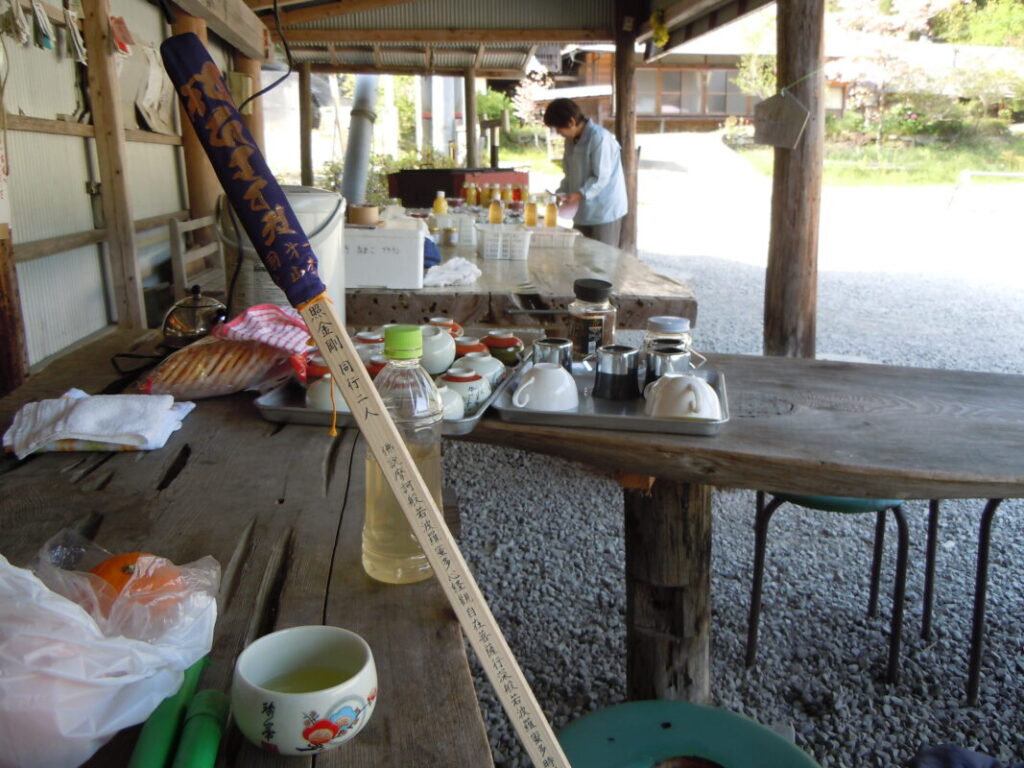
During the Shikoku pilgrimage, you will often see the phrase “Dōgyō Ninin”.
It is commonly written on a pilgrim’s white clothing (hakui) or walking staff (kongō-zue), so some people may recognize it.
“Dōgyō Ninin” literally means “two traveling together.”
In the context of the pilgrimage, it expresses the idea that the pilgrim is walking together with Kōbō Daishi (Kūkai).
Even when a person is physically walking alone, it is believed that Kōbō Daishi is always by their side, accompanying them on the journey.
Along the long pilgrimage route, there are days when pilgrims feel tired or uncertain. In walking pilgrimages especially, there are times spent alone on mountain paths or hours without meeting anyone.
However, when pilgrims understand the meaning of “Dōgyō Ninin,” many say they no longer feel as if they are truly alone.
This belief may be one of the reasons why the Ohenro pilgrimage is not just a journey of travel, but a deeply meaningful and personal experience for many people.
What Do You Actually Do on the Ohenro Pilgrimage?
Some people who are interested in the Ohenro pilgrimage may wonder, “What do you actually do during the journey?”
At first, many people imagine it as simply visiting 88 temples. However, in reality, pilgrims perform basic prayers at each temple and collect stamps known as nōkyō as they make their way through the pilgrimage route.
That said, there are no overly strict rules, and even beginners can start the pilgrimage without difficulty.
Before I began my own walking pilgrimage, I also had the impression that the customs and practices might be complicated. However, once I started walking, I gradually became familiar with them, even if I did not fully understand everything at first.
Basic Temple Visit Procedure on the Ohenro Pilgrimage
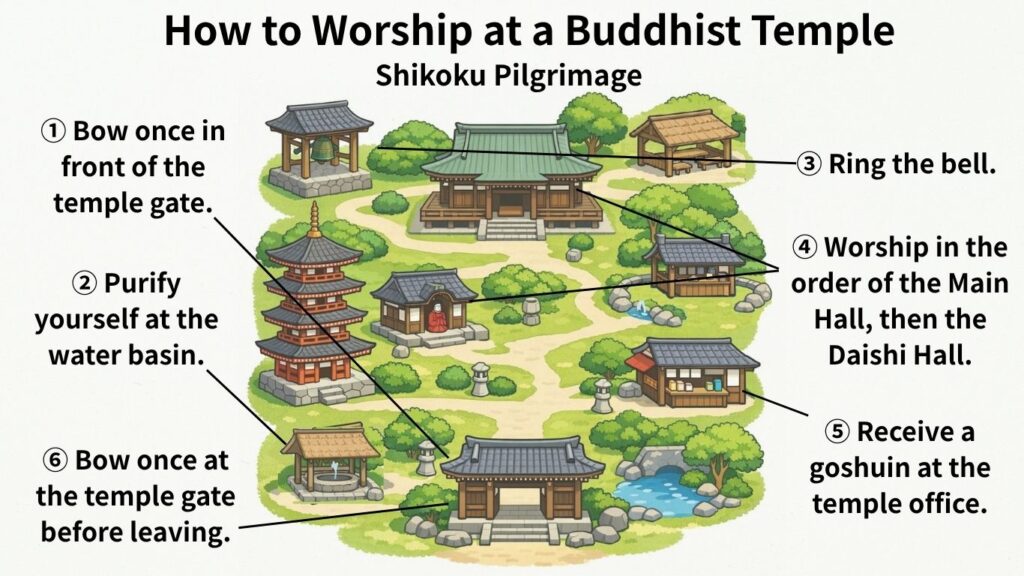
On the Shikoku pilgrimage, it is common to visit each temple and receive a nōkyō (temple stamp) as part of the journey.
The basic flow of worship at each temple is generally as follows:
- Bow once at the temple gate (sanmon)
- Purify your hands and mouth at the water pavilion (temizuya)
- Offer prayers at the main hall (hondō)
- Offer prayers at the Daishi Hall (daishidō)
- Receive your temple stamp at the nōkyō office
- Bow again before leaving
While there are slight variations in how people worship, many pilgrims offer candles and incense, and some also recite sutras.
However, it is not necessary to memorize sutras in order to complete the pilgrimage.
In practice, you will see a variety of approaches—some people quietly join their hands in prayer, while others recite sutras aloud. Each person follows their own style of worship.
There is no need to know everything perfectly from the beginning.
For more detailed information on how to visit temples, please refer to the article below.
How to Worship at Japanese Temples : Shikoku Pilgrimage Guide
The Difference Between a Nōkyōchō and a Goshuin
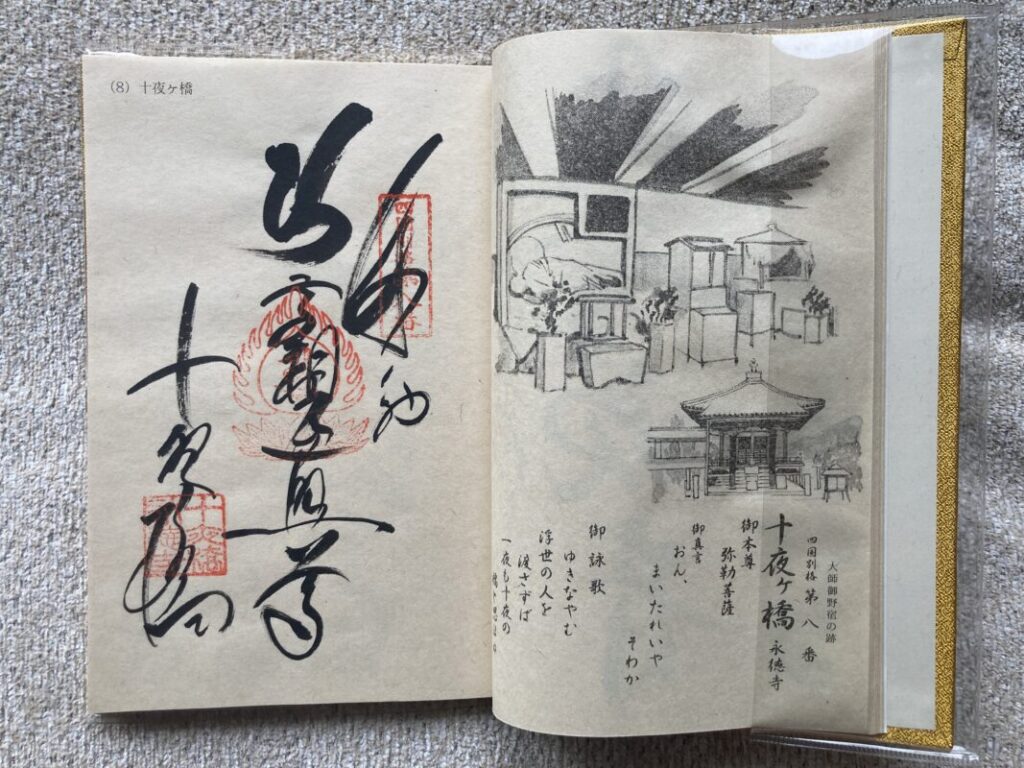
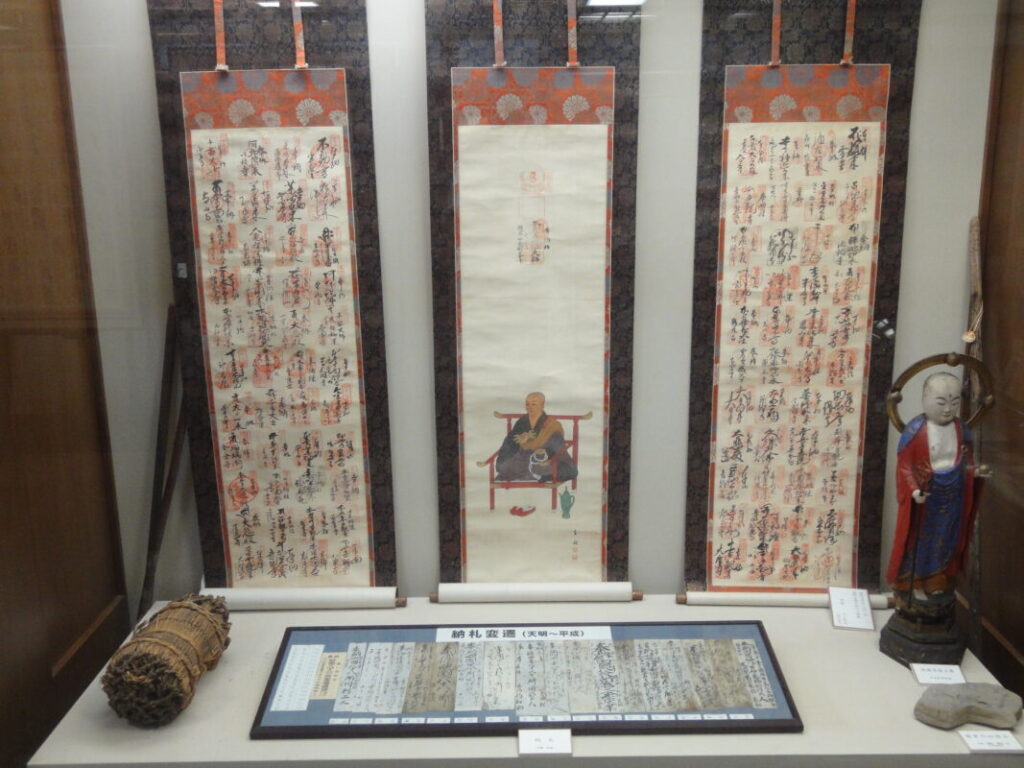
One point that often confuses first-time Ohenro pilgrims is: “Are a nōkyōchō and a goshuin the same thing?”
In short, they are similar in appearance, but their meanings are slightly different.
A nōkyōchō is a dedicated notebook used in the Shikoku pilgrimage to record visits to each temple. Pilgrims receive stamps and calligraphy in this book as proof of completing each temple visit.
Originally, “nōkyō” referred to the practice of submitting handwritten Buddhist sutras (shakyō) to a temple as an offering. In the past, this act of dedicating sutras was required, but today it is common to receive a nōkyō simply as proof of worship without submitting a sutra.
On the other hand, a goshuin is a seal or stamp given as proof of visiting a shrine or temple in general.
Although they may look similar today, in the context of the Ohenro pilgrimage, the nōkyō carries a stronger meaning as a “record of pilgrimage.”
When walking the pilgrimage route, many pilgrims find great encouragement in watching their nōkyōchō gradually fill up.
After walking for many days, looking back through the pages often brings a strong sense of achievement—realizing how far they have come.
Differences Between Walking, Driving, and Bus Pilgrimages
There are several ways to complete the Shikoku pilgrimage, not just on foot.
Each method has its own characteristics:
Walking pilgrimage
- You can move at your own pace
- Provides a strong sense of accomplishment
- Allows you to fully experience the landscapes of Shikoku and encounters with people
- Requires significant time and physical endurance
Driving pilgrimage
- Easier to complete in a shorter period
- Suitable for families or groups
- Less physically demanding
Bus pilgrimage
- No need to plan routes or navigation
- Easy for beginners to join
- Allows efficient visits to many temples
There is no single “correct” way to do the pilgrimage.
I personally completed the pilgrimage on foot in both the forward and reverse directions, and I experienced many landscapes and encounters that can only be found by walking.
However, everyone has different purposes.
For those who simply want to “try the experience once,” starting with a car or bus pilgrimage is also a perfectly valid choice.
What I Felt After Completing the Ohenro Pilgrimage Twice (Forward and Reverse)
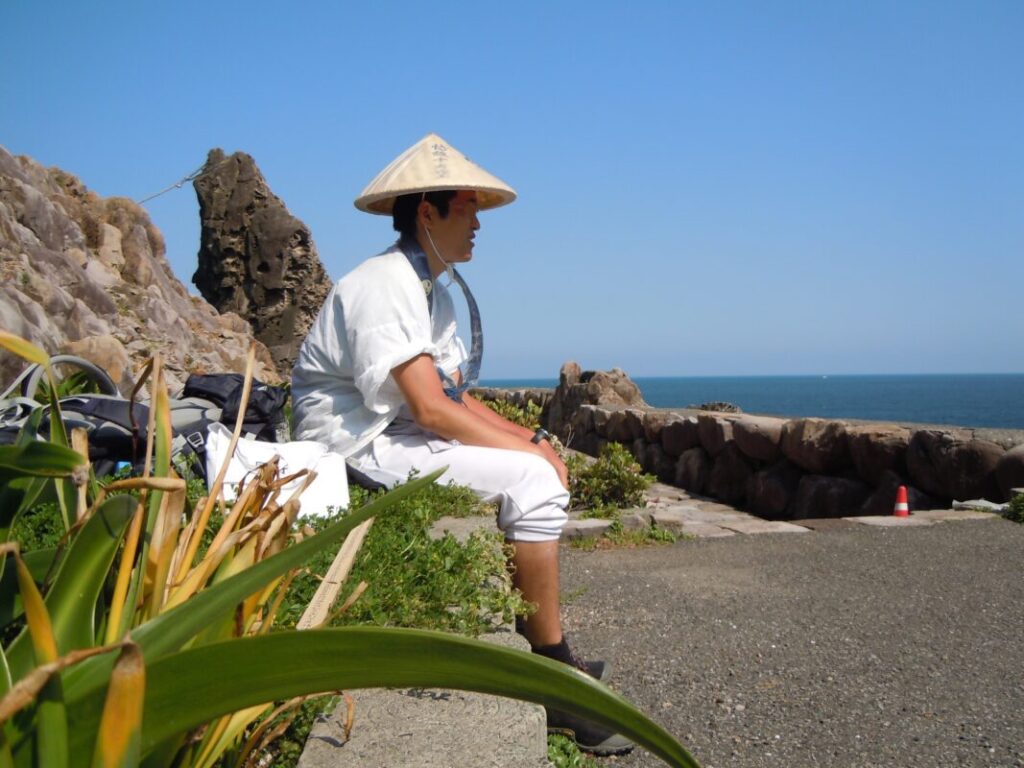
Before I began the walking pilgrimage, I had a strong image of it as a form of ascetic practice.
I imagined it as a harsh journey where one walks long distances alone in silence, overcoming difficulties entirely on their own, without relying on anyone else. I thought it would be a strict path of continuously facing oneself.
Before actually starting the pilgrimage, I remember imagining that it would be a very lonely journey.
The Ohenro Pilgrimage as I Imagined It Before Walking
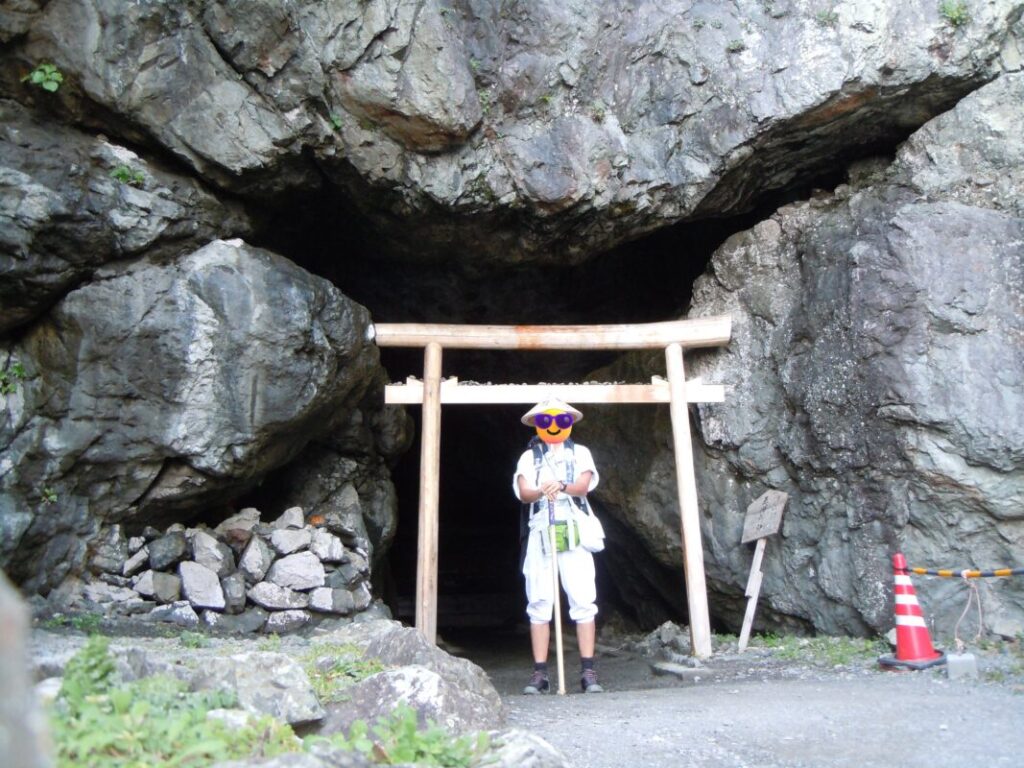
The Ohenro pilgrimage I had envisioned was, quite literally, a form of ascetic practice.
Walking alone in silence
Solving all difficulties by myself
Enduring hardship until the very end
A constant battle with myself
The walking pilgrimage is said to cover a long distance of over 1,200 kilometers.
Because of that, I believed it would not be an easy journey. I also thought it was something that could only be completed through one’s own strength, without relying on anyone else.
What I Actually Felt While Walking the Pilgrimage
However, what I felt after actually starting the pilgrimage was quite different from what I had imagined.
Rather than feeling like I was walking alone, I had a much stronger sense that I was not truly alone on the journey.
As I walked, I was often greeted by many people—from small children to elderly locals—who would kindly speak to me.
“Good luck, Ohenro-san.”
Even such a simple phrase strangely made my fatigue feel lighter.
I also became aware of the many forms of support along the route: people maintaining the pilgrimage paths, those managing direction signs, and others offering free lodging known as zenkon-yado.
Only after walking the route myself did I truly realize that the Ohenro pilgrimage is not something completed alone, but a culture sustained by the support of many people.
I also naturally became more aware of the presence of Kōbō Daishi, who is believed to have connected this tradition across a long history.
In addition, encounters with other pilgrims left a strong impression on me.
People walk for different reasons. Some are making prayers or vows, others are at turning points in their lives, and some are searching for themselves.
Yet everyone shares the same goal:
to complete all 88 temples.
Even though the purposes are different, everyone walks the same path.
That feeling was both fascinating and deeply mysterious.
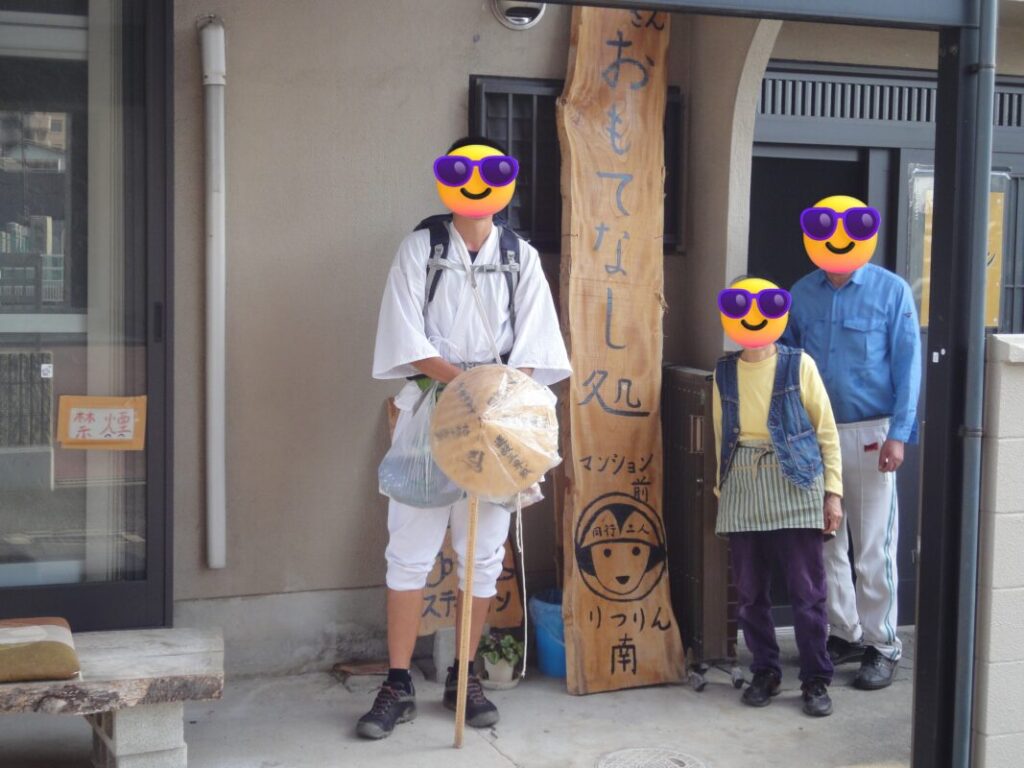
The Most Memorable Moment
The most memorable moment for me was when I was walking while feeling exhausted and received words of encouragement from a complete stranger.
At that time, my legs felt heavy, and I was barely managing to move forward step by step.
Then someone passing by said, “Good luck, Ohenro-san.”
It was only a short phrase, but I still remember how unexpectedly happy it made me feel in that moment.
Before I started walking, I thought of the pilgrimage as a form of ascetic practice—something you must overcome entirely on your own.
But what I actually experienced was a strong sense of connection with other people.
Even now, after completing the walking pilgrimage twice, I strongly feel that the Ohenro pilgrimage is not just a journey of visiting temples, but also a journey supported by the kindness of others.
Differences I Felt Between the Forward and Reverse Pilgrimage
In the Ohenro pilgrimage, there are two main ways of traveling the route: “jun-uchi” (forward pilgrimage), which goes from Temple 1 to Temple 88, and “gyaku-uchi” (reverse pilgrimage), which goes from Temple 88 back to Temple 1.
It is often said that reverse pilgrimage is more difficult or brings greater spiritual benefits. However, when I actually walked both routes, the biggest difference I felt was not related to faith, but rather to how easy or difficult the roads were to walk.
I have personally experienced both the forward and reverse walking pilgrimages, and the difference between them was greater than I had expected.
What I Felt While Walking the Forward Pilgrimage
The first thing I felt while walking the forward pilgrimage (jun-uchi) was that it is hard to get lost.
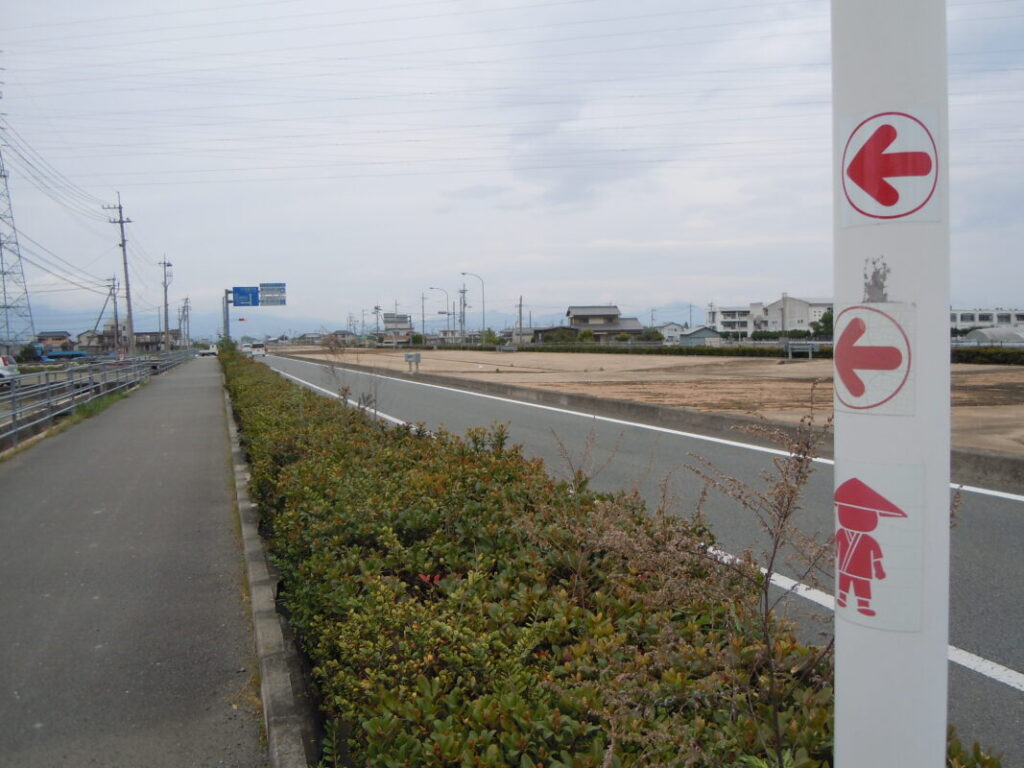
Along the pilgrimage route, there are far more signs and markers than I had expected.
For example:
- guardrails
- utility poles
- signboards
- Ohenro stickers
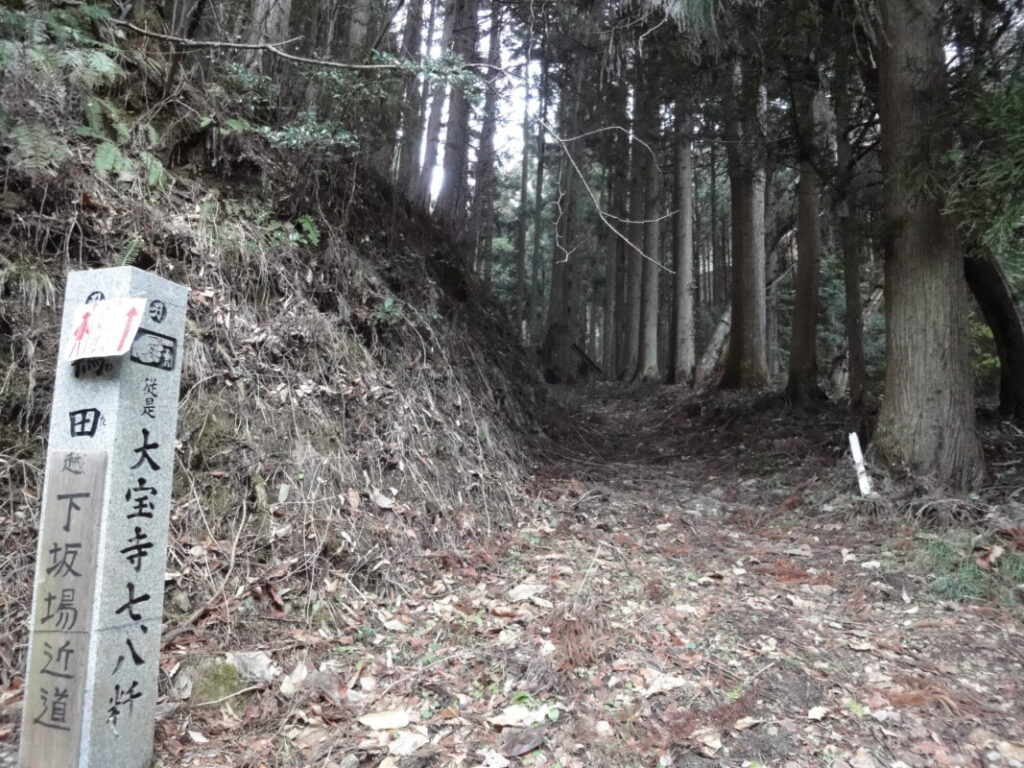
- markers along mountain trails
These guides can be found in many different places along the route.
Especially on mountain paths, I often found myself surprised, thinking, “There’s even a marker here.”
When I was actually walking the forward route, I was able to follow these signs, so I rarely needed to use a smartphone map.
It felt as if I was naturally being guided—“go this way next,” “turn right next”—which allowed me to focus more on the act of walking itself.
A guide sign on a national highway
A guide marker in the mountains
What I Felt While Walking the Reverse Pilgrimage
The reverse pilgrimage (gyaku-uchi) felt more difficult than I had imagined.
The reason is simple: most of the signs and markers along the route are designed for pilgrims walking in the forward direction.
Signs that were easy to notice during the forward pilgrimage become much harder to see when walking in reverse.
In some cases, if you simply follow the signs without thinking, you may end up unknowingly heading in the forward direction instead.
Because of this, while walking the reverse route, I often had to stop and look back to check:
“Am I really going in the opposite direction of the arrows?”
This was especially important on mountain paths and at road junctions.
In the forward pilgrimage, I felt as if I was simply “following the guidance.” In contrast, the reverse pilgrimage required me to constantly “confirm my own direction as I moved forward.”
I was surprised by how different the same route could feel depending on the direction.
Which Is Recommended for Beginners?
If someone is attempting the walking pilgrimage for the first time, I would personally recommend the forward pilgrimage (jun-uchi).
The main reason is that it is much easier to navigate and less likely to get lost.
On the walking pilgrimage, the challenge is not only distance and physical endurance, but also the mental effort of constantly thinking, “Where should I go next?”
With the forward route, the signs and markers are very clear, allowing you to focus more on the act of walking itself.
The reverse pilgrimage (gyaku-uchi) is certainly interesting, but it requires more frequent route confirmation, which can be mentally tiring for beginners.
Even after experiencing both routes myself, my answer remains the same: if it is your first pilgrimage, choose the forward route.
Estimated Time and Cost Required for the Ohenro Pilgrimage
When people first consider trying the Ohenro pilgrimage, two of the most common questions are: “How many days does it take?” and “How much does it cost?”
Before I started walking myself, I also found it difficult to form a clear image of the time and expenses involved.
However, what I learned from actually walking the route is that the conditions vary greatly from person to person.
The number of days required and the total cost depend heavily on factors such as:
- how far you walk each day
- your accommodation style
- whether you take rest days
- how you manage meals
Because of this, it is difficult to give a single fixed answer such as “the walking pilgrimage takes X days and costs Y yen.”
You Can Check Time and Cost Using a Simulator
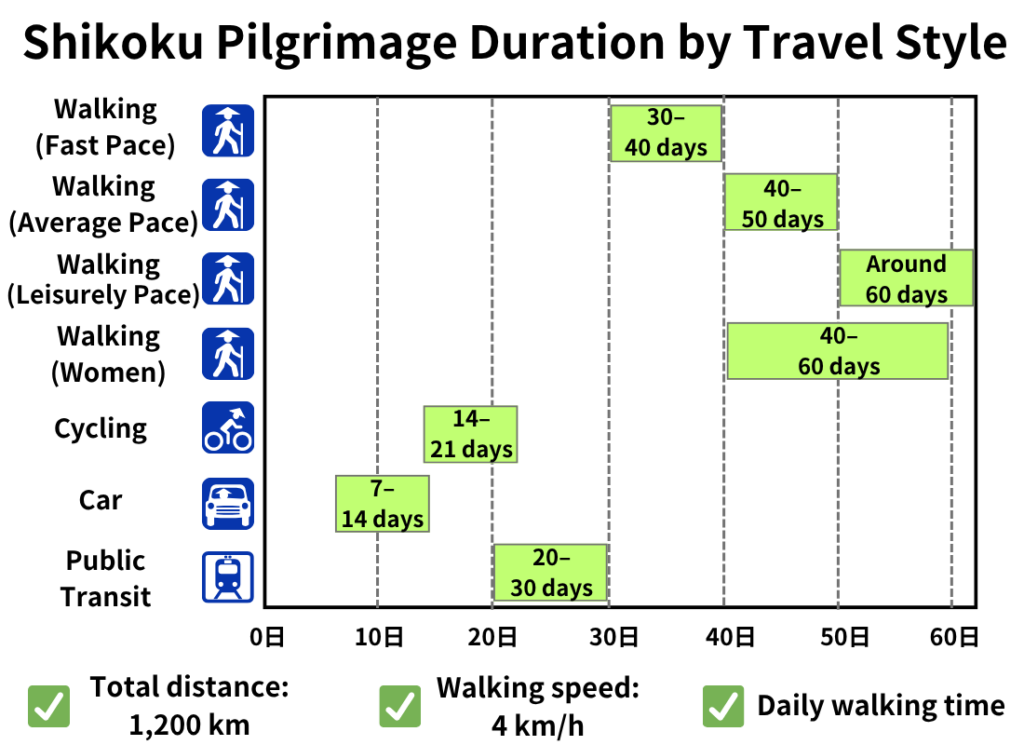
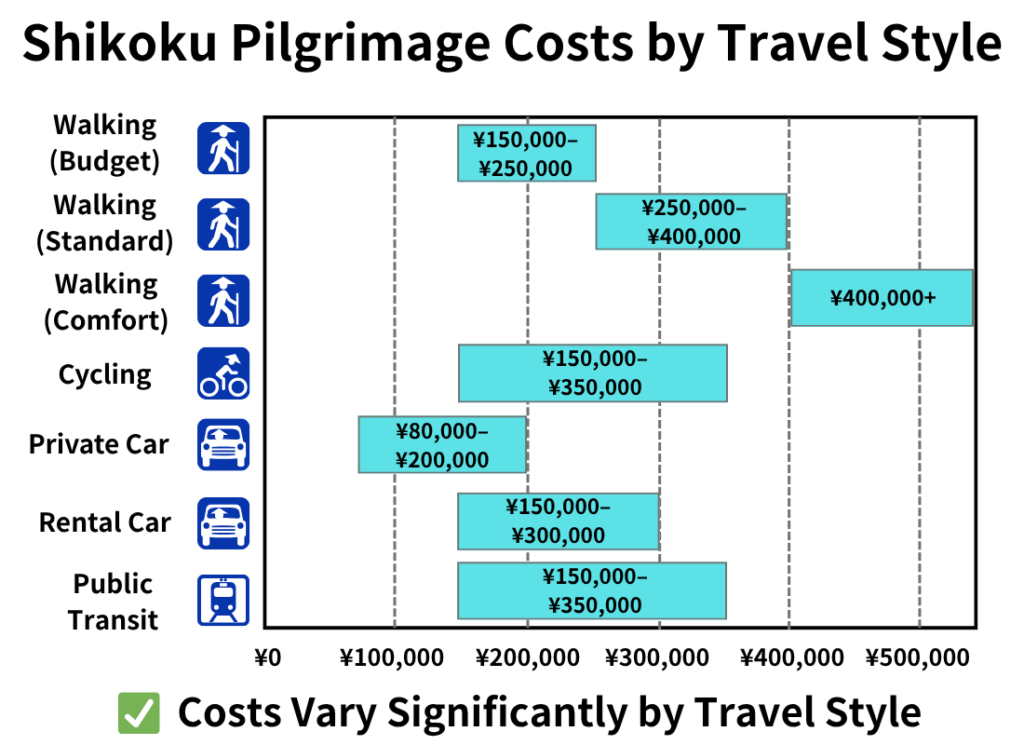
In the walking pilgrimage, the required number of days and budget can vary greatly depending on walking pace and accommodation style.
For example:
- how many kilometers you walk per day
- whether you stay mainly in minshuku (guesthouses) or hotels
- whether you take rest days
- whether you collect temple stamps (nōkyō)
All of these factors can significantly change the overall result.
From my own experience walking the route, I also found that things rarely go exactly as planned.
Some days I was able to walk more than expected, while on other days I had to stop earlier than planned due to fatigue.
Because of this, I created a simulator that allows you to estimate the required time and budget by adjusting different conditions, so you can get a clearer idea before starting.
For example, you can easily check things like:
- “How many days would it take if I walk 20 km per day?”
- “How much budget is needed including accommodation costs?”
If you are considering the walking pilgrimage, I recommend using it as a reference before your departure.
Walking pilgrimage time & cost simulator is available here.
What Beginners Should Know Before Starting the Ohenro Pilgrimage
People who are considering the Ohenro pilgrimage for the first time may wonder, “What should I prepare?” or “Do I need special equipment?”
Before I started my own walking pilgrimage, I also spent a lot of time researching what to bring and what kind of clothing to wear.
However, what I realized after actually starting the journey is that you don’t need to aim for perfection from the very beginning.
Of course, there are some basic essentials, but it is not necessary to have expensive, specialized gear in order to complete the pilgrimage.
It is also common for beginners to make similar mistakes along the way.
I have summarized these in more detail in a separate article, but here I will briefly introduce the key points you should know before starting your journey.
Essential Items to Bring
For the walking pilgrimage, it is important to prepare your belongings with long-distance walking in mind.
However, beginners often tend to overpack, thinking, “I might need this too.”
Before I started my own pilgrimage, I also felt anxious and considered bringing many items. But in reality, I learned that lightness is extremely important.
The essential items to bring, as well as what I personally found useful during the journey, are explained in detail in a separate article.
Walking pilgrimage packing list is available here.
Essential Gear for the Shikoku Pilgrimage
Clothing for the Ohenro Pilgrimage
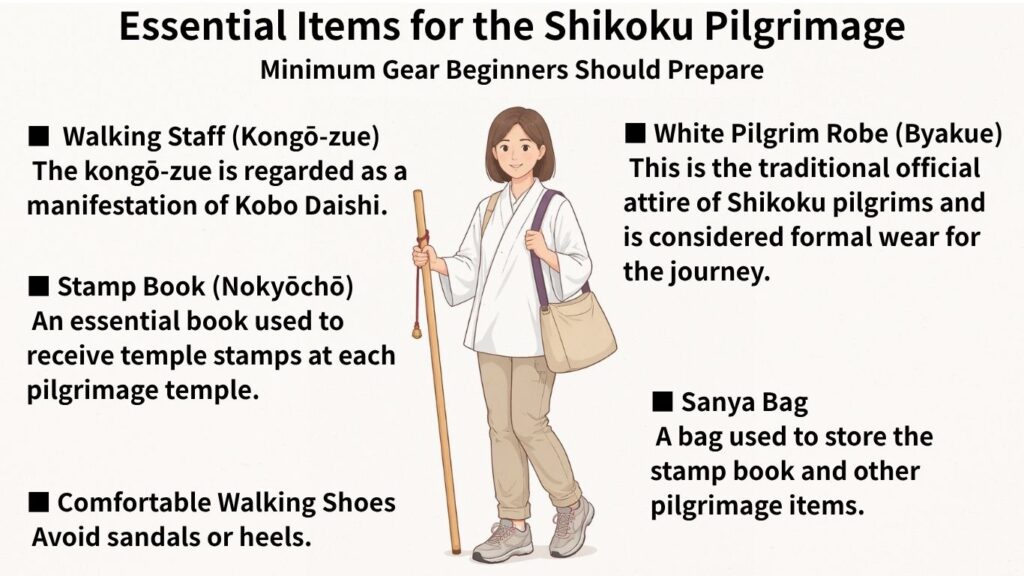
When people think of Ohenro clothing, they may imagine traditional pilgrim attire such as a white robe (hakui) or a sedge hat (sugegasa).
Of course, some pilgrims still walk the route in traditional clothing. However, today many people also walk in practical, comfortable clothing suitable for long-distance travel.
Especially in the walking pilgrimage, I felt that what matters most is not appearance, but rather comfort and ease of walking, as well as reducing fatigue.
Since appropriate clothing also changes depending on the season, it is recommended to check conditions carefully before starting the journey.
Common Mistakes
During the walking pilgrimage, beginners often tend to make similar mistakes.
For example:
- bringing too many items
- starting the journey with unbroken-in shoes
- setting overly ambitious daily distances
- underestimating the importance of hydration
- walking without planning accommodation in advance
From my own experience, I also initially thought that “determination alone would be enough to get through it.”
However, the walking pilgrimage is a long journey that continues for many days.
Rather than pushing too hard at the beginning, I believe that the most important thing is to continue steadily without overexerting yourself.
Frequently Asked Questions (FAQ)
- QWhat is an “Ohenro-san”?
- A
An Ohenro-san refers to a pilgrim who travels the Shikoku 88-temple pilgrimage route. The basic process involves visiting each temple in order, offering prayers, and receiving temple stamps (nōkyō).
- QHow is Ohenro different from sightseeing?
- A
While it can be done as tourism, the Ohenro pilgrimage originally has religious and ascetic roots. Today, many people also walk it for self-reflection or as a life milestone, and motivations vary from person to person.
- QCan beginners do the walking pilgrimage?
- A
Yes, it is possible. However, since the distance is long and requires physical endurance, careful planning is important. Many beginners start with driving pilgrimages or section walking (kugiri-uchi).
- QWhich is better, forward or reverse pilgrimage?
- A
For beginners, the forward pilgrimage (jun-uchi) is recommended. Since most signs are designed for the forward direction, it is easier to navigate and less likely to get lost.
- QHow much does the pilgrimage cost?
- A
For the walking pilgrimage, a general estimate is around 150,000–300,000 yen, but this varies greatly depending on accommodation style and duration. You can check details using a simulator.
- QIs it safe to walk alone?
- A
Many people walk the pilgrimage alone. There is also “Osettai” (local support culture) and opportunities to meet other pilgrims, so it is not a completely solitary journey. However, basic safety measures are necessary, especially in mountain areas and long-distance sections.
Summary
An Ohenro pilgrim is a person who travels the Shikoku 88-temple pilgrimage route. However, its meaning goes far beyond simple sightseeing or temple visits.
I have personally completed the walking pilgrimage twice, covering both the forward and reverse routes. Through that experience, I strongly felt that the pilgrimage is less about “ascetic practice” and more about a journey supported by connections with other people.
Encouragement from strangers, the culture of Osettai, and encounters with fellow pilgrims all left a lasting impression on me. I came to feel that it is a journey where you are “walking alone, yet not truly alone.”
If you are considering the Ohenro pilgrimage, I believe that what matters most is not perfect preparation, but first learning about it and taking that first step forward.
Related Articles
I have compiled a detailed guide to the Shikoku Pilgrimage for beginners.
What is the Shikoku Pilgrimage? Beginner’s Guide to Your First Sacred Journey in Japan
This article provides a complete list of the Shikoku 88 Temple pilgrimage route, including distances, travel times, and temple lodging (shukubo).
Temple List and Full Route