
- Conclusion: Estimated Time Required for the Shikoku Pilgrimage
- What Determines the Duration of the Shikoku Pilgrimage?
- Estimated Duration for Walking the Shikoku Pilgrimage
- Estimated Duration for a Bicycle Pilgrimage
- Estimated Duration for a Car Pilgrimage
- Estimated Duration When Using Public Transportation
- The Duration Changes Depending on Whether You Do a Continuous or Segmental Pilgrimage
- Shikoku Pilgrimage Duration Simulator
- Frequently Asked Questions (FAQ)
- Summary: The Duration of the Shikoku Pilgrimage Depends on Your Own Pace
- Related Articles
Conclusion: Estimated Time Required for the Shikoku Pilgrimage
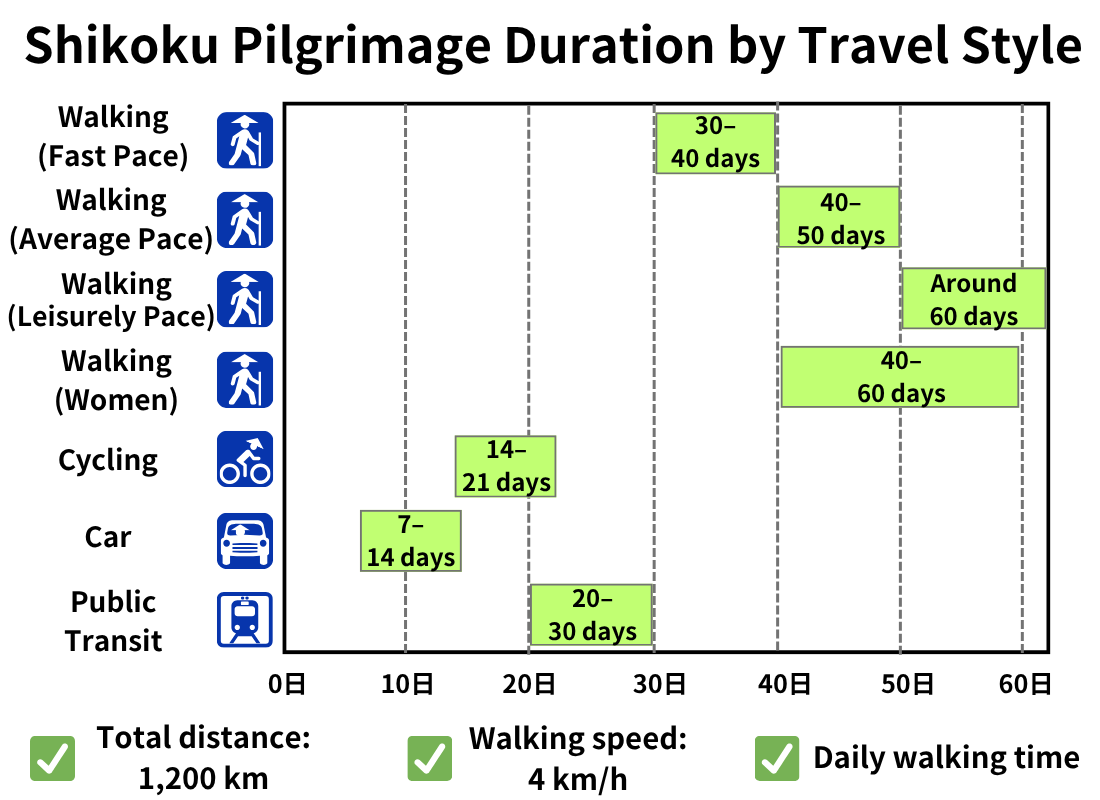
The time needed to complete the 88-Temple Shikoku Pilgrimage varies greatly depending on the pilgrimage style you choose.
Here is a general guide:
| Pilgrimage Style | Estimated Duration |
|---|---|
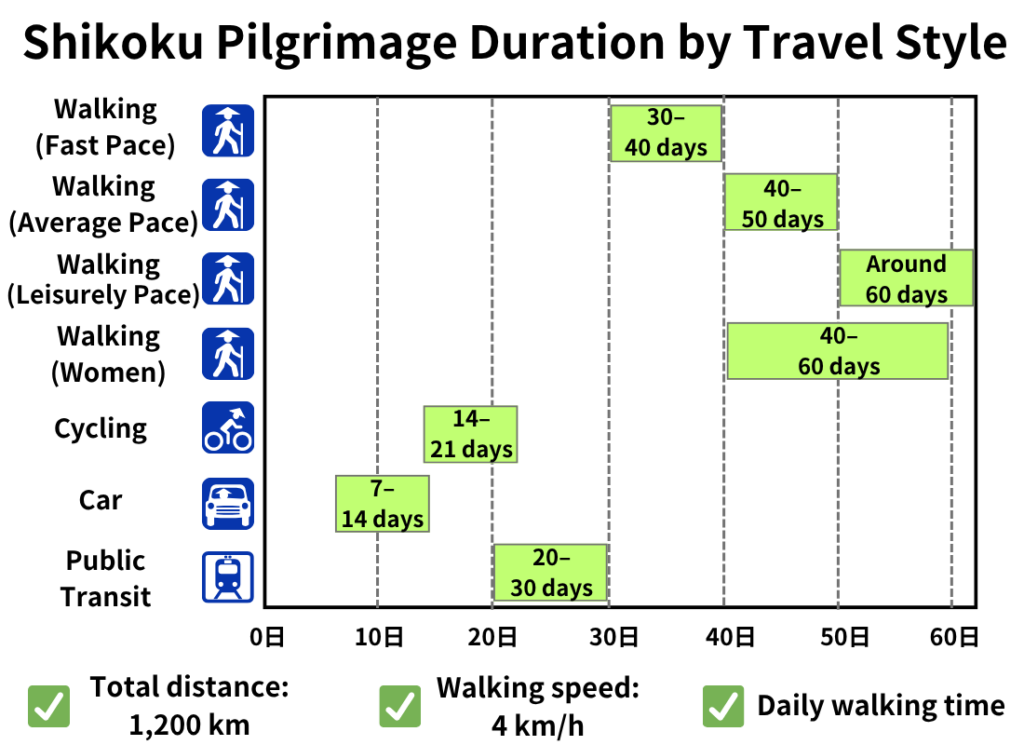
| Walking (Fast Pace) | 30–40 days |
| Walking (Average Pace) | 40–50 days |
| Walking (Leisurely Pace) | Around 60 days |
| Walking (Women) | 40–60 days |
| Bicycle | 14–21 days |
| Car | 7–14 days |
| Public Transportation | 20–30 days |
However, these figures are only general estimates.
Even among walking pilgrims, some complete the pilgrimage in about 30 days, while others take more than two months and travel at a much slower pace.
The biggest factor that determines how many days the pilgrimage will take is not how fast you can walk, but how many hours you spend traveling each day.
Check Your Estimated Pilgrimage Duration Now
The number of days required to complete the Shikoku Pilgrimage varies significantly depending on your travel style, whether you are walking, cycling, driving, or using public transportation.
If you’re wondering, “How many days will it take me?”, try our pilgrimage duration calculator first.
Shikoku Pilgrimage Duration Calculator
Supports fast-paced walkers, average walkers, leisurely walkers, women, cyclists, drivers, and public transportation travelers.
What Determines the Duration of the Shikoku Pilgrimage?
Many people assume that those with greater physical fitness can complete the pilgrimage much faster. In reality, the situation is a little different.
The duration of the Shikoku Pilgrimage is mainly determined by the following three factors:
- Total distance
- Walking speed
- Daily walking hours
Among these, daily walking hours are by far the most important factor.
The Total Distance Is About 1,200 km
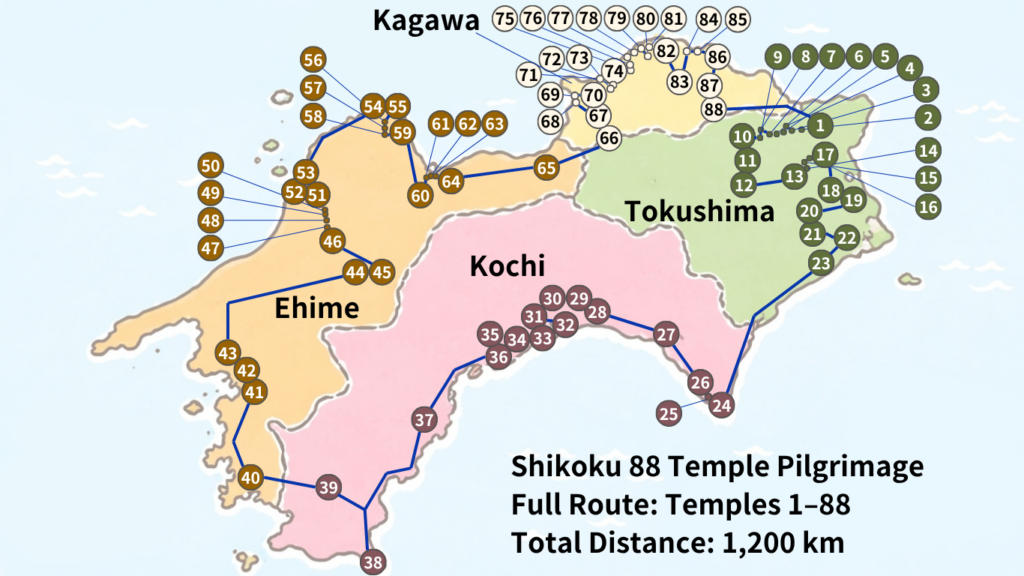
If you complete the 88-temple pilgrimage in the traditional order while traveling on foot, the total distance is generally estimated to be around 1,200 kilometers (750 miles).
The exact distance can vary depending on the routes taken between temples and where you stay overnight, but it is roughly equivalent to walking from Tokyo to Hakata.
Therefore, when estimating how long the pilgrimage will take, the first thing to consider is how you will cover those 1,200 kilometers.
For example:
- 20 km per day → approximately 60 days
- 30 km per day → approximately 40 days
- 40 km per day → approximately 30 days
These figures provide a simple way to estimate your overall pilgrimage duration.
Walking Speed Doesn’t Vary as Much as You Might Think
You might assume that people who walk faster can complete the pilgrimage in a much shorter time.
However, the difference in walking speed among pilgrims is often smaller than expected.
Most walking pilgrims maintain an average pace of around 4 km/h (2.5 mph).
This is because they need to:
- Carry a backpack
- Walk on mountain trails
- Travel on more than just paved roads
- Sustain their pace over many consecutive days
Even people who normally walk quickly cannot maintain an aggressive pace throughout a long pilgrimage.
As a result, the difference in average walking speed is usually not dramatic:
- Fast walkers: about 4–5 km/h
- Average walkers: about 4 km/h
- Leisurely walkers: about 3.5–4 km/h
For this reason, walking speed alone has a relatively limited impact on the total number of days required to complete the pilgrimage.
Daily Walking Time Has the Biggest Impact
The most important factor affecting the duration of the Shikoku Pilgrimage is not how fast you walk, but how many hours you walk each day.
For example, if you walk at an average speed of 4 km/h, your daily distance would look like this:
| Daily Walking Time | Distance Covered Per Day |
|---|---|
| 6 hours | About 24 km |
| 8 hours | About 32 km |
| 10 hours | About 40 km |
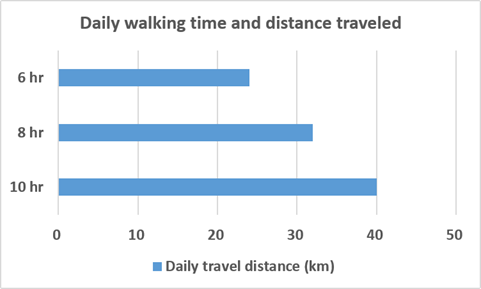
Even with the same walking speed, someone who walks only six hours per day may need 50–60 days to complete the pilgrimage, while someone who consistently walks close to ten hours per day may finish in just over 30 days.
Anyone who has experienced a walking pilgrimage will quickly realize that differences in completion time are usually caused more by daily activity hours than by walking speed.
Pilgrims who book accommodations in advance often stop walking by late afternoon, which naturally limits their daily distance.
In contrast, those who are not tied to a fixed lodging schedule and continue walking until near sunset can cover significantly more ground each day.
In other words, when estimating how long the pilgrimage will take, it is more practical to focus on:
“How many hours will I walk each day?”
rather than:
“How fast can I walk?”
A Typical Pilgrim vs. a Fast-Paced Pilgrim: A Day-by-Day Comparison
For example, the daily schedules of an average pilgrim and a fast-paced pilgrim can be quite different.
A Typical Pilgrim’s Day
| Time | Activity |
|---|---|
| 6:00 AM | Wake up and breakfast |
| 7:00 AM | Depart |
| 9:00 AM | Temple visit & short break |
| 12:00 PM | Lunch |
| 1:00 PM | Resume walking |
| 2:00 PM | Temple visit & short break |
| 4:00 PM | Temple visit & short break |
| 6:00 PM | Check in at accommodation |
| 7:00 PM | Dinner |
| 10:00 PM | Sleep |
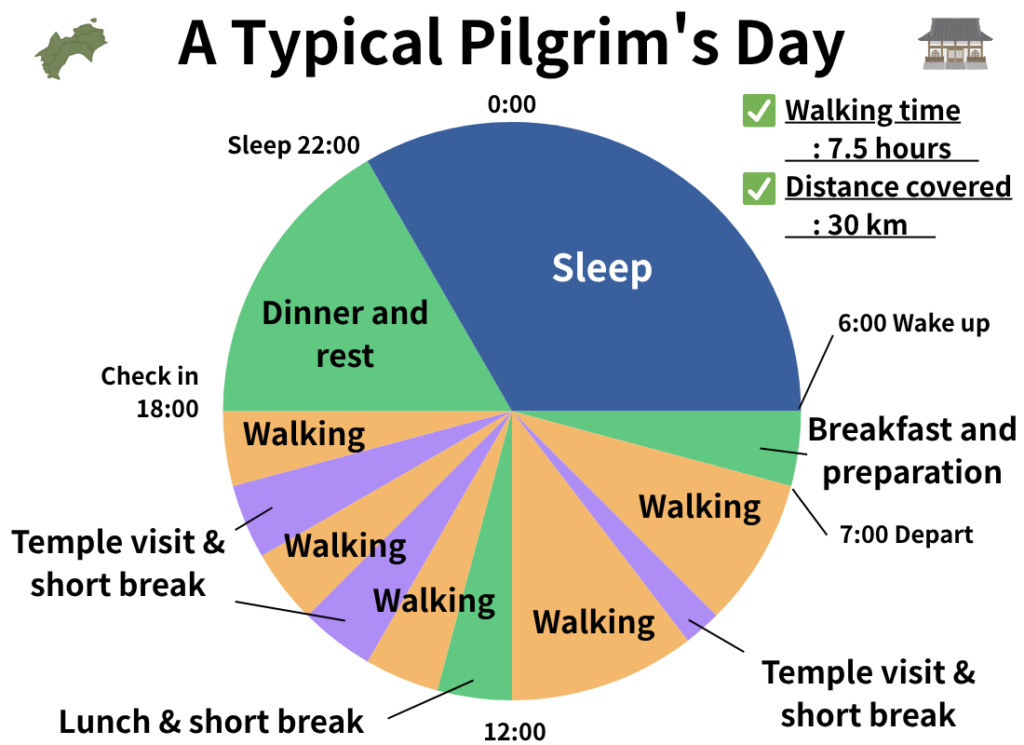
In this example, time is spent on:
- Breakfast: about 30 minutes
- Lunch: about 60 minutes
- Temple visits and short breaks: about 2.5 hours
- Accommodation check-in and preparation
Although the pilgrim appears to be active from 7:00 AM to 6:00 PM, the actual walking time is typically only 7–8 hours.
Assuming an average walking speed of 4 km/h, this results in:
Approximately 28–32 km per day
This is one of the main reasons why many pilgrims take around 40–50 days to complete the entire Shikoku Pilgrimage. Their daily routine is generally similar to this schedule.
A Fast-Paced Pilgrim’s Day
| Time | Activity |
|---|---|
| 5:00 AM | Wake up and breakfast |
| 6:00 AM | Depart |
| 9:00 AM | Temple visit & short break |
| 12:00 PM | Lunch |
| 1:00 PM | Resume walking |
| 2:00 PM | Temple visit & short break |
| 4:00 PM | Temple visit & short break |
| 7:00 PM | Prepare camp for the night |
| 8:00 PM | Sleep |
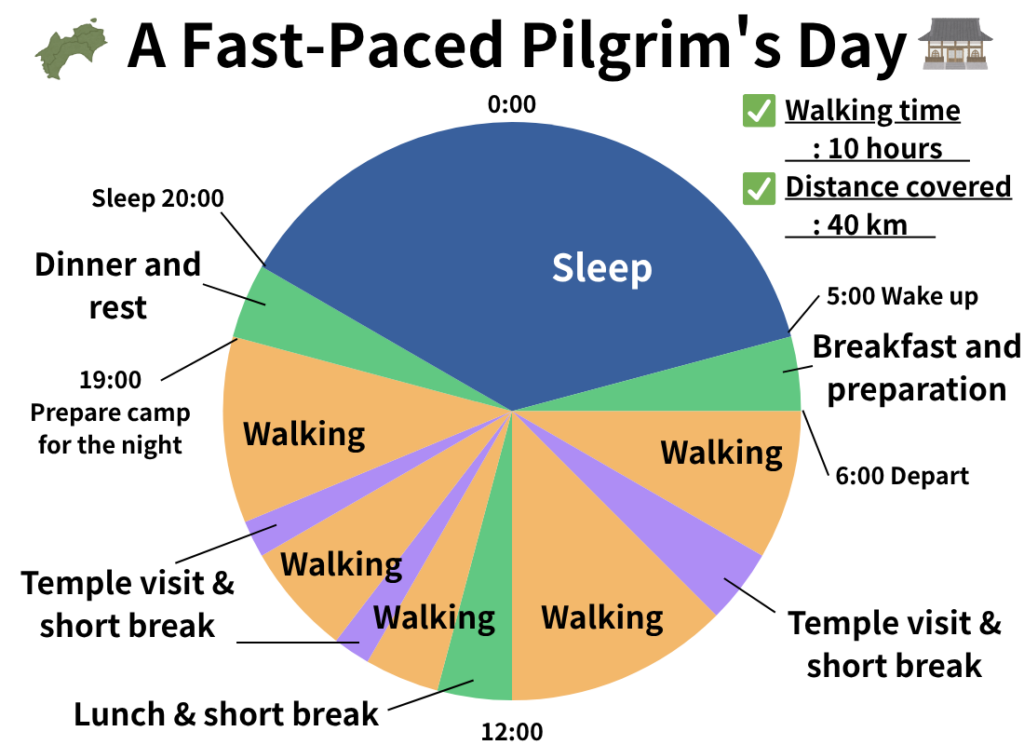
Fast-paced pilgrims are generally not restricted by accommodation check-in times.
They also tend to:
- Keep meal breaks short
- Buy food at convenience stores and eat on the go
- Minimize rest breaks
- Continue walking until close to sunset
For pilgrims who primarily camp outdoors, there is usually little to do after dark. As a result, they naturally adopt an early-to-bed, early-to-rise lifestyle, making it easier to maximize their daily walking time.
In this scenario, actual walking time is typically 10–12 hours per day.
Even if their walking speed remains the same—around 4 km/h—their longer activity hours allow them to cover:
Approximately 40–45 km per day
As a result, fast-paced pilgrims can often complete the entire pilgrimage significantly sooner than average pilgrims, not because they walk much faster, but because they spend more time walking each day.
The Difference Comes from Walking Time, Not Walking Speed
When comparing the two types of pilgrims, the key difference becomes clear:
| Type | Daily Walking Time | Daily Distance |
|---|---|---|
| Typical Pilgrim | 7–8 hours | 28–32 km |
| Fast-Paced Pilgrim | 10–12 hours | 40–45 km |
Their walking speeds are not dramatically different.
However, simply walking 3–4 additional hours per day can increase the daily distance covered by more than 10 kilometers.
As a result, the overall pilgrimage duration can differ significantly:
- Typical pilgrim: approximately 40–50 days
- Fast-paced pilgrim: approximately 30–35 days
This is why, when estimating how long the Shikoku Pilgrimage will take, it is more practical to focus on how many hours you can walk each day rather than how fast you can walk.
Using daily walking time as your benchmark will help you create a more realistic and achievable pilgrimage plan.
Estimated Duration for Walking the Shikoku Pilgrimage
Walking is the most time-consuming way to complete the Shikoku Pilgrimage.
While 40–50 days is often cited as the standard estimate, the actual duration can vary significantly from person to person.
This is because the number of days required depends less on walking speed and more on how many hours and kilometers you cover each day.
In this section, we’ll look at the estimated duration for different types of walking pilgrims.
Fast-Paced Walkers (30–40 Days)
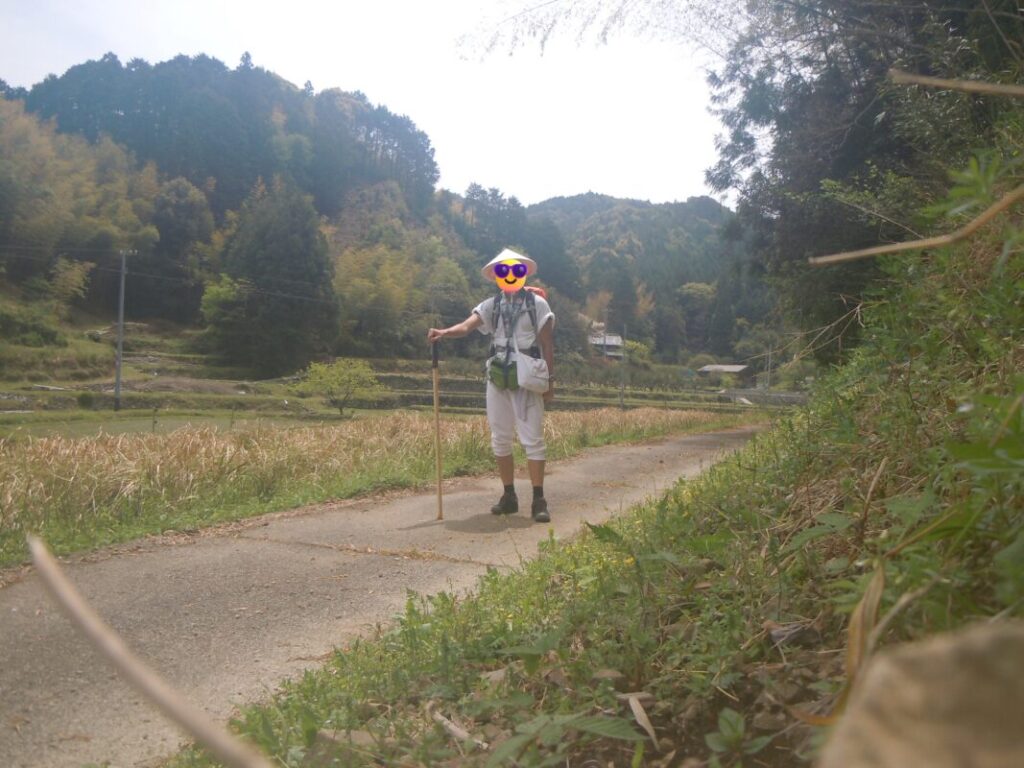
If you are physically fit and able to maintain long walking days, it is possible to complete the Shikoku Pilgrimage in 30–40 days.
I personally completed both the clockwise and counterclockwise routes on foot. On my clockwise pilgrimage, I finished the entire circuit in approximately 33 days.
On average, I walked 30–35 km per day, and on some days I covered as much as 45 km.
The biggest reason I was able to finish in a relatively short time was not exceptional walking speed, but the fact that I spent many hours walking each day.
I also relied primarily on wild camping rather than booked accommodations, which meant I was not constrained by hotel or guesthouse check-in times.
As a result, I could continue walking until just before sunset and maximize the distance covered each day.
If you are physically strong or want to complete the pilgrimage during a limited vacation period, 30–40 days is a realistic target.
Typical Walking Pilgrims (40–50 Days)
The most common pace for walking the Shikoku Pilgrimage is around 40–50 days.
Pilgrims who stay in accommodations and walk at a comfortable, sustainable pace typically cover 20–30 km per day.
Since many people follow a schedule of departing in the morning and arriving at their lodging by late afternoon or early evening, the total pilgrimage duration naturally falls within this range.
If this is your first pilgrimage, it is generally a good idea to plan around 40–50 days.
This pace places less strain on the body and allows more time to enjoy the temples, local culture, and scenery along the route.
Typical estimates are as follows:
- About 20 km per day: around 60 days
- About 25 km per day: around 48 days
- About 30 km per day: around 40 days
Most walking pilgrims ultimately finish within this range, making it a realistic benchmark for first-time pilgrims.
Leisurely Walking Pace (50–60+ Days)
The Shikoku Pilgrimage is not a race.
Many pilgrims choose to walk at their own pace, taking time to fully enjoy the experience rather than focusing on completing the route as quickly as possible.
For example, you may choose to:
- Spend more time praying and reflecting at each temple
- Enjoy photography along the route
- Interact with local residents
- Schedule regular rest days
- Visit tourist attractions and scenic spots
With this style of pilgrimage, taking 50–60 days or more is not uncommon.
This approach is especially popular among retirees on extended journeys and among those who want to savor the pilgrimage itself rather than simply reach the finish line.
In such cases, it is wise to allow extra time in your schedule.
Rather than pushing yourself to cover longer distances each day, maintaining a comfortable pace and avoiding injuries is often the safest and most enjoyable way to successfully complete the pilgrimage.
How Long Does the Shikoku Pilgrimage Take for Women?
Many people wonder, “How long does it take for a woman to complete the pilgrimage on foot?”
The short answer is that there is generally little difference in walking speed between men and women during the pilgrimage.
Because pilgrims carry their belongings and walk long distances day after day, most people naturally settle into a pace of around 4 km/h.
As a result, men are not necessarily much faster, nor are women necessarily much slower.
However, women often tend to:
- Reserve accommodations in advance
- Finish walking before dark
- Avoid wild camping
For these reasons, daily walking hours may be slightly shorter on average.
As a result, many women complete the walking pilgrimage in approximately 40–60 days.
Of course, there are plenty of fit women who finish in the 30-day range, while others prefer a slower pace and take more than two months to complete the journey.
Ultimately, the most important factor is not gender, but finding a pace that is comfortable, sustainable, and safe for you throughout the pilgrimage.
Estimated Duration for a Bicycle Pilgrimage
Cycling is one of the most popular ways to complete the Shikoku Pilgrimage in a shorter period of time.
While a walking pilgrimage typically takes 40–50 days, many cyclists complete the 88-temple route in about two to three weeks.
However, the total duration depends less on fitness or cycling experience and more on how many kilometers you ride each day.
Let’s start by looking at the general time estimates for a bicycle pilgrimage.
A Bicycle Pilgrimage Typically Takes 2–3 Weeks
The estimated duration of a bicycle pilgrimage generally falls into the following ranges:
| Pace | Estimated Duration |
|---|---|
| Fast-paced / Long-distance cyclist | 14–20 days |
| Average pace | Around 20 days |
| Sightseeing-focused pace | 20+ days |
Because bicycles are significantly faster than walking, cyclists can efficiently visit multiple temples in a single day.
However, cycling pilgrims must also contend with challenges such as steep climbs to mountain temples and weather conditions, both of which can greatly affect daily progress.
If this is your first bicycle pilgrimage, planning for around three weeks is usually a good idea. This provides enough flexibility to handle unexpected delays and enjoy the journey without feeling rushed.
Daily Riding Distance Determines the Duration
Just like a walking pilgrimage, the biggest factor that determines the length of a bicycle pilgrimage is how far you ride each day.
Assuming a total route distance of approximately 1,200 km, the following estimates provide a rough guideline:
| Daily Riding Distance | Estimated Duration |
|---|---|
| 60 km per day | About 20 days |
| 80 km per day | About 15 days |
| 100 km per day | About 12 days |
Of course, real-world conditions are rarely this simple.
Temple visits, sightseeing stops, detours, steep mountain roads, and weather conditions can all reduce the distance you are able to cover on a given day.
Nevertheless, when planning a bicycle pilgrimage, it is often more useful to think in terms of:
“How many kilometers can I comfortably ride each day?”
rather than:
“How many days do I want the pilgrimage to take?”
Using daily riding distance as your starting point will make it much easier to create a realistic and achievable itinerary.
Mountain Temples Can Make the Journey Much Slower Than Expected
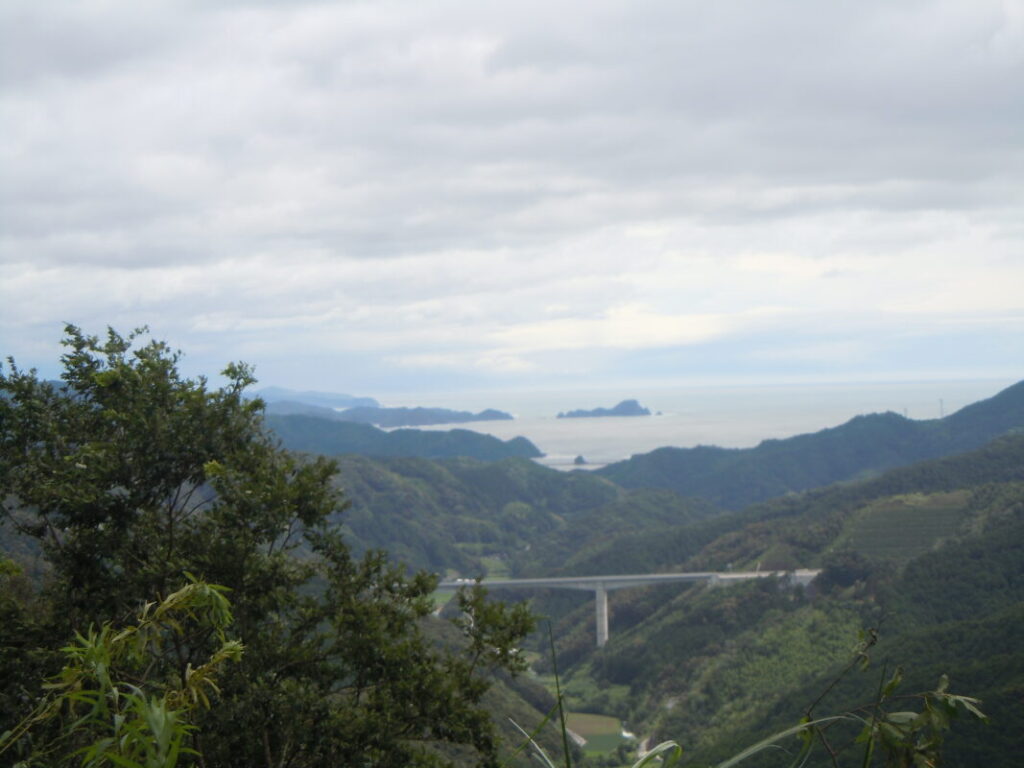
One factor that many first-time cycling pilgrims underestimate is the number of mountain temples along the route.
The Shikoku Pilgrimage is not entirely flat. Several temples require long and steep climbs that can significantly slow your progress.
Some of the most well-known examples include:
- Temple No. 12 – Shosanji Temple
- Temple No. 20 – Kakurinji Temple
- Temple No. 21 – Tairyuji Temple
- Temple No. 60 – Yokomineji Temple
Among these, the climb to Shosanji is particularly famous. It is part of a section known as “Henro Korogashi” (Pilgrim Killer), a nickname given to some of the most demanding climbs on the pilgrimage route.
Even cyclists who can comfortably ride more than 20 km in an hour on flat roads may find their speed dropping to below 5 km/h on steep ascents.
For this reason, when estimating the duration of a bicycle pilgrimage, it is important to consider not only the distance shown on a map but also the total elevation gain along the route.
A route with significant climbing can require far more time and energy than a longer route on relatively flat terrain.
For a detailed guide to the most challenging climbs and the famous “Henro Korogashi” sections, see our dedicated article on the toughest temples of the Shikoku Pilgrimage.
The Shikoku Pilgrimage Through Data
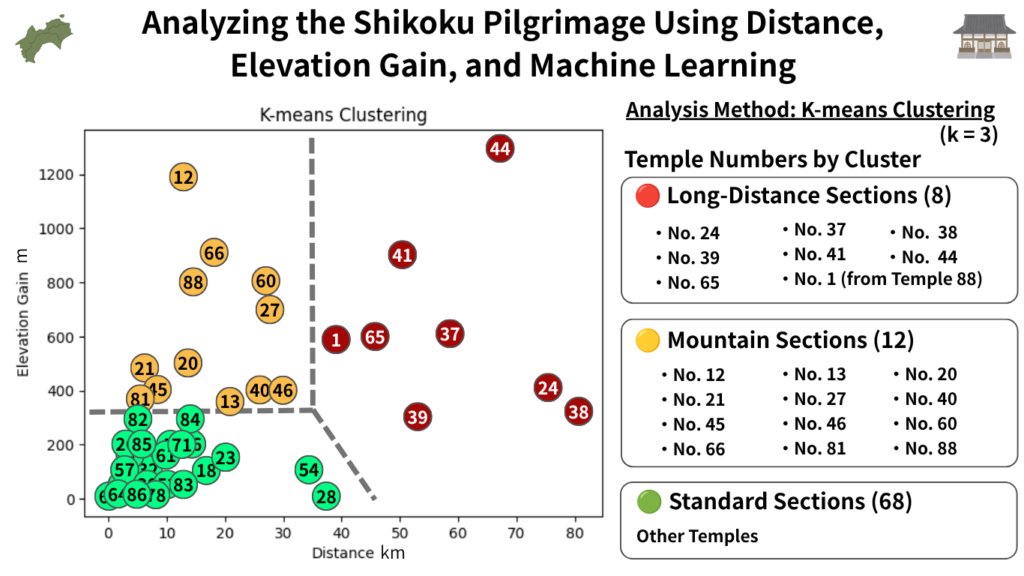
How Much Time Can a Bicycle Pilgrimage Save Compared to Walking?
There is a significant difference in the time required for a walking pilgrimage and a bicycle pilgrimage.
A general comparison looks like this:
| Pilgrimage Method | Estimated Duration |
|---|---|
| Walking Pilgrimage | 40–50 days |
| Bicycle Pilgrimage | 14–21 days |
With a bicycle, it is possible to complete the pilgrimage in less than half the time required for most walking pilgrims.
That said, walking offers unique advantages. Moving at a slower pace allows you to experience the local scenery, culture, and encounters with people along the route in a way that is difficult to replicate by bicycle.
Neither approach is inherently better than the other.
As a general guideline:
- Choose a bicycle pilgrimage if you want to complete the route within a limited vacation period.
- Choose a walking pilgrimage if you want to fully immerse yourself in the pilgrimage experience and enjoy the journey itself.
The best choice ultimately depends on your personal goals, available time, and preferred travel style.
Estimated Duration for a Car Pilgrimage
Traveling by car is the most efficient way to complete the Shikoku Pilgrimage.
While a walking pilgrimage typically takes 40–50 days and a bicycle pilgrimage usually requires 14–21 days, many pilgrims can complete the entire route by car in about one to two weeks.
However, the total duration of a car pilgrimage is not determined by driving time alone.
In practice, a significant amount of time is also spent at each temple, including:
- Temple visits and prayers
- Collecting temple stamps and calligraphy (Nokyo)
- Parking and walking between parking areas and temple grounds
- Waiting times during busy periods
As a result, planning a car pilgrimage involves more than simply calculating travel distances between temples. The time spent at each temple plays an important role in determining the overall schedule.
The Fastest Car Pilgrimages Can Be Completed in About 7 Days
If your primary goal is to complete the pilgrimage as quickly as possible, it is possible to finish the entire Shikoku Pilgrimage by car in around seven days.
In fact, many organized pilgrimage tours are designed to visit all 88 temples in 7–8 days.
By starting early each morning and visiting approximately 10–15 temples per day, completing the full route within a week is entirely achievable.
However, this pace leaves very little time for:
- Sightseeing
- Detours
- Exploring local attractions
- Extended stays at temples
In other words, this type of itinerary is designed with pilgrimage completion as the top priority, rather than a relaxed travel experience.
If your goal is simply to receive all temple stamps and complete the pilgrimage within a limited schedule, a one-week plan can work well. However, those who wish to enjoy the journey more leisurely may prefer to allow additional time.
10–14 Days Is Ideal for Combining Pilgrimage and Sightseeing
For most people, a car pilgrimage takes around 10–14 days.
With this amount of time, you can comfortably:
- Spend more time at each temple
- Visit popular attractions around Shikoku
- Enjoy local cuisine and hot springs
- Follow a relaxed and safe driving schedule
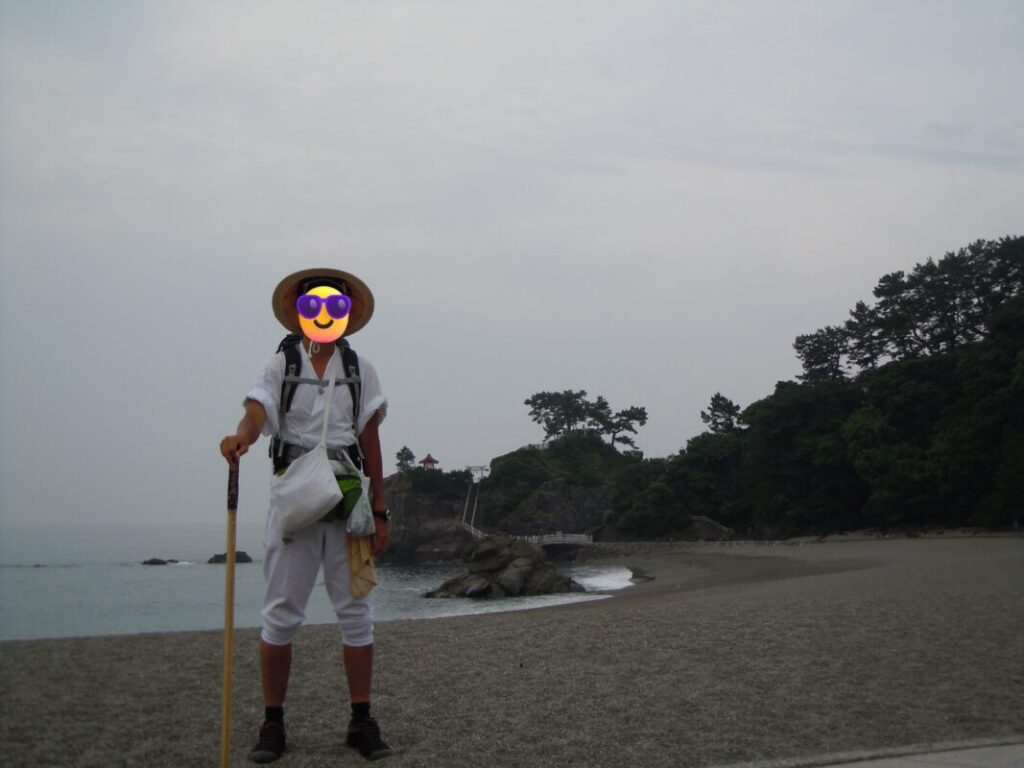
Katsurahama, a scenic spot in Kochi
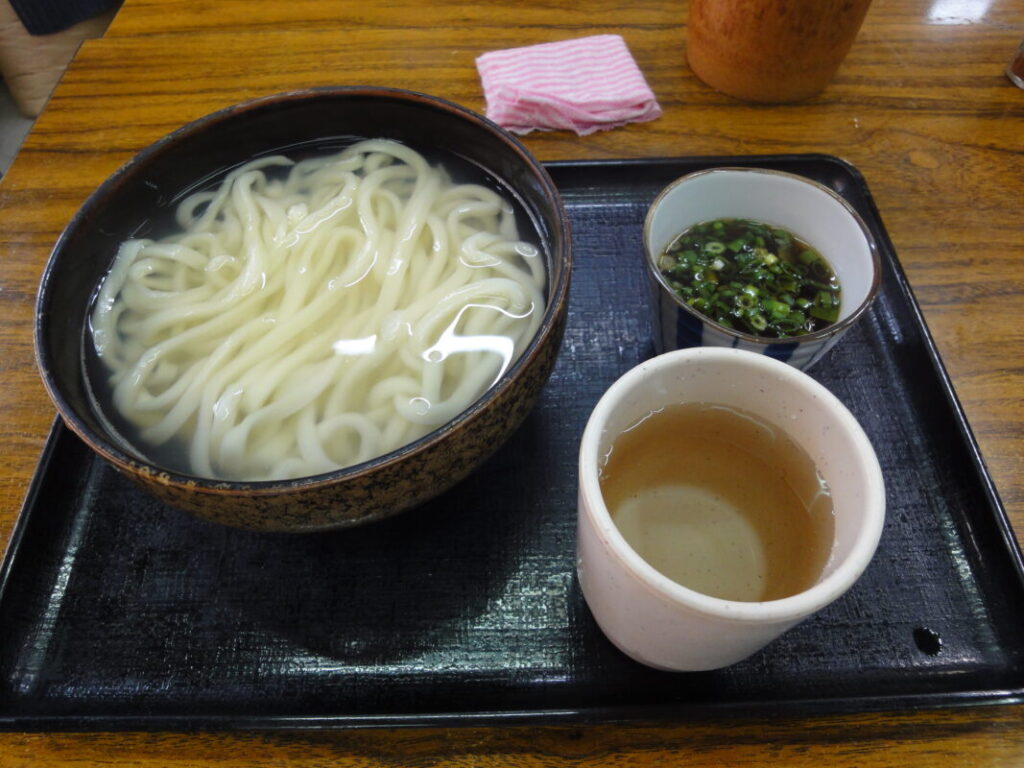
Sanuki udon, a specialty of Kagawa
For first-time pilgrims in particular, aiming for the shortest possible schedule is not always the best approach. Allowing around two weeks generally leads to a more enjoyable and rewarding experience.
A longer itinerary also provides greater flexibility in case of:
- Bad weather
- Traffic delays
- Unexpected detours
- Additional sightseeing opportunities
By avoiding a rushed schedule, you can focus not only on completing the pilgrimage but also on appreciating the culture, scenery, and hospitality of Shikoku.
For a detailed 10-day car pilgrimage itinerary, see our dedicated guide to a model Shikoku pilgrimage route.
Temple Visits and Nokyo Collection Take More Time Than Many People Expect
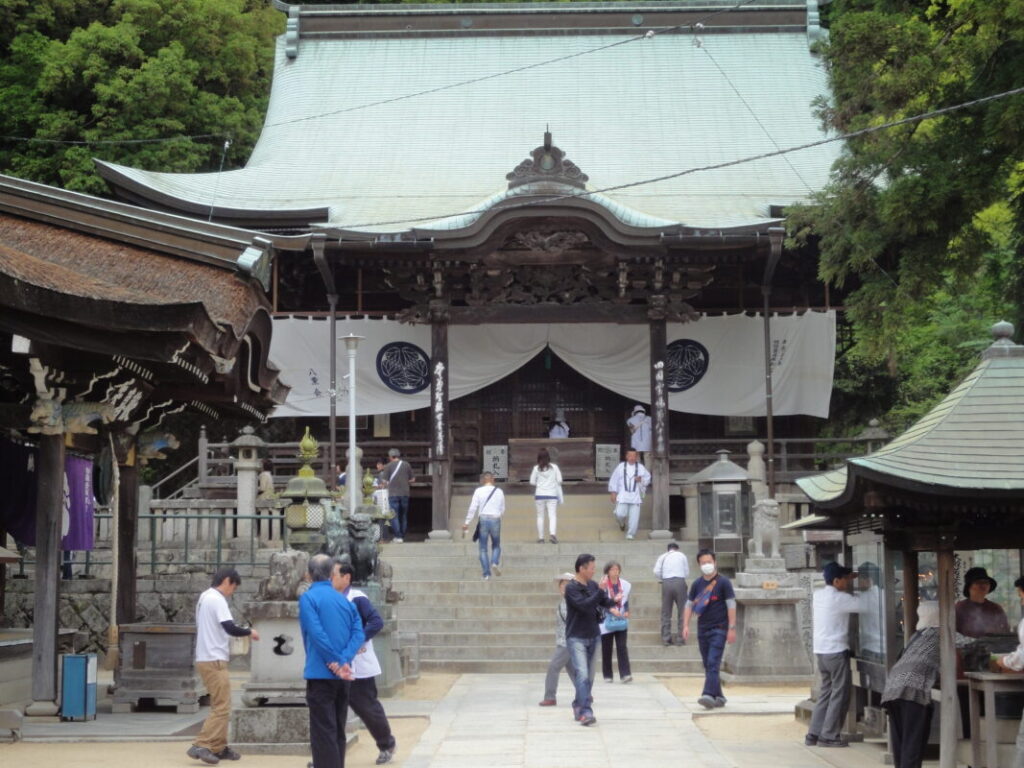
One factor that is often overlooked when planning a car pilgrimage is the amount of time spent at each temple.
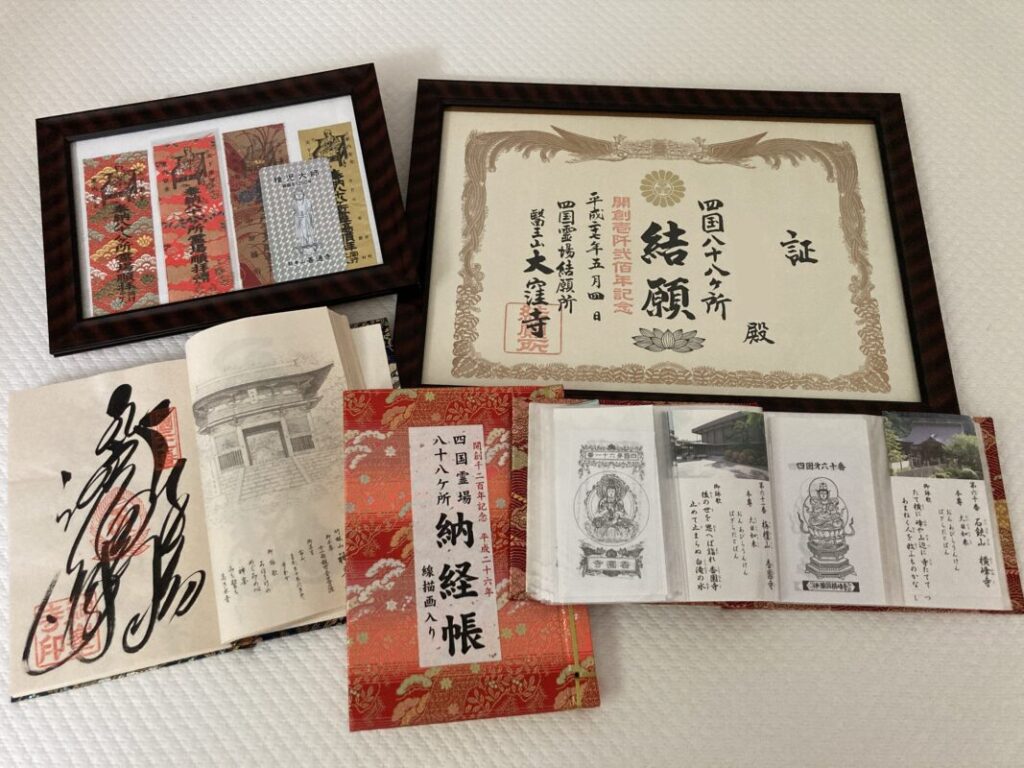
While driving allows you to travel quickly between locations, each temple visit still requires time for worship and collecting your Nokyo (temple stamp and calligraphy).
Even following a standard routine—visiting the Main Hall, paying respects at the Daishi Hall, and receiving a Nokyo at the temple office—can easily take 15–30 minutes per temple.
If you prefer to take your time and pray more thoroughly, the visit may take even longer.
For example, if you spend 30 minutes at each temple, the total time spent at all 88 temples would be:
88 temples × 30 minutes = approximately 44 hours
That amounts to nearly two full days spent at temples alone.
For this reason, pilgrims aiming to complete the route in the shortest possible time must keep their visits relatively brief.
However, doing so can make the experience feel rushed. Instead of a meaningful pilgrimage, it may begin to resemble a stamp-collecting challenge.
The ideal schedule ultimately depends on what you hope to gain from the pilgrimage.
If your goal is simply to complete all 88 temples, a tight schedule may be sufficient. But for most people, allowing a little extra time leads to a more rewarding experience and a deeper appreciation of the spiritual and cultural aspects of the journey.
Estimated Duration When Using Public Transportation
A pilgrimage using public transportation sits between walking and car travel in terms of style and flexibility.
By combining trains and buses, long-distance travel can be significantly shortened, while still allowing pilgrims to walk around temple areas and experience parts of the journey on foot.
This style is often chosen by people who:
- Find a full walking pilgrimage too demanding
- Want to experience the atmosphere of walking pilgrimages
- Aim to complete the pilgrimage within a limited vacation period
Because of this balance, public transportation pilgrimages offer a flexible way to approach the 88-temple route while still maintaining a sense of the traditional pilgrimage experience.
Public Transportation Greatly Reduces Long-Distance Sections
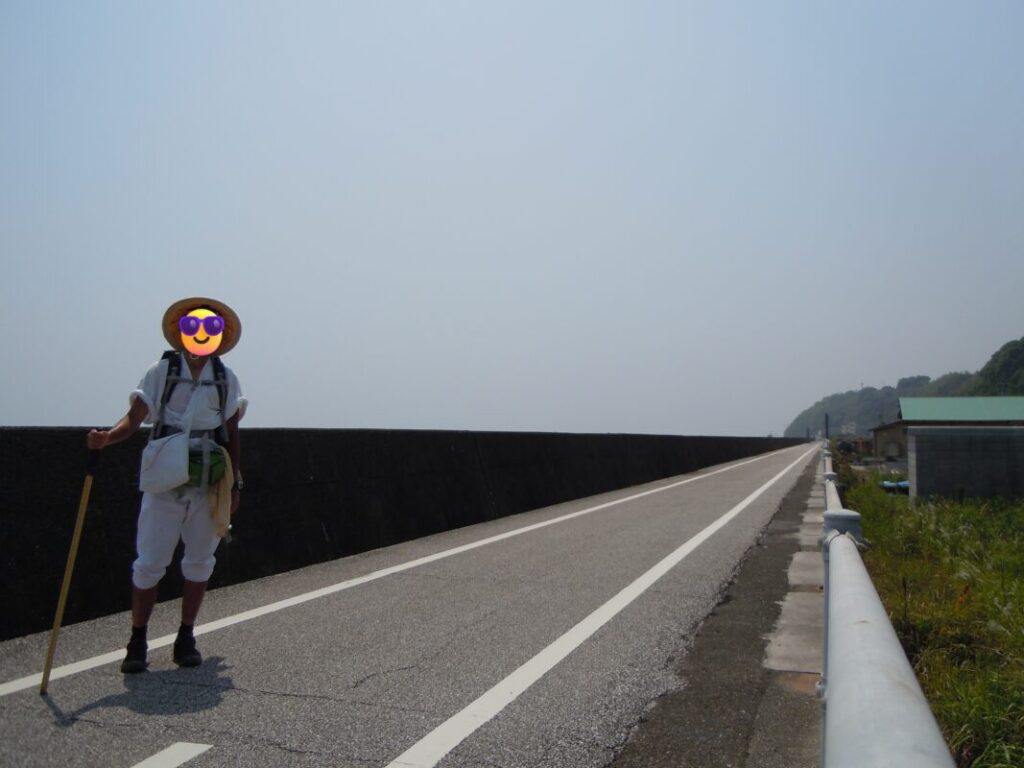
One of the biggest factors that determines the total duration of a walking pilgrimage is the long-distance travel between temples.
In particular, the following sections are well known as difficult stretches:
- From Temple 23 Yakuoji Temple to Temple 24 Muroto Misakiji Temple
- From Temple 37 Iwamotoji Temple to Temple 38 Kongofukuji Temple
These routes are considered challenging because of their long distances:
- 23 → 24: approximately 75 km
- 37 → 38: approximately 80 km
Even for pilgrims walking around 30 km per day, each of these sections typically requires 2–3 days to complete.
However, using trains or buses can reduce these journeys to around half a day.
As a result, simply using public transportation for these two sections alone can shorten the pilgrimage by approximately 4–6 days.
For pilgrims looking to reduce the overall duration of a walking pilgrimage, replacing long-distance segments with public transportation is one of the most effective strategies.
For detailed information on routes and transfers using public transport, see the dedicated guide on Shikoku pilgrimage transit options.
Using Public Transportation as Support for Walking Pilgrims
Public transportation is not only for non-walking pilgrims.
In fact, many walking pilgrims use trains and buses as a supplementary tool during their journey.
Common examples include:
- Using transportation only when there is not enough time
- Taking a bus or train when experiencing injury or fatigue
- Skipping particularly long-distance sections
One of the most physically demanding parts of the pilgrimage is not the temple approaches themselves, but the long stretches of asphalt road between temples.
Walking along highways or national roads for dozens of kilometers can become mentally monotonous and place significant strain on the legs and knees.
By strategically using public transportation, pilgrims can bypass these difficult sections, conserve energy, and continue their journey more safely and comfortably.
In this way, transportation can be seen not as a replacement for walking, but as a flexible support tool that helps make the pilgrimage more sustainable.
Reducing Strain on the Legs and Feet
One of the biggest advantages of using public transportation during the Shikoku Pilgrimage is the significant reduction in physical strain.
Many pilgrims find that their feet are more likely to be damaged not on mountain trails, but during long hours of walking on asphalt roads.
In particular, long-distance sections such as:
- Temple 23 Yakuoji Temple to Temple 24 Muroto Misakiji Temple
- Temple 37 Iwamotoji Temple to Temple 38 Kongofukuji Temple
are mostly made up of paved roads, which can place continuous stress on the feet and legs.
By using trains or buses for these sections, pilgrims can significantly reduce physical damage and fatigue.
This leads to several benefits:
- Reduced accumulation of fatigue
- Lower risk of injury
- Improved comfort for the following days
For those who want to walk as much as possible but avoid overexertion, public transportation can be a highly effective and practical option.
The Duration Changes Depending on Whether You Do a Continuous or Segmental Pilgrimage
One factor that is often overlooked when estimating the total duration of the Shikoku Pilgrimage is the difference between “continuous pilgrimage” and “segmental pilgrimage”.
Even if the route and method are the same, the total number of days required can vary significantly depending on which style you choose.
This distinction is especially important for people planning their pilgrimage around limited vacation time.
What Is a Continuous Pilgrimage?
A continuous pilgrimage means traveling from Temple 1 all the way to Temple 88 in a single, uninterrupted journey.
For walking pilgrims, this means staying on the road until the entire circuit is completed.
Typical examples include:
- Walking for 30 consecutive days
- Walking for 40 consecutive days
- Walking for 50 consecutive days
For many people, this is the traditional image of the Shikoku Pilgrimage.
Its main advantage is that it requires less logistical planning and allows pilgrims to maintain a consistent rhythm throughout the journey.
What Is a Segmental Pilgrimage?
A segmental pilgrimage involves completing the route in multiple separate trips.
For example:
- First trip: Temples 1–20
- Second trip: Temples 21–40
- Continuing over several long vacations
This approach is now quite common.
It is especially suitable for people who cannot take long continuous breaks from work or life commitments.
It also reduces physical strain, making it popular among beginners and retirees.
Some pilgrims take several years to complete all 88 temples using this method.
Continuous Pilgrimage Tends to Require Fewer Total Days
When covering the same total distance, a continuous pilgrimage generally requires fewer days than a segmental pilgrimage.
One of the main reasons is travel inefficiency.
In a segmental pilgrimage, each trip involves additional time that is not part of walking or riding, such as:
- Traveling from home to Shikoku
- Returning to the previous stopping point
- Traveling back home after completing a section
While these are not “walking days,” they still increase the overall time and effort required to complete the pilgrimage.
Another important factor is what can be called restart loss.
During a walking pilgrimage, the body gradually adapts after several consecutive days of walking. However, when there is a long break between trips, that rhythm is often lost.
When restarting, many pilgrims experience:
- Heaviness in the legs
- Difficulty readjusting to carrying a backpack
- A few days needed to regain walking rhythm
With a continuous pilgrimage, this adaptation process is maintained, allowing for a more efficient and steady progression.
That said, segmental pilgrimages are by no means inferior.
For people who cannot take long consecutive holidays, breaking the pilgrimage into sections is a practical and sustainable option.
While a continuous pilgrimage may be more efficient in terms of total days, the best approach ultimately depends on one’s lifestyle and available time.
Shikoku Pilgrimage Duration Simulator
“How many days will it take me?”
Many people researching the Shikoku Pilgrimage are not just looking for average figures—they want an estimate based on their own situation.
The number of days required for a walking pilgrimage depends less on fitness and more on how many kilometers you can walk per day.
First, try the simulator below to get a rough estimate of your personal pilgrimage duration.
Shikoku Pilgrimage Duration Simulator
Estimate your approximate completion time based on your pilgrimage style.
Frequently Asked Questions (FAQ)
- QWhat is the fastest possible time to complete the Shikoku Pilgrimage?
- A
The duration depends on the travel method.
For a car pilgrimage, it is possible to complete the route in about 7–8 days, while for a walking pilgrimage, the fastest estimate for strong and experienced pilgrims is around 30 days.However, aiming for the shortest possible schedule leaves almost no time for sightseeing or rest. Most pilgrims choose a more relaxed itinerary.
- QIs it possible to complete the walking pilgrimage in 30 days?
- A
Yes, it is possible.
However, it requires consistently walking about 35–40 km per day.
It is also important not to be restricted by accommodation check-in times, allowing for longer daily walking hours. In practice, the key factor is not walking speed, but how many hours you can walk each day.
- QHow many days should I plan for my first pilgrimage?
- A
For first-time walking pilgrims, a schedule of around 40–50 days is recommended.
On the first few days, many people are not yet accustomed to carrying a backpack or walking long distances, so daily progress may be slower than expected. A realistic plan helps prevent injury and exhaustion.
- QHow long does the pilgrimage take for women?
- A
There is generally no significant difference in walking speed between men and women.
Most pilgrims walk at an average pace of around 4 km/h, so gender does not greatly affect duration.
However, many women choose to stay in accommodations for safety reasons, which can result in a total duration of around 40–60 days.
- QCan older adults or retirees complete the walking pilgrimage?
- A
Yes.
It is not uncommon to see pilgrims in their 60s or 70s completing the route on foot.
However, rather than focusing on reducing the number of days, it is more important to choose a pace that matches your physical condition. Many pilgrims also use rest days or public transportation when needed.
- QHow much does adding rest days affect the total duration?
- A
If you include one rest day per week, the total pilgrimage duration typically increases by 5–8 days.
For example, a schedule that normally takes 40 days may extend to around 45–50 days with regular rest days.
Rest days help prevent fatigue and injury, and are especially recommended for longer walking pilgrimages.
Summary: The Duration of the Shikoku Pilgrimage Depends on Your Own Pace
The number of days required to complete the Shikoku Pilgrimage varies greatly depending on the travel style.
As a general guideline:
- Walking pilgrimage: 40–50 days
- Bicycle pilgrimage: 14–21 days
- Car pilgrimage: 7–14 days
- Public transportation: 20–30 days
However, even among walking pilgrims, some complete the journey in about 30 days, while others take 60 days or more at a slower, more relaxed pace.
For this reason, it is more practical to think in terms of your personal style rather than fixed numbers.
If you are wondering, “How many days will it take me?”, try using a pilgrimage duration simulator.
It supports different walking styles (fast, average, slow, and women), as well as cycling, driving, and public transportation, allowing you to estimate your own completion time.
Shikoku Pilgrimage Duration Simulator
Before planning your trip or vacation, it is recommended to check your estimated pilgrimage duration first.
Related Articles
Shikoku Pilgrimage Cost Guide 2026: Walking, Cycling, Car & Budget Breakdown.
Cost of the Shikoku Pilgrimage