
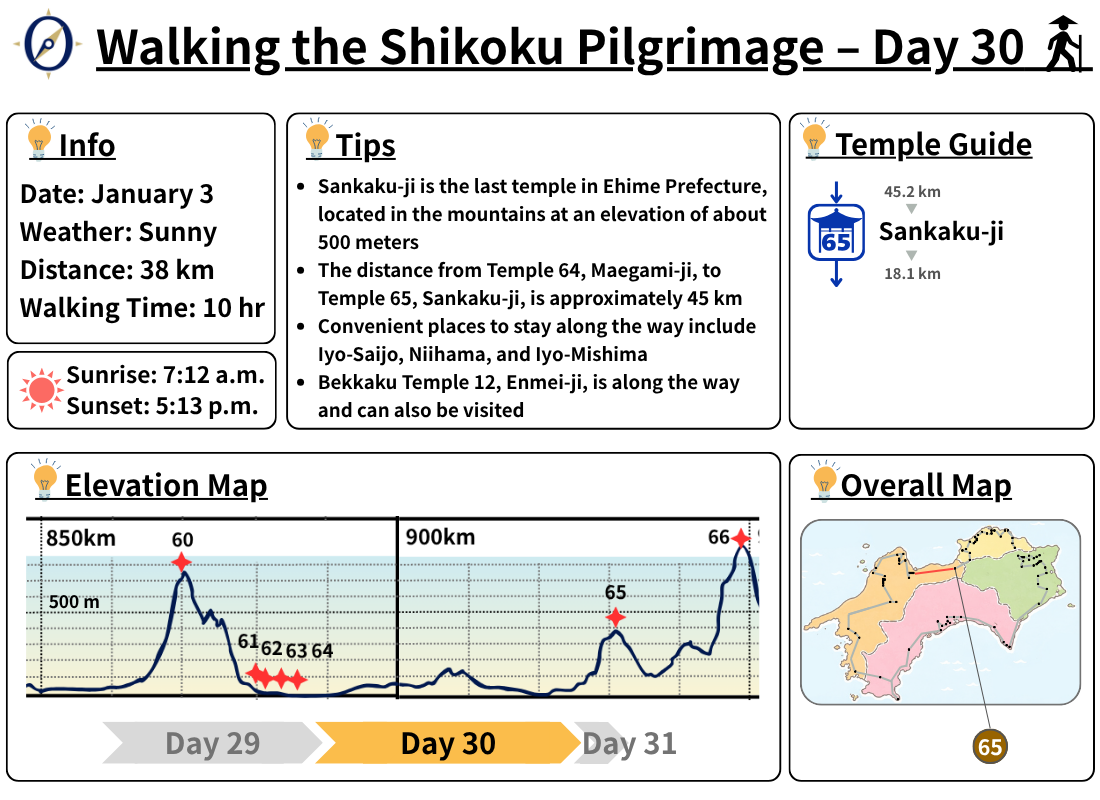
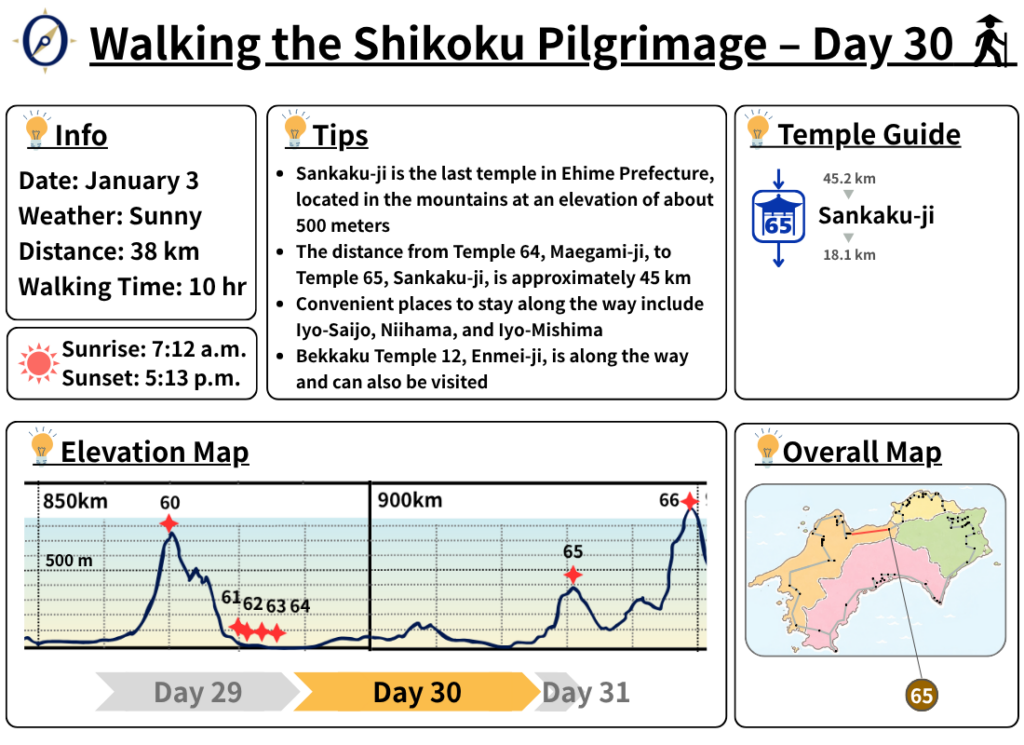
January 3, Day 30 of my Shikoku Pilgrimage on Foot. I left Iyo-Saijo and headed east through Niihama toward Shikokuchuo City. Along the way, I visited Bekkaku Temple 12, Enmei-ji, and enjoyed views of the Seto Inland Sea. By evening, I reached Togawa Park, where I camped overnight. The next day, I would finally head for Temple 65, Sankaku-ji, the last temple in Ehime Prefecture.
- Itinerary
- Getting Ready in the Morning
- Heading for Sankaku-ji, the Last Temple in Ehime Prefecture
- Crossing Seki-no-To
- Leaving National Route 11 for the Old Highway
- Visiting Enmei-ji, Bekkaku Temple 12
- Shikokuchuo’s Industrial Zone and the Seto Inland Sea
- Looking for a Place to Camp in Iyo-Mishima
- Camping Overnight at Togawa Park
- Temple Information
Itinerary
- 7:30Departure
- Iyo-Saijo
- Niihama
- Seki-no-To
- Enmei-ji
- Iyo-Mishima
- 18:00Togawa Park
Overnight stay
Getting Ready in the Morning
January 3. Clear skies. Day 30 of my Shikoku Pilgrimage on Foot.
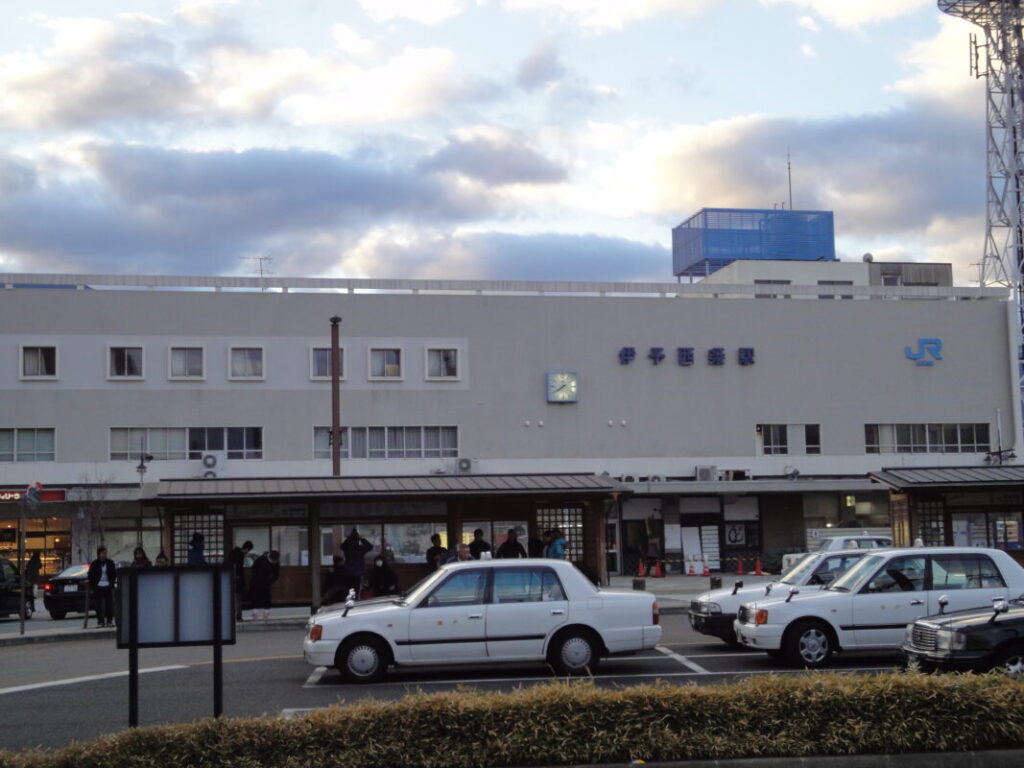
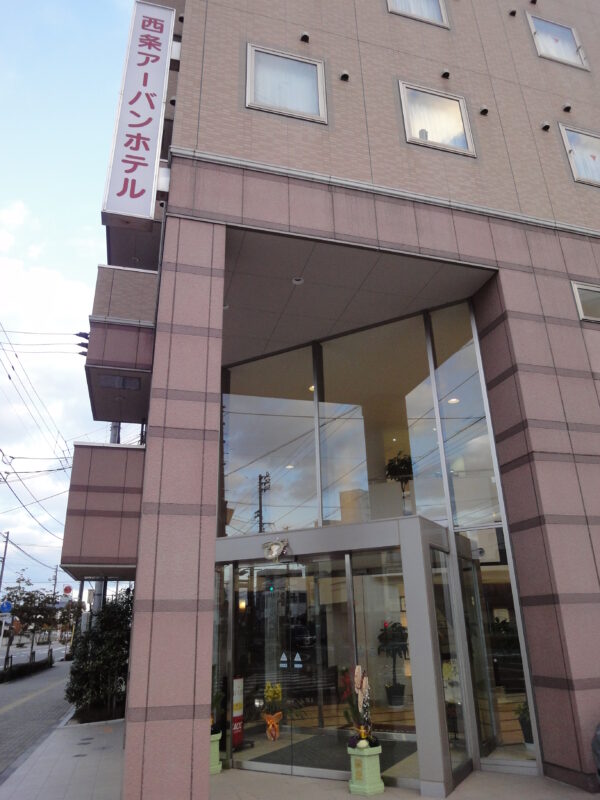
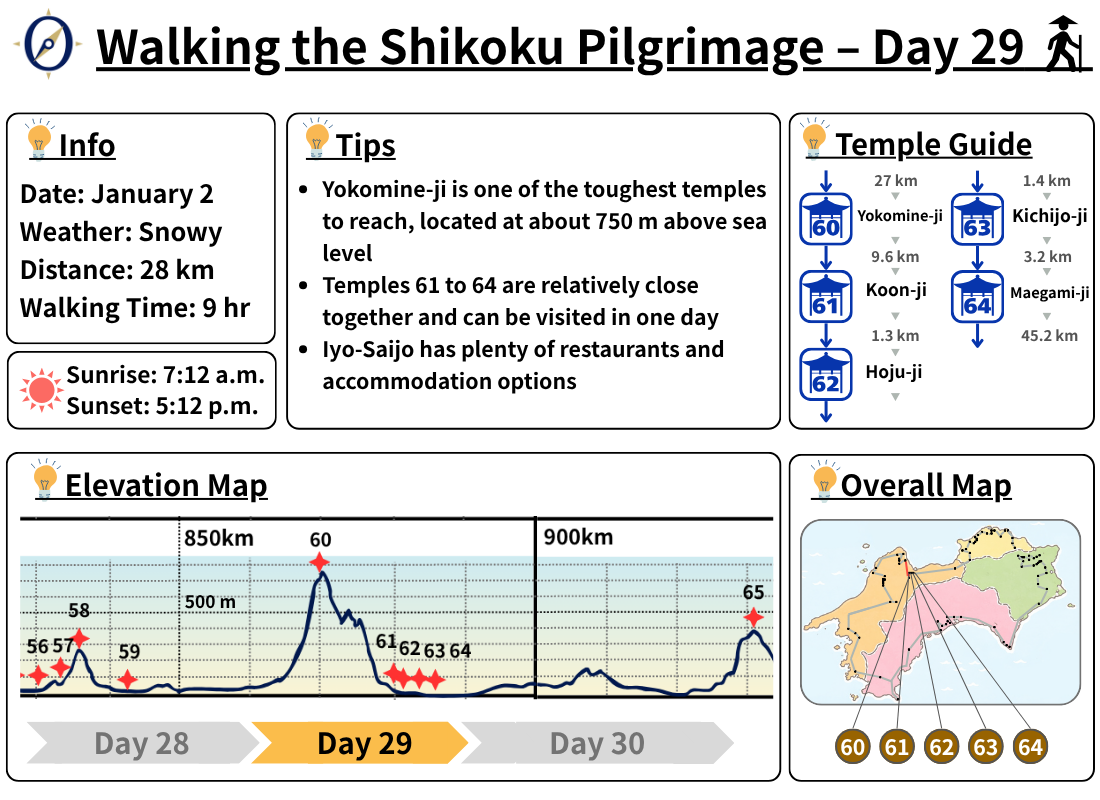
Yesterday, I visited Temple 60, Yokomine-ji, known as one of the most challenging temples to reach in Ehime Prefecture, then descended the mountain and continued on to Temple 64, Maegami-ji. Afterward, I stayed at a business hotel in Iyo-Saijo. Thanks to a good rest in a warm room, I had recovered from the fatigue of walking through the snowy mountain trails.
Today, I would finally begin making my way toward Temple 65, Sankaku-ji.
Sankaku-ji is the last temple in Ehime Prefecture. Visiting it would mark the end of the pilgrimage route through a prefecture I had been walking across for so long. The thought filled me with a sense of accomplishment.
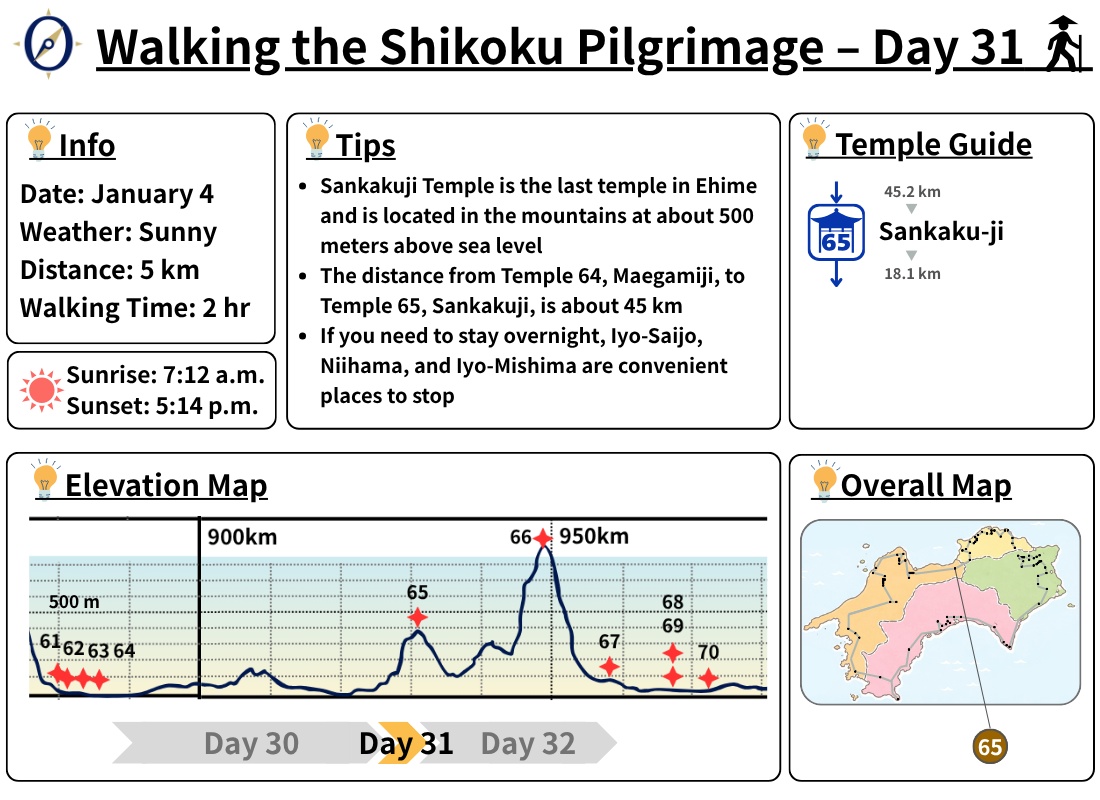
However, the distance from Temple 64, Maegami-ji, to Sankaku-ji is approximately 45 km. Sankaku-ji is also located in the mountains at an elevation of around 500 meters. I decided that covering the distance and climbing to the temple in a single day would be too demanding, so I planned to take two days and make the journey without pushing myself too hard.
At 7:30 a.m., I left the hotel.
Heading for Sankaku-ji, the Last Temple in Ehime Prefecture
The easiest route to Sankaku-ji is to head east along National Route 11. The route passes through urban areas such as Niihama and Shikokuchuo, where restaurants and accommodation are relatively easy to find. Although it is a long stretch, being able to replenish supplies along the way is reassuring.
The Shikoku Pilgrimage traditionally begins at Temple 1, Ryozen-ji, in Tokushima Prefecture and proceeds clockwise around the island toward Temple 88, Okubo-ji, in Kagawa Prefecture. Until now, I had often been walking west, but today I would be heading steadily east.
The finish line was gradually getting closer.
I still remember the feeling that began to grow within me.
Crossing Seki-no-To
As noon approached, I passed through the urban area of Niihama, and the scenery gradually changed to a mountainous landscape.
This area is known as Seki-no-To. It lies in a valley where mountains rise on both sides, with a mountain pass reaching just under 200 meters in elevation.
Although it is a mountain pass, most of the route follows National Route 11, so no special preparations like those needed for hiking are necessary. Once past this stretch, which marks the boundary between Niihama and Shikokuchuo, Iyo-Mishima, my next destination, comes closer.
Leaving National Route 11 for the Old Highway
As I walked along National Route 11, I occasionally came across signboards guiding pilgrims on foot.
Following these signs led me to sections of the old highway that branched off from the national route. Although described as an old highway, the road runs parallel to National Route 11, so taking it does not involve a major detour.
These paths sometimes preserve old stone monuments and other traces of the past, offering a glimpse of what the historic roads once looked like.
Continuing along the national route is certainly an option, but if you have enough time, it is worth following the signs and exploring the old highway. You may discover something special that can only be experienced on a pilgrimage on foot.
Visiting Enmei-ji, Bekkaku Temple 12
About 25 km from Maegami-ji, I reached Enmei-ji, Temple 12 of the Shikoku Bekkaku Twenty Sacred Sites.
Although it is not one of the eighty-eight temples of the main Shikoku Pilgrimage, it is an additional sacred site that can be visited along the pilgrimage route.
A legend associated with Enmei-ji tells how Kobo Daishi helped a person with impaired mobility.
What left the strongest impression on me during my visit was the head priest’s personality. He was an excellent conversationalist and had a friendly, approachable manner, which made a positive impression on me.
There is also a pavilion on the temple grounds, providing a welcome place for pilgrims on foot to take a break.
Shikokuchuo’s Industrial Zone and the Seto Inland Sea
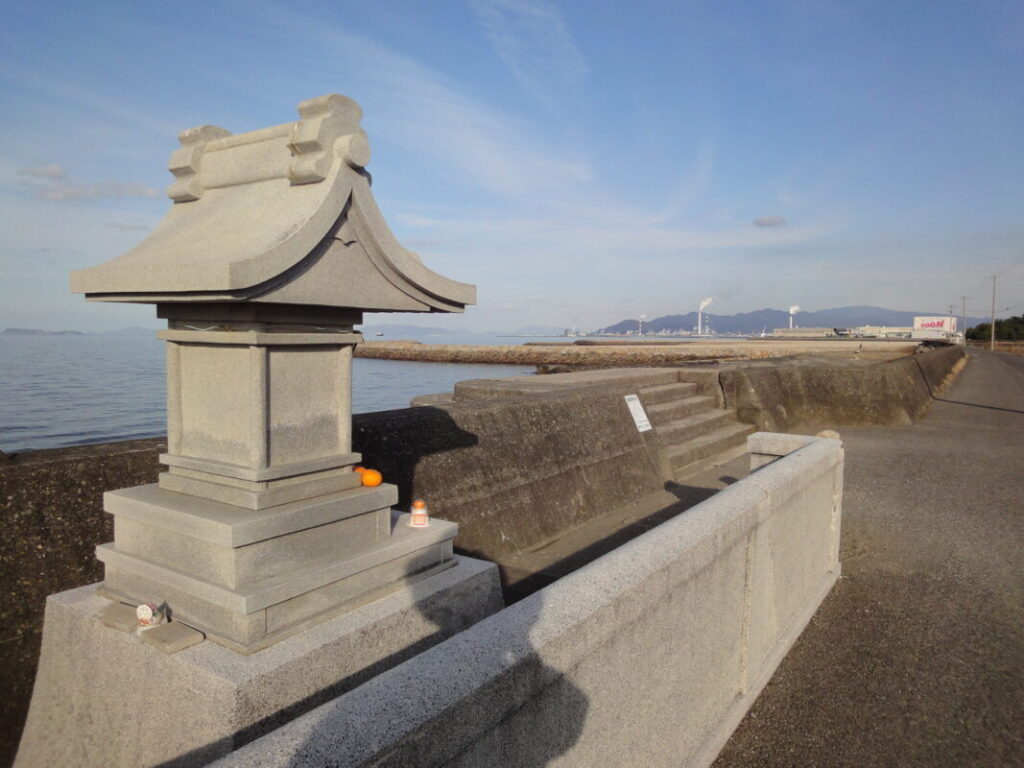
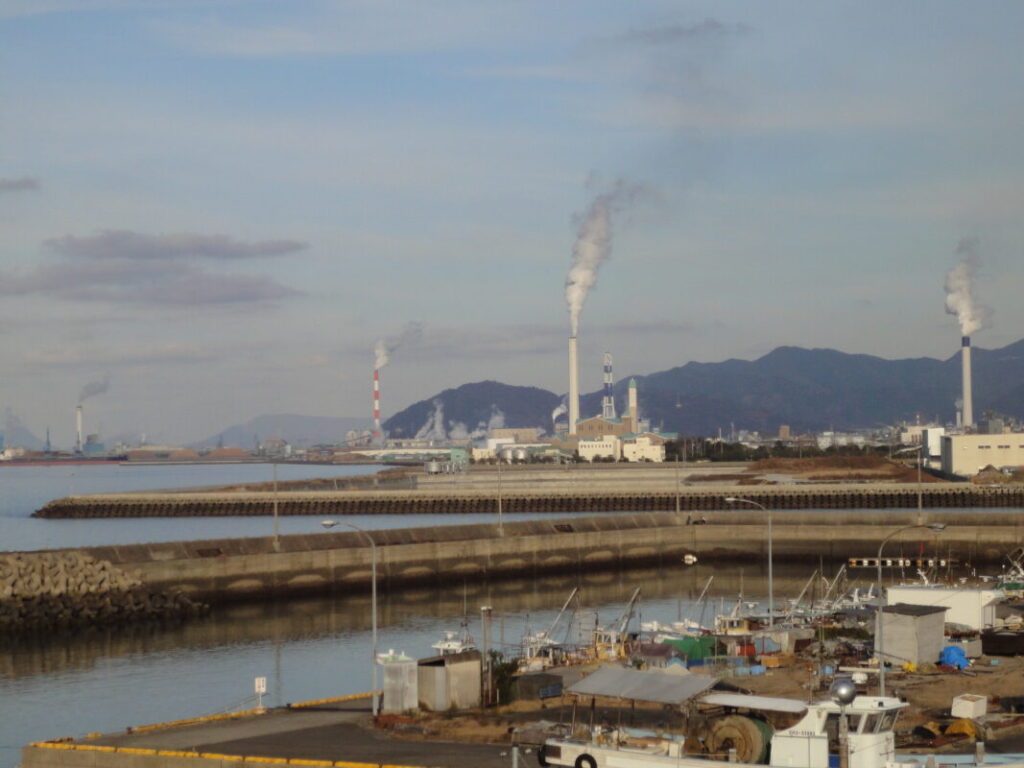
Around 3:00 p.m., I felt like taking in the views of the Seto Inland Sea, so I decided to leave the main road and walk along the coast.
The sea stretched out calmly before me, with islands scattered across the distant horizon. As I walked while enjoying the view, the industrial zone of Shikokuchuo also came into sight. Smoke rose from factory chimneys, creating a distinctive landscape where the sea and industrial facilities stood side by side.
By this point, Iyo-Mishima, located at the foot of the mountains leading up to Sankaku-ji, was not far away.
Looking for a Place to Camp in Iyo-Mishima
A little after 4:00 p.m., I arrived in the town of Iyo-Mishima.
I could have looked for accommodation in town, but the weather was fine that day. Instead, I decided to walk a little farther and look for a suitable place to spend the night outdoors.
After checking the map, I found Togawa Park, located a short distance up the road toward Sankaku-ji.
With a potential camping spot in mind, I first stopped in town to buy supplies. I purchased bento meals for dinner and breakfast the following morning, then set off toward Togawa Park.
Camping Overnight at Togawa Park
I arrived at Togawa Park at 6:00 p.m.
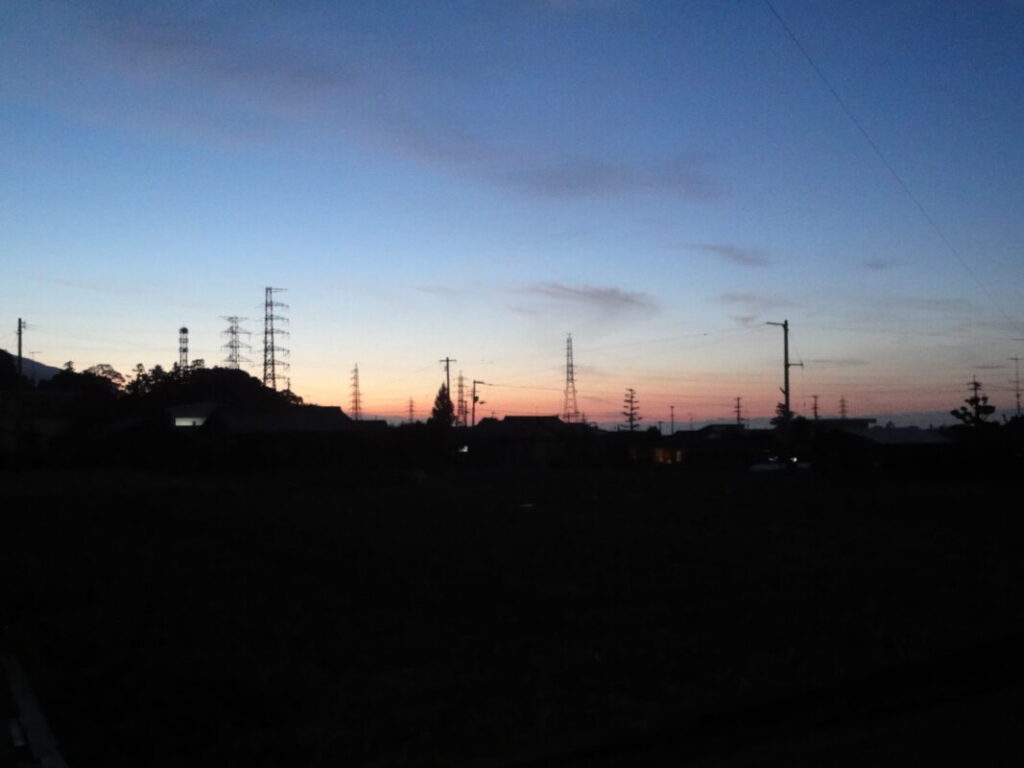
Since I had stopped to shop in Iyo-Mishima before heading there, it was completely dark by the time I arrived.
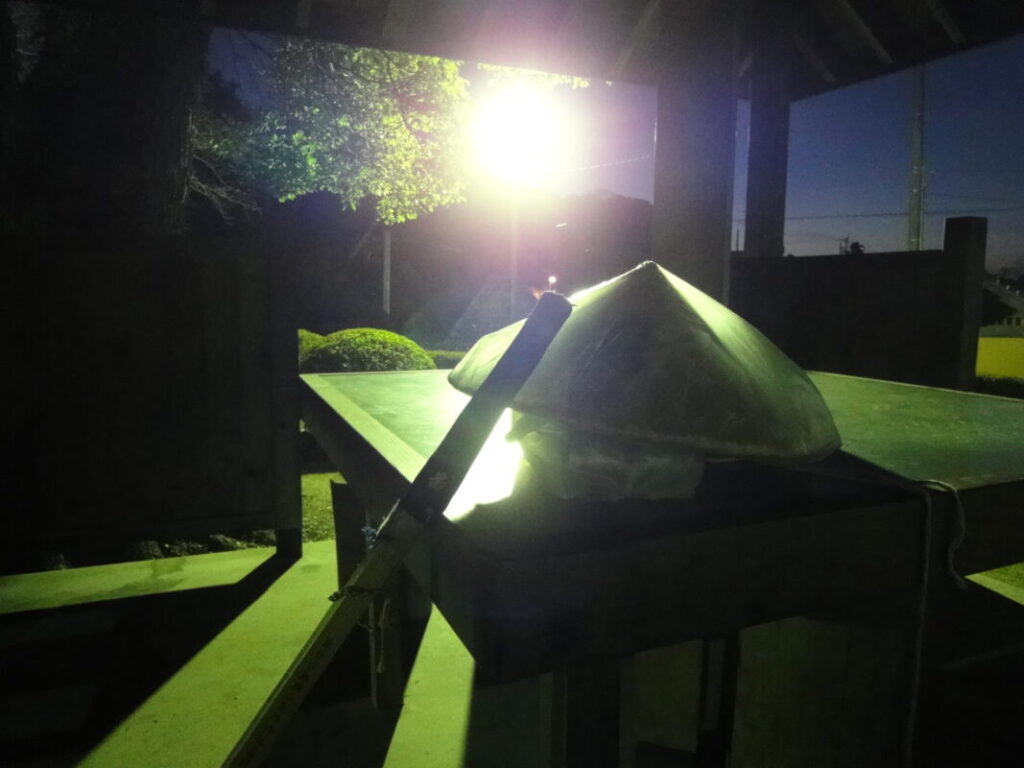
Togawa Park had public toilets and a large pavilion, making it a convenient place to rest and spend the night outdoors.
The park sits on elevated ground, offering a view over the town below. I could also see smoke rising from the factories in Shikokuchuo, enjoying a landscape characteristic of this industrial region.
After eating the bento I had bought earlier, I prepared my sleeping arrangements for the night.
Looking Back on Day 30 of My Shikoku Pilgrimage on Foot
Today, I left Iyo-Saijo and continued east through Niihama toward Shikokuchuo.
The weather was fine, allowing me to enjoy not only the roads along the national highway but also sections of the old highway and the coastal scenery. I made considerable progress toward Sankaku-ji.
My current section of the pilgrimage would finally come to an end tomorrow.
Over the ten days since December 26, when I set out from Uwajima in Ehime Prefecture and began walking from Temple 41, Ryuko-ji, I had covered a great deal of ground. Tomorrow, I planned to visit Sankaku-ji, the last temple in Ehime Prefecture, before returning home.
I wanted to keep my guard up until the very end and walk safely. Hoping the good weather would continue the following day, I settled down to sleep at Togawa Park.


Comments