
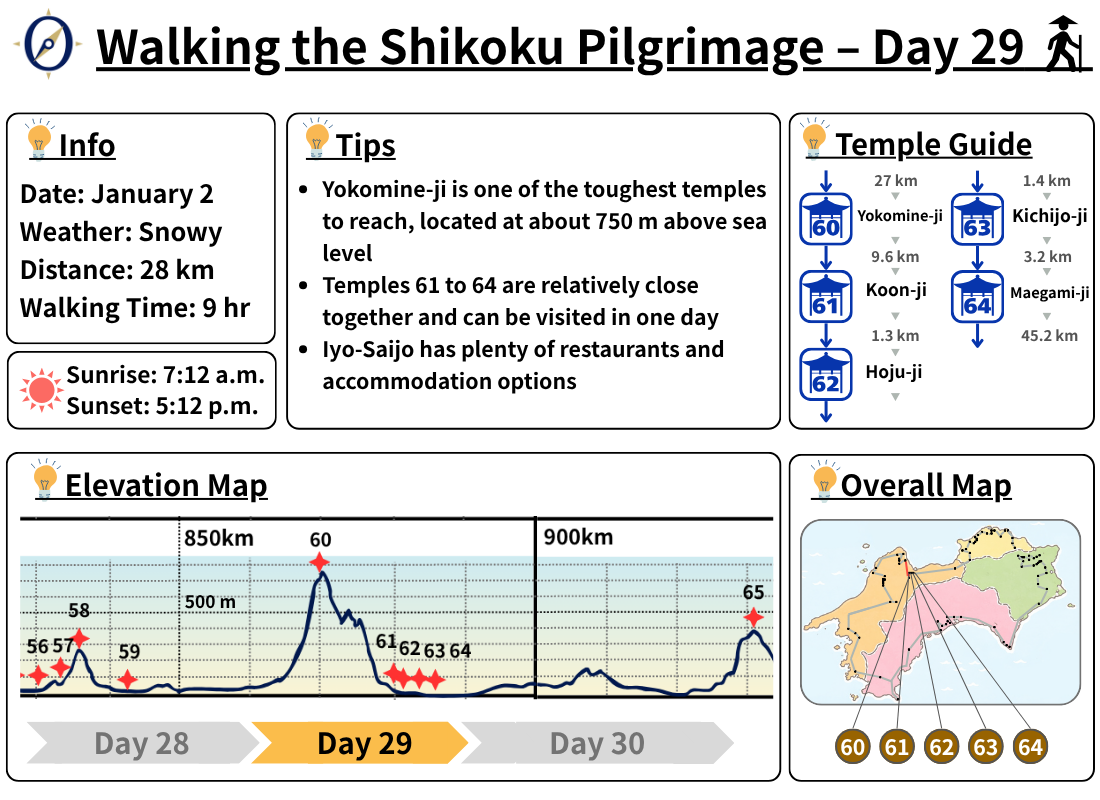
Day 29 of my walking pilgrimage, January 2. In falling snow, I climbed the steep mountain trail to Yokomine-ji and visited the temple grounds blanketed in snow. After descending the mountain, I continued to Koon-ji, Hoju-ji, Kichijo-ji, and Maegami-ji, completing all the temples planned for the day. It was a challenging day that reminded me of the harshness of winter mountain trails and the sense of achievement that comes with walking the Shikoku Pilgrimage.
- Itinerary
- Heading for Snow-Covered Yokomine-ji
- Yunami Rest Area
- The Snow-Covered Trail to Yokomine-ji
- Yokomine-ji: A Temple in the Mountains
- The Descent from Yokomine-ji
- Koon-ji: An Impressive Modern Cathedral
- Visiting Temple 62, Hoju-ji
- Kichijo-ji, the Only Temple in the Shikoku Pilgrimage with Bishamonten as Its Principal Deity
- Heading to Maegami-ji with Views of the Ishizuchi Mountain Range
- Maegami-ji and Its Beautiful Covered Corridors
- Looking for Accommodation in Iyo-Saijo
- Arriving at a Business Hotel in Iyo-Saijo
- Temple Information
Itinerary
- 7:00Departure
- Shikokuya
- Yunami Rest Area
- Yokomine-ji Mountain Trail
- 10:15Temple No. 60, Yokomine-ji
- Shirataki Okunoin
- Otani Pond
- 13:30Temple No. 61, Koon-ji
- 14:30Temple No. 62, Hoju-ji
- 15:30Temple No. 63, Kichijo-ji
- 16:30Temple No. 64, Maegami-ji
- 18:00Iyo-Saijo
Business hotel
Heading for Snow-Covered Yokomine-ji
January 2. Snow. Day 29 of my walking pilgrimage.
Yesterday, I left the tsuyado at Taisan-ji, visited Temples 57 through 59, and then stayed at Shikokuya, a hotel at the foot of Temple 60, Yokomine-ji.
It had been a tough day of sleet and strong winds, but after soaking in the hot springs and resting in a warm room, I had fully recovered.
Today, I would finally tackle Yokomine-ji, known as one of the most challenging temples in Iyo. Knowing what lay ahead on the mountain trail, I had bought food at a convenience store the day before. With everything ready, I left the hotel at 7 a.m.
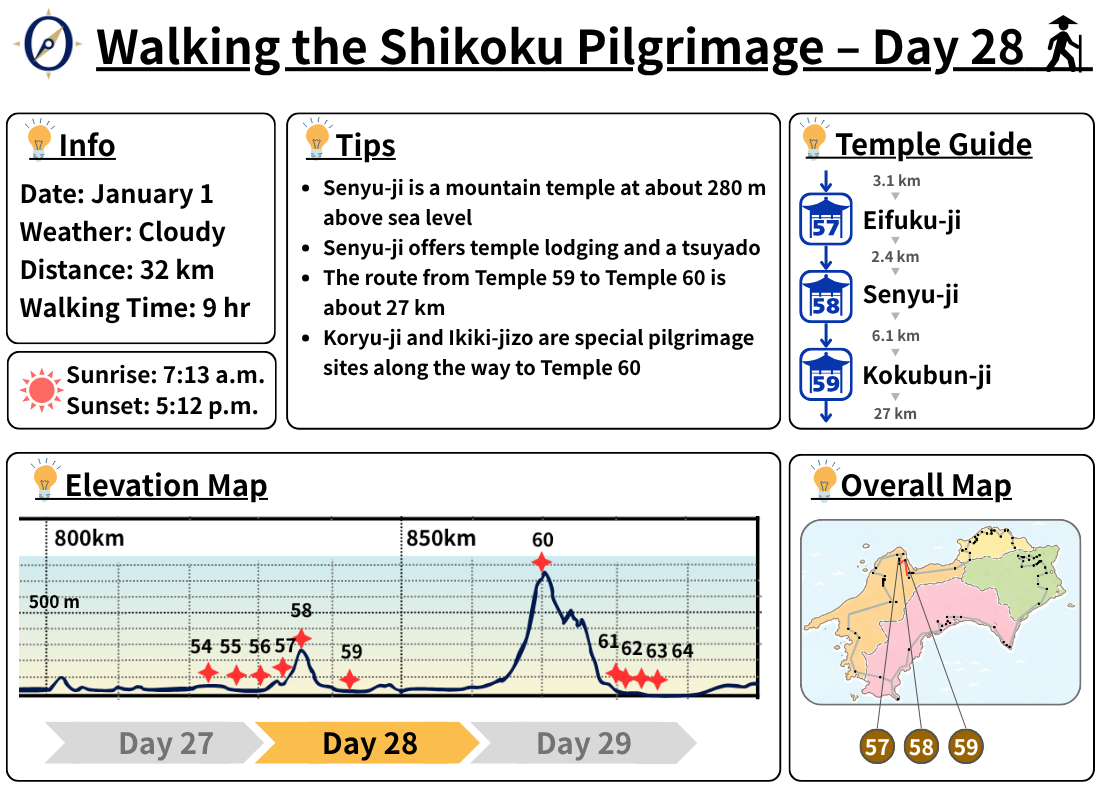
The route from Temple 59, Kokubun-ji, to Temple 60, Yokomine-ji, is about 27 km long. Since Shikokuya is roughly 20 km from Kokubun-ji, I had already covered about 70 percent of the distance.
However, Yokomine-ji lies in the mountains at an elevation of approximately 750 meters. From here on, a serious climb awaited me. Although I had already covered much of the distance, the real challenge of the day’s pilgrimage was only just beginning.
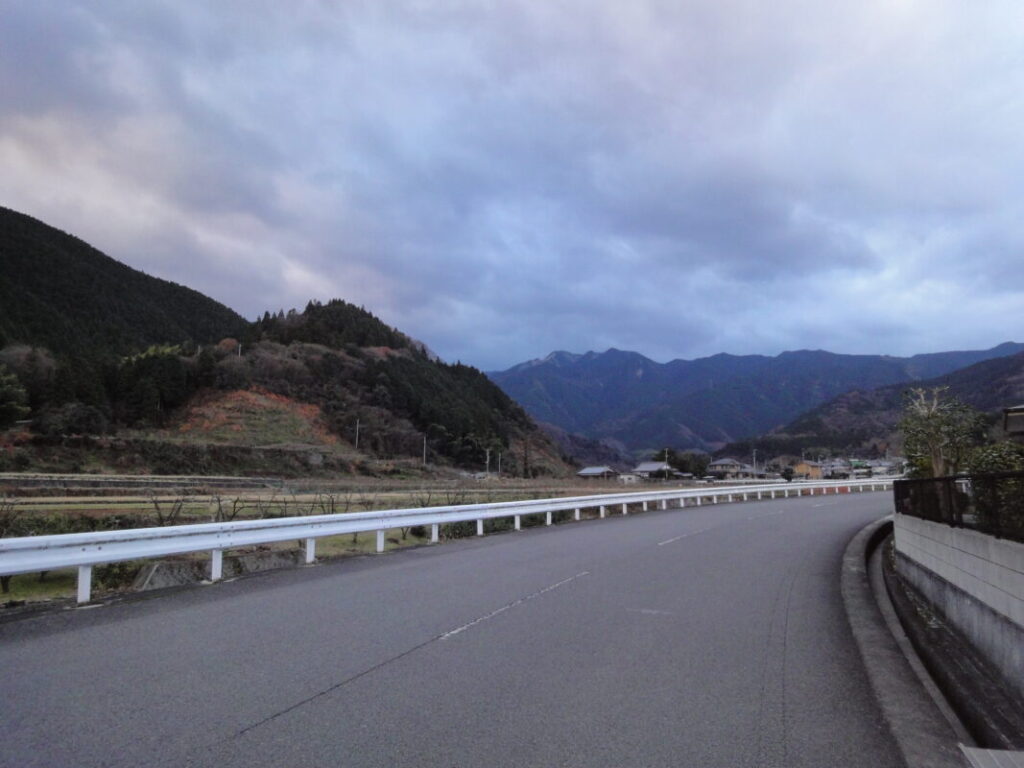
After leaving the hotel, I headed south along the Myotani River. My destination was the trailhead for Yokomine-ji, located at an elevation of around 300 meters.
A paved road led all the way to the trailhead. As I continued walking, the surrounding mountains seemed to close in around me, hinting at the difficult mountain pilgrimage that lay ahead.
The sky was covered with heavy, dark clouds, and it looked as though snow could begin falling at any moment.
Yunami Rest Area
I arrived at Yunami Rest Area at 9 a.m., about two hours after leaving the hotel at the foot of the mountain. So far, everything was going smoothly.
The rest area is relatively large and has a well-maintained public restroom. Depending on the season and weather, it can also be a suitable place to camp overnight.
Located right by the trailhead, it is a convenient place to take a break before heading into the mountains. I paused here to catch my breath and prepare for the long climb ahead.
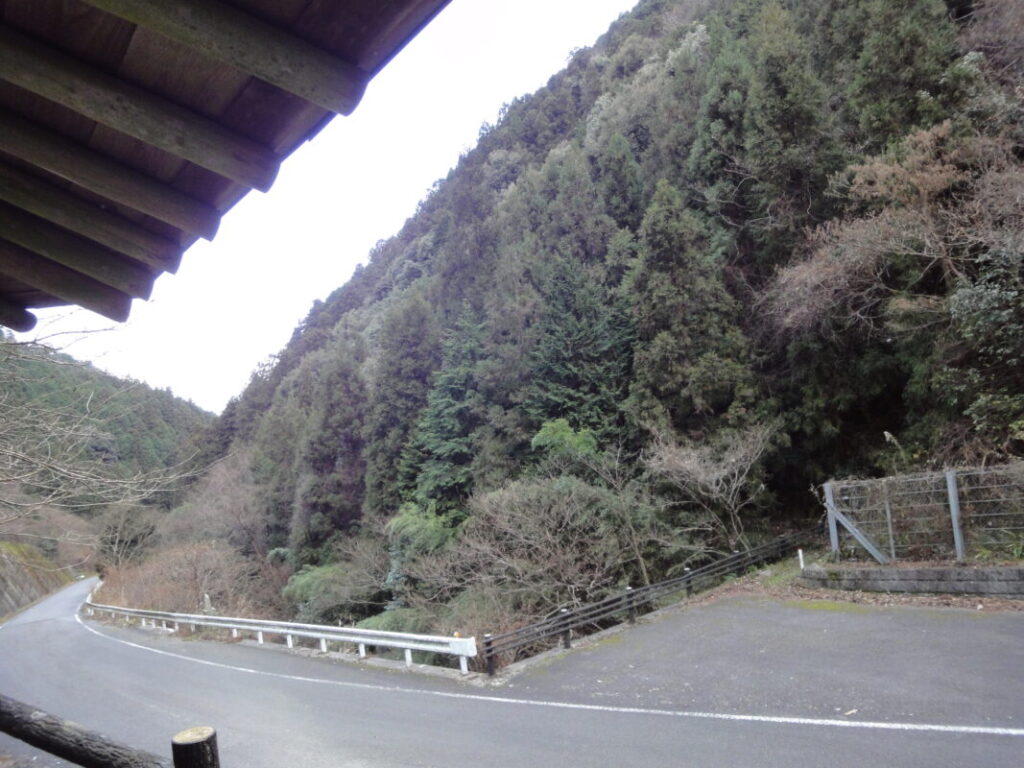
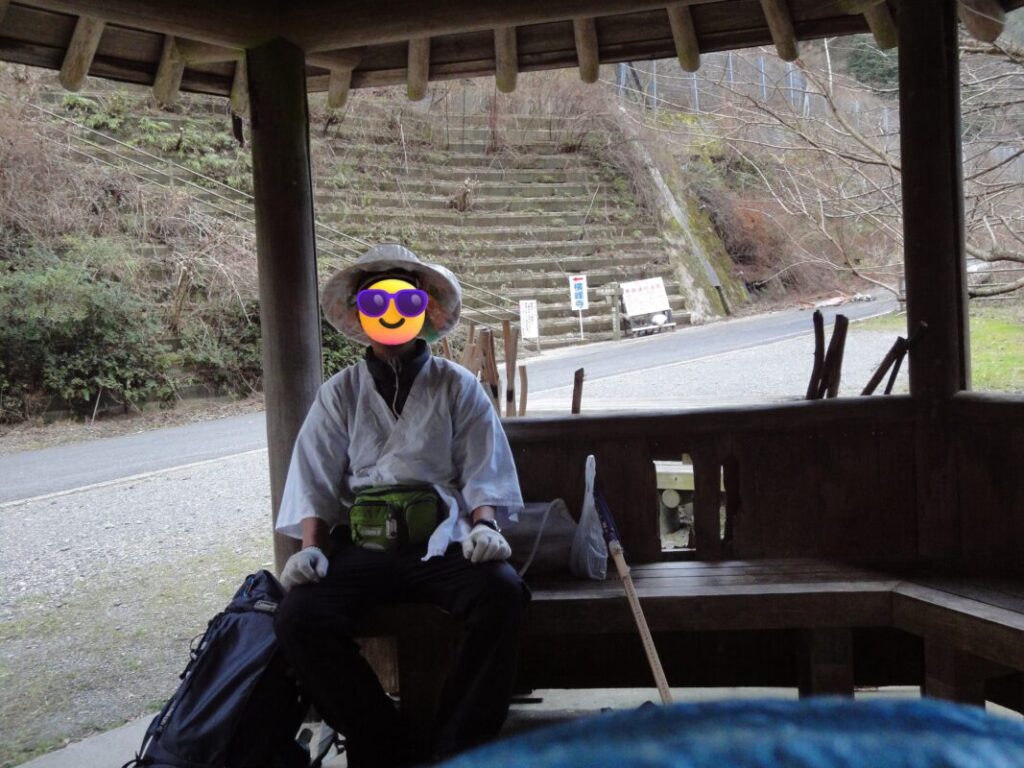
The Snow-Covered Trail to Yokomine-ji
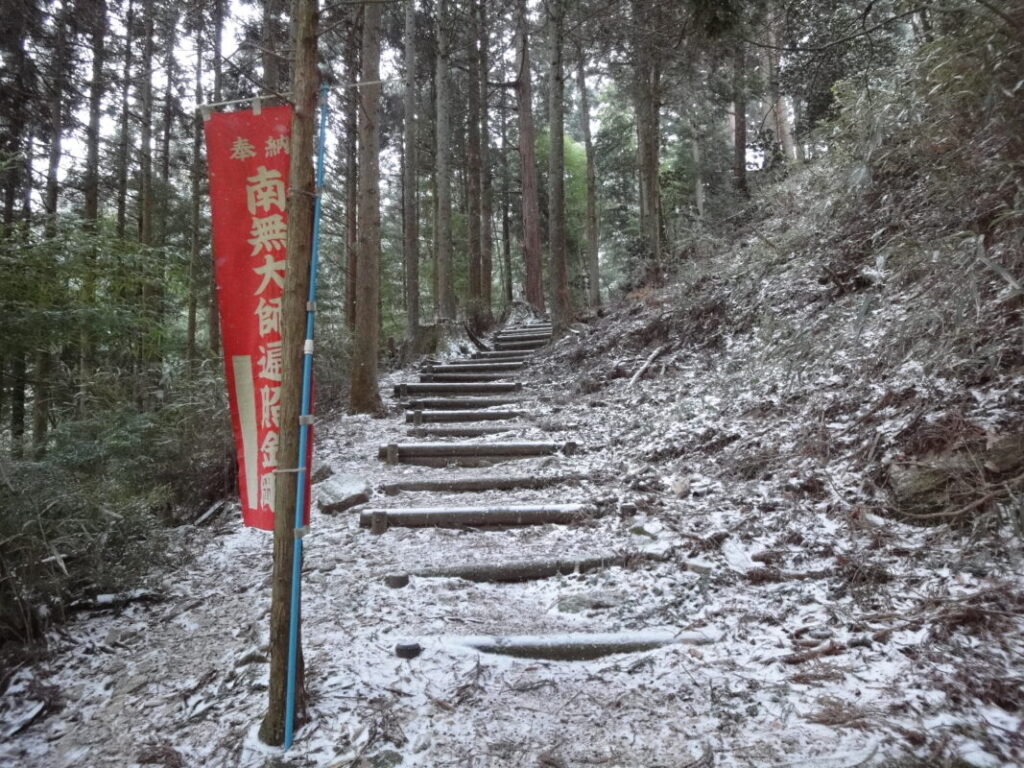
Once I entered the mountain trail, I found a well-maintained path stretching ahead. However, that did not make the climb easy. The trail continued uphill, and I steadily gained elevation.
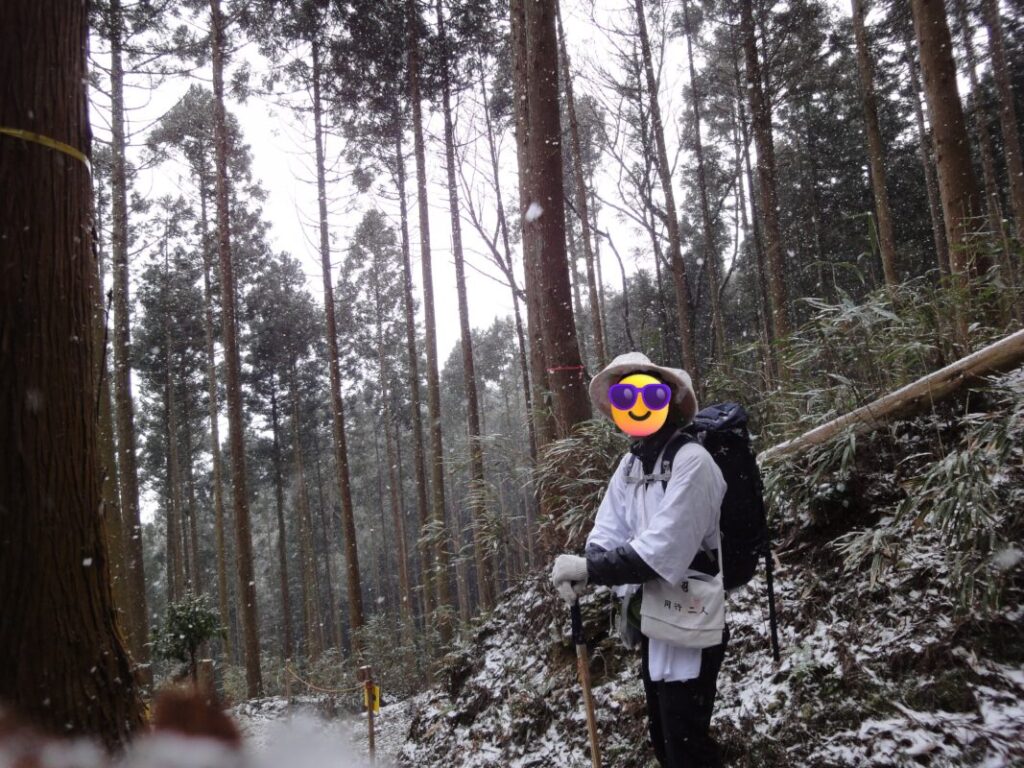
Despite the midwinter conditions, my body warmed up as I continued climbing, and I began to sweat. I took off the down jacket I had been wearing beneath my white pilgrim’s robes and tied it around my waist.
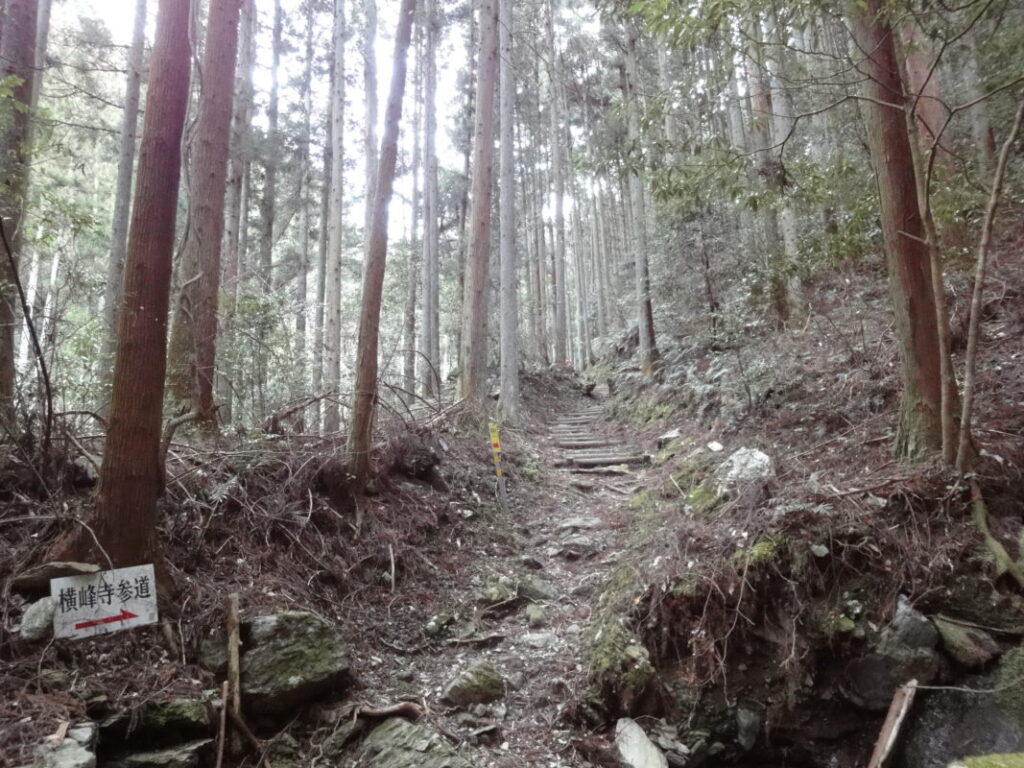
Walking Through the Snow
As I climbed higher, the weather began to change. Before long, snow started falling, gradually turning the surrounding landscape white. The familiar mountain trail looked completely different as snow accumulated on the ground.
Along the way, I occasionally came across trail markers and red flags bearing the words “南無大師遍照金剛” a sacred invocation to Kobo Daishi. These signs reminded me that I was walking the Shikoku Pilgrimage route.
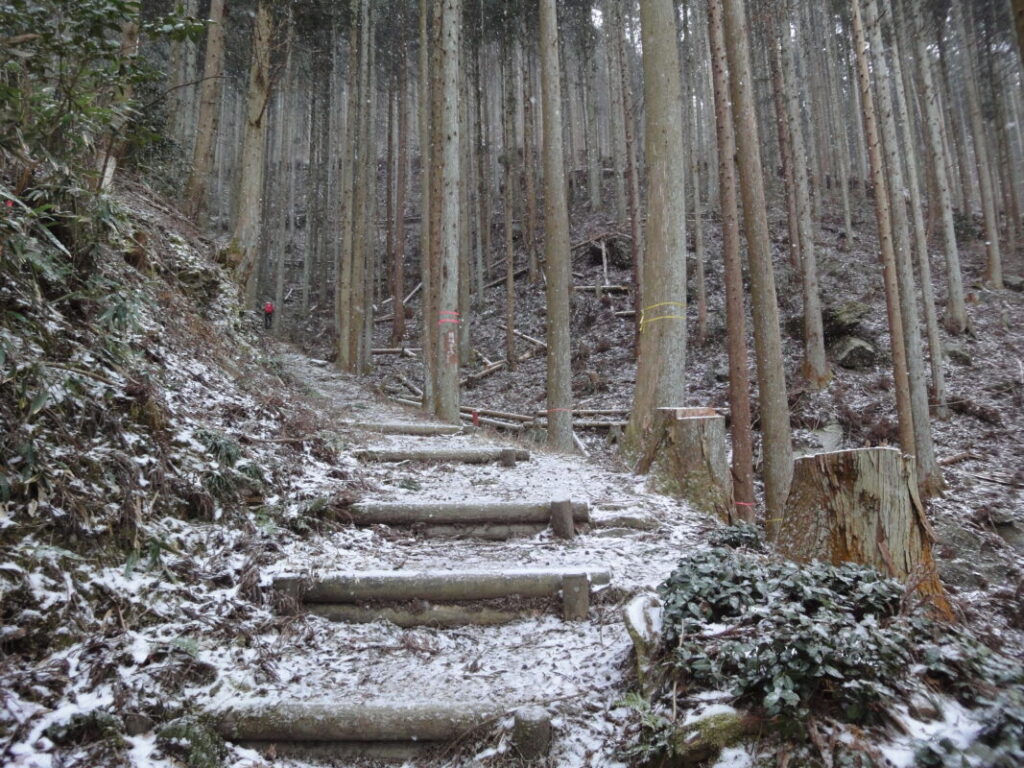
The Final Climb
I continued climbing through forests of tall, straight cedar and cypress trees.
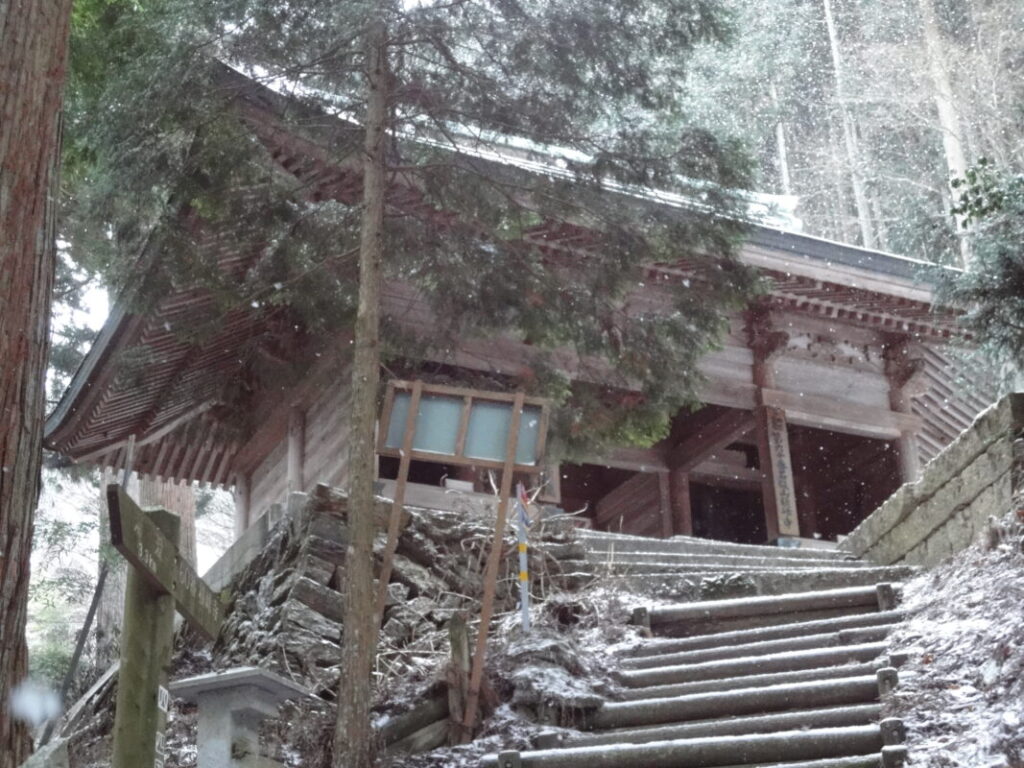
Then, I heard the sound of a temple bell in the distance.
“Almost there.”
The thought eased some of the fatigue from the long ascent. I had never imagined that the sound of a bell echoing through the mountains could be so reassuring.
Yokomine-ji: A Temple in the Mountains
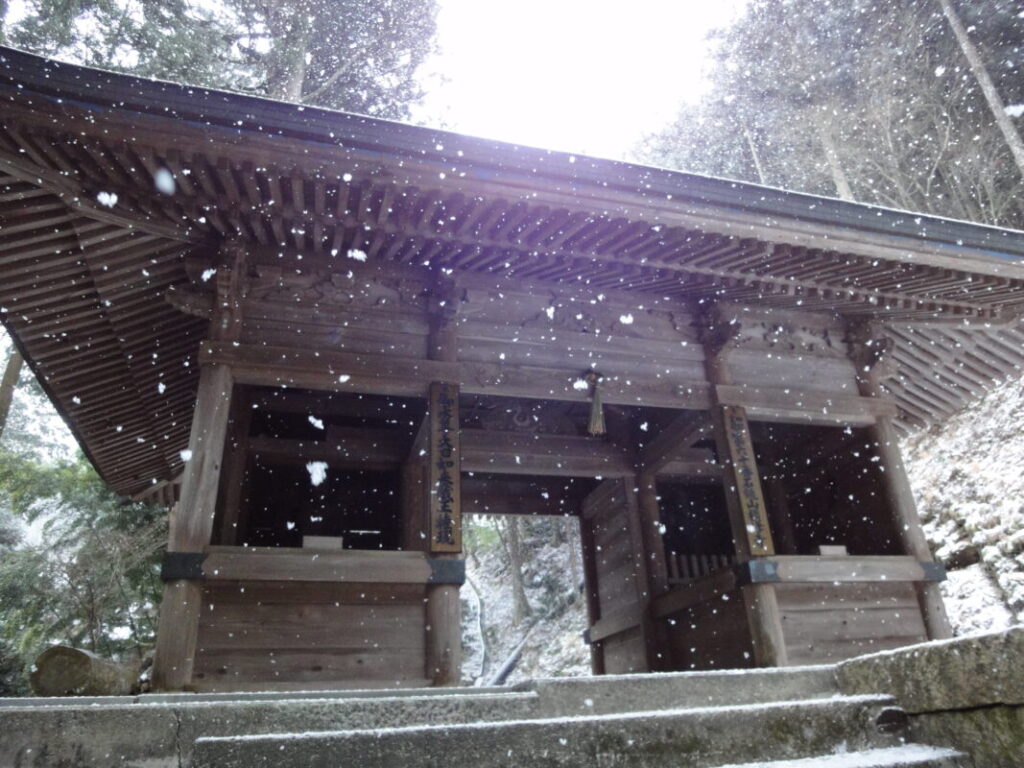
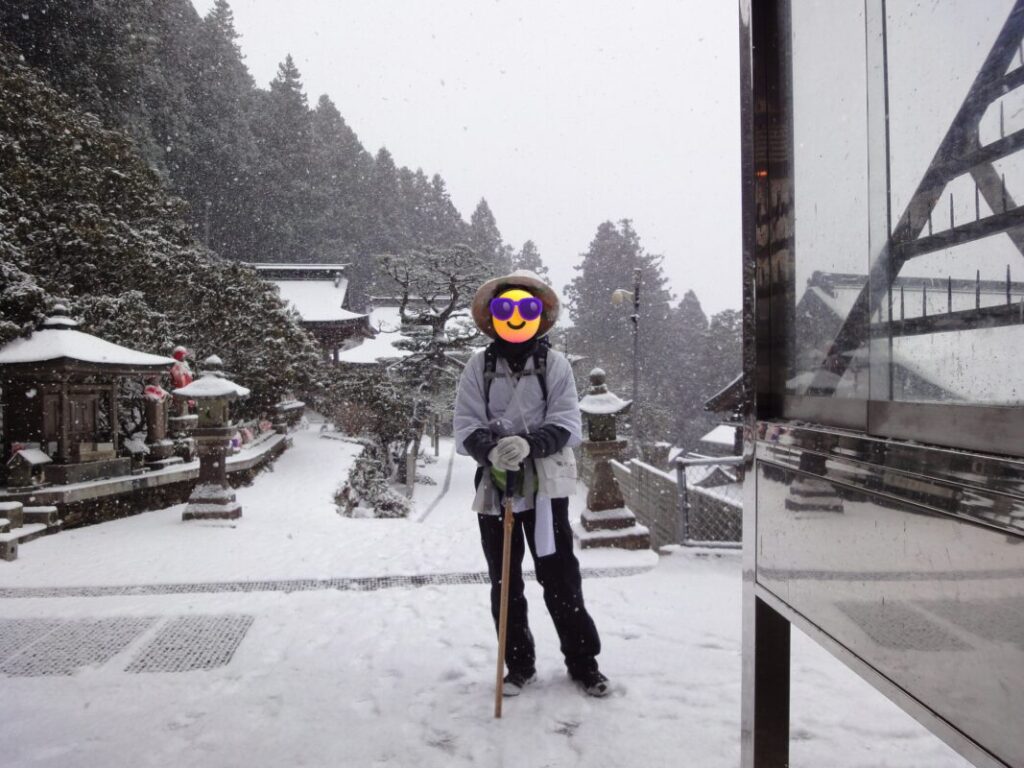
I arrived at Yokomine-ji at 10:15 a.m.
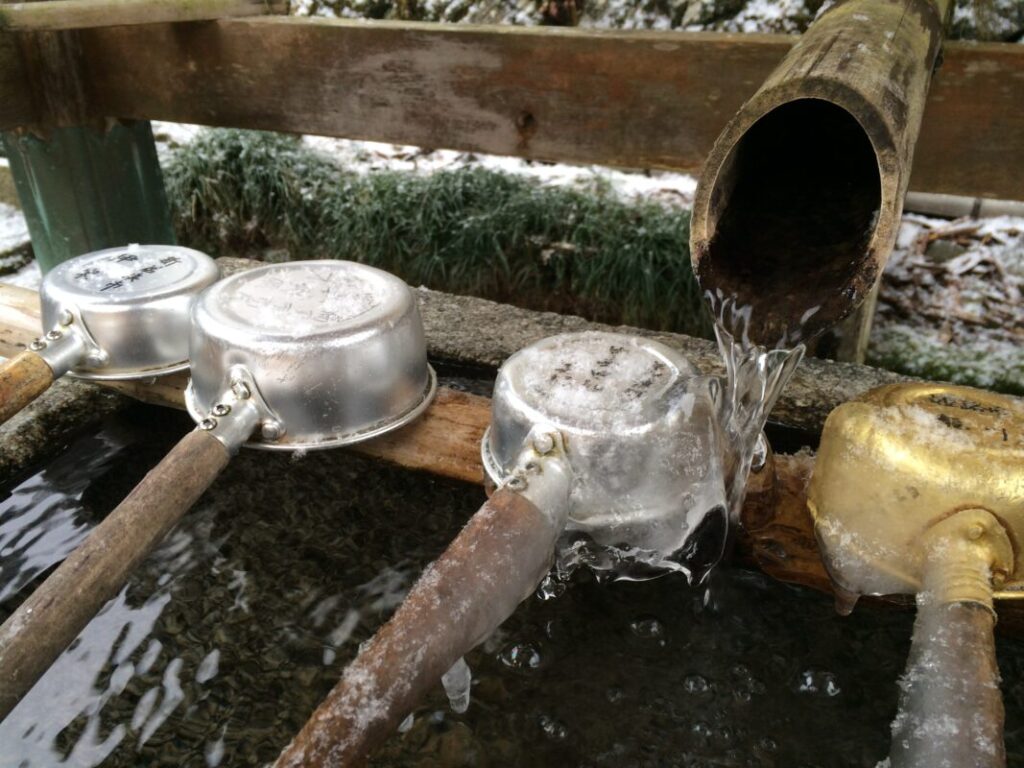
By the time I reached the temple grounds, everything was blanketed in snow. I bowed at the temple gate and headed toward the purification basin, only to find that the water had frozen completely solid.
Visiting Yokomine-ji
After spending some time in the temple grounds, I began to feel the cold creeping into my body. I quickly put my down jacket back on.
There were several other pilgrims in the temple grounds. Knowing that I wasn’t the only one walking this challenging mountain trail gave me a sense of reassurance.
Yokomine-ji is said to be the temple where Kobo Daishi practiced ascetic training at the age of 24. Climbing the mountain on foot myself, I could appreciate just how demanding the journey must have been to this remote mountain temple, steeped in such traditions.
A Warm Welcome at the Temple Office
A stove was burning inside the temple office. As I warmed my chilled body, I was also offered a cup of hot ginger tea as osettai, a traditional act of generosity toward pilgrims.
After making it up the snowy mountain trail, that warm drink tasted especially wonderful. More than ever, I felt deeply grateful for the kindness shown to me.
The Descent from Yokomine-ji
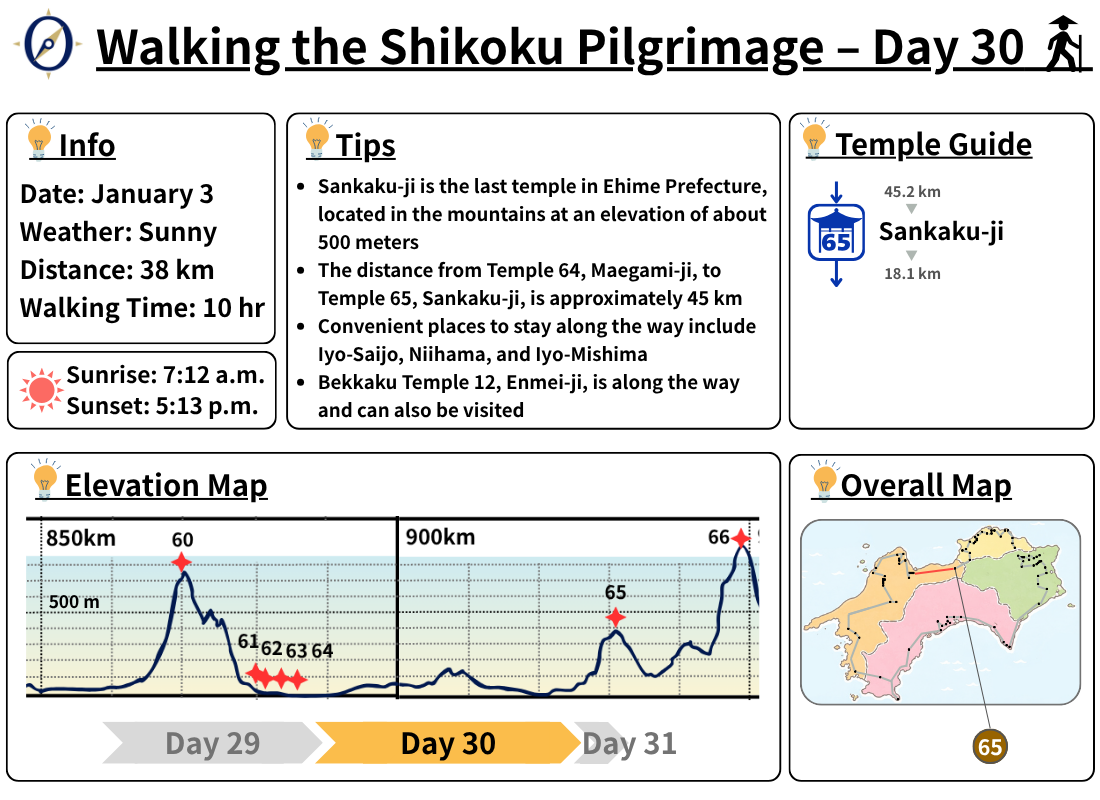
My next destination was Temple 61, Koon-ji. Temples 62, Hoju-ji; 63, Kichijo-ji; and 64, Maegami-ji were also relatively close together, leaving just four temples to visit.
Having successfully reached Yokomine-ji, I began to feel that I might be able to visit all the way to Maegami-ji by the end of the day.
After taking a short break at the temple office, I set off down the mountain.
When descending from Yokomine-ji, it is important to pay attention to the trail junctions.
Rather than returning toward the temple gate I had used on the way up, I headed toward the forest road leading to the parking lot, following the signs along the way.
The mountain trail that had felt so demanding on the ascent seemed less intimidating on the way down. My steps felt lighter, and I could enjoy the satisfaction of having made it to the top.
However, a long descent puts considerable strain on the knees. On slippery sections, I also had to watch my footing to avoid falling. It was important to take my time and proceed one step at a time.
As I descended, the snowfall gradually stopped, and the snow-covered scenery disappeared. The landscape at the foot of the mountain looked so different from the summit that it was hard to believe they were part of the same day.
I continued down the trail, thinking back to the temple grounds at Yokomine-ji, blanketed in snow.
Shirataki Okunoin
After leaving the mountain trail, I reached a paved road.
About 8 km from Yokomine-ji lies Shirataki Okunoin, the inner sanctuary of Koon-ji.
When I visited, there was no one else on the grounds, and the entire place was enveloped in silence.
I offered incense and candles, then stood quietly with my hands together in prayer.
Taking a Break at Otani Pond
Leaving Shirataki Okunoin, I continued along the road until I saw the elevated expressway of the Matsuyama Expressway. Just beyond it lay Otani Pond.
There are public restrooms and a gazebo beside the pond, making it a convenient place to take a break after the long descent from Yokomine-ji.
Temple 61, Koon-ji, was just a short distance from Otani Pond.
Koon-ji: An Impressive Modern Cathedral
I arrived at Temple 61, Koon-ji, at 1:30 p.m.
Koon-ji is a historic temple believed to have been founded around 600 AD.
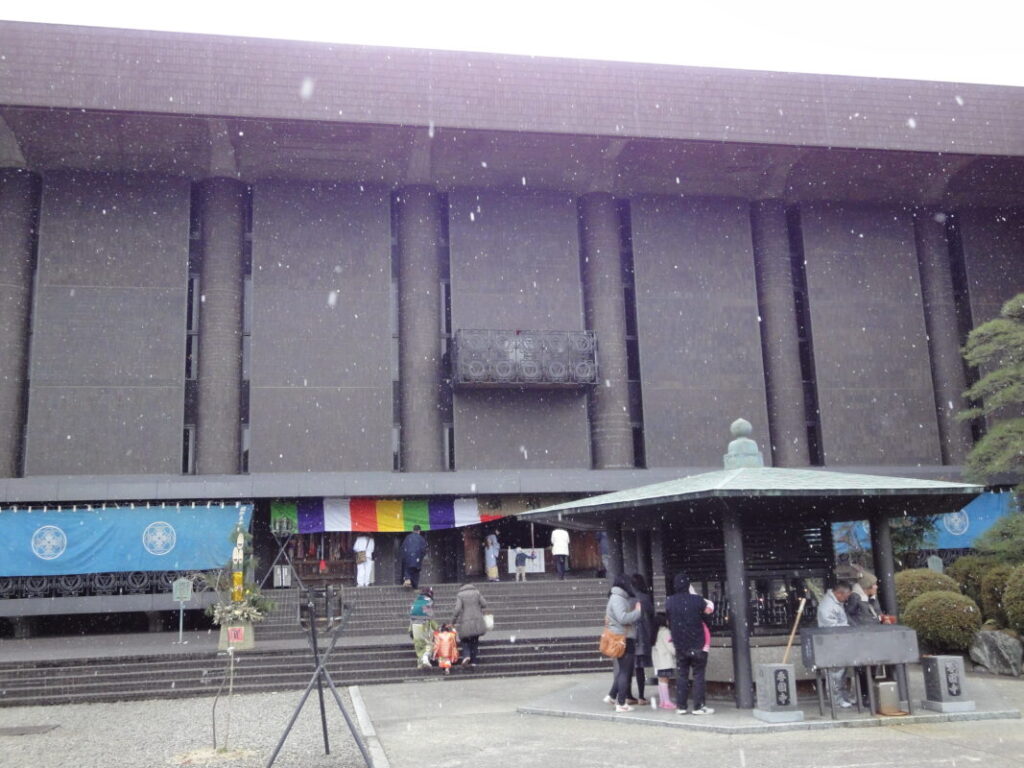
However, the first thing that catches the eye within the temple grounds is a reinforced-concrete cathedral that stands apart from traditional Japanese temple architecture. The building serves as both the main hall and the Daishi Hall, and its modern appearance makes it particularly striking among the 88 temples of the Shikoku pilgrimage.
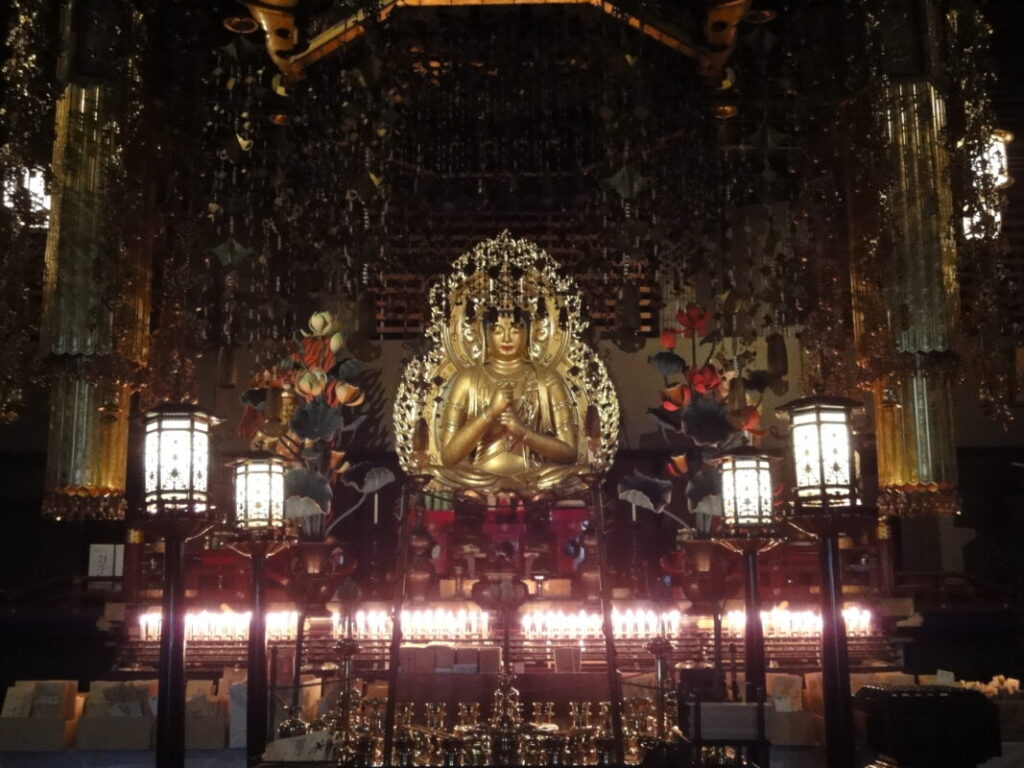
The entrance to the worship hall is on the second floor, reached by climbing a flight of stairs. Visitors remove their shoes before entering. Inside, the spacious hall resembles a large auditorium, with a solemn statue of Dainichi Nyorai enshrined at the front.
Many people probably picture a traditional wooden main hall when they think of a Buddhist temple. I think discovering architecture that challenges this image is one of the pleasures of visiting Koon-ji.
Since I visited during the New Year holidays, the temple grounds were bustling with worshippers dressed in their finest clothes and families with small children.
After walking through snowy mountain trails, returning to the town at the foot of the mountain and seeing a temple filled with people making their New Year visits gave me a comforting sense of relief.
Visiting Temple 62, Hoju-ji
After heading about 1 km east from Koon-ji, I arrived at Temple 62, Hoju-ji. Located near JR Iyo-Komatsu Station, it is one of the temples that is relatively easy to reach by public transportation.
Among the pilgrims I met along the way, some told me that they had left their luggage at an inn near Maegami-ji, returned by train, and then continued their pilgrimage on foot.
Even when undertaking the Shikoku pilgrimage on foot, there is no need to carry all your heavy luggage everywhere. I was impressed by how leaving bags at an inn and walking light could be a sensible way to make the journey.
Visiting Hoju-ji
I arrived at Hoju-ji at 2:30 p.m.
Hoju-ji is also known for the dispute surrounding its relationship with the Shikoku Eighty-Eight Temple Pilgrimage Association. A conflict arose over the management of the temple, and following legal proceedings, Hoju-ji temporarily withdrew from the association.
From around 2017 to 2019, a facility called the “62nd Temple Worship Site” was also set up in the parking lot of Koon-ji.
I have personally visited Hoju-ji both before and after its withdrawal from the association.
On this day, when I went to the Nokyo-sho (the office where pilgrims receive temple stamps and calligraphy), a pilgrim and the head priest were engaged in a heated argument. I remember feeling deeply unsettled by this unexpected encounter.
However, when it was my turn, the priest calmed down and carefully wrote the temple’s calligraphy for my pilgrimage stamp.
I would like to cover this matter in greater detail in a separate article, including the events that led up to the dispute.
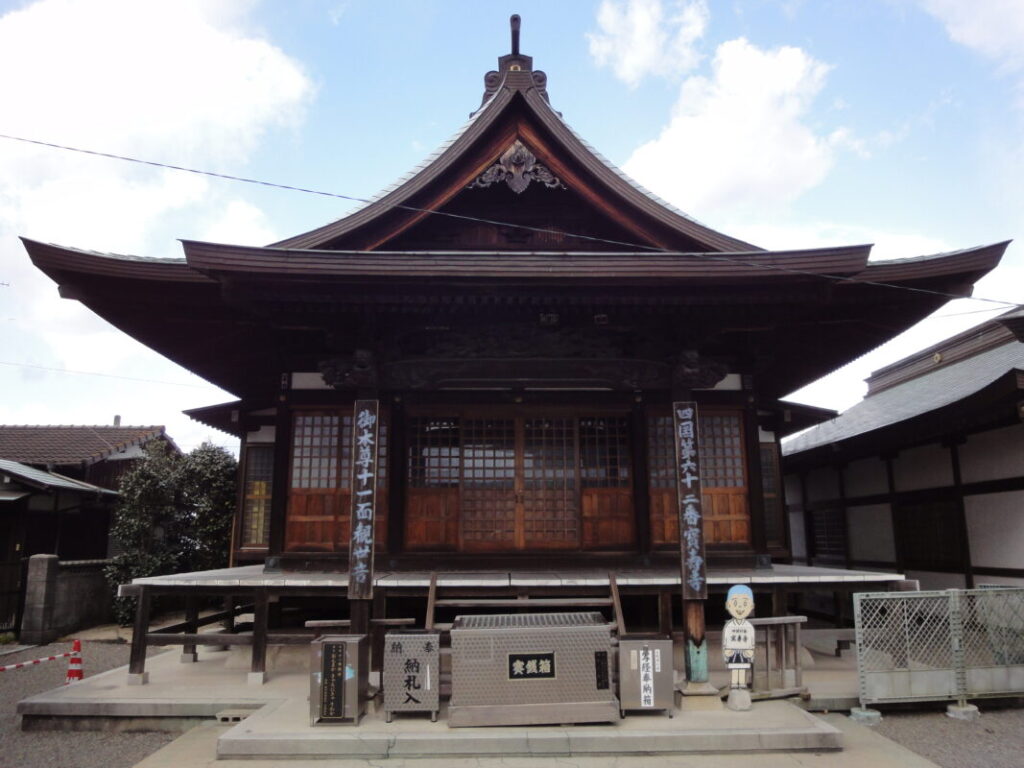
Kichijo-ji, the Only Temple in the Shikoku Pilgrimage with Bishamonten as Its Principal Deity
About 1 km east of Hoju-ji, near JR Iyo-Himi Station, stands Temple 63, Kichijo-ji.
After walking the steep mountain trails of Yokomine-ji, I was grateful to be able to cover a short distance along flat roads.
Visiting Kichijo-ji
I arrived at Kichijo-ji at 3:30 p.m.
Kichijo-ji is the only temple among the eighty-eight sacred sites of the Shikoku Pilgrimage that enshrines Bishamonten as its principal deity.
Bishamonten is one of the Four Heavenly Kings and is worshipped as a Buddhist guardian who protects the Dharma and brings prosperity, wealth, and good fortune. The inscription above the temple gate, “The Only Bishamonten in Shikoku,” conveys what makes this temple unique.
According to tradition, when Kobo Daishi traveled through this area, he discovered a Japanese cypress radiating light and sensed a sacred presence within the tree. This event is said to have inspired the founding of the temple.
The Daishi is believed to have carved an image of Bishamonten from the sacred tree and established the temple in the hope of rescuing people from poverty and hardship.
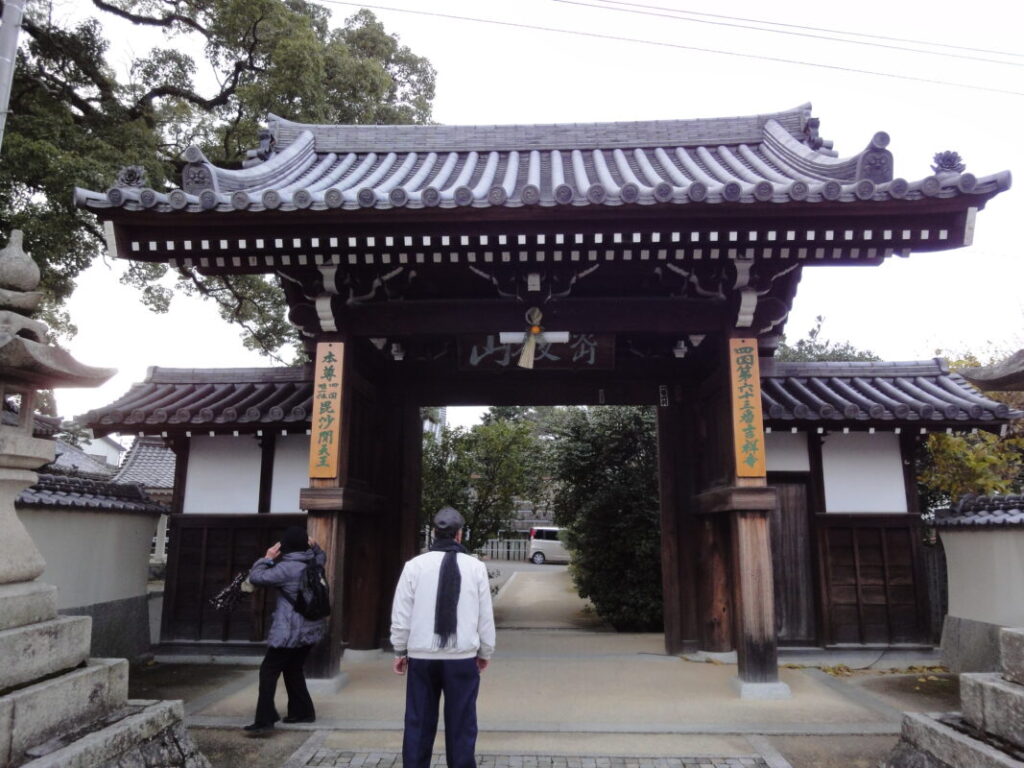
The Jōjū-seki Stone: A Place to Make Wishes Come True
The temple grounds contain several unusual features unique to Kichijo-ji.
One of them is the Jōjū-seki, or “Wish-Fulfillment Stone,” located to the right of the purification basin. The stone stands approximately one meter tall and has a hole about 30–40 cm in diameter near its base. According to tradition, passing a pilgrim’s kongō-zue (Buddhist walking staff) through the hole will make one’s wish come true.
Kisshōten and the “Goddess Passage”
Another attraction is the temple’s devotion to Kisshōten, also known as Kichijōten or Lakshmi.
Kisshōten is regarded as the consort of Bishamonten and is worshipped as a deity who dispels poverty and bestows wealth and happiness. She is also closely associated with the temple’s name, Kichijo-ji.
Beyond paying respects to the principal deity, I believe that experiencing these distinctive traditions is part of what makes a visit to Kichijo-ji so rewarding.
Heading to Maegami-ji with Views of the Ishizuchi Mountain Range
Leaving Kichijo-ji behind, I set out for Temple 64, Maegami-ji, the final temple of the day.
Maegami-ji lies about 3 km to the east. Along the way, the Ishizuchi mountain range, where Yokomine-ji is located, stretched out to my right.
“Was I really walking through those mountains just a little while ago?”
As I gazed at the mountains before me, I recalled the climb to Yokomine-ji through the snow. That morning, I had been caught in snowfall up in those mountains, yet now I was walking along a flat road at their foot. It was remarkable how much the scenery had changed within a single day.
At the entrance to Maegami-ji, there is a signboard just before a bridge crossing an irrigation channel. Following the sign to the right leads to the temple grounds.
Maegami-ji and Its Beautiful Covered Corridors
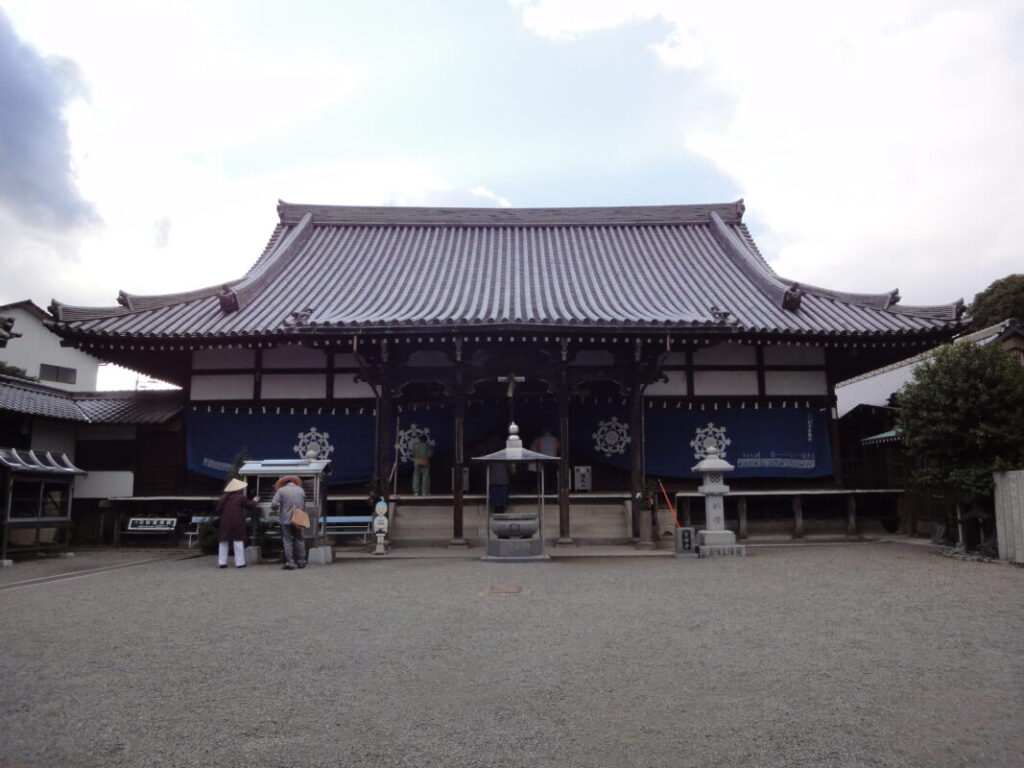
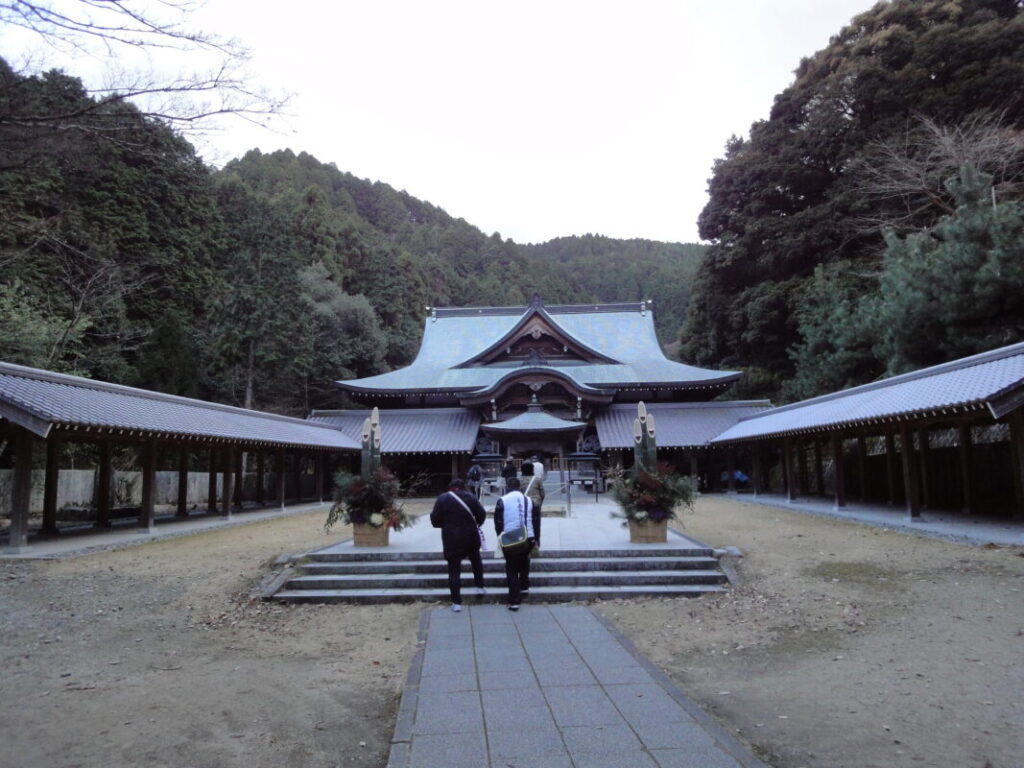
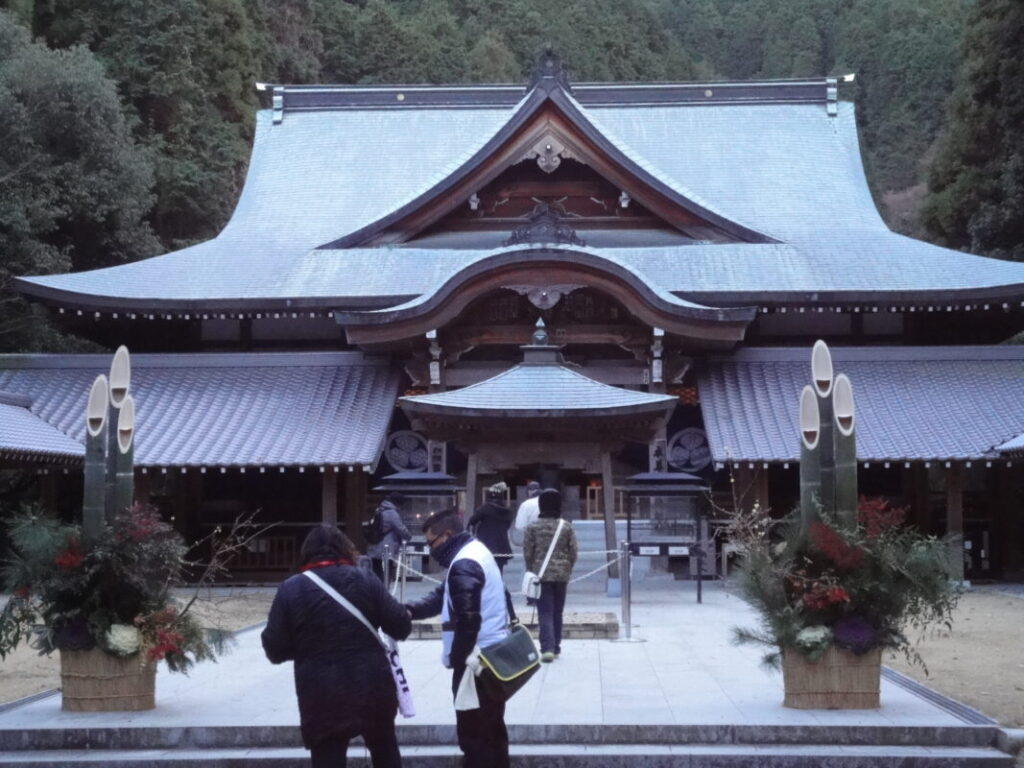
I arrived at Temple 64, Maegami-ji, at 4:30 p.m.
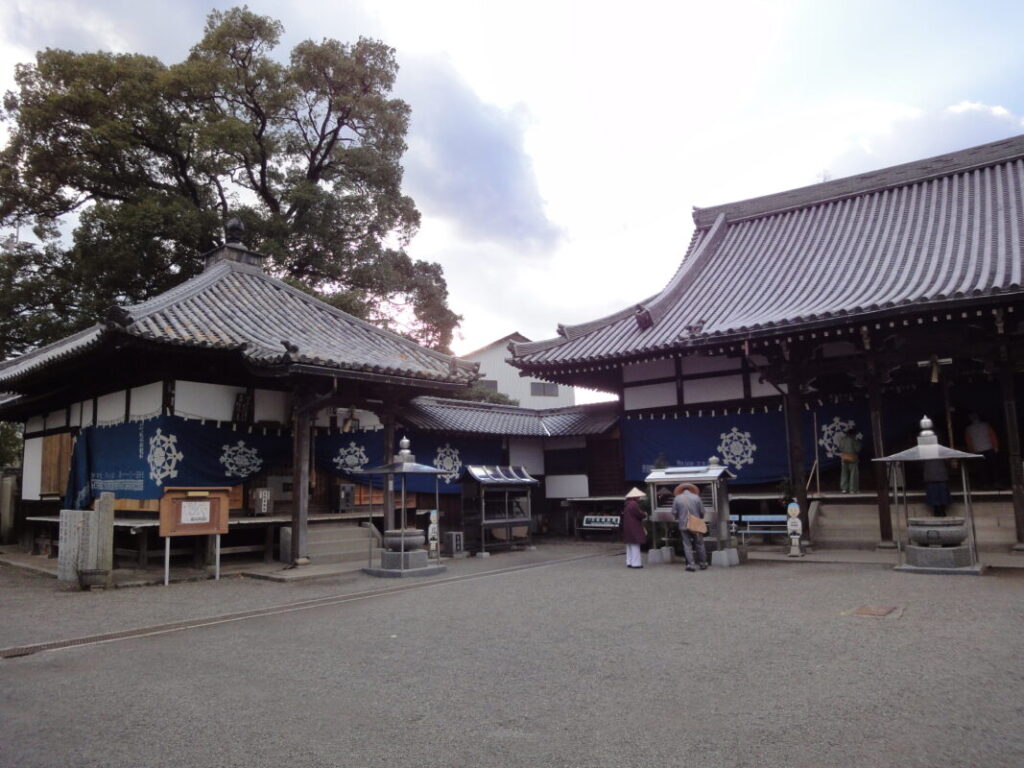
What first caught my eye on the temple grounds was the covered corridors extending to the left and right of the main hall.
The verdigris-colored roofs blended harmoniously with the surrounding forest, creating a peaceful atmosphere throughout the grounds. The arrangement of the buildings spreading out on either side was also beautiful, making it a scene I instinctively wanted to capture in photographs.
Since I visited during the New Year holidays, festive decorations could also be seen around the grounds, adding a cheerful touch to the beginning of the year.
A Temple Deeply Connected to the Faith of Mount Ishizuchi
Maegami-ji is known as the bettō-ji, or administrative temple, associated with Mount Ishizuchi, which is counted among Japan’s Seven Sacred Mountains.
For this reason, the temple holds special significance not only for Shikoku pilgrims but also for hikers and worshippers visiting Mount Ishizuchi.
Behind and to the right of the Daishi Hall, remnants of a waterfall used in the past for takigyō—ascetic purification through standing beneath a waterfall—can still be found. It is a place where one can sense the history of Mount Ishizuchi and its deep connections with mountain worship and Shugendō, a tradition of mountain asceticism.
Looking for Accommodation in Iyo-Saijo
With this, I had completed all five temples planned for the day, from Temple 60, Yokomine-ji, to Temple 64, Maegami-ji.
The snowy mountain trails had been challenging that morning, but I felt relieved to have completed the day’s itinerary safely.
However, I had not yet decided where to stay that night. Iyo-Saijo Station is about 4 km east of Maegami-ji. The area around the station has a relatively good selection of restaurants and hotels, making it a convenient place to look for accommodation.
I called a business hotel to check whether a room was available. Fortunately, I was able to make a reservation, so I headed toward Iyo-Saijo Station.
Arriving at a Business Hotel in Iyo-Saijo
I arrived at the business hotel at 6:00 p.m.
As I stepped through the entrance, I was enveloped by warm air.
During the winter, even when walking keeps your body warm during the day, the cold can gradually seep in as sunset approaches.
After a day like that, stepping into a warm place to stay finally brings a sense of relief.
Looking Back on Day 29 of My Shikoku Pilgrimage on Foot
Today, I made my way through the snowy trails of Yokomine-ji and visited four more temples: Koon-ji, Hoju-ji, Kichijo-ji, and Maegami-ji. It was a day in which I experienced both challenging mountain paths and the easier pilgrimage routes through town.
At Yokomine-ji, several moments stayed with me precisely because of the difficulties I had faced, including the warm ginger tea offered to me as o-settai at the temple office and the sound of a bell echoing through the mountains.
The twenty-ninth day of my pilgrimage had given me a taste of nature’s harshness, people’s kindness, and the unique character of each temple. Once again, I had gained an experience that could only come from making the journey on foot.
Temple Information
- No. 60
- No. 61
- No. 62
- No. 63
- No. 64



Comments