
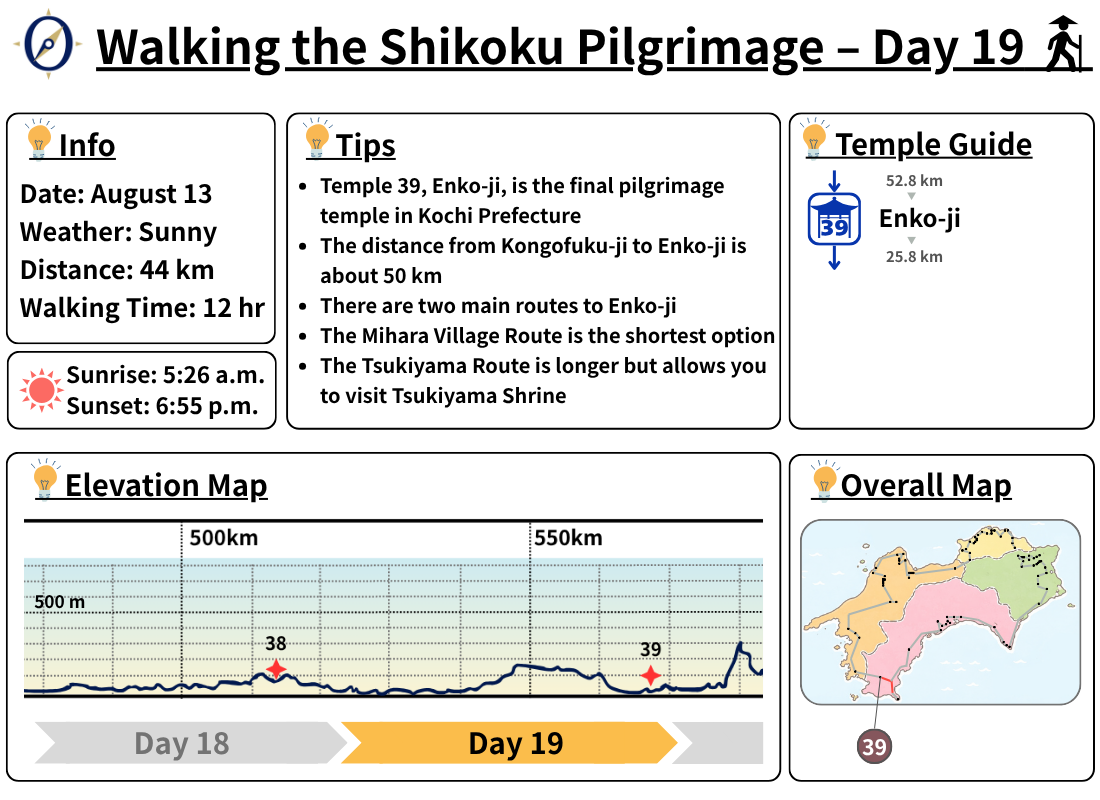
On Day 19 of my walking pilgrimage, I left Iburi and headed toward Temple 39, Enko-ji, passing through Shimonokae and Mihara Village along the way.
The distance from Temple 38, Kongofuku-ji, to Enko-ji is about 50 km, making it a long stretch of the pilgrimage. I followed narrow mountain roads through Mihara Village and Hirata, finally reaching Enko-ji, the last pilgrimage temple in Kochi Prefecture, shortly after 4 p.m.
After visiting the temple, I continued toward Sukumo and spent the night outdoors at Arneya.
- Itinerary
- Preparing to Leave in the Morning
- The Two Routes to Temple 39, Enko-ji
- Following the Early Morning Trail to Shimonokae
- From Shimonokae to Mihara Village
- Leaving Mihara Village and Heading to Hirata
- From Hirata to No. 39 Enko-ji
- Arriving at No. 39 Enko-ji
- Heading to Sukumo
- Finishing the Kochi Section of the Pilgrimage
- Temple Information
Itinerary
- 5:30Departure
- Iburi
- Ohki Beach
- Shimonokae
- Yoshii Rest Area
- Mihara Village
- Hirata
- 16:15Temple No. 39, Enko-ji
- 18:30Arneya
Overnight stay
Preparing to Leave in the Morning
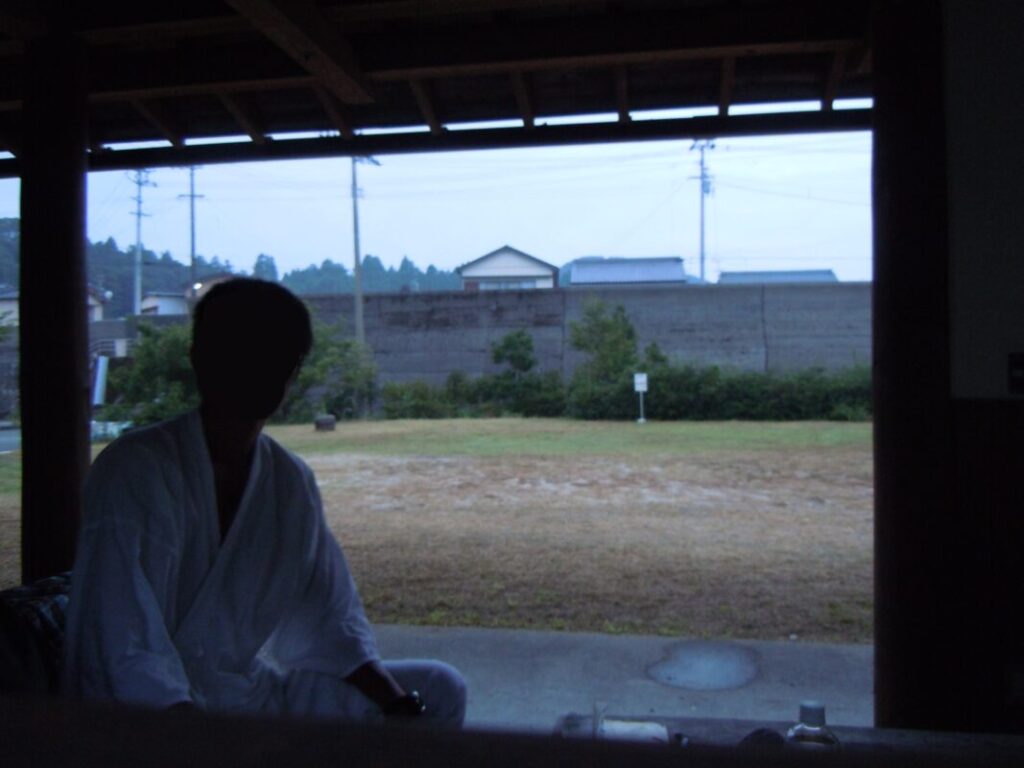
August 13, sunny. The morning of Day 19 of my walking pilgrimage.
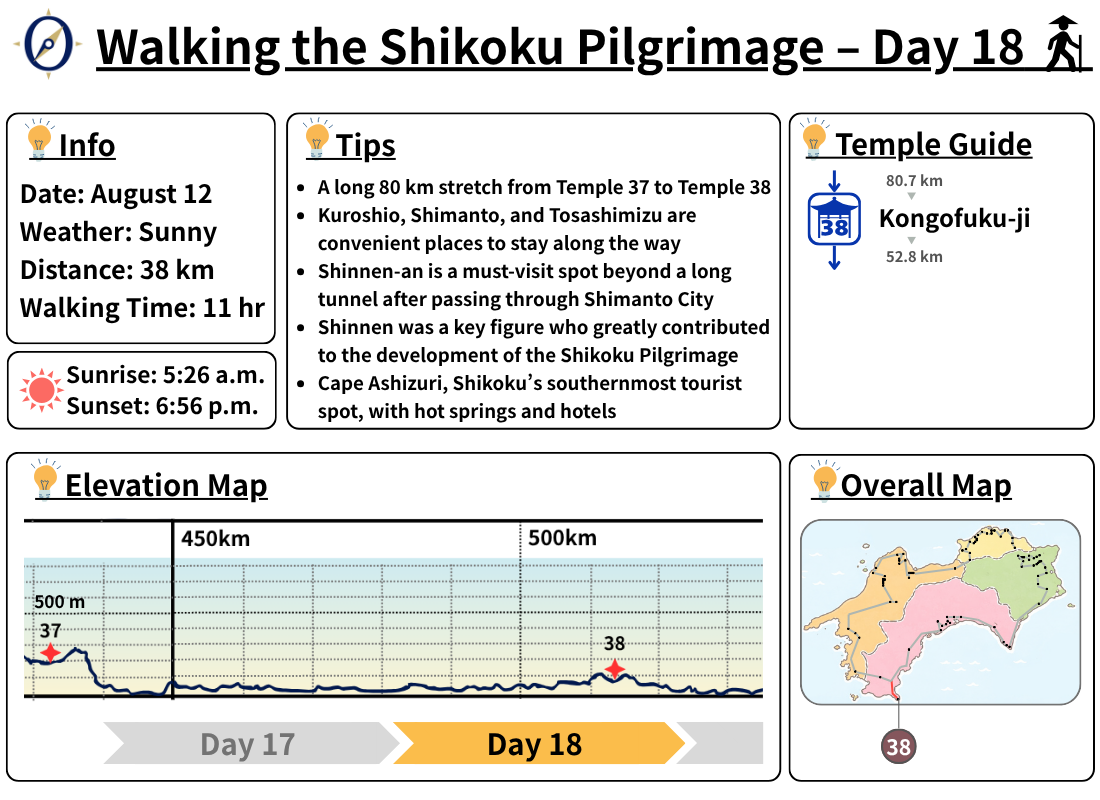
The previous day, I walked through Shinnen-an to Temple 38, Kongofuku-ji, explored the area around Cape Ashizuri, and then retraced my steps to Iburi, where I spent the night outdoors.
The other pilgrims who had joined me in the gazebo were still asleep.
Today’s destination was Temple 39, Enko-ji.
Enko-ji is also the final pilgrimage temple in Kochi Prefecture. Once I completed this temple, I would finally enter Ehime Prefecture.
I quietly got ready so as not to wake the others, and set off at 5:30 a.m.
The Two Routes to Temple 39, Enko-ji
There are two main routes from Temple 38, Kongofuku-ji, to Temple 39, Enko-ji.
The first is the route through Mihara Village. It involves retracing the road from Cape Ashizuri toward Shimonokae before heading north toward Enko-ji. This is known as the “uchimodori” or backtracking route.
The biggest advantage of this route is its shorter distance.
The other option is the “Gassan Route.” This route follows the coastline around from Cape Ashizuri, passing through Gassan Shrine before continuing to Enko-ji. While it allows you to visit Gassan Shrine, it is longer than the Mihara Village route.
I have walked the Shikoku Pilgrimage twice, so I have experienced both routes.
On my first pilgrimage, I chose the Mihara Village route.
If this is your first time walking the pilgrimage, I would recommend the Mihara Village route. Because it is shorter, I found it somewhat easier than the Gassan Route.
Following the Early Morning Trail to Shimonokae
The pilgrimage trail in the early morning is much cooler than during the day, making it considerably easier to walk.
When walking the pilgrimage in summer, I think it is important to cover as much distance as possible during the cool early morning hours. During the hottest part of the day, it is better not to push yourself too hard and to take frequent breaks.
I retraced the route I had walked the previous day, this time heading in the opposite direction.
The scenery was familiar, but somehow it looked different from the day before.
“Walking the pilgrimage in the opposite direction could be interesting, too.”
I continued walking while thinking about that.
A little after 8 a.m., I arrived at Shimonokae.
From here, I could head north along Prefectural Route 21 toward Enko-ji.
There was a convenience store in Shimonokae, so I stocked up on breakfast and lunch. It was the same convenience store I had used when heading toward Kongofuku-ji, and it was an especially welcome sight for a walking pilgrim.
From Shimonokae to Mihara Village
From Shimonokae to Mihara Village, the route follows a prefectural road along the Shimonokae River for about 15 km.
The road winds through the valley, with some sections so narrow that only a single car can pass through the forest.
There are very few shops beyond this point, so it is best to stock up on food and drinks in Shimonokae before setting out.
The road gradually climbs as it follows the Shimonokae River upstream.
The slopes are not particularly steep, but the seemingly endless uphill gradually drains my energy.
I could not pick up the pace as much as I wanted.
“Will I be able to reach Enko-ji today?”
I was beginning to feel a little uneasy.
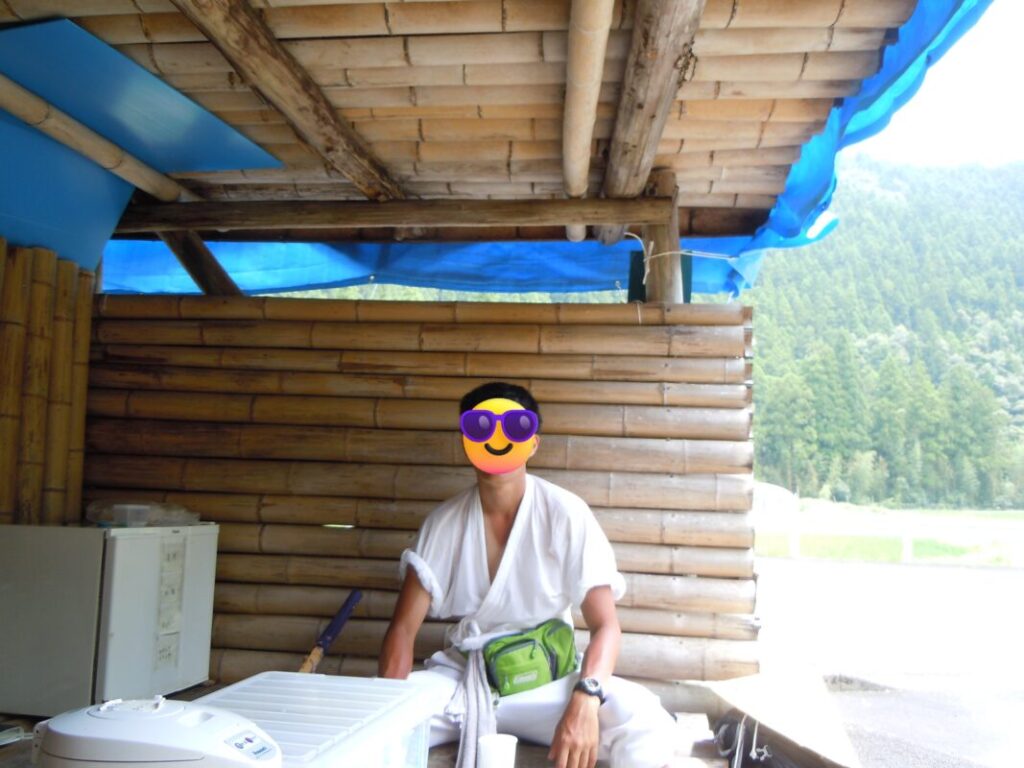
Yoshii Rest Area
About two hours after leaving Shimonokae, I came across Yoshii Rest Area.
I could not resist stopping for a break.
There were drinks left there as a form of osettai, a welcome offering to pilgrims. For a pilgrim walking under the blazing sun, this was incredibly appreciated. I replenished my fluids with a cold drink, spread out my map, and checked how much distance remained.
About 20 km to Enko-ji.
It was 11:30 a.m.
With only about five hours remaining until the nokyo office closed at 5 p.m., there was not much time left.
“This is no time to take it easy.”
From here on, I decided to keep moving without slowing my pace as much as possible.
Leaving Mihara Village and Heading to Hirata
After walking for about two more hours from the rest area, the scenery around me gradually began to change.
The forested road opened up, revealing a peaceful rural landscape.
I had apparently entered Mihara Village.
Mihara Village has a supermarket, making it a valuable place to take a break and stock up on food and drinks along this section of the pilgrimage route. There are also minshuku guesthouses, so I imagine that quite a few pilgrims choose to stay in this area.
It is about 10 km from Mihara Village to Enko-ji.
It was 2:00 p.m.
At this pace, I should be able to reach the temple before the time for receiving the temple stamp ends.
Still, I couldn’t afford to let my guard down yet.
After leaving Mihara Village, the scenery changed back to forest.
There are some sections around here where the road is quite narrow, so I had to be careful of passing cars.
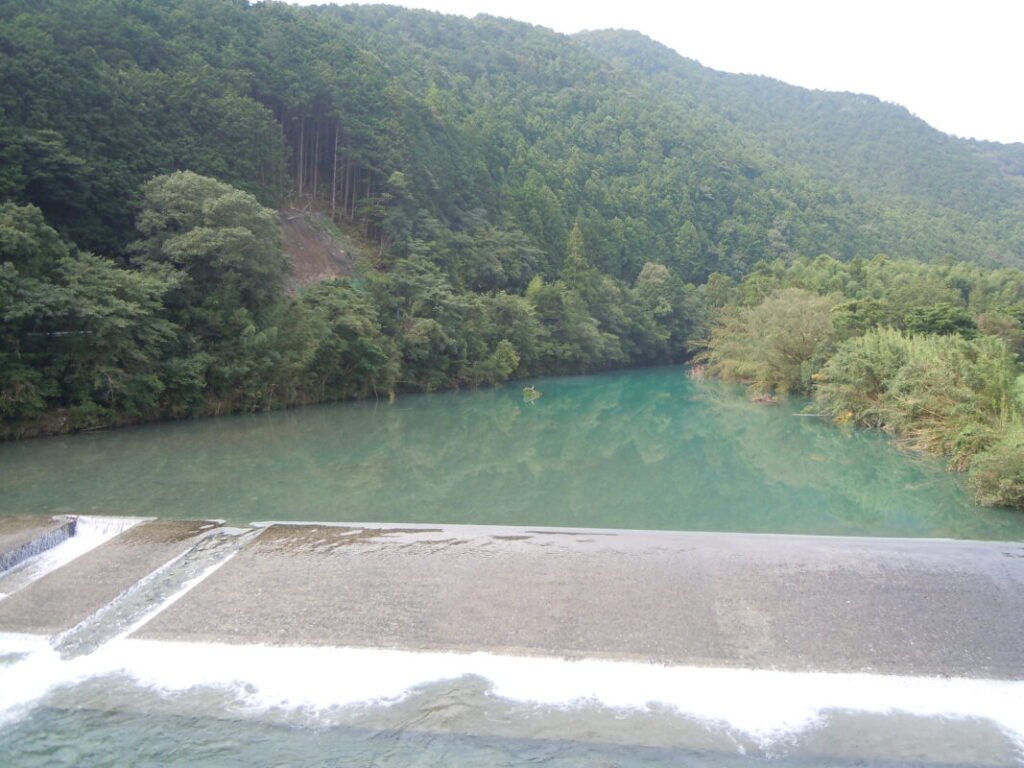
Along the way, I crossed a bridge over a reservoir. From the bridge, I could look out over the dam. The sight of such a large man-made structure suddenly appearing deep in the mountains was impressive and left a lasting impression.
After passing the dam, I continued downhill along a winding mountain road.
After a while, the view suddenly opened up, and houses came into sight.
I had reached the Hirata area, just before Enko-ji.
From Hirata to No. 39 Enko-ji
Hirata is about 2 km from Enko-ji and is a convenient town with restaurants and convenience stores. There are also places to stay, so if you cannot make it to Enko-ji before the temple’s stamp office closes, staying overnight here is a good option.
It was just before 4:00 p.m.
I had walked about 20 km with almost no breaks, and honestly, I was already quite tired.
Even so, it looked like I would make it to Enko-ji before the stamp office closed.
Once I was sure of that, I slowed my pace slightly and continued along the final stretch.
From Hirata, I passed under the railway tracks and turned left at a T-junction.
From there, I joined National Route 56.
It was my first time in a while to be back on National Route 56, a road I had walked along many times around Iwamoto-ji.
After walking for a while, I saw a sign on the right pointing toward Enko-ji.
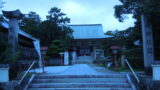
Following the sign, I finally caught sight of the temple’s main gate.
Arriving at No. 39 Enko-ji
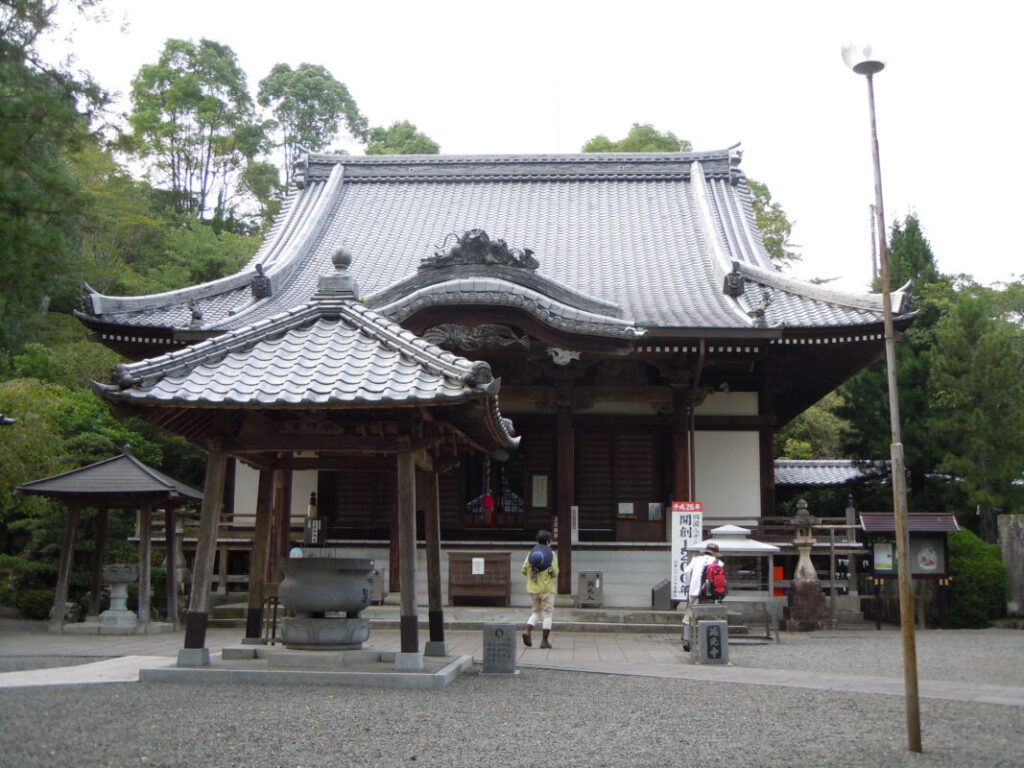
Just after 4:00 p.m., I arrived at No. 39 Enko-ji.
It was the last temple of the pilgrimage in Kochi Prefecture.
Thinking back on the long pilgrimage route that had begun in Muroto, I couldn’t help but feel a sense of accomplishment and emotion.
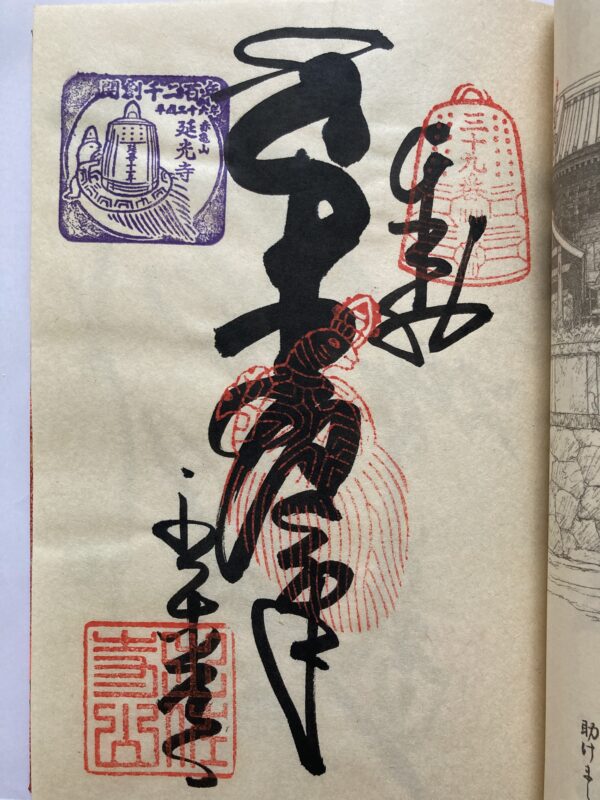
Enko-ji is known for a legend in which a red turtle appeared carrying a temple bell on its back. The temple is also said to be popular as a place to pray for protection from misfortune and for safe childbirth.
One distinctive feature of the temple’s stamp is the image of a turtle.
Along the way, I had seen several pilgrims wearing white robes marked with both a crane and a turtle.
I already knew that the “crane” referred to No. 20 Kakurin-ji, but I had wondered for some time, “Where is the turtle?”
Here, I finally found the answer.
The “crane” of Kakurin-ji and the “turtle” of Enko-ji.
After walking such a long pilgrimage route, it was interesting to discover these connections between the temples.
Once I finished my prayers, the tension I had been holding onto suddenly disappeared.
At that moment, the fatigue from walking for nearly five hours hit me all at once.
I sat down on a bench in the temple grounds and took a long, much-needed break.
Heading to Sukumo
So, where should I stay tonight?
I still hadn’t decided where I would spend the night.
Sukumo is about 8 km west of Enko-ji. It is a relatively large town in this area, so finding accommodation and places to eat should not be a problem.
Having successfully reached Enko-ji, my goal for the day, I felt a little like I had run out of energy.
So rather than pushing myself, I decided to walk toward Sukumo and look for a place where I could camp for the night.
At 5:00 p.m., I left Enko-ji.
After walking for a while, I spotted a sign for a pilgrim rest area at Arune-ya, a roadside farm stand along National Route 56.
There was a small gazebo on the premises.
I asked the staff at the farm stand if I could camp there for the night, and they kindly gave me permission.
I had found my place to stay.
I also bought dinner and a bento for breakfast the following morning at the farm stand.
To be honest, I was extremely tired.
I was truly relieved to find a place to camp near Enko-ji.
It appears that this pilgrim rest area no longer exists.
Finishing the Kochi Section of the Pilgrimage
I had completed the visit to No. 39 Enko-ji, the last temple of the pilgrimage in Kochi Prefecture.
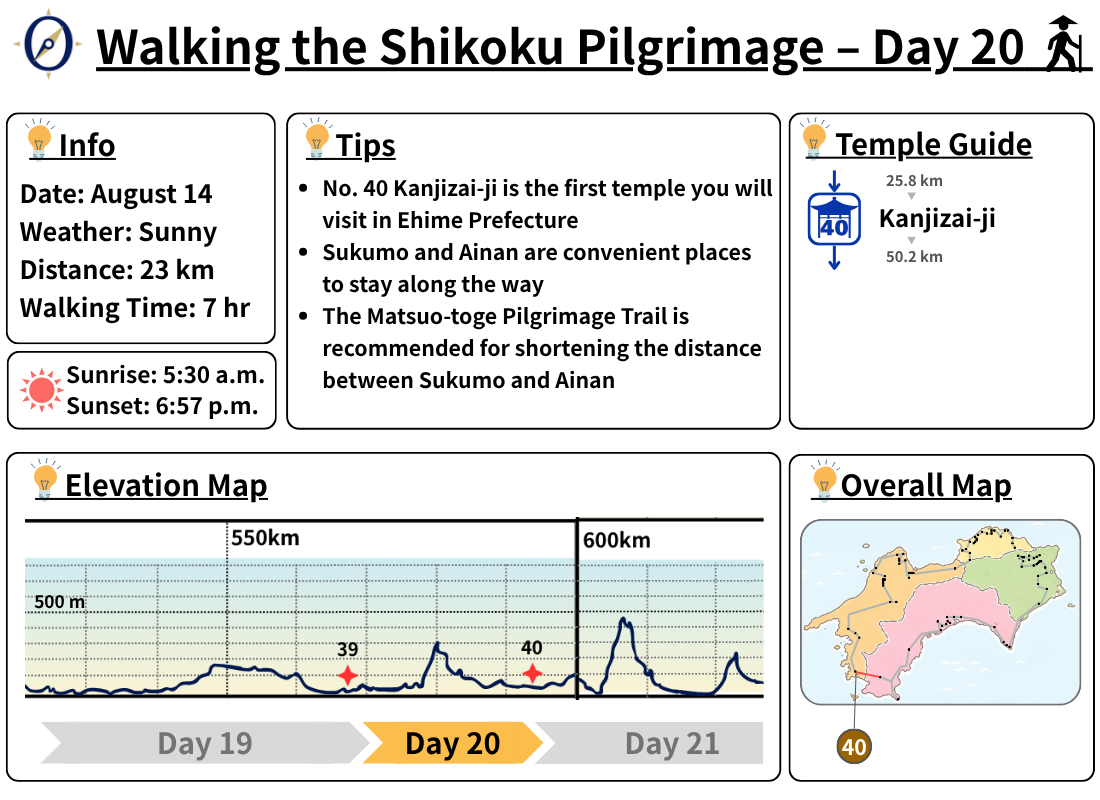
Tomorrow, I would finally enter Ehime Prefecture.
The journey through Kochi had been a long one, stretching from Cape Muroto all the way to Cape Ashizuri.
I had heard that Ehime would also have long stretches of road, no less challenging than those in Kochi.
What kind of pilgrimage route would be waiting for me ahead?
After setting up my tent, I looked back on the day and began thinking about the road that awaited me tomorrow as I headed into Ehime.
Temple Information
- No. 39
- No. 40
Comments