
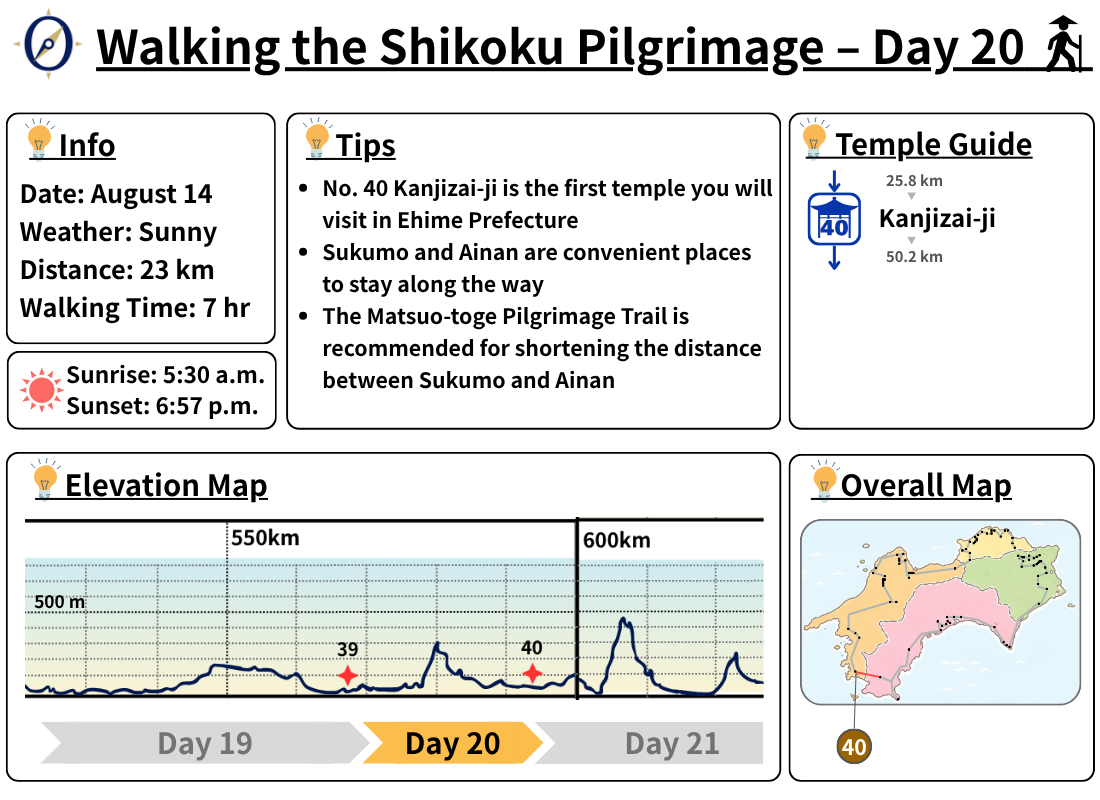
Leaving Sukumo, I crossed Matsuo-toge and finally entered Ehime Prefecture. The Matsuo-toge Pilgrimage Trail can shorten the distance, although the trail was rough in places due to the effects of a typhoon. Despite the difficult conditions, I was able to cross the prefectural border safely.
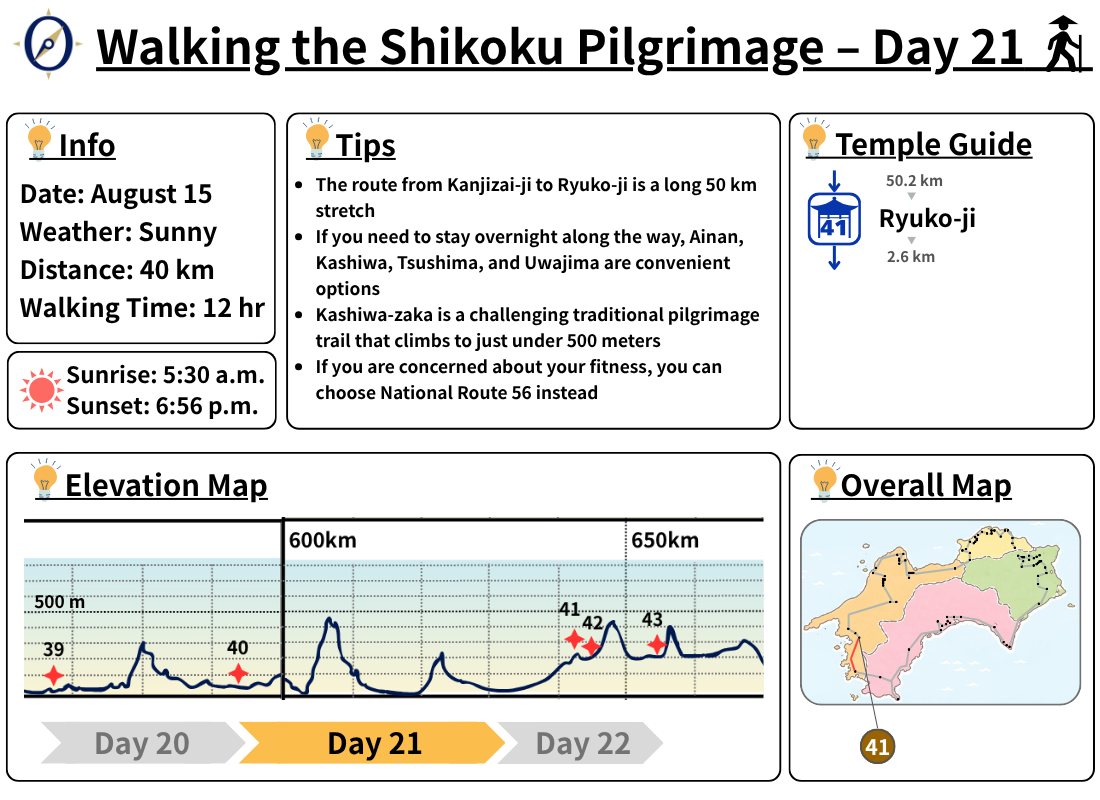
From there, I passed through Ipponmatsu and Ainan before reaching No. 40 Kanjizai-ji, the first temple of the pilgrimage in Ehime. Entering the “Training Ground of Bodhi,” I spent the night in the temple’s Tsuyado Hall and also had the chance to experience a local Bon festival along the way.
Itinerary
- 7:00Departure
- Arneya
- Sukumo
- Matsuo-toge
- Ipponmatsu
- Ainan
- 15:30Temple No. 40, Kanjizai-ji
Tsuyado
Getting Ready in the Morning
August 14, sunny.
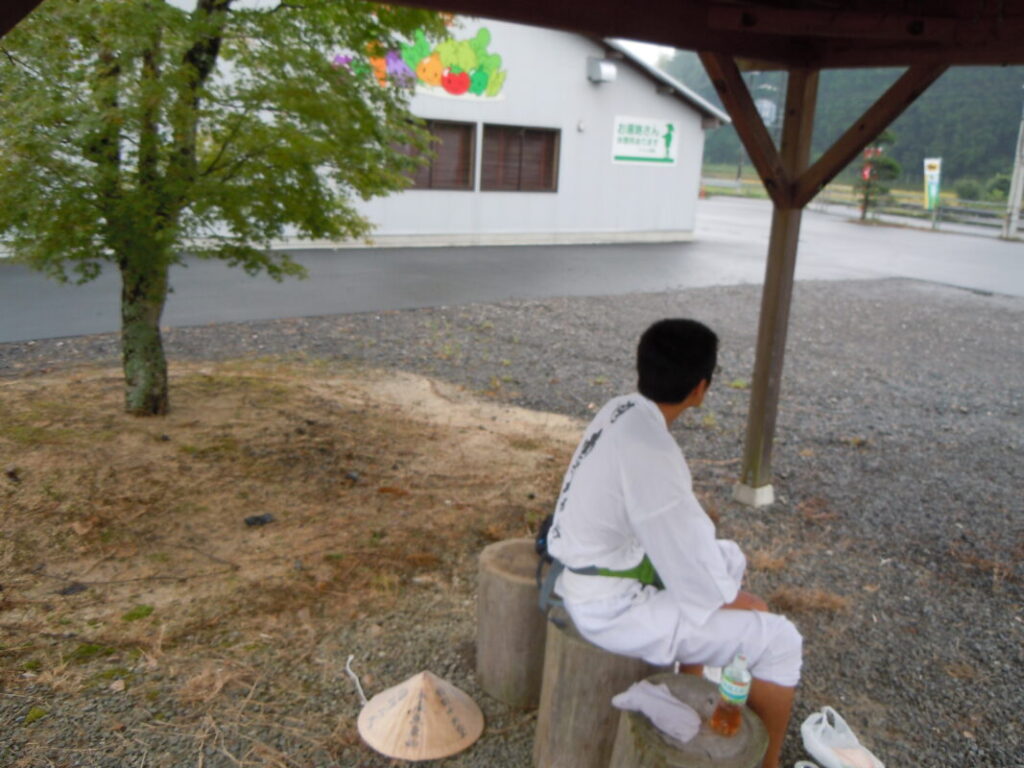
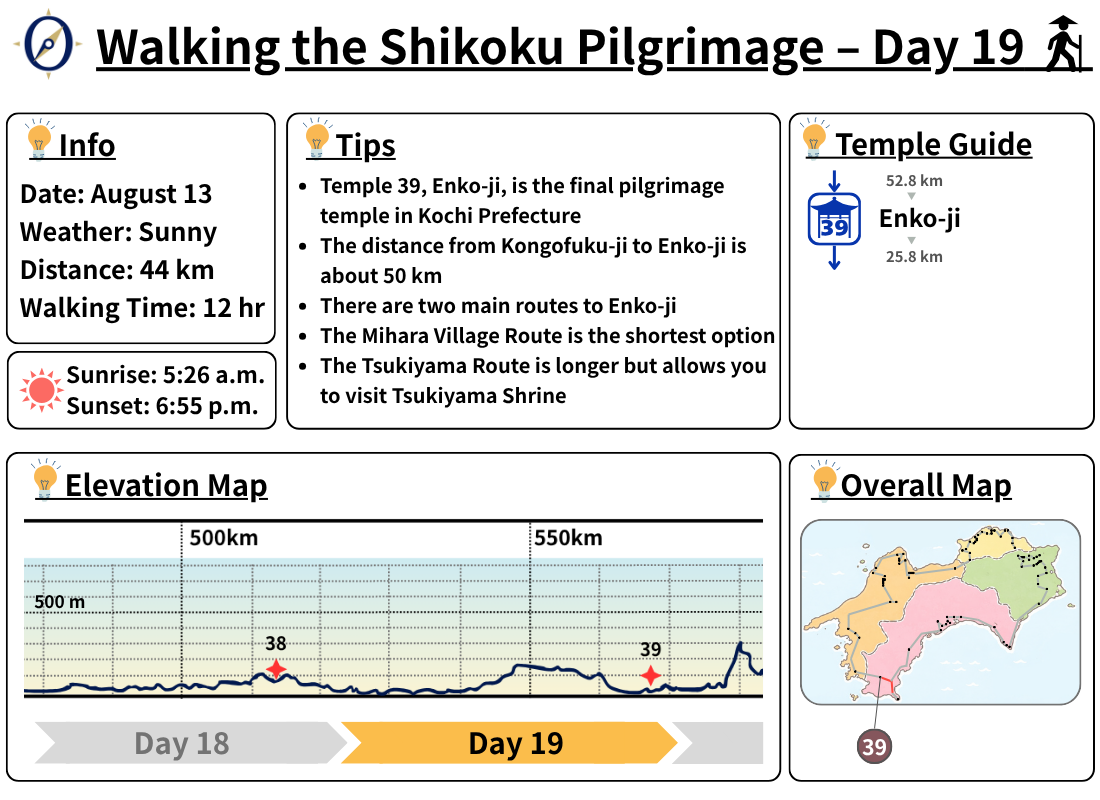
Yesterday, I walked from Iburi through Mihara Village to No. 39 Enko-ji, then spent the night camping on the grounds of a nearby farm stand with permission from the staff.
When I looked around in the morning, the ground was wet. It seemed that it had rained briefly during the night.
This is one of the things that can happen when camping outdoors. It reminded me once again how important it is to choose a place with a roof whenever possible, especially to protect yourself from sudden rain.
After getting ready for the day, I set off just before 7:00 a.m.
Heading to Sukumo
My first destination was Sukumo, about 8 km west of Enko-ji.
The route follows National Route 56 almost all the way, so there is little risk of getting lost. Sukumo is a relatively large town in this area, with plenty of restaurants and accommodation.
If you need a place to stay along the way, Sukumo is a convenient option.
There are two main routes from Sukumo toward Ehime Prefecture.
The first is to simply continue along National Route 56. The road follows a valley along the river, so there are relatively few steep climbs and descents. However, the trade-off is a longer distance.
The other option is to cross Matsuo-toge Pass.
Although you have to climb Matsuo-toge, at an elevation of about 300 meters, the route heads more directly from Sukumo toward Ainan in Ehime Prefecture. As a result, it is shorter than taking National Route 56.
For those walking the pilgrimage, I recommend taking this route.
Walking Over Matsuo-toge
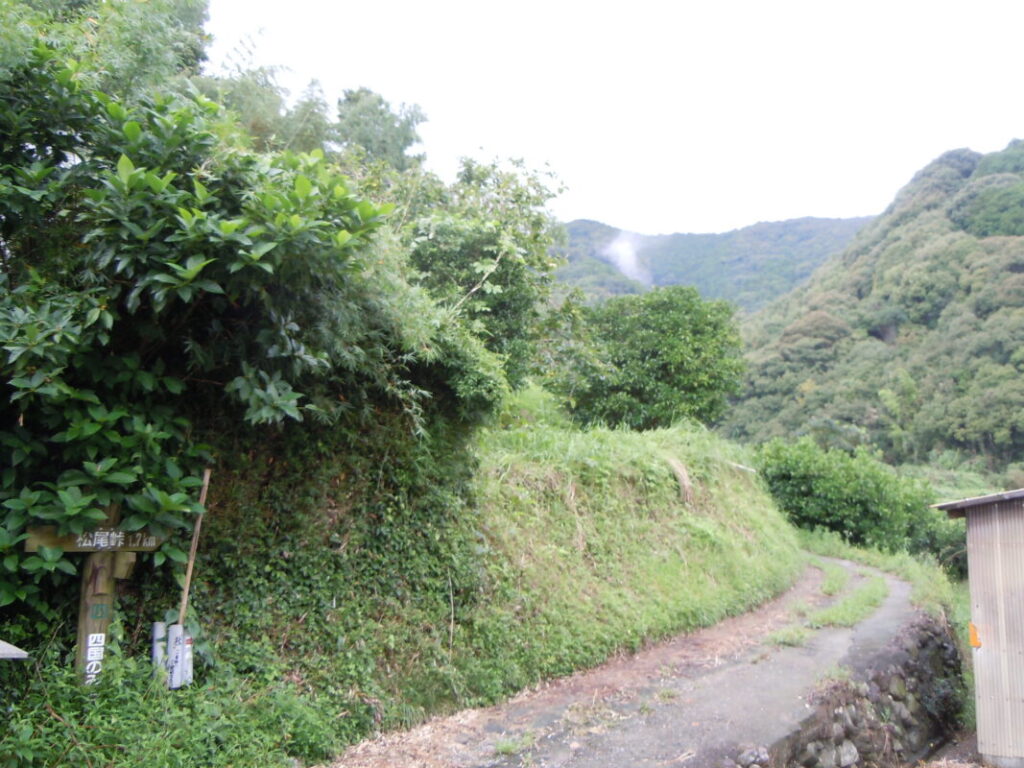
Following the trail markers, I made my way onto the Matsuo-toge Pilgrimage Trail.
However, perhaps because of the typhoon that had passed through recently, the trail was in fairly rough condition.
Small branches were scattered across the path and blocked the way.
Protecting my head with my sugegasa pilgrimage hat, I used my walking staff to push the branches aside and somehow continued onward.
Crossing Matsuo-toge into Ehime Prefecture
It was 11:30 a.m.
After continuing up the steep trail, I finally reached Matsuo-toge, the mountain pass on the border between Kochi and Ehime Prefectures.
The area around the pass opens up a little, and there is a small Buddhist hall standing there.
According to the information sign, around 1800, this was an important route connecting Tosa and Iyo, and there was even a teahouse here at the time.
The road that was once busy with travelers has now become a quiet pilgrimage trail.
Seeing it like this feels a little lonely, but I suppose it is inevitable that the role of a road changes with the times.
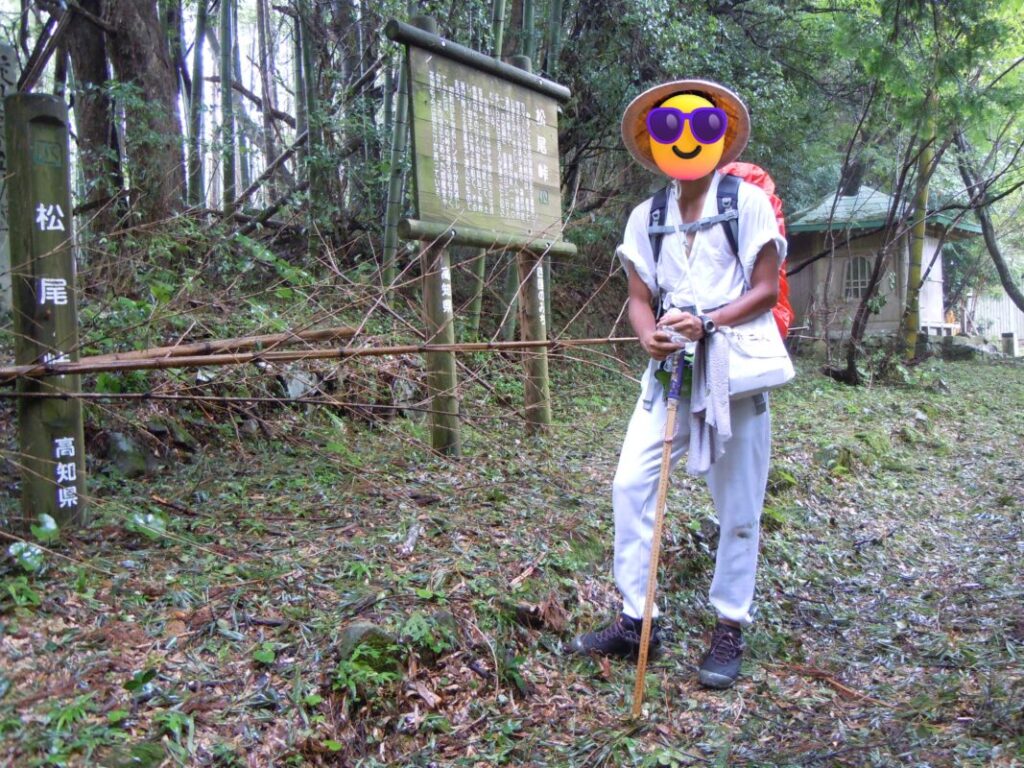
Once I crossed Matsuo-toge, I had finally entered Ehime Prefecture.
The gentle downhill trail leading to the paved road was well maintained and easy to walk.
The first town I reached was the Ipponmatsu area of Ainan.
There is a convenience store at an intersection along the main road. It was a good place to rest my tired body after crossing the mountain pass and replenish my drinks and food.
Perhaps it serves much the same purpose as the teahouse that once stood along the old pilgrimage trail.
From Ipponmatsu to Kanjizai-ji
From Ipponmatsu, I followed National Route 56 west.
It was about 10 km to Kanjizai-ji.
Along the way, I passed through the approximately 600-meter-long Renjoji Tunnel.
After exiting the tunnel, I needed to turn right onto the prefectural road. The turn is a little difficult to spot, so it is worth paying attention here.
After walking along the prefectural road for a while, I entered the urban area of Ainan.
One distinctive feature of Ainan is that the town is divided into northern and southern areas by the Soso River.
There are plenty of restaurants and accommodation options, making it a convenient place to stay for the first night after entering Ehime Prefecture.
From the town center, I followed the river west for about 1 km.
At 3:30 p.m., I finally arrived at No. 40 Kanjizai-ji.
Visiting No. 40 Kanjizai-ji
I visited Kanjizai-ji.
No. 40 Kanjizai-ji is the first temple of the pilgrimage in Ehime Prefecture.
In the Shikoku Pilgrimage, Ehime is known as the “Training Ground of Bodhi.”
Bodhi is a Buddhist term that refers to enlightenment and peace of mind.
It is a place for spiritual practice, where pilgrims can reflect on the journey they have taken so far, calm their minds, and look inward.
It may sound like a difficult concept, but I felt that the only way to understand it was to experience it little by little while continuing to walk.
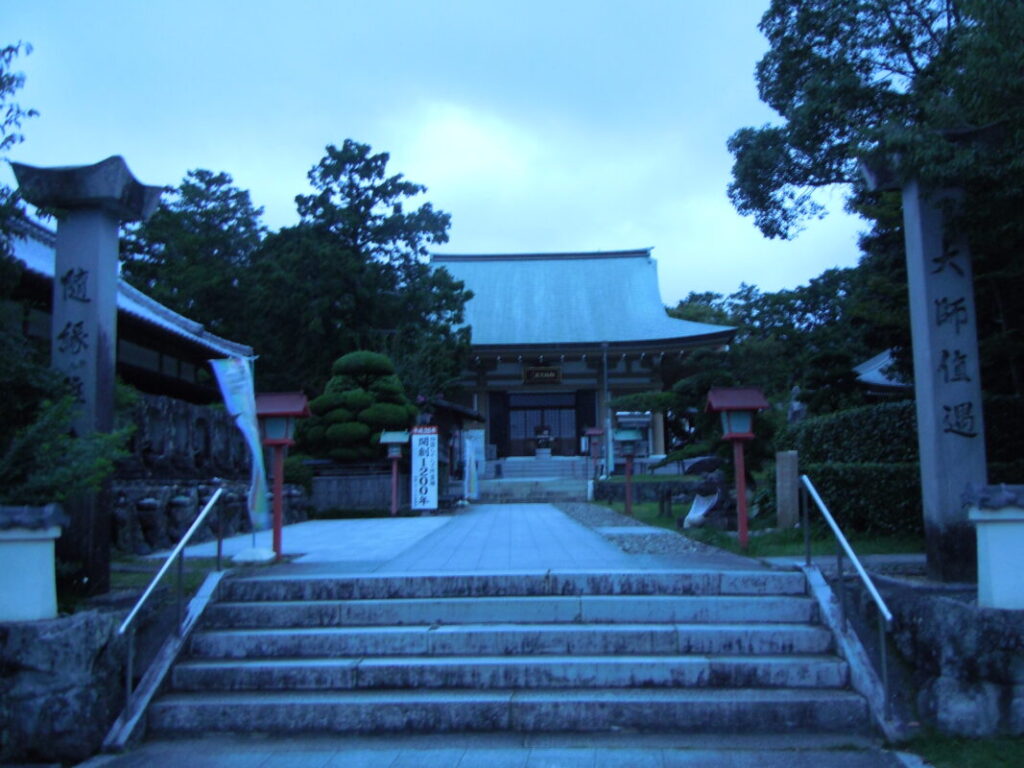
Kanjizai-ji’s Pilgrim Lodging — No Longer Available
When I made my pilgrimage, Kanjizai-ji offered both temple lodging and a Tsuyado, a simple overnight shelter for pilgrims. It was well regarded by many people walking the pilgrimage.
It was still fairly early in the day, but since I had the opportunity, I decided to ask at the temple office if I could stay in the Tsuyado.
Fortunately, I was given permission to use it.
Please note that neither the temple lodging nor the Tsuyado is currently available. If you are planning to stay here, be sure to check the latest information in advance.
The Tsuyado at Kanjizai-ji
A Tsuyado is a simple place to stay provided by temples along the Shikoku Pilgrimage for pilgrims.
Some Tsuyado facilities are free and operate in a dormitory-style setting. However, the rules and conditions vary from temple to temple, so it is important to check in advance.
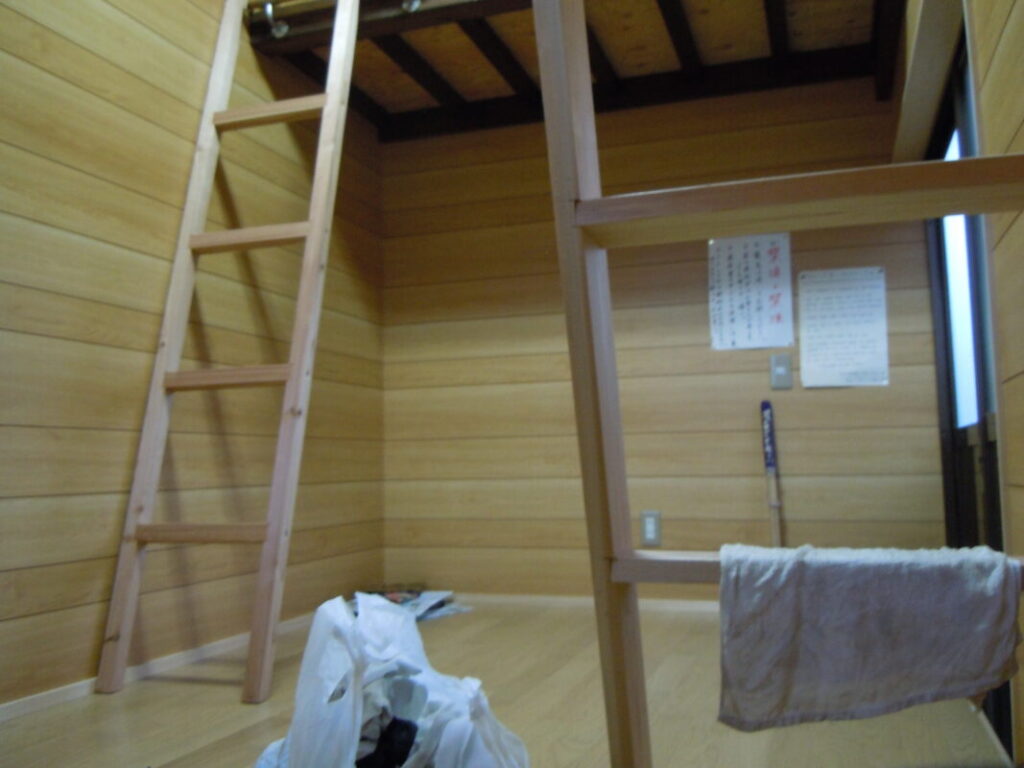
The Tsuyado I was shown was a small wooden room of about four tatami mats.
There was even a ladder leading up to a second floor.
Considering that I was allowed to stay there for free, it was more than enough.
I put down my luggage and washed off some of the sweat using the water supply at the temple.
There was still plenty of time before sunset, so I spent the rest of the afternoon walking around the temple grounds and exploring the surrounding town.
A Bon Festival in Ainan
As the sun began to set, the elementary school behind Kanjizai-ji suddenly became lively.
Curious about what was going on, I went over to take a look.
A Bon festival was being held there.
Food stalls lined the grounds, while local people dressed in yukata and kimono walked around.
It was a local festival I happened to come across during my journey.
There was a warmth among the local people that felt very different from what you experience at tourist attractions.
As I watched the festival for a while, a thought suddenly occurred to me.
Just because I was walking the Shikoku Pilgrimage didn’t mean I had to keep walking toward the next temple without stopping.
Maybe there was no need to hurry.
That feeling slowly began to take root in me.
I still didn’t fully understand what the phrase “Training Ground of Bodhi” really meant.
Even so, having walked all the way here on my own two feet, I felt that perhaps I had come just a little closer to understanding it.
It was a night I would remember.
Comments