
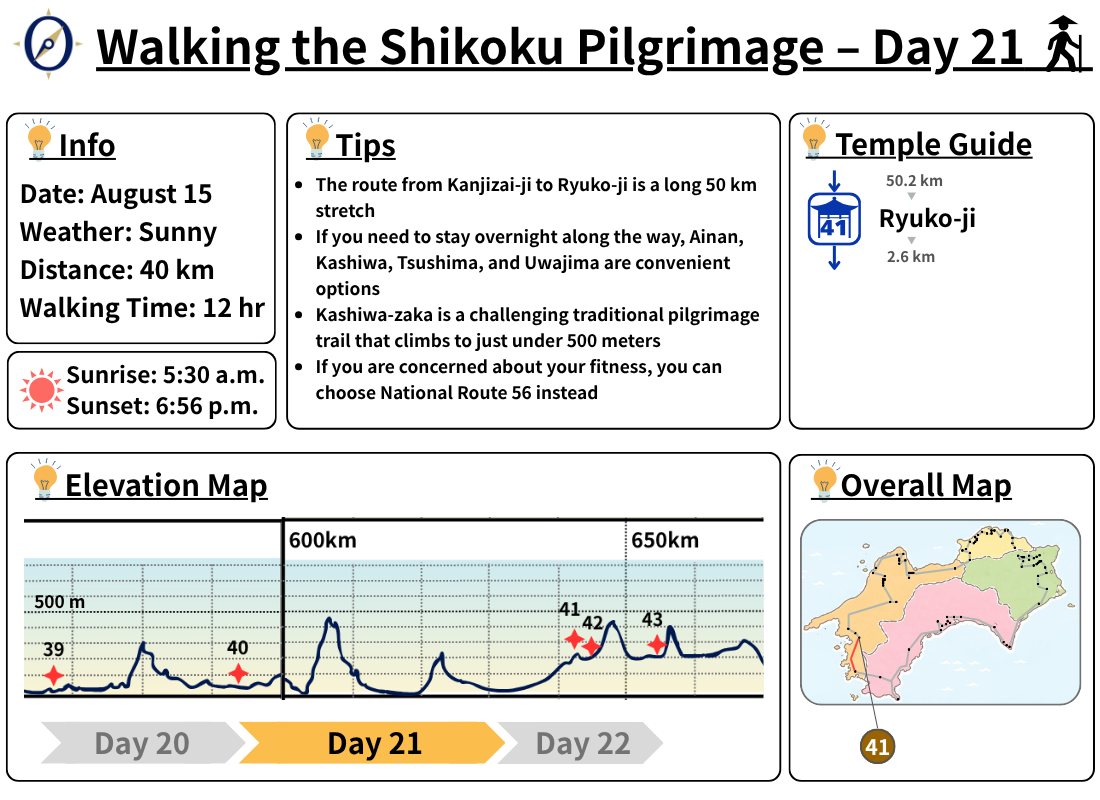
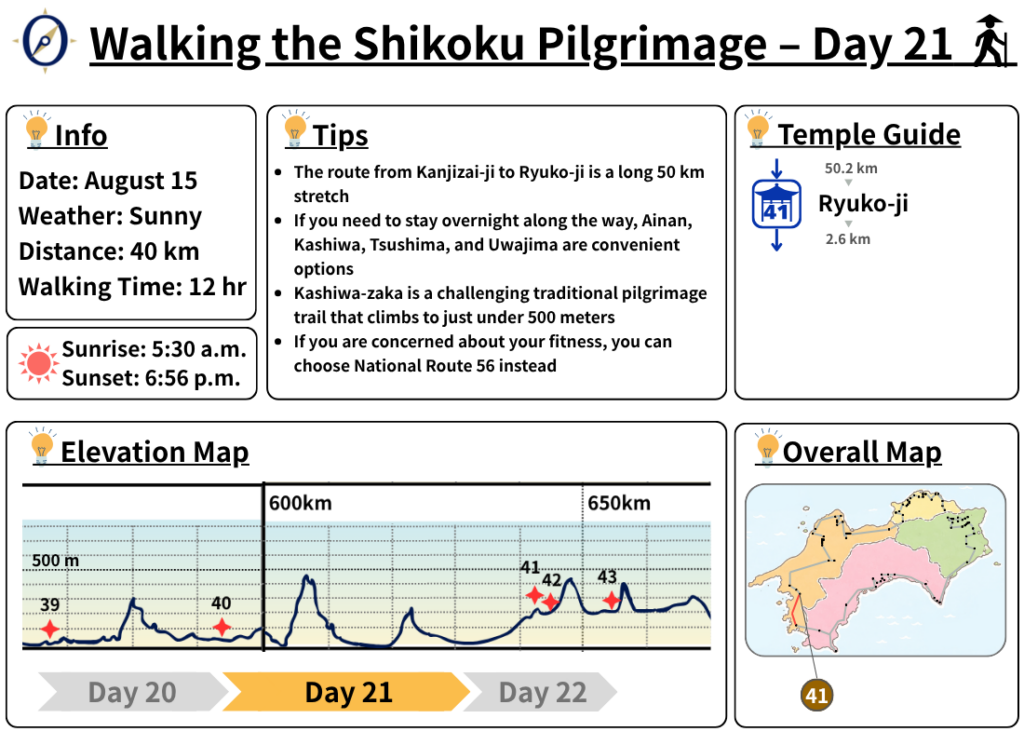
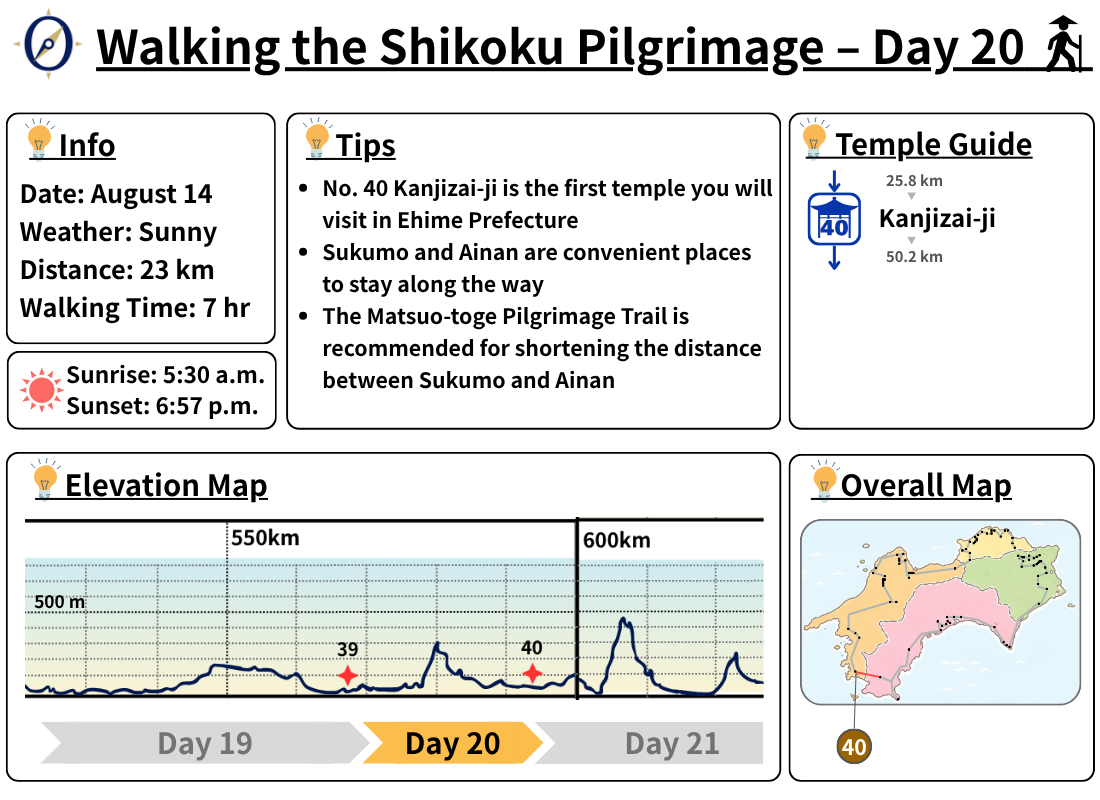
From Kanjizai-ji, I crossed Kashiwa-zaka, passed through Tsushima, and continued on to Uwajima. After tackling the challenging Kashiwa-zaka, which rises to just under 500 meters, and another pilgrimage trail, I walked about 40 km before finally reaching the end point of this section of my pilgrimage.
The following day, I visited Ryuko-in in Uwajima and successfully completed my approximately 280 km walking pilgrimage, which had begun on August 8.
Itinerary
- 5:30Departure
- Tsuyado at Kanjizai-ji
- Kashiwa-zaka
- Tsushima Town
- Tsushima Roadside Station
- 19:00Uwajima City
Business hotel
Getting Ready in the Morning
August 15, sunny.
Yesterday, I crossed Matsuo-toge from Enko-ji, entered Ehime Prefecture, and spent the night in the Tsuyado at Kanjizai-ji.
I walked about 23 km, which was a little shorter than usual for me, so I felt better than normal when I woke up.
Early in the morning, I cleaned the Tsuyado before heading to the Daishi-do Hall, where I quietly expressed my thanks.
Then I left Kanjizai-ji.
The Final Day of This Section of the Pilgrimage
Today was effectively the final day of this section of my pilgrimage.
I was planning to take the first train home tomorrow morning.
Come to think of it, I hadn’t taken a bath for four days.
At least for the final night, I wanted to stay at a hotel, clean myself up properly, and head home feeling refreshed.
I decided to aim for Uwajima, which has good train connections and plenty of accommodation.
The distance from Kanjizai-ji to the next temple, Ryuko-ji, is about 50 km.
It is quite a long stretch.
Along the way, there are several towns, including Ainan, Kashiwa, and Tsushima, where it is easy to find places to stay or take a break.
Uwajima is the largest of these towns, but it is still about 40 km from Kanjizai-ji.
And there was another challenge waiting along the way: Kashiwa-zaka.
For a continuous pilgrimage, this would probably be an overly ambitious itinerary.
But this was the final day of my sectioned pilgrimage.
Since I didn’t have to worry about the next day’s journey, I decided to push myself and walk all the way to Uwajima.
Being able to plan a flexible itinerary like this is one of the attractions of doing the Shikoku Pilgrimage in sections.
Heading to Kashiwa-zaka
For a while after leaving Kanjizai-ji, I continued northwest along National Route 56.
The road passes through the mountains, slightly inland from the Iyo coast. It was quiet, with beautiful scenery along the way.
After walking for about two hours, the view gradually opened up and the sea came into sight.
I had reached the Kashiwa area.
The small bay was almost completely calm, with several fishing boats quietly anchored offshore.
This is also the starting point of Kashiwa-zaka, an old pilgrimage trail that has been used for centuries.
Kashiwa-zaka is a challenging pilgrimage trail connecting Ainan and Uwajima, rising to just under 500 meters above sea level.
There are also accommodations for pilgrims along the way, and I heard that many pilgrims stay in Kashiwa the night before, rest up, and then tackle Kashiwa-zaka the following day.
There is also a convenience store, so it is a good idea to stock up on food and drinks before setting off over the pass.
Of course, if you are concerned about your fitness, you can simply continue along National Route 56 instead.
You can choose the route according to your physical condition and travel style.
I think this flexibility is one of the interesting things about walking the Shikoku Pilgrimage.
I wanted to experience the old pilgrimage trail for myself, so I chose Kashiwa-zaka.
Kashiwa-zaka, an Old Pilgrimage Trail
I found the Kashiwa-zaka trailhead by following the signs upstream along the river that runs through the center of the Kashiwa area.
As soon as I started climbing, the trail became quite rugged and wild.
The climb is about 1 km long, but there are several sections with steep slopes that seem to rise up in front of you.
I shortened my stride and climbed one careful step at a time, making sure not to slip.
About 40 minutes after leaving the foot of the mountain, I reached Ryusui Daishi.
This is the highest point of Kashiwa-zaka.
From here, the trail continues gently downhill.
According to legend, Kobo Daishi thrust his walking staff into the ground here and caused water to spring forth for travelers passing through the area.
There was also a small Buddhist hall nearby.
Because this trail has been used by pilgrims for so long, you can still feel its history and see traces of what it must have looked like in the past.
Even so, people in the old days were truly remarkable.
The pilgrims of that time must have carried loads even heavier than the pack I was carrying and crossed these mountain trails wearing straw sandals.
When I thought about that, all I could do was admire them.
As I began the descent from Kashiwa-zaka, abandoned houses occasionally appeared along the remote mountain trail.
They were probably places where people had once lived.
It was a somewhat lonely sight, reminding me of the remains of a depopulated village.
People had gradually disappeared from these communities after their more prosperous days had passed.
It was a trail that left me with mixed feelings, as I could sense not only the history of the pilgrimage route but also the history of the communities that once flourished here.
Omotenashi in Tsushima
After crossing Kashiwa-zaka, I entered Uwajima City.
The first town I came to was Tsushima.
The town stretches along the winding Iwamatsu River and is surrounded by mountains. With its open views and scenic surroundings, it had a peaceful atmosphere.
There are convenience stores and restaurants here, making it a convenient place to rest and stock up after crossing Kashiwa-zaka.
I stopped at a convenience store to buy some food and drinks.
Then, while I was in the parking lot, an elderly woman called out to me.
“Are you walking the pilgrimage? I was discharged from the hospital today.”
She then offered me some tea as osettai, a traditional act of hospitality toward pilgrims.
I gratefully accepted it.
When you are walking, you sometimes have unexpected encounters like this.
The longer I continued the pilgrimage, the more often I found myself experiencing the warmth and kindness of other people.
Tsushima Atsuta Onsen Roadside Station
There is another convenient place for walking pilgrims in Tsushima: Tsushima Atsuta Onsen Roadside Station.
I had also stopped here during my second walking pilgrimage.
It is one of the few roadside stations where you can enjoy a day-use hot spring, and it was lively with local residents and tourists.
There is also a restaurant.
When you are tired from walking, it is a great place to soak in the hot spring, wash away the sweat, and have a meal.
It appears to have been renovated in spring 2026, making it even more convenient for visitors.
Another Pilgrimage Trail
Continuing north along National Route 56 from the roadside station, I came to Matsuo Tunnel.
Here again, there is a choice between two routes.
One option is to continue along the national highway.
Although the route has relatively little elevation change because it passes through the mountains, it requires walking through a long tunnel of about 1.7 km.
The other option is the old pilgrimage trail.
This route involves climbing over the mountains, but the appeal is that you can walk through nature.
The trailhead is on the left side of the tunnel entrance and is relatively easy to find.
Without hesitation, I chose the pilgrimage trail.
However, this trail passes near a quarry, so there is a lot of truck traffic.
You should take extra care when walking this section.
After crossing the mountain, the trail rejoined National Route 56.
I had walked about 30 km from Kanjizai-ji to this point.
There were about 10 km left to central Uwajima.
After crossing two mountains, including Kashiwa-zaka, I was already quite tired.
Even so, I gathered the last of my strength and kept walking.
Heading to Uwajima
It was 6:00 p.m.
The sun was beginning to sink.
I wanted to reach the hotel before sunset.
I had already made a reservation by phone.
Uwajima is surrounded by a quiet bay to the west and mountains on the other sides, giving the town the appearance of a natural fortress.
Uwajima Castle stands on a small hill in the center of the town, and the winding streets still retain something of the character of an old castle town.
Following the road around the hill where Uwajima Castle stands, I finally caught sight of Uwajima Station.
It was 7:00 p.m.
It was completely dark by then.
Even so, I somehow managed to reach the hotel.
I checked in safely.
And with that, my week-long section of the pilgrimage, which had begun on August 8, came to an end.
A 280 km Section of the Pilgrimage
This time, I walked approximately 280 km from No. 34 Tanema-ji to Uwajima.
Along the way, I encountered a powerful typhoon and was even forced to stop for a while.
Under the blazing sun at Cape Ashizuri, I poured water over my head whenever I found a place with running water to cool myself down.
The scenery of the sea and the mountains.
The encounters with fellow pilgrims I met along the way.
The nights spent camping outdoors.
And all the acts of osettai I received from people along the route.
With the help and kindness of so many people, I was able to walk all the way here.
Looking back, I was filled with gratitude.
I looked at myself in the mirror in the hotel room.
My skin was deeply tanned, and I had lost some weight.
At the same time, my upper thighs had become noticeably more muscular, giving me a physique that almost reminded me of an old-fashioned hikyaku, a traditional Japanese courier who traveled long distances on foot.
It seemed that my body was gradually changing into one specialized for walking.
And then there was my first bath in about four days.
I washed myself thoroughly.
The air-conditioned room felt incredibly comfortable after sleeping outdoors.
And needless to say, the bed was in a completely different league from sleeping outside.
I fell asleep almost instantly, completely exhausted.
Visiting a Temple Before Heading Home
August 16, sunny.
The final day of this sectioned pilgrimage was the day I would take the train home from Uwajima Station.
Since I didn’t have any particular time constraints, I decided to spend some time exploring Uwajima before heading home.
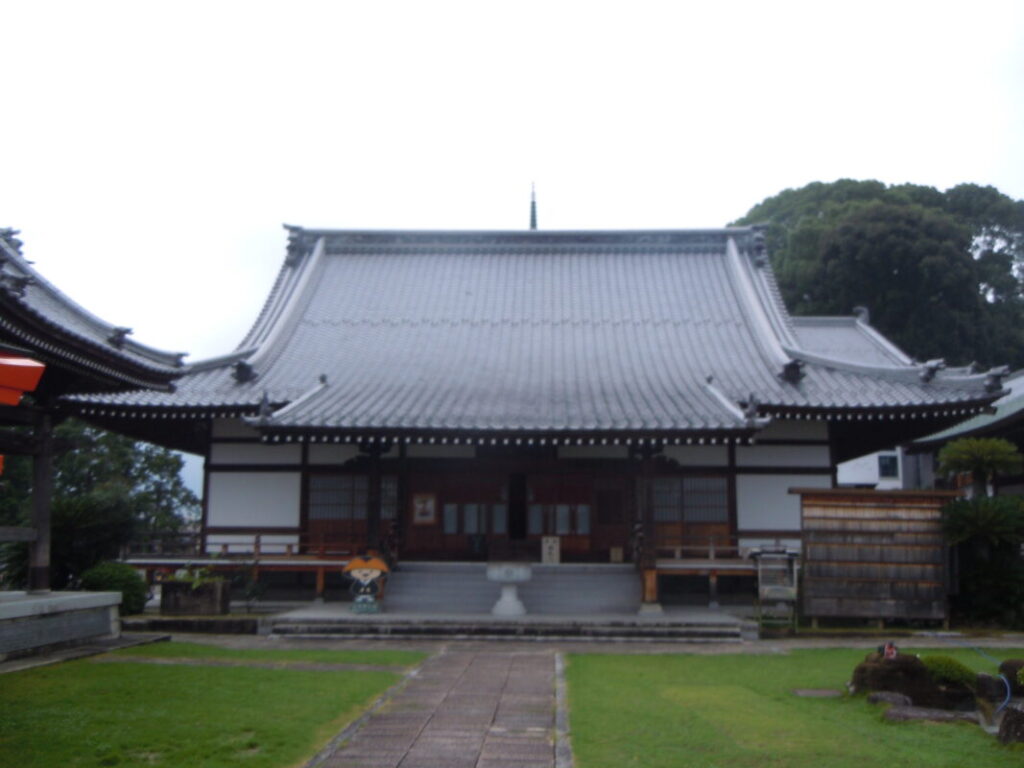
There is actually another temple in Uwajima: Ryuko-in, No. 6 of the Shikoku Bekkaku Reijo, a pilgrimage to twenty additional sacred sites associated with Kobo Daishi.
Since I had the opportunity, I decided to visit the temple and report to Kobo Daishi that I had successfully completed this section of my pilgrimage.
Shikoku Bekkaku Reijo No. 6 Ryuko-in
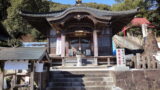
Ryuko-in stands on a small hill, and I climbed a flight of steps to reach the temple grounds.
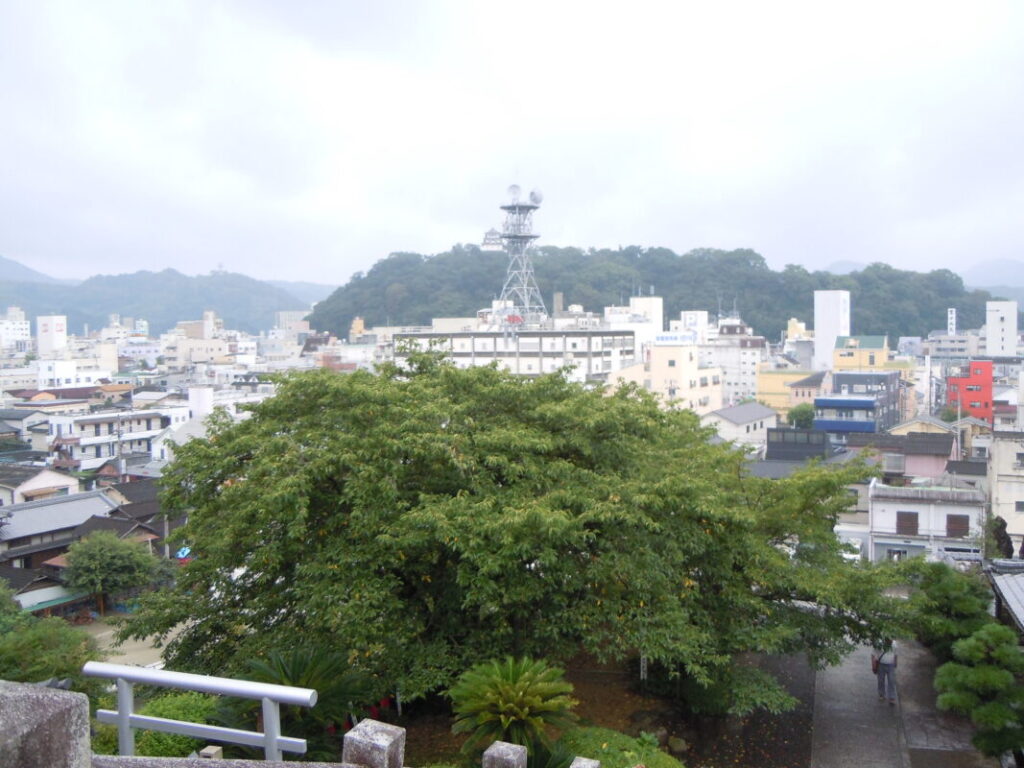
From the grounds, I could look out over the town of Uwajima, with a beautiful and refreshing view spreading out before me.
Early in the morning, local residents also seemed to visit the temple, perhaps combining their prayers with their morning walk.
“Good morning.”
I exchanged greetings with people as we passed each other.
Seeing local people taking such good care of their town and temple made me feel that I should learn from them as well.
The Journey Home
And so, I finished this section of my pilgrimage and began my journey home.
My next sectioned pilgrimage would be during the New Year holidays.
This time, I would be walking in the middle of winter.
It should be a very different pilgrimage from this one, which had been a battle against the summer heat.
Comments