
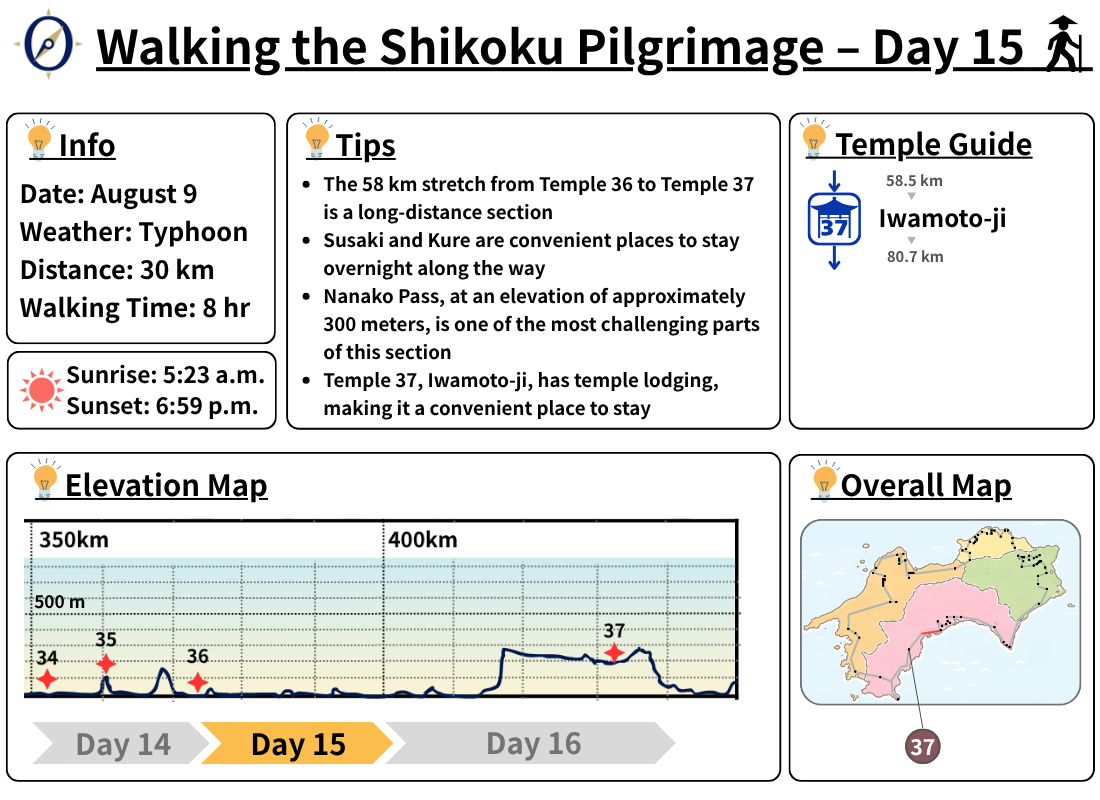
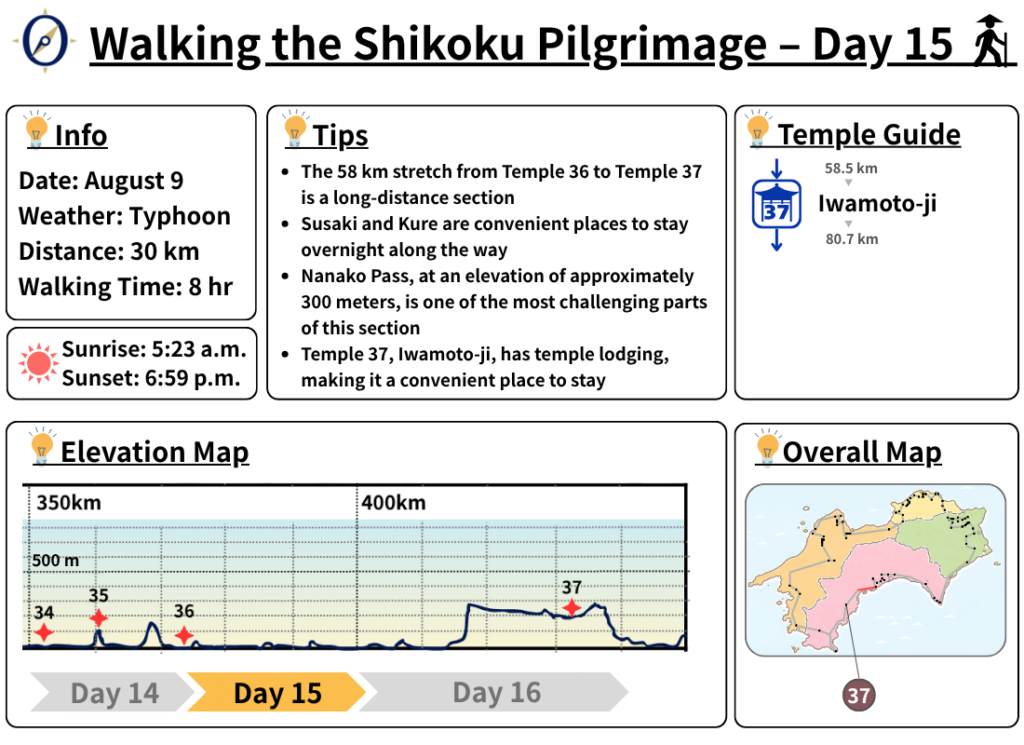
On August 9, with a typhoon approaching, I walked approximately 30 km from Temple 36, Shoryu-ji, through Susaki to Awa. As the strong winds and heavy rain made walking increasingly difficult, I was unable to find accommodation and eventually decided to sleep outdoors at a roadside farmers’ market in Awa. Around 3:00 a.m., the typhoon came closest, bringing violent winds and torrential rain that were strong enough to nearly blow my tent away. It was a day when I experienced firsthand the terrifying power of a typhoon in Shikoku unlike anything I had ever encountered before.
Itinerary
- 7:00Departure
- Kokumin Shukusha Tosa
- Statue of Hanpeita Takechi
- Susaki Rest Area
- Susaki City
- 16:00Awa Town
Overnight stay
Heading for Susaki as a Typhoon Approaches
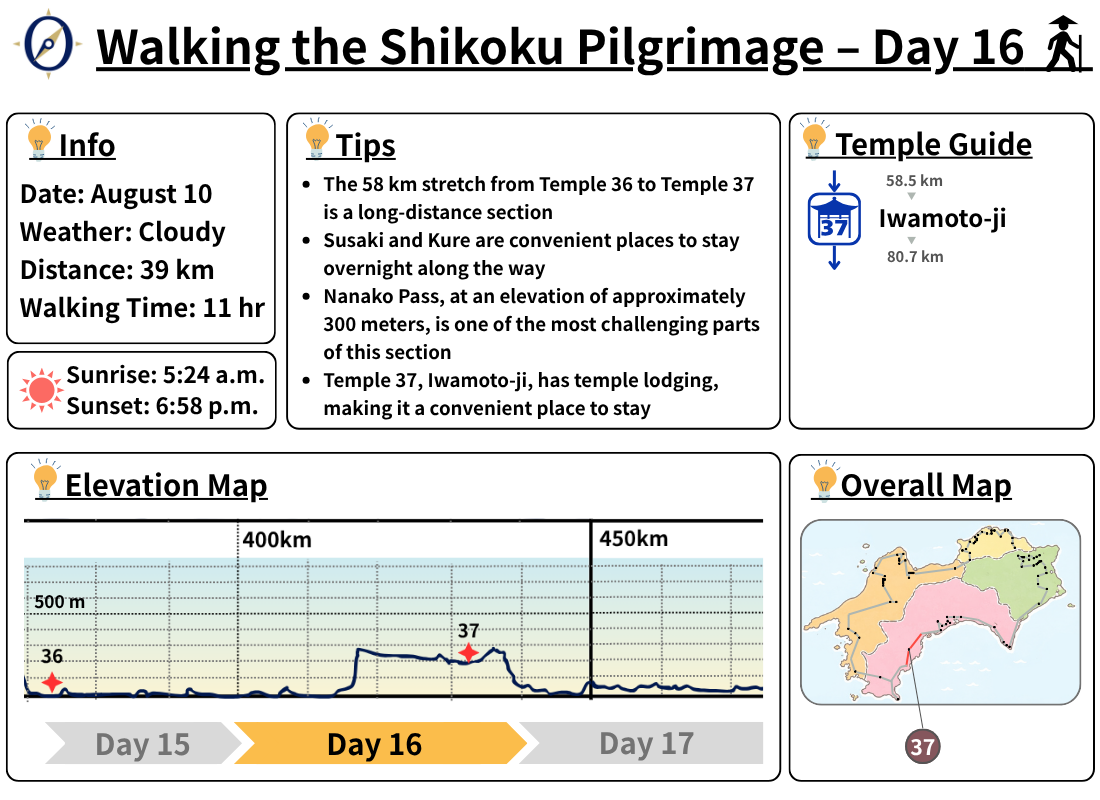
August 9 was rainy. It was the second day of my third sectional pilgrimage, and the 15th day of my pilgrimage overall.
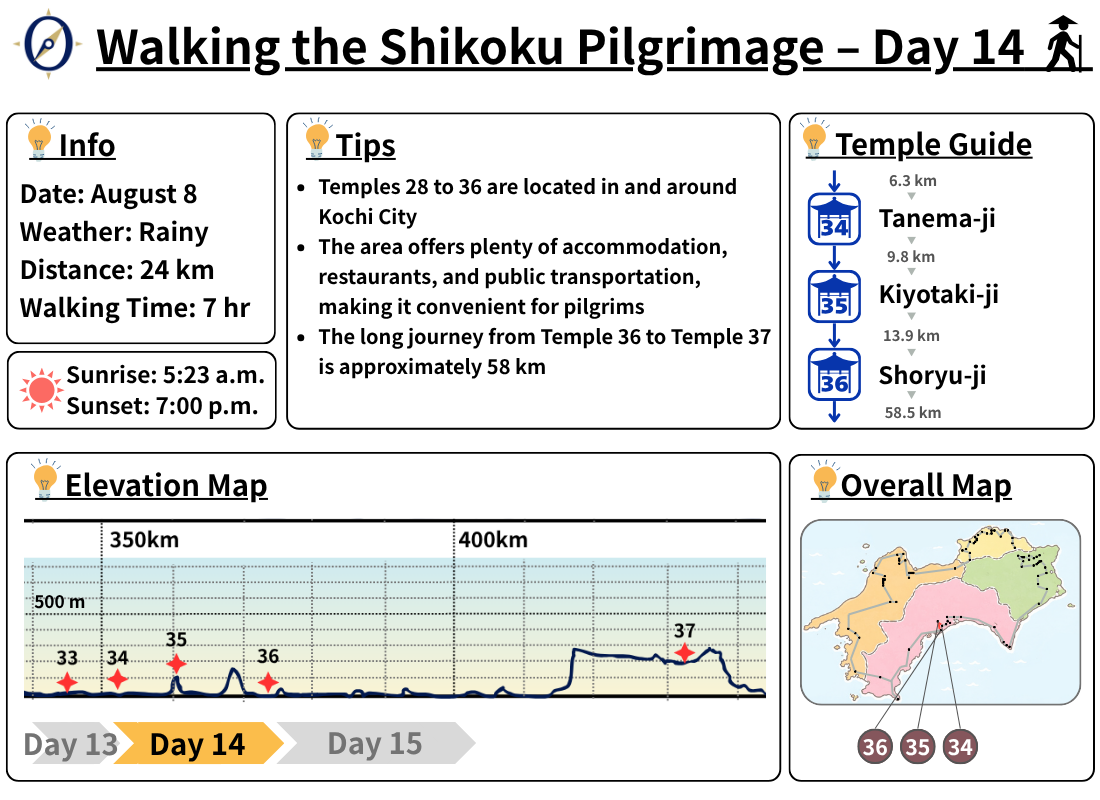
The previous day, I had walked approximately 24 km from Temple 34, Tanema-ji, to Temple 36, Shoryu-ji, and stayed at Kokumin Shukusha Tosa. Thanks to getting a good night’s rest at the hotel, I had almost no fatigue left from the previous day. After breakfast, I left the hotel at 7:00 a.m.
The distance from Temple 36, Shoryu-ji, to Temple 37, Iwamoto-ji, is approximately 58 km, making it a long-distance section of the pilgrimage. Walking the entire distance in a single day would be difficult, so Susaki or Kure would be convenient places to stay overnight along the way.
However, a large typhoon was forecast to make landfall in Shikoku that day. I had no idea how far I would be able to walk. I set out with the intention of seeking shelter at a hotel early if conditions became dangerous rather than pushing myself too far.
My first goal was Susaki, the next town along the route. It was approximately 20 km from Shoryu-ji and would take around five hours on foot. There are few convenience stores or restaurants along the way, so I packed more snacks than usual to keep me going.
Two Routes to Susaki
There are two main routes to Susaki.
One follows the prefectural road along the Yokonami Skyline. Although this route is shorter, it has a series of small ups and downs that gradually drain your energy.
The other route crosses Usa Ohashi Bridge and follows the coastline of Usa Bay. This route has fewer hills, but is slightly longer.
This time, I chose the route along the Yokonami Skyline.
The weather alternated between rain and brief dry spells. The sky was covered with dark, ominous clouds, and the clouds seemed to be moving faster than usual. I could feel the approaching typhoon in the air.
A Rest Stop on the Yokonami Skyline
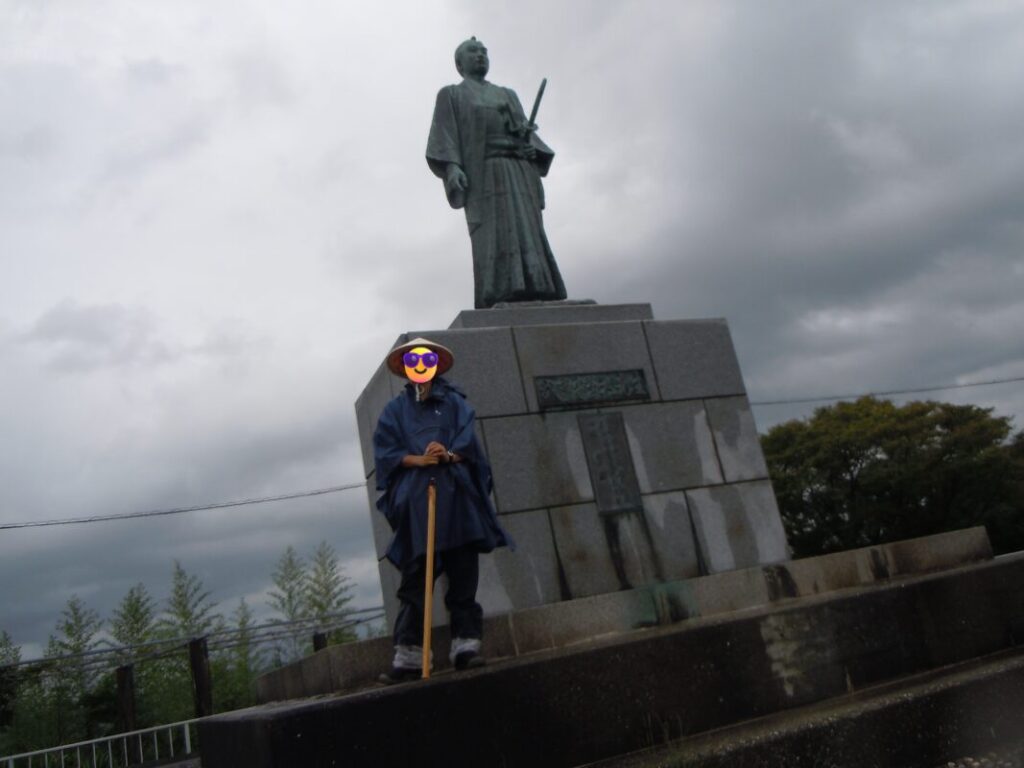
About two hours after setting out, I came across a statue of Hanpeita Takechi.
Takechi Hanpeita was a Tosa samurai and political activist who played a role during the final years of the Tokugawa shogunate. Throughout Kochi Prefecture, statues of figures from the final days of the shogunate can be found in various places.
There was also a toilet near the statue, making it a valuable rest stop along this route.
Whether to Stay in Susaki or Keep Walking
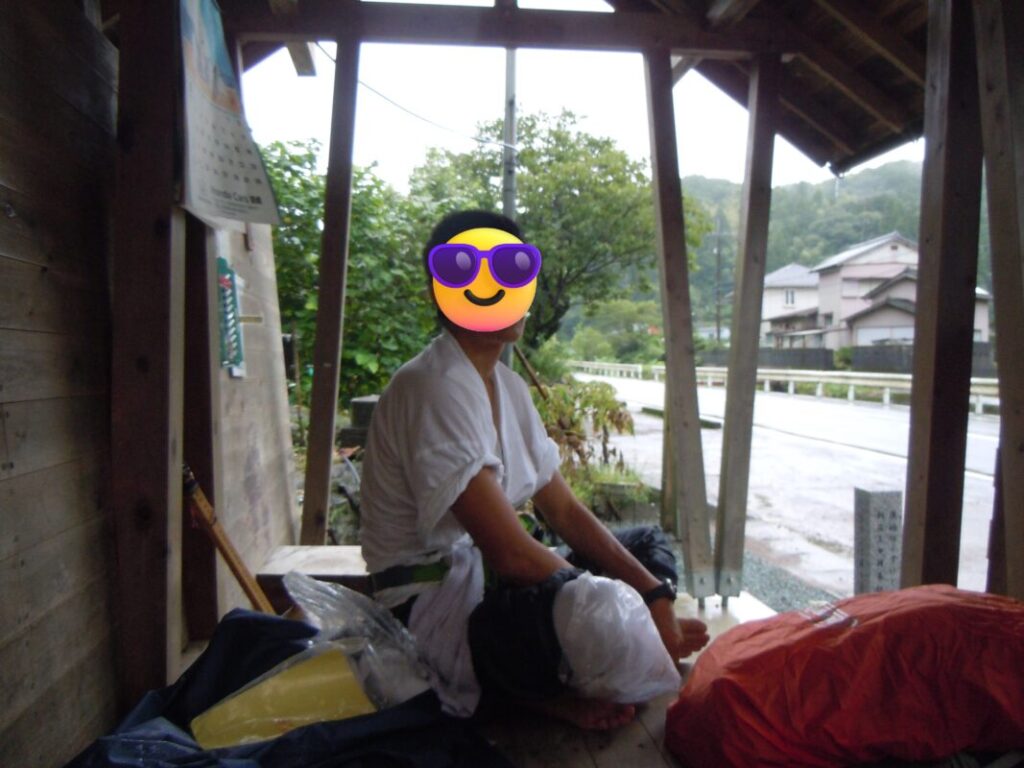
It was noon. I decided to take a break at the Susaki Rest Area, just before reaching the city center, using the opportunity to shelter from the rain.
In addition to the rain, the wind was getting stronger. I spread out my map and began thinking about how far I could continue from there.
It was about 3 km to Susaki. From Susaki, it was another 13 km to Kure. If I pushed myself, could I make it to Kure before sunset?
Little by little, my next destination was beginning to take shape.
Shortly after 1:00 p.m., I arrived in central Susaki. With convenience stores, restaurants, and hotel signs all around, it was a convenient town where finding accommodation or supplies would not be a problem.
The typhoon winds were steadily growing stronger as time passed. As I walked past the hotels, I found myself wondering whether I should stop and stay in Susaki.
On the other hand, there was still plenty of daylight left. I also wanted to make as much progress as possible.
“I can probably keep walking.”
With that thought, I decided to pass through Susaki and continue toward the next town.
Reaching Awa in the Middle of a Typhoon
However, the situation continued to deteriorate with every passing moment.
Susaki and Kure are coastal towns facing Tosa Bay. To make matters worse, the approaching typhoon was forecast to make landfall directly in this area.
I had experienced powerful typhoons on Honshu before, but the typhoon in Kochi was on an entirely different level.
The wind grew stronger and stronger. With a backpack weighing around 10 kg on my back, even walking normally was becoming difficult.
I had confidence in my physical strength and endurance, but whenever a powerful gust hit me, it could easily knock me off balance. From time to time, I looked toward the sea and saw enormous waves crashing against the coast.
If I were blown into the sea, I might not survive.
That terrifying possibility crossed my mind.
After enduring more than an hour of strong winds and heavy rain beyond the center of Susaki, I finally reached the town of Awa.
There was a guesthouse in Awa, so I decided to try my luck. I rang the intercom and asked if they had a room available. Unfortunately, they turned me away.
There was no choice now. I would have to sleep outdoors.
I steeled myself and began looking for somewhere nearby where I could take shelter from the wind and rain, even if only partially.
As I walked around the area, I came across a roadside farmers’ market. The shop was closed, but the building had concrete walls and a roof that seemed to offer some protection from the elements.
There was nothing else I could do. I would have to wait here for the typhoon to pass.
I quickly set up my tent. Having secured a place where I could at least escape the worst of the rain and wind, I felt slightly more at ease.
I sat down and watched the conditions outside, but the wind and rain only grew more intense.
“Can it really get this strong…?”
For the first time, I truly experienced firsthand the terrifying power of a typhoon in Shikoku.
Spending the Night in the Typhoon at Awa
By around 6:00 p.m., it was completely dark.
Looking at the roadside trees outside, I could see them bending so far that their branches seemed almost to touch the ground. If one of the trees were to fall and come crashing toward me, the consequences could be serious.
What frightened me even more was how close I was to the sea. If a storm surge hit the area, there would be nowhere to escape. One worst-case scenario after another crossed my mind, but there was nothing I could do except pray that I would make it through the night safely.
The next day would be a long journey toward Temple 37, Iwamoto-ji. I decided to sleep inside my tent and get as much rest as possible so I could recover some of my strength.
3:00 a.m.—The Typhoon Comes Closest
Around 3:00 a.m., the typhoon finally came closest, and the conditions reached their worst.
I had been drifting in and out of a shallow sleep as the wind shook the tent, but the sheer intensity of the storm eventually woke me. I checked the rain radar on my smartphone, and a bright red swirl was directly over my location.
The wind and rain were beyond anything I had imagined. Blinding, wind-driven rain slammed into the tent like spears. Water even began leaking inside, leaving my sleeping area completely soaked.
Then the tent itself started to look as though it might be blown away.
“This is bad!”
Using both my hands and feet, I desperately held down the frames at the four corners of the tent, doing everything I could to keep it from being blown away.
Outside, warning sirens or some other emergency alert could be heard echoing through the darkness.
I knew I was in a situation where I absolutely should not have been. But with the wind and rain raging outside, there was no way I could safely leave the tent and move elsewhere.
I even recited the Heart Sutra, praying that I would make it through the ordeal safely.
For the time being, all I could do was endure.
I never imagined that I would come to understand the terrifying power of Shikoku’s typhoons quite so vividly.
Temple Information
- No. 37
Comments