
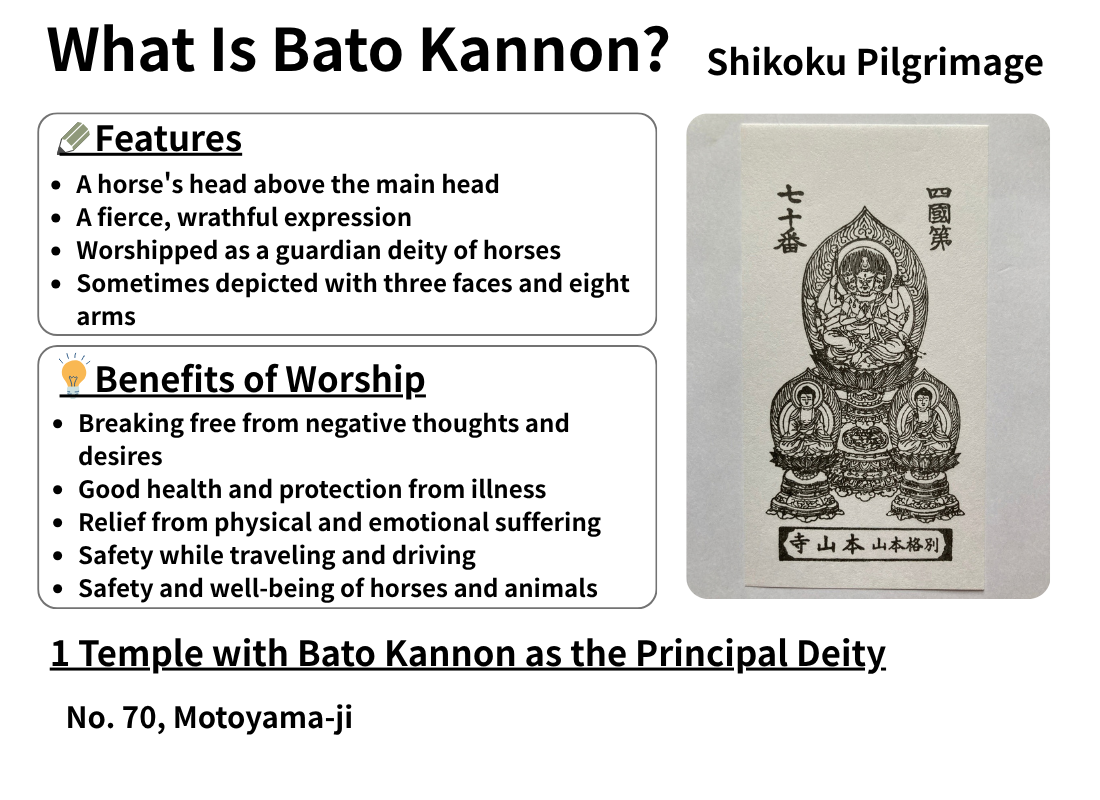
Across the 88 temples on the Shikoku 88 Temple Pilgrimage, various Buddhist deities are enshrined as the principal deity. Among them, Bato Kannon (Horse-Headed Kannon) is a rare form of Kannon Bosatsu depicted with a fierce, wrathful expression.
As the name suggests, one of the most distinctive features of Bato Kannon is the horse’s head above the main head. While Kannon Bosatsu is generally depicted with a calm and compassionate appearance, Bato Kannon’s fierce expression represents the strength needed to cut through confusion and worldly desires and save people from suffering.
On the Shikoku 88 Temple Pilgrimage, only Temple No. 70, Motoyama-ji, enshrines Bato Kannon as its principal deity.
In this article, we will explain in an easy-to-understand way what Bato Kannon is, its relationship with Kannon Bosatsu, what Bato Kannon looks like, why it has a fierce expression, and the benefits associated with worshipping Bato Kannon.
- What Is Bato Kannon?
- Why Does Bato Kannon Have a Horse’s Head?
- Why Does Bato Kannon Have an Angry Expression?
- Bato Kannon and the Six Forms of Kannon
- The Relationship Between Bato Kannon and Horses
- Benefits of Worshipping Bato Kannon
- What Does Bato Kannon Save People From?
- The Shikoku 88 Temple Pilgrimage Temple Where Bato Kannon Is the Principal Deity
- Conclusion
What Is Bato Kannon?
Bato Kannon (Horse-Headed Kannon) is one of the many forms that Kannon Bosatsu takes to save people.
Like Juichimen Kannon (Eleven-Faced Kannon) and Senju Kannon (Kannon with a Thousand Arms), Bato Kannon has long been worshipped as a transformed form of Kannon Bosatsu.
One of the most distinctive features of Bato Kannon is the horse’s head above the main head.
Bato Kannon is also unusual among the various forms of Kannon Bosatsu because it is depicted with a fierce, wrathful expression.
This expression does not simply represent anger. It is said to symbolize the power to cut through the worldly desires and confusion that cause people to suffer and to drive away evil with great strength.
In this sense, Bato Kannon can be understood as a form of Kannon who saves people not only by offering gentle compassion, but sometimes also through firm and powerful action.
What Does Bato Kannon Look Like?
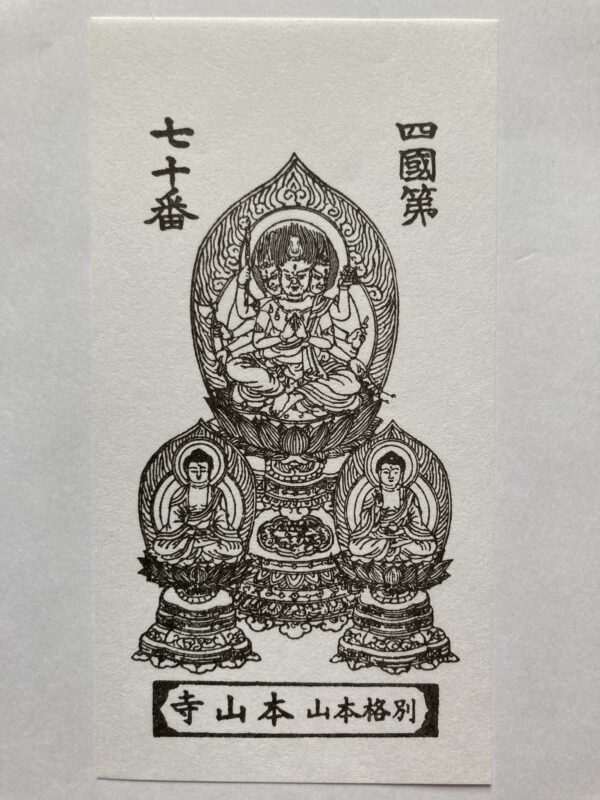
Bato Kannon has an appearance that is somewhat different from the typical depictions of Kannon Bosatsu.
Above the main head is a horse’s head, and the face has a fierce, wrathful expression. The details vary depending on the Buddhist statue, but Bato Kannon is sometimes depicted with three faces and eight arms.
The hands hold various Buddhist ritual implements, giving Bato Kannon a powerful and imposing appearance.
This distinctive appearance symbolizes Bato Kannon’s “power to defeat evil.”
In Japan, horses have been closely connected with people’s daily lives, transportation, and farming since ancient times. For this reason, Bato Kannon also came to be worshipped as a guardian deity of horses.
Omie
On Amirito Dohanba Un Patta Sowaka
- Breaking free from negative thoughts and desires
- Good health and protection from illness
- Relief from physical and emotional suffering
- Safety while traveling and driving
- Safety and well-being of horses and animals
Why Does Bato Kannon Have a Horse’s Head?
The horse’s head above Bato Kannon’s head has a symbolic meaning in Buddhism.
Horses are powerful animals known for their strong vitality and energy.
There is also a Buddhist interpretation that, just as a horse eats grass, Bato Kannon devours people’s worldly desires, consuming them completely.
The Bato Kannon traditionally associated with Motoyama-ji is also described as removing the evil thoughts, greed, anger, and worries that people carry, just as a horse eagerly eats grass.
For this reason, the “horse” in Bato Kannon does not simply represent the animal itself. It can also be understood as a symbol of the power to remove people’s confusion and worldly desires.
Why Does Bato Kannon Have an Angry Expression?
One of the most distinctive features of Bato Kannon is its fierce, wrathful expression.
When people think of Kannon Bosatsu, many may imagine a calm and compassionate face.
However, in Buddhism, it is not always believed that a gentle appearance alone is enough to save people.
Sometimes, great strength is needed to cut through the desires, anger, and confusion within people.
The fierce expression of Bato Kannon is therefore understood to represent the “sternness needed to save people.”
In other words, the anger of Bato Kannon is not directed at people themselves. Instead, it represents the power to drive away the worldly desires and evil that cause people to suffer.
Bato Kannon and the Six Forms of Kannon
Bato Kannon is one of the forms of Kannon Bosatsu included among the Six Kannon.
The Six Kannon refers to the Buddhist belief that Kannon Bosatsu takes on six different forms in order to save sentient beings in each of the Six Realms of Existence.
Among these six forms, Bato Kannon is sometimes regarded as the form of Kannon who saves sentient beings in the Animal Realm.
The Six Realms are the six worlds into which, according to Buddhist teachings, sentient beings may be reborn. They are:
- The Hell Realm
- The Hungry Ghost Realm
- The Animal Realm
- The Asura Realm
- The Human Realm
- The Deva Realm
Through its powerful appearance, Bato Kannon is believed to save people who are lost or suffering and guide them toward the right path.
The Relationship Between Bato Kannon and Horses
Bato Kannon has long been worshipped as a guardian deity of horses.
In Japan, horses were essential for farming, transportation, carrying goods, and travel.
For this reason, many communities enshrined Bato Kannon and prayed for the safety and good health of their horses.
Even today, Bato Kannon may be worshipped by people who work with horses or pray for the safety and well-being of horses.
At Motoyama-ji, there is also a statue of a horse on the temple grounds, allowing visitors to see the connection between Bato Kannon and horses for themselves.
Benefits of Worshipping Bato Kannon
Bato Kannon has long been worshipped as a Buddhist figure with the power to remove worldly desires and confusion and drive away evil.
Some of the main benefits traditionally associated with worshipping Bato Kannon include:
- Breaking free from negative thoughts and desires
- Good health and protection from illness
- Relief from physical and emotional suffering
- Safety while traveling and driving
- Safety and well-being of horses and animals
In particular, Bato Kannon is worshipped not only for the compassion traditionally associated with Kannon Bosatsu, but also for its power to drive away evil and worldly desires through strength and determination.
For this reason, people can pray to Bato Kannon when they want to break free from their own confusion or bad habits, or when they want the strength to move forward without being defeated by difficulties.
What Does Bato Kannon Save People From?
Bato Kannon can be understood as a form of Kannon who cuts through the worldly desires and confusion that cause people to suffer and guides them toward the right path.
People can suffer because of desires, anger, attachments, and other forms of inner confusion.
When these struggles are left unchecked, they can sometimes lead to even greater suffering.
Bato Kannon is regarded as a powerful Buddhist figure who overcomes these worldly desires and confusion.
For this reason, Bato Kannon is not simply a Buddhist figure who “gives” people something they wish for. Rather, Bato Kannon can be understood as a form of Kannon who gives people the strength to overcome the confusion and negative thoughts within themselves and move forward.
Because Bato Kannon has also long been worshipped as a guardian deity of horses, people have traditionally prayed to Bato Kannon for the safety of horses and animals, as well as safety while traveling and moving from place to place.
The Shikoku 88 Temple Pilgrimage Temple Where Bato Kannon Is the Principal Deity
On the Shikoku 88 Temple Pilgrimage, only Temple No. 70, Motoyama-ji, enshrines Bato Kannon as its principal deity.
Temple No. 70, Motoyama-ji
Temple No. 70, Motoyama-ji, is a temple of the Koyasan Shingon school of Buddhism located in Mitoyo City, Kagawa Prefecture.
The principal deity is Bato Kanzeon Bosatsu, making Motoyama-ji the only temple on the Shikoku 88 Temple Pilgrimage where Bato Kannon is enshrined as the principal deity.
Motoyama-ji is traditionally said to have been founded by Kobo Daishi in 807.
According to temple tradition, Kobo Daishi founded the temple at the imperial request of Emperor Heizei and carved the principal deity, Bato Kannon, along with the attendant statues of Yakushi Nyorai and Amida Nyorai. It is said that he made one stroke of the carving tool and offered three prayers with each stroke.
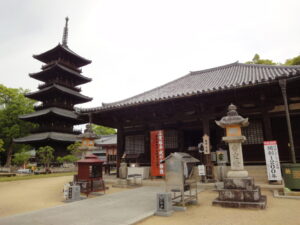
There is also a statue of a horse near the main hall.
This is a distinctive feature of Motoyama-ji, the only temple on the Shikoku 88 Temple Pilgrimage with Bato Kannon as its principal deity, and it allows visitors to experience the deep connection between Bato Kannon and horses.
Conclusion
Bato Kannon (Horse-Headed Kannon) is one of the many forms that Kannon Bosatsu takes, and its most distinctive feature is the horse’s head above its head.
Unlike the typical depictions of Kannon Bosatsu, Bato Kannon has a fierce, wrathful expression.
This anger is not directed at people. Instead, it represents the great strength needed to drive away confusion, worldly desires, and evil.
Bato Kannon has also long been worshipped as a guardian deity of horses.
On the Shikoku 88 Temple Pilgrimage, only Temple No. 70, Motoyama-ji, enshrines Bato Kannon as its principal deity.
When visiting Temple No. 70, Motoyama-ji, understanding the meaning behind Bato Kannon’s role in “forcefully cutting through worldly desires and confusion” can help you appreciate your visit to the principal deity on a deeper level.
Comments