
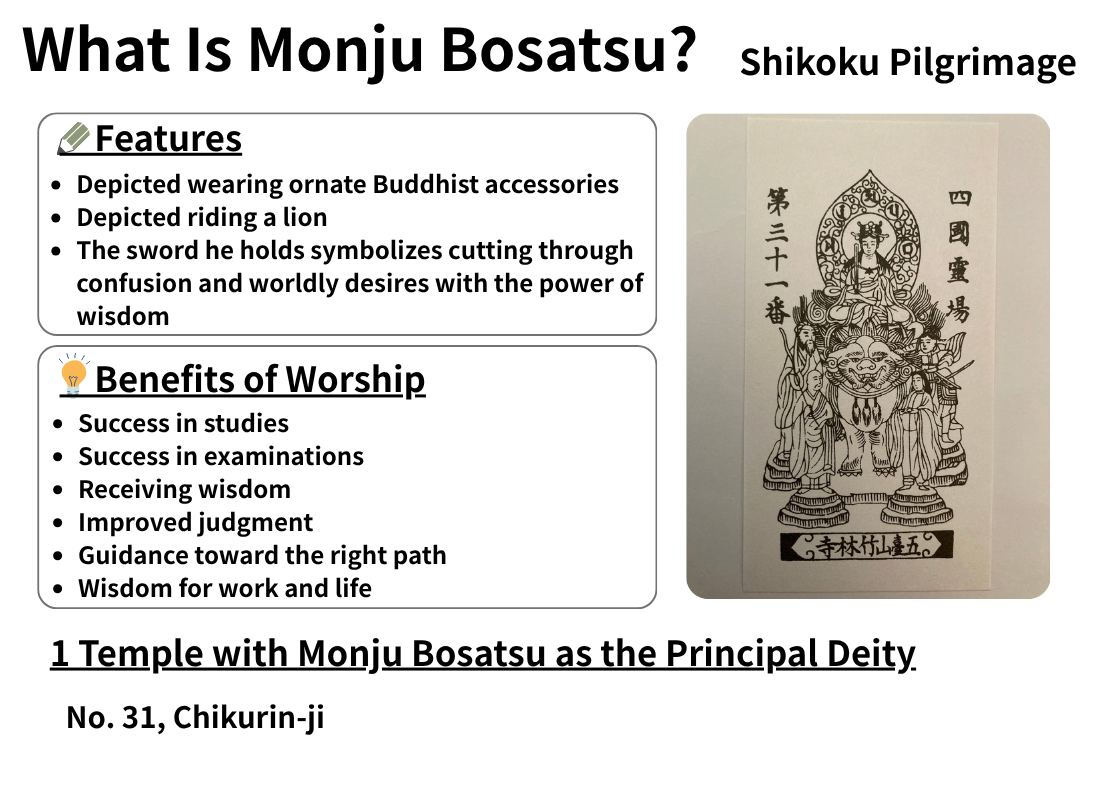
Among the 88 temples on the Shikoku 88 Temple Pilgrimage, various Buddhist deities are enshrined as the principal deity. Among them, Monju Bosatsu (Manjusri Bodhisattva) is known as the bodhisattva who symbolizes wisdom in Buddhism.
Monju Bosatsu is worshipped not simply as a source of knowledge or memory, but as a Buddhist figure who grants the wisdom to see the true nature of things and make sound judgments. For this reason, he is also widely worshipped by people praying for academic success and success in examinations.
On the Shikoku 88 Temple Pilgrimage, there is only one temple, Temple No. 31, Chikurin-ji, where Monju Bosatsu is enshrined as the principal deity.
In this article, we will explain in an easy-to-understand way who Monju Bosatsu is, his connection with wisdom, what he looks like, his relationship with Shaka Nyorai (Shakyamuni Buddha), and the benefits associated with worshipping him.
- What Is Monju Bosatsu?
- What Kind of Wisdom Does Monju Bosatsu Represent?
- The Relationship Between Monju Bosatsu and Shaka Nyorai
- Monju Bosatsu and the Japanese Saying “Three People Together Have the Wisdom of Monju”
- Benefits of Worshipping Monju Bosatsu
- What Does Monju Bosatsu Save People From?
- Temple on the Shikoku 88 Temple Pilgrimage Where Monju Bosatsu Is the Principal Deity
- Conclusion
What Is Monju Bosatsu?
Monju Bosatsu (Manjusri Bodhisattva) is a bodhisattva who symbolizes wisdom in Buddhism.
In Sanskrit, his name is Manjusri, and in Japan he is also known as Monju Shiri Bosatsu.
In Buddhism, wisdom is different from simply having knowledge or academic learning.
Wisdom is the ability to understand things correctly, see their true nature, and distinguish between what is right and what is wrong.
Monju Bosatsu is worshipped as the embodiment of this kind of wisdom.
For this reason, he is believed to bestow not only wisdom for study and academic learning, but also the wisdom needed to overcome confusion and difficulties in life and choose the right path.
What Does Monju Bosatsu Look Like?
Monju Bosatsu is generally depicted as a youthful-looking bodhisattva. He is often shown wearing a jeweled crown and ornate Buddhist accessories.
One of the best-known symbols associated with Monju Bosatsu is the sword. The sword he holds is not simply a weapon. In Buddhism, it symbolizes cutting through confusion and worldly desires with the power of wisdom. For this reason, the sword of Monju Bosatsu is often called the “Sword of Wisdom.”
Monju Bosatsu is also sometimes depicted riding a lion. As the king of beasts, the lion represents the power of wisdom and the courage to face confusion and uncertainty.
Omie
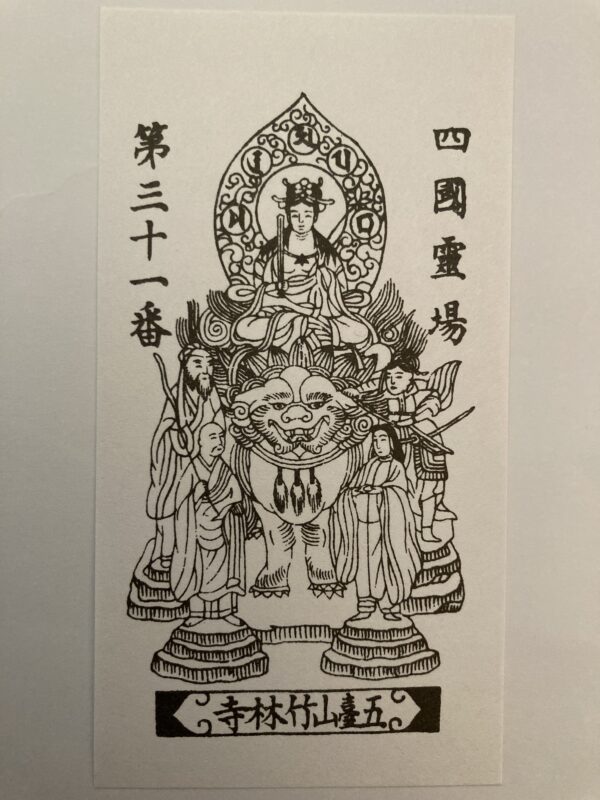
On Arahasya Nau
- Success in studies
- Success in examinations
- Receiving wisdom
- Improved judgment
- Guidance toward the right path
- Wisdom for work and life
What Kind of Wisdom Does Monju Bosatsu Represent?
The wisdom symbolized by Monju Bosatsu is not simply the ability to know a lot of things.
In Buddhism, wisdom means the ability to understand the true nature of things, free oneself from confusion and attachment, and see things clearly.
For example, when making an important decision in life, people can sometimes become caught up in short-term benefits or emotions.
At such times, the ability to look at things calmly and determine what is truly necessary is what Buddhism calls wisdom.
Monju Bosatsu is a Buddhist figure who symbolizes this kind of wisdom.
For this reason, worshipping Monju Bosatsu is not only about wishing to become better at studying. It is also a form of faith in which people pray for the wisdom needed to follow the right path in life.
The Relationship Between Monju Bosatsu and Shaka Nyorai
Monju Bosatsu is one of the important bodhisattvas who appears in Buddhist scriptures and in accounts of Shaka Nyorai’s teachings.
In particular, in Mahayana Buddhism, Monju Bosatsu appears in many scriptures as a figure who represents wisdom.
When Shaka Nyorai teaches the Dharma, Monju Bosatsu sometimes plays the role of asking questions with his wisdom and helping to reveal deeper truths.
For this reason, Monju Bosatsu has long been worshipped as a bodhisattva who symbolizes the wisdom needed to understand the teachings of Buddhism.
Monju Bosatsu and the Japanese Saying “Three People Together Have the Wisdom of Monju”
In Japan, the saying “San-nin yoreba Monju no chie” is well known.
It means that even ordinary people can come up with remarkably wise ideas when three people gather together and share their knowledge and ideas, like the wisdom of Monju Bosatsu.
This saying also shows how Monju Bosatsu has long been familiar to people in Japan as a figure possessing exceptional wisdom.
The wisdom represented by Monju Bosatsu is not limited to school studies.
It can also be understood as the wisdom needed to make sound decisions in many areas of life, including work, relationships, and important choices about the future.
Benefits of Worshipping Monju Bosatsu
Monju Bosatsu is worshipped as a Buddhist figure who represents wisdom and is believed to offer various benefits.
Some of the main benefits include:
- Success in studies
- Success in examinations
- Receiving wisdom
- Improved judgment
- Guidance toward the right path
- Wisdom for work and life
Among these, success in studies and examinations are particularly well known.
Temple No. 31, Chikurin-ji, is also known as a temple associated with learning, and students preparing for examinations visit the temple to pray to Monju Bosatsu for success.
What Does Monju Bosatsu Save People From?
Monju Bosatsu can be understood as a bodhisattva who guides people suffering from confusion and ignorance through the power of wisdom.
People can sometimes feel anxious or make the wrong decisions because they do not know or understand something.
Monju Bosatsu is believed to guide people away from this kind of “confusion” and grant them the wisdom needed to see things clearly.
For this reason, people may pray to Monju Bosatsu for the wisdom to make the right decisions at important moments in life, or seek his guidance when they want to overcome their own doubts and uncertainty.
Temple on the Shikoku 88 Temple Pilgrimage Where Monju Bosatsu Is the Principal Deity
On the Shikoku 88 Temple Pilgrimage, there is only one temple where Monju Bosatsu is enshrined as the principal deity: Temple No. 31, Chikurin-ji.
Chikurin-ji is the only temple on the Shikoku 88 Temple Pilgrimage where Monju Bosatsu is enshrined as the principal deity. For this reason, it is a particularly important temple for people who wish to worship Monju Bosatsu.
Temple No. 31, Chikurin-ji
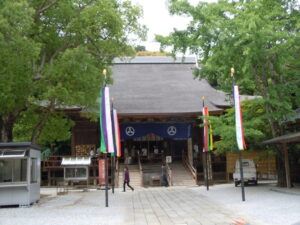
Temple No. 31, Chikurin-ji, is located on Mount Godai in Kochi City, Kochi Prefecture.
The temple grounds feature several highlights, including a five-story pagoda and a traditional garden. The temple is also located in a scenic area overlooking Kochi City and Urado Bay.
The Monju Bosatsu at Chikurin-ji has long been known as one of the “Three Great Monju” statues in Japan.
The Monju Bosatsu at Chikurin-ji is also preserved in the form of a Five-Figure Monju Group, with Monju Bosatsu accompanied by four attendants. This group of Buddhist statues is designated as an Important Cultural Property of Japan.
According to Kochi City, Chikurin-ji houses 17 Buddhist statues designated as Important Cultural Properties of Japan, all of which are preserved in the temple’s treasure hall.
From the perspective of its cultural properties as well, Chikurin-ji is one of the particularly important sacred sites associated with the worship of Monju Bosatsu among the temples of the Shikoku 88 Temple Pilgrimage.
Conclusion
Monju Bosatsu is a bodhisattva who symbolizes wisdom in Buddhism.
This wisdom is not simply academic knowledge. It refers to the wisdom needed to see the true nature of things, cut through confusion and worldly desires, and choose the right path.
For this reason, Monju Bosatsu is worshipped not only by people praying for success in studies and examinations, but also by those seeking the wisdom to make sound decisions in life and overcome confusion.
On the Shikoku 88 Temple Pilgrimage, only Temple No. 31, Chikurin-ji, enshrines Monju Bosatsu as its principal deity.
When visiting Temple No. 31, Chikurin-ji, understanding the meaning of “wisdom,” which Monju Bosatsu symbolizes, can help you appreciate your visit to the principal deity on a deeper level.
Comments