
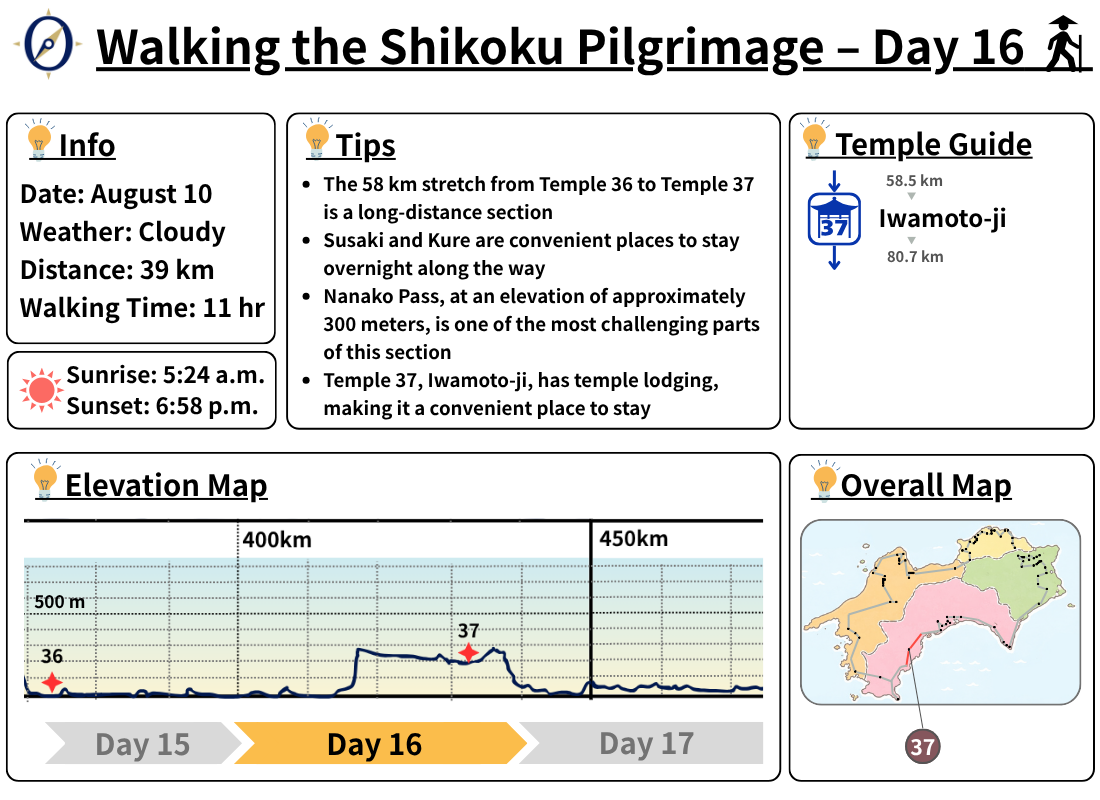
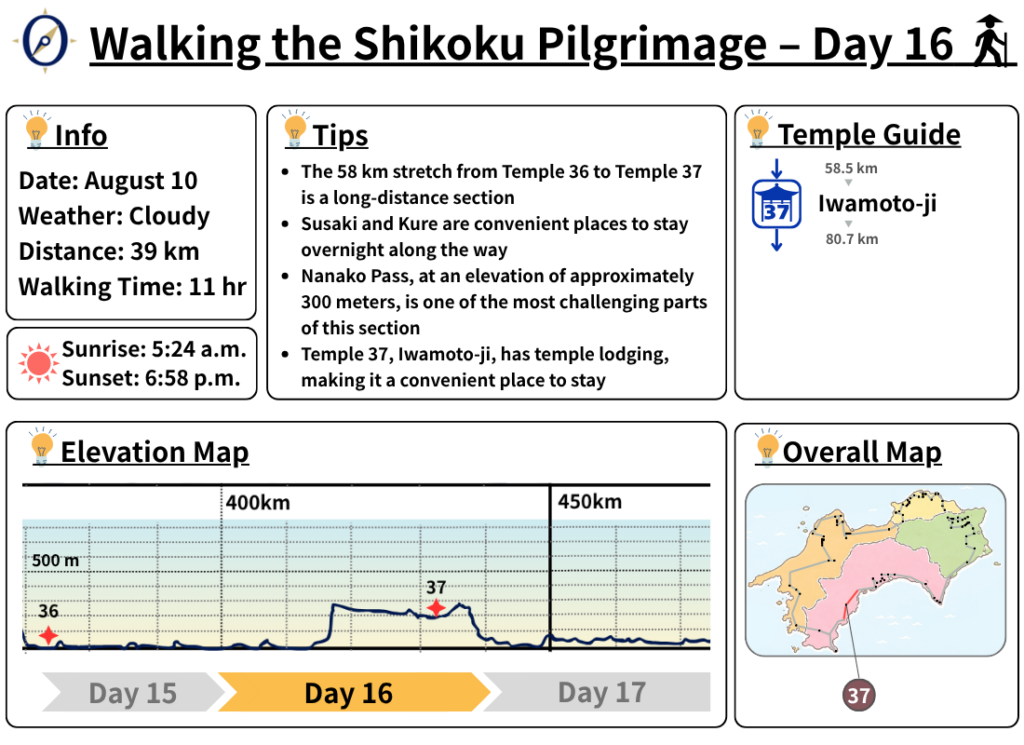
On August 10, after the typhoon had passed, I set out from Awa and walked through Kure, crossing Nanako Pass to reach Temple 37, Iwamoto-ji. With the damage left behind by the previous day’s typhoon still visible, I received a warm osettai from a local resident and safely completed my visit to the temple. I then continued to Tosa Saga Onsen, where I relaxed in the hot springs and rested at a pilgrim hut. A chance encounter and conversation with a fellow pilgrim there made this a truly memorable day.
- Itinerary
- Setting Out from Awa on the Morning After the Typhoon
- From Awa to Kure and Nanako Pass
- Crossing Nanako Pass and Heading to Kubokawa
- The Aftermath of the Typhoon and Osettai from a Local Resident
- Visiting Temple 37, Iwamoto-ji
- Heading for Tosa Saga Onsen
- Meeting Fellow Pilgrims at Tosa Saga Onsen
- Temple Information
Itinerary
- 7:00Departure
- Awa Town
- Kure City
- Nanako Pass
- Roadside Station Kubokawa
- 15:00Temple No. 37, Iwamoto-ji
- Kobushinokawa Rest Area
- 18:15Tosa Saga Onsen
Overnight stay
Setting Out from Awa on the Morning After the Typhoon
August 10. Cloudy. I woke up just before 6:00 a.m.
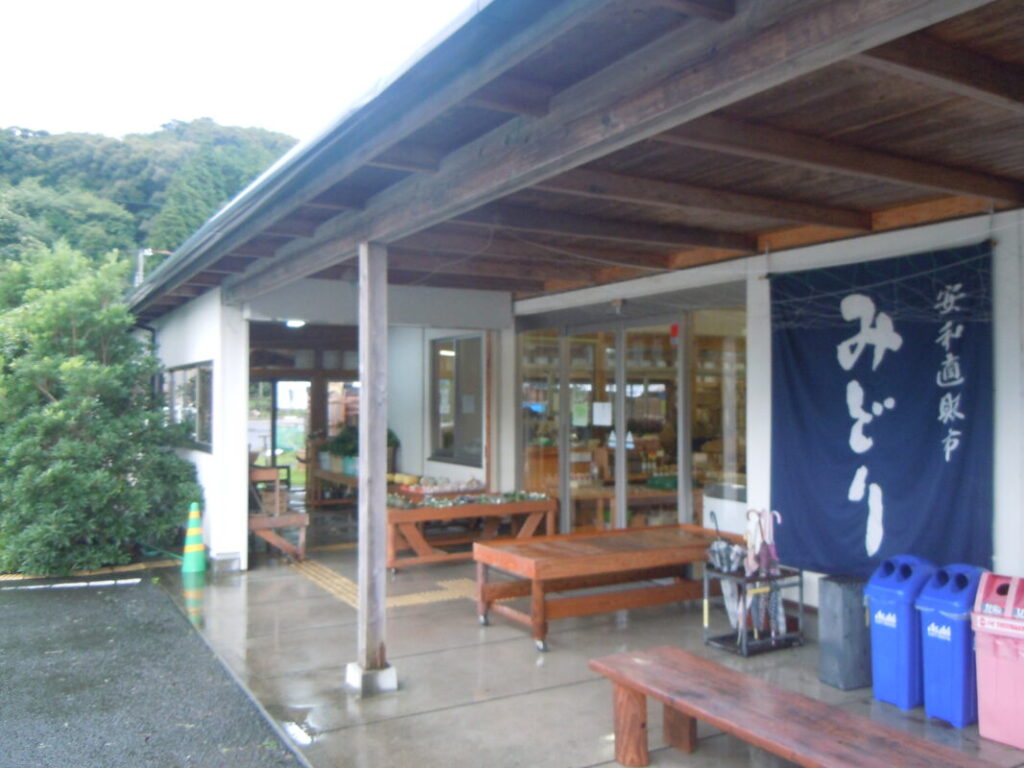
The previous day, with a powerful typhoon approaching, I had been forced to sleep outdoors under the eaves of a roadside farmers’ market in Awa. The typhoon had made landfall in the area during the night and had already passed through Shikoku. Both the wind and rain had finally stopped.
I could hear the rattling sound of a metal shutter being opened outside my tent. When I poked my head out, a middle-aged woman who appeared to work at the market muttered, “The master is awake.”
I thanked her for allowing me to spend the night there.
The previous night had been terrifying, but somehow I had made it safely through until morning. Looking around, I saw branches and leaves scattered everywhere. The damage left by the typhoon was a vivid reminder of just how fierce the storm had been.
Then I happened to notice a small flower in a nearby flower bed. It was standing proudly, its petals and leaves still covered with raindrops that sparkled in the morning sunlight.
“Did you survive that typhoon, too?”
At first glance, it was such a delicate little flower, something that could easily be plucked by a person’s hand. Yet, when I thought about how it had endured the immense forces of nature with nothing but its tiny roots holding it in place, I was reminded of how fragile human beings really are.
Looking toward the surrounding forest, I began imagining the wild animals that had endured the storm deep among the trees, and the insects that had desperately clung to the undersides of leaves.
A sense of respect and awe toward nature welled up inside me. Even now, I vividly remember those feelings.
A little later, the woman from the market called out to me.
“I’m preparing breakfast, so stay and have something to eat.”
She even kindly offered me sandwiches as osettai, a traditional act of generosity toward pilgrims. I expressed my heartfelt gratitude.
Shortly after 7:00 a.m., I set out from Awa.
From Awa to Kure and Nanako Pass
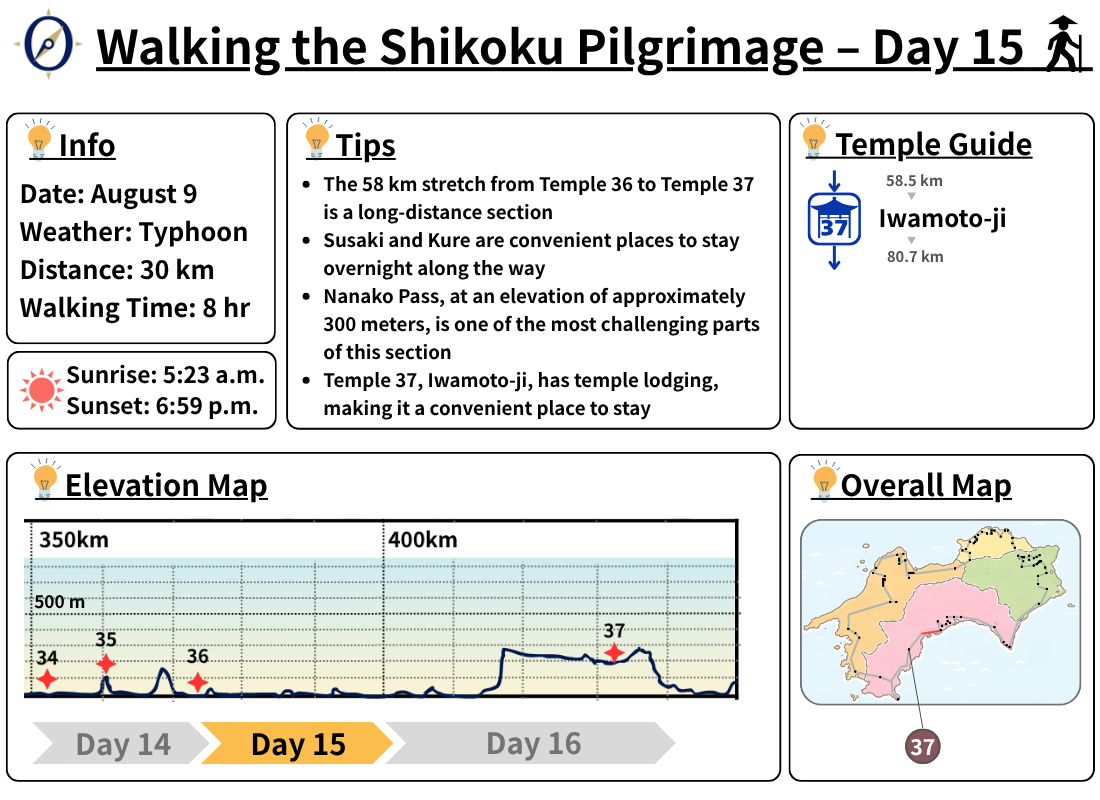
The distance from Temple 36, Shoryu-ji, to Temple 37, Iwamoto-ji, is approximately 58 km, making it a long-distance section of the pilgrimage. Awa is located roughly halfway along this route, so reaching Iwamoto-ji by the end of the day was certainly achievable.
There are several possible routes from Awa to Iwamoto-ji.
The most straightforward option is to follow National Route 56. By taking the tunnels through the mountain sections, pilgrims can conserve their energy. Alternatively, those who wish to experience the traditional pilgrimage trails can choose the Yakesaka or Osaka pilgrimage routes.
When I walked this section, the signs for the old pilgrimage trails were somewhat difficult to follow, so I decided to take the route along National Route 56.
After approximately an hour and a half of walking from Awa, I arrived in central Kure. It was a lively town with convenience stores and restaurants.
Crossing Nanako Pass
After leaving central Kure, the climb toward Nanako Pass began almost immediately.
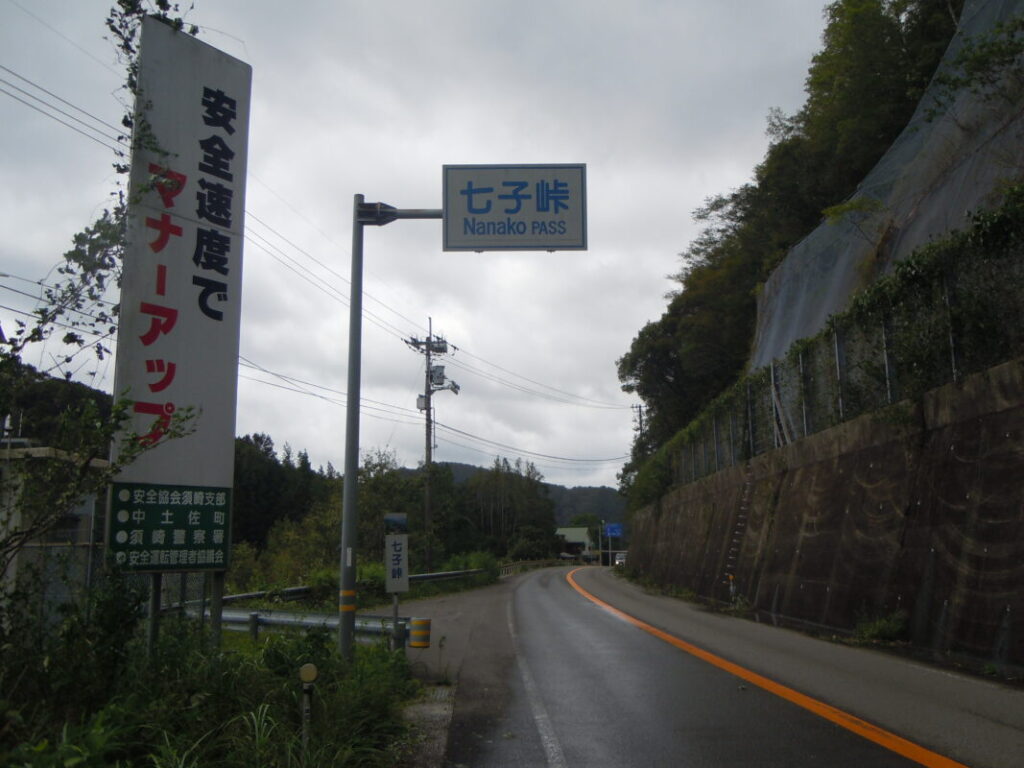
At an elevation of approximately 300 meters, Nanako Pass is one of the most challenging parts of this section, with a long uphill climb. Although the slope is not particularly steep, the sustained ascent gradually takes its toll on your legs.
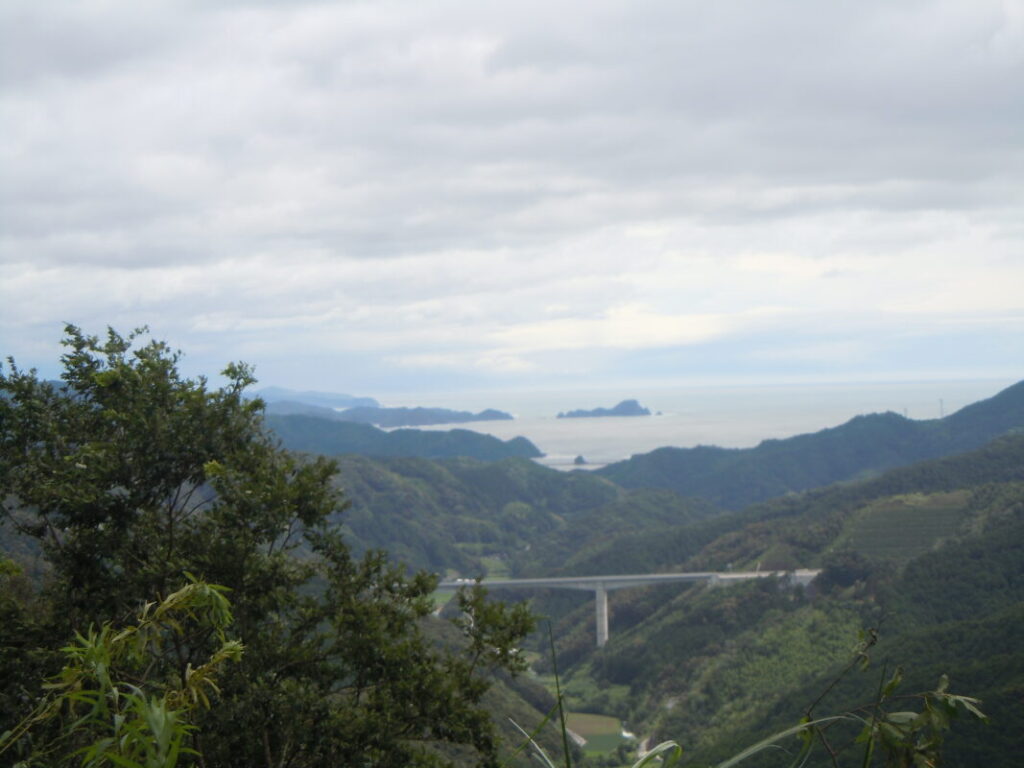
After finally reaching the top, I came across a viewpoint. The Pacific Ocean stretched out in the distance, giving me a clear sense of just how high I had climbed.
The viewpoint also had vending machines and toilets, making it a convenient place to take a break after completing the climb.
Crossing Nanako Pass and Heading to Kubokawa
Although I had crossed Nanako Pass, there were still approximately 16 km to go before reaching Iwamoto-ji.
This area lies about 10 km inland from Tosa Bay, with quiet roads winding through mountains on either side. As I continued south along National Route 56, I could occasionally hear the gentle sound of streams flowing nearby. The peaceful scenery of the mountain countryside stretched out around me.
Since I had walked a shorter distance the previous day due to the typhoon, my legs were feeling good. I continued walking without taking any long breaks and arrived in Kubokawa, where Iwamoto-ji is located, shortly before 3:00 p.m.
Roadside Station Kubokawa
Roadside Station Kubokawa, located just before Iwamoto-ji, was bustling with tourists. Situated along National Route 56, it is a convenient facility where visitors can enjoy light meals and refreshments.
If you have some time to spare, it is well worth stopping by.
The Aftermath of the Typhoon and Osettai from a Local Resident
As I walked along the street leading to Iwamoto-ji, I came across an unexpected sight.
Perhaps it was the aftermath of the previous day’s typhoon. A nearby river had swollen, and local residents were busy carrying water-damaged belongings out of their homes and clearing away the mud that had flowed inside.
The moment I saw this scene, I felt as though I had suddenly been brought back to reality.
The local people were struggling with the damage caused by the typhoon. Meanwhile, I was using my vacation to enjoy walking the Shikoku pilgrimage. Thinking about this contrast left me with mixed feelings that were difficult to put into words.
Just then, an elderly local woman called out to me.
“I’ve found Kobo Daishi.”
With those words, she handed me 500 yen as osettai.
I thanked her and gratefully accepted it.
This was not an offering made to me personally. It was an offering to Kobo Daishi, who was walking alongside me through Dogo Ninin—the belief that pilgrims are never alone on their journey.
I was reminded that I was not walking this pilgrimage entirely on my own. I must continue toward the next temple carrying not only my own thoughts, but also the kindness and feelings of the local people.
It was an encounter that once again strengthened this awareness in me.
Visiting Temple 37, Iwamoto-ji
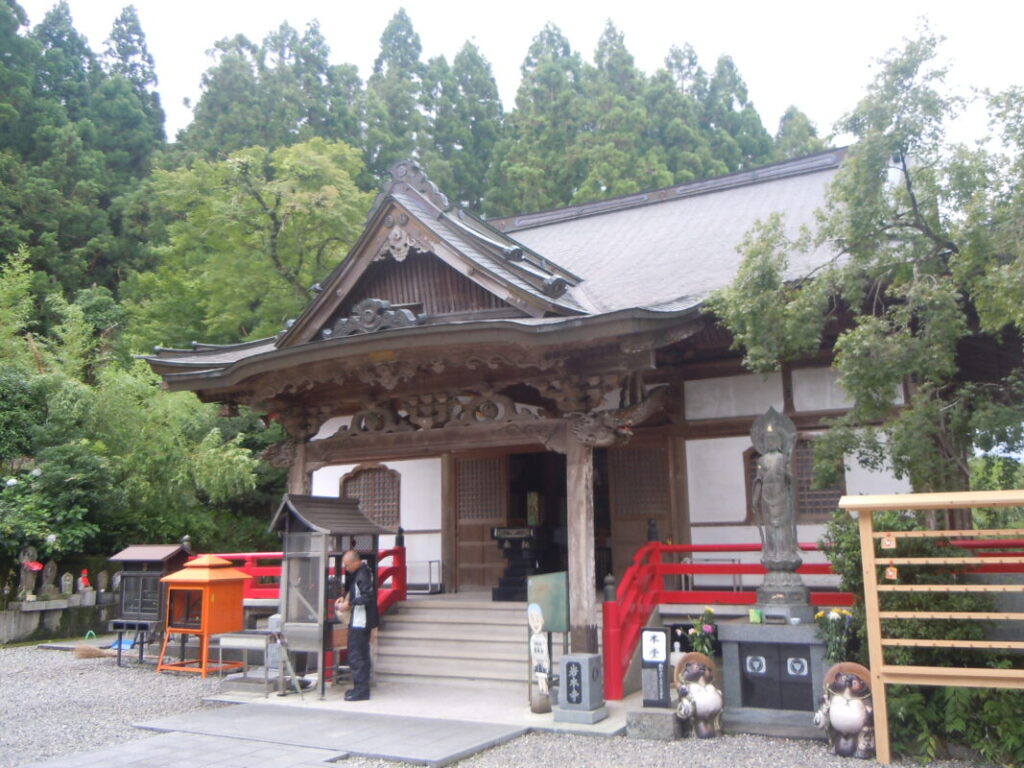
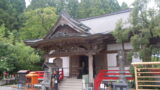
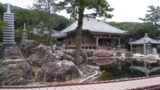
Iwamoto-ji is one of the most memorable temples on the Shikoku 88 Temple Pilgrimage.
The first thing that catches the eye is the colorful collection of paintings covering the ceiling of the main hall. A total of 575 paintings are displayed, featuring an extraordinary variety of subjects, including Marilyn Monroe and the Virgin Mary.
The paintings were deliberately collected without restricting their themes, reflecting the wish that people from all backgrounds, regardless of race or religion, would feel welcome to visit the temple.
Another distinctive feature of Iwamoto-ji is that it enshrines five principal Buddhist deities:
- Fudo Myoo
- Kannon Bosatsu
- Amida Nyorai
- Yakushi Nyorai
- Jizo Bosatsu
In the main hall, I recited the mantra for each of the five deities three times, making a total of 15 recitations. It was truly a blessing to be able to pay my respects to so many principal deities at one temple.
Iwamoto-ji also offers temple lodging, making it a convenient place for pilgrims to stay overnight. It also appears to attract visitors beyond the pilgrimage community, with facilities such as a sauna now available.
Heading for Tosa Saga Onsen
It was just after 3:00 p.m. After finishing my visit to the temple, I unfolded my map and considered where to head for the day.
I had been soaked by yesterday’s typhoon, and after another full day of walking, I was drenched in sweat. I was definitely ready for a bath.
The leading option was Tosa Saga Onsen, about 10 km from Iwamoto-ji. I had learned in advance that there was a pilgrim hut on the grounds where I could sleep outdoors.
I decided that Tosa Saga Onsen would be my destination for the day.
After leaving Iwamoto-ji, I faced a long downhill stretch. Having climbed up to Nanako Pass, I now had to descend all the way back down.
The road was surrounded by deep mountains. After 5:00 p.m., the light gradually began to fade. I wanted to arrive before sunset. Trying to keep my impatience in check, I continued walking at a steady pace.
Arriving at Kobushinokawa Rest Area at 5:30 p.m.
I had been walking since early morning and had covered nearly 40 km again that day. Feeling the fatigue catch up with me, I spotted a rest area and stopped without thinking.
I checked the map. Tosa Saga Onsen was just a little farther ahead.
“Just a little more. Keep going!”
Meeting Fellow Pilgrims at Tosa Saga Onsen
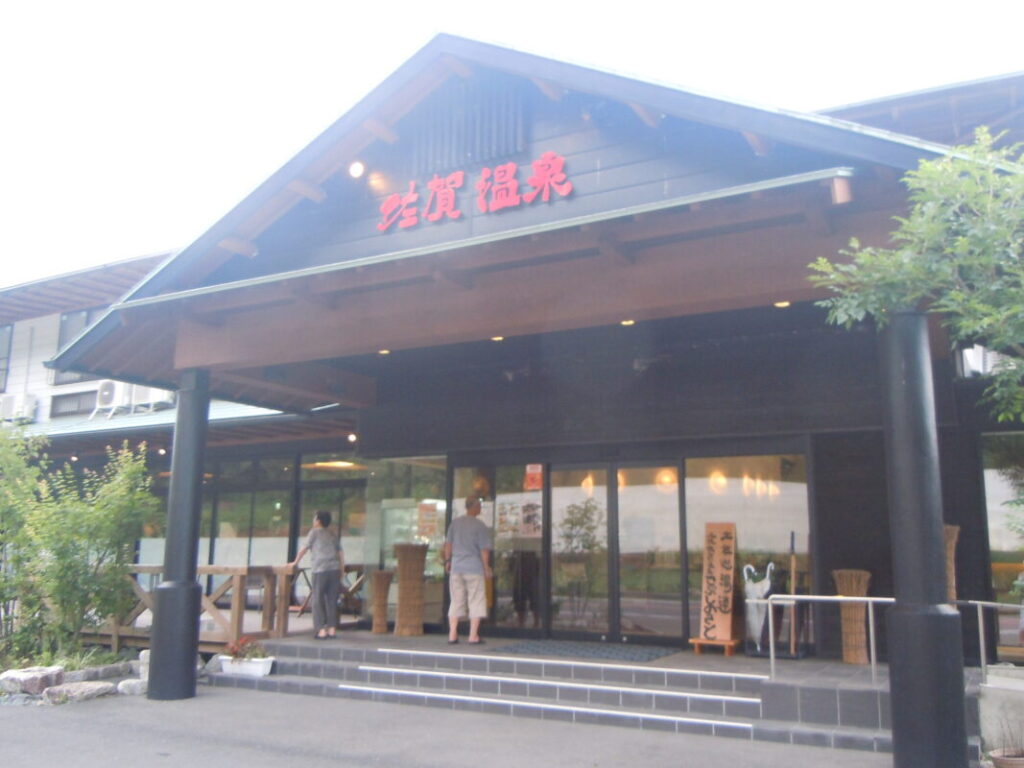
I arrived at Tosa Saga Onsen at 6:15 p.m.
I was relieved to have made it before sunset. Tosa Saga Onsen is a facility where visitors can enjoy a day-use hot spring bath at a reasonable price. In addition to the hot spring, there is also a restaurant and accommodation available for an additional fee.
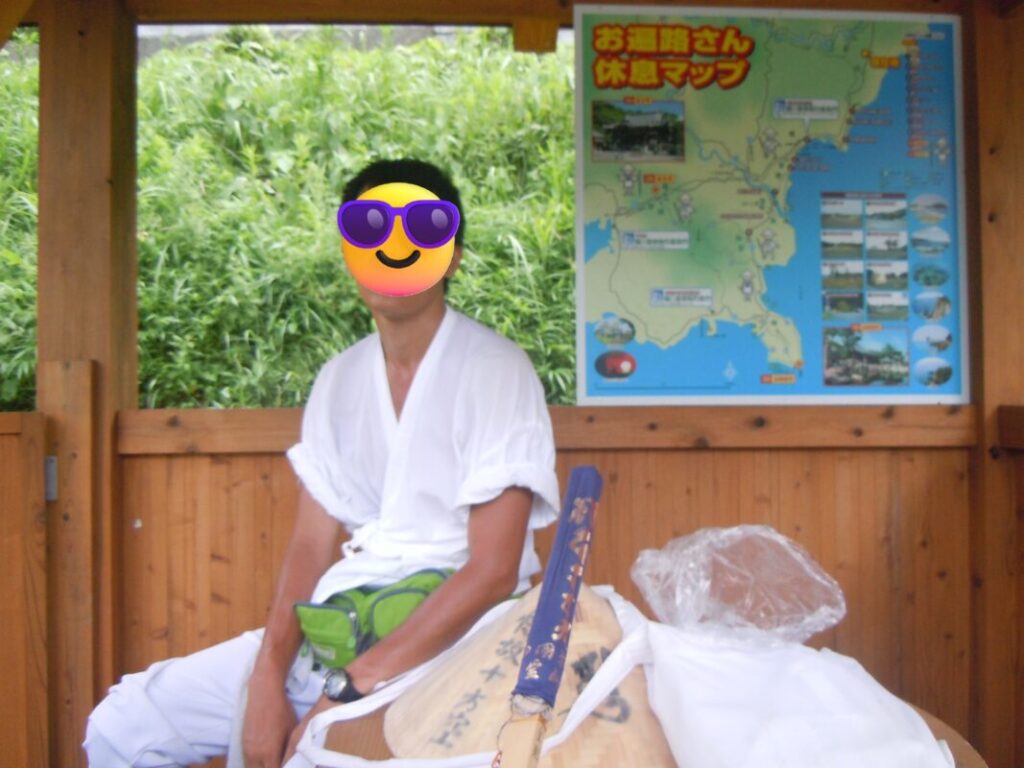
What makes this place even more special for pilgrims is that there is a dedicated pilgrim hut on the premises. For those walking the Shikoku Pilgrimage, this is truly a welcome facility.
I immediately took a bath to wash away the day’s sweat, then had dinner at the restaurant.
By the time I finished eating, it was completely dark. When I headed to the pilgrim hut, I found that someone had already arrived. He was a young man who looked slightly younger than me.
“You’re a Henro pilgrim, aren’t you?”
Apparently, he had spotted me somewhere around the facility. The hut was spacious enough for two people, so I decided to stay there with him.
We soon got into a conversation about the typhoon the previous night.
When I told him how the typhoon had left me stranded and forced me to sleep outdoors in Awa, he revealed that he had also spent the night outdoors under similar circumstances.
We felt a strange sense of camaraderie, as if we were congratulating each other for having made it through such a difficult ordeal.
What surprised me even more was that he also knew the pilgrim I had met at Kokumin Shukusha Tosa two days earlier.
Apparently, they had both started the full pilgrimage around the same time. Along the way, they had taken occasional detours and crossed paths several times.
In a way, they were like fellow classmates on the pilgrimage.
As I continue walking the Shikoku Pilgrimage, I find that connections with other people naturally develop along the way. Perhaps yesterday’s difficult experience with the typhoon had somehow led to today’s encounter.
Once again, it had been an unforgettable day.
Temple Information
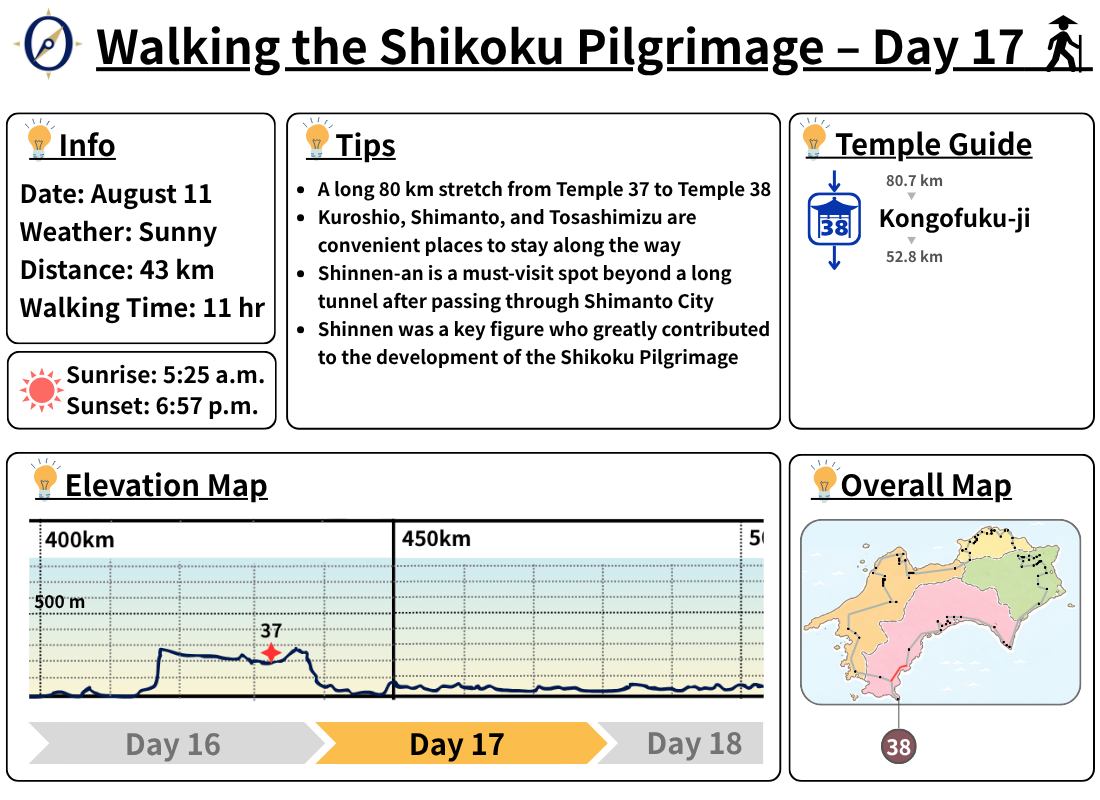
- No. 37
- No. 38
Comments