
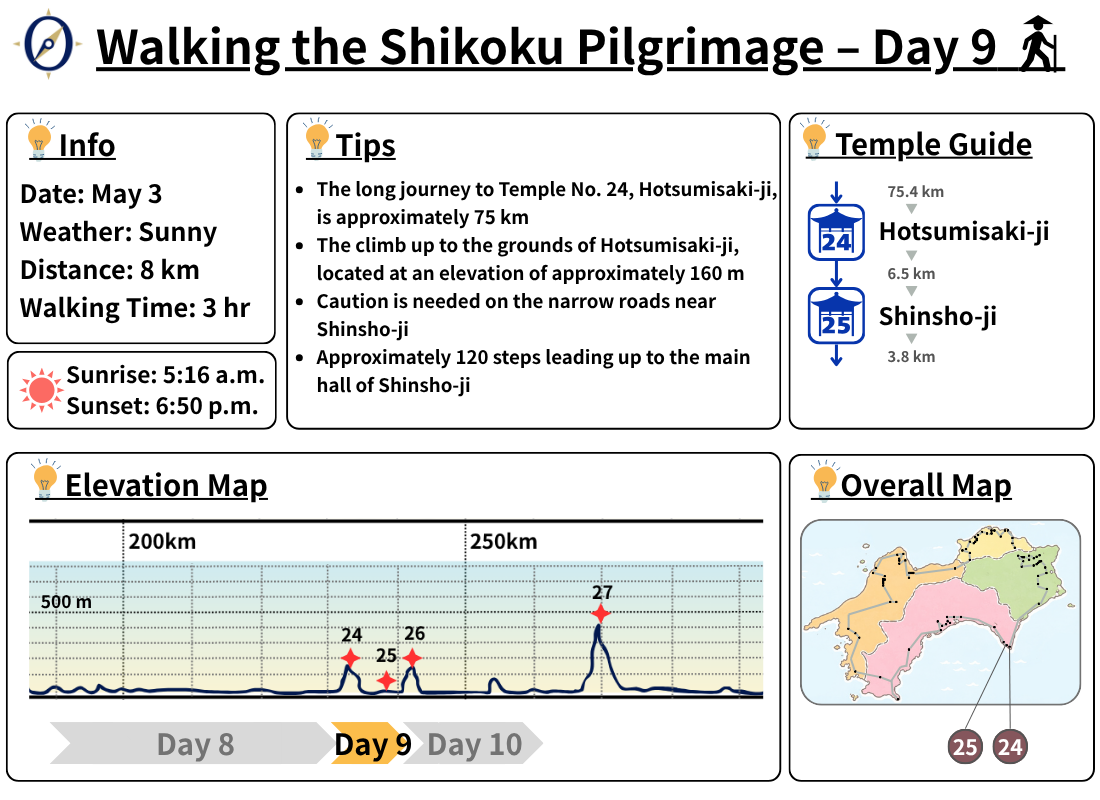
On Day 9 of my walking pilgrimage, I set out from Cape Muroto and visited Temple No. 24, Hotsumisaki-ji, and Temple No. 25, Shinsho-ji. On the final day of my first section of the pilgrimage, I enjoyed the scenery around Cape Muroto while visiting these two temples. I ended this leg of my journey at Shinsho-ji, then took a bus and train back to Tokushima. My first week-long walking pilgrimage had come to an end.
- Itinerary
- Morning at Cape Muroto | The Final Day of My First Pilgrimage Section
- Temple No. 24, Hotsumisaki-ji | Climbing the Trail from Cape Muroto
- Temple No. 25, Shinsho-ji | Walking Through Muroto’s Port Town
- Completing My First Pilgrimage Section | Lunch Near Shinsho-ji
- Returning to Tokushima by Bus and Train
- Temple Information
Itinerary
- 6:00Departure
- Cape Muroto
- 8:00Temple No. 24, Hotsumisaki-ji
- 10:00Temple No. 25, Shinsho-ji
- End of This Pilgrimage Section
Morning at Cape Muroto | The Final Day of My First Pilgrimage Section
May 3. Sunny. I woke up at 5 a.m.
The day before, I had walked from Shishikui to Cape Muroto and spent the night outdoors at its tip. Today was the final day of my first section of the pilgrimage. I planned to visit the temples up to a convenient stopping point before returning to Tokushima.
My first destination was Temple No. 24, Hotsumisaki-ji, near Cape Muroto. Although it is close to the cape, the temple grounds are located at an elevation of about 160 meters, so I would need to climb a mountain trail to reach them.
For breakfast, I ate a boxed meal I had bought at the supermarket in Sakihama the day before. Since there was still some time before the temple office opened, I decided to explore the area around Cape Muroto before taking down my tent.
The Shintaro Nakaoka Statue and the Rugged Pacific Ocean at Cape Muroto
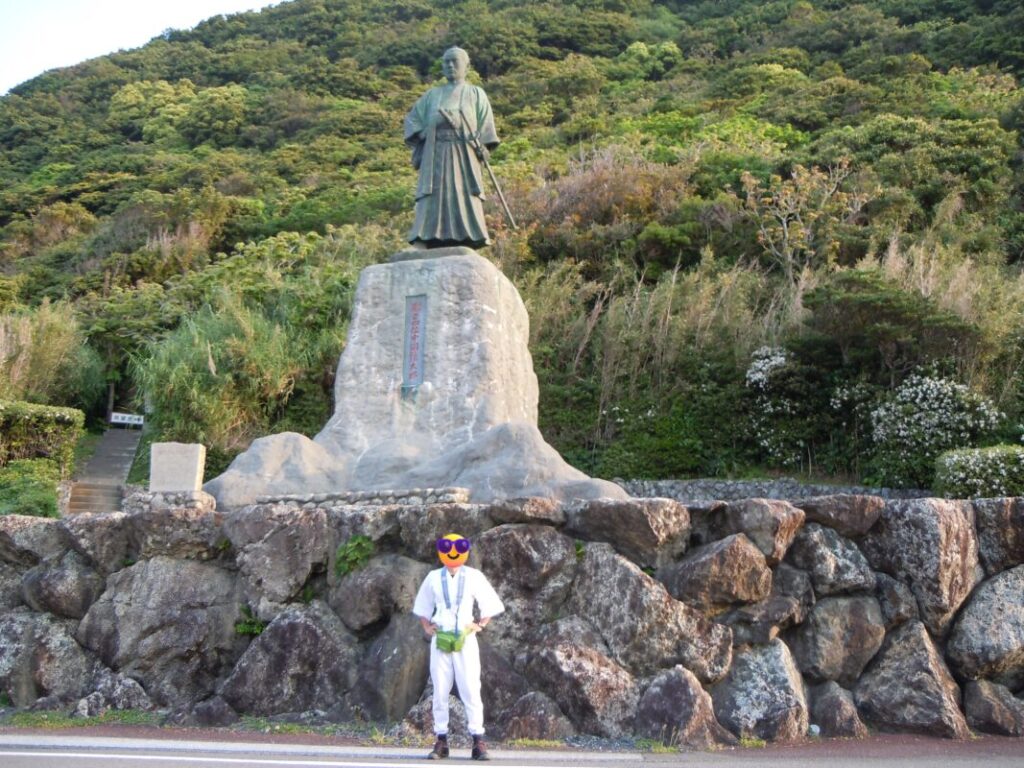
The first thing that caught my eye at Cape Muroto was the statue of Shintaro Nakaoka.
Nakaoka was a samurai from Tosa Domain who played an active role in the final years of the Edo period. As I looked at his figure gazing out over the Pacific, I could sense the intensity of his expression.
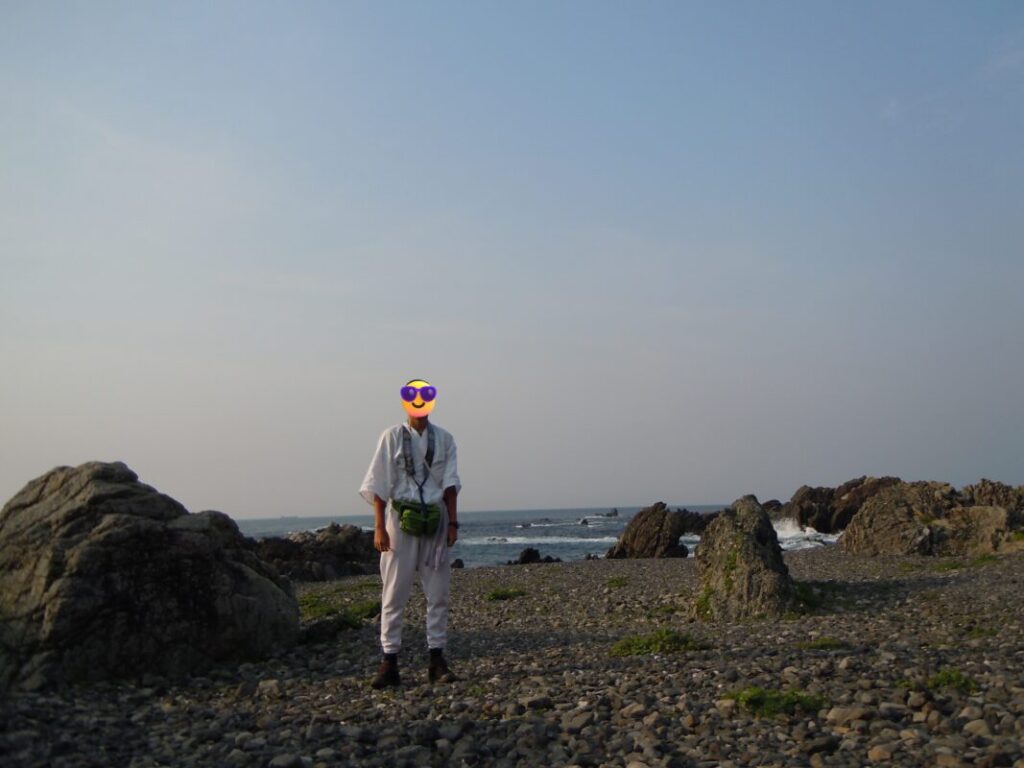
Large rocks were scattered along the shore, and the waves showed the rugged power of the open ocean.
I had heard that pilgrims in the past walked over rocky terrain like this. Considering that their footwear was made of straw sandals, the journey must have been far more difficult than it is today.
With these thoughts in mind, I spent some time taking in the scenery at Cape Muroto.
Temple No. 24, Hotsumisaki-ji | Climbing the Trail from Cape Muroto
It was almost time to set off. I packed up my tent and began climbing the mountain trail from the entrance to Hotsumisaki-ji.
The trail was paved with stone steps, but once I started climbing, I found it quite strenuous.
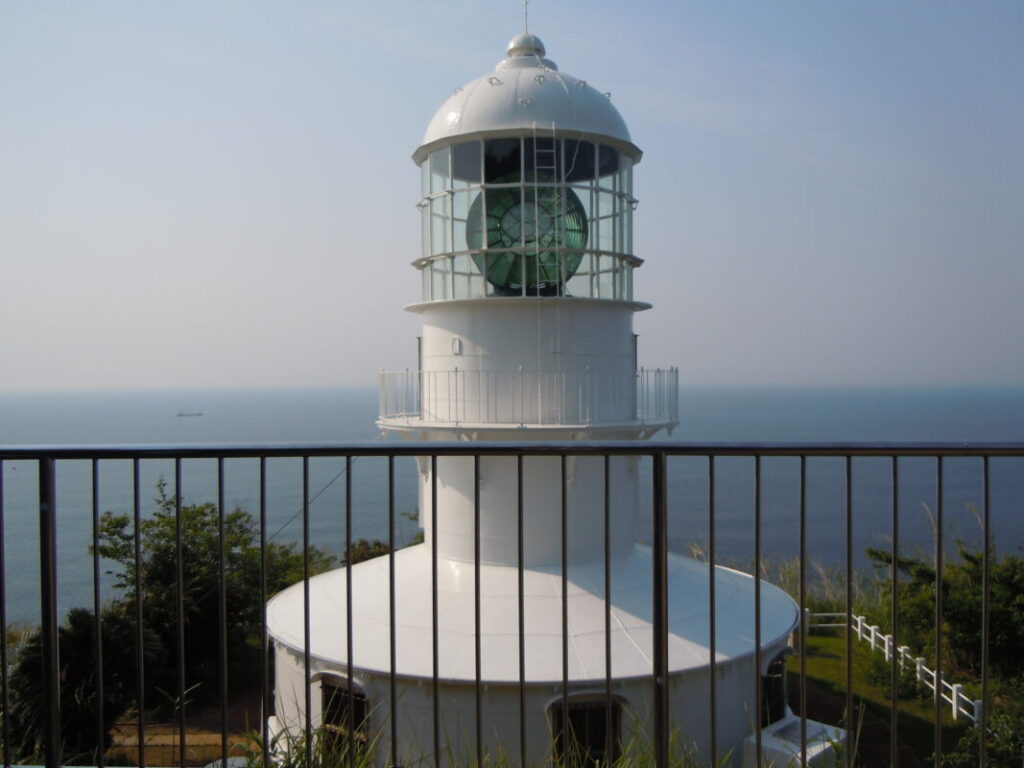
Just before the temple gate, I took a side path downhill and caught a glimpse of Cape Muroto Lighthouse. It was a rare view, from almost the same height as the part of the lighthouse that emits its beam.
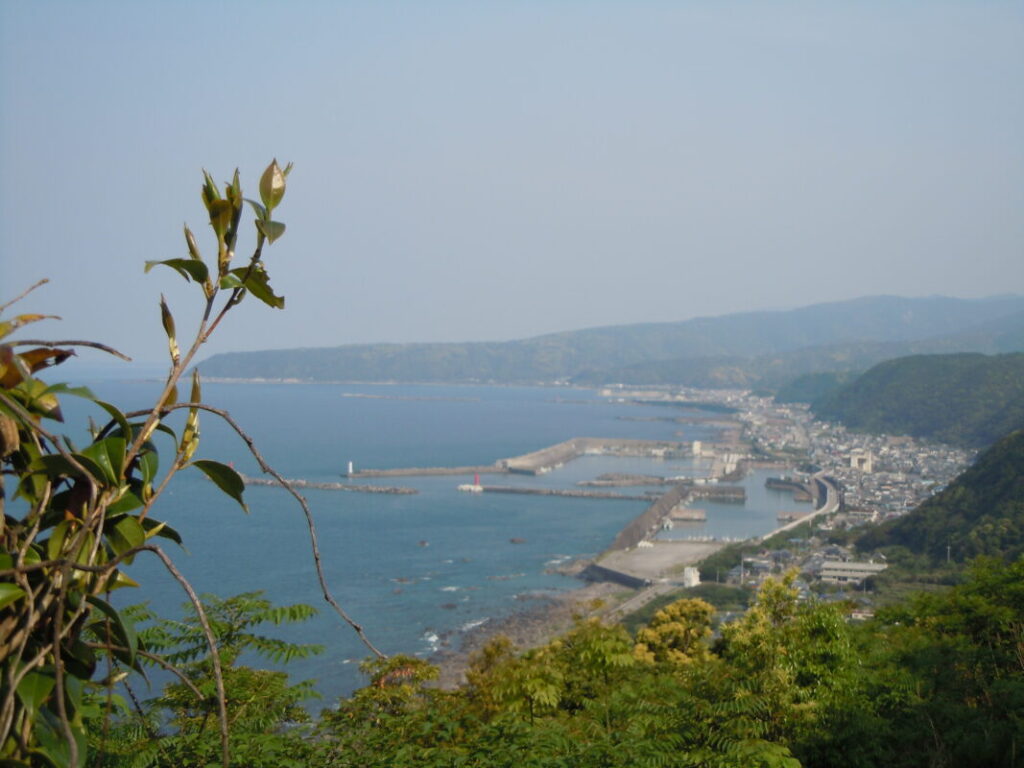
From a nearby open area, I could also see the port town of Muroto. I wondered if Temple No. 25, Shinsho-ji, was somewhere over there.
The Grounds of Hotsumisaki-ji and the Bell Stone
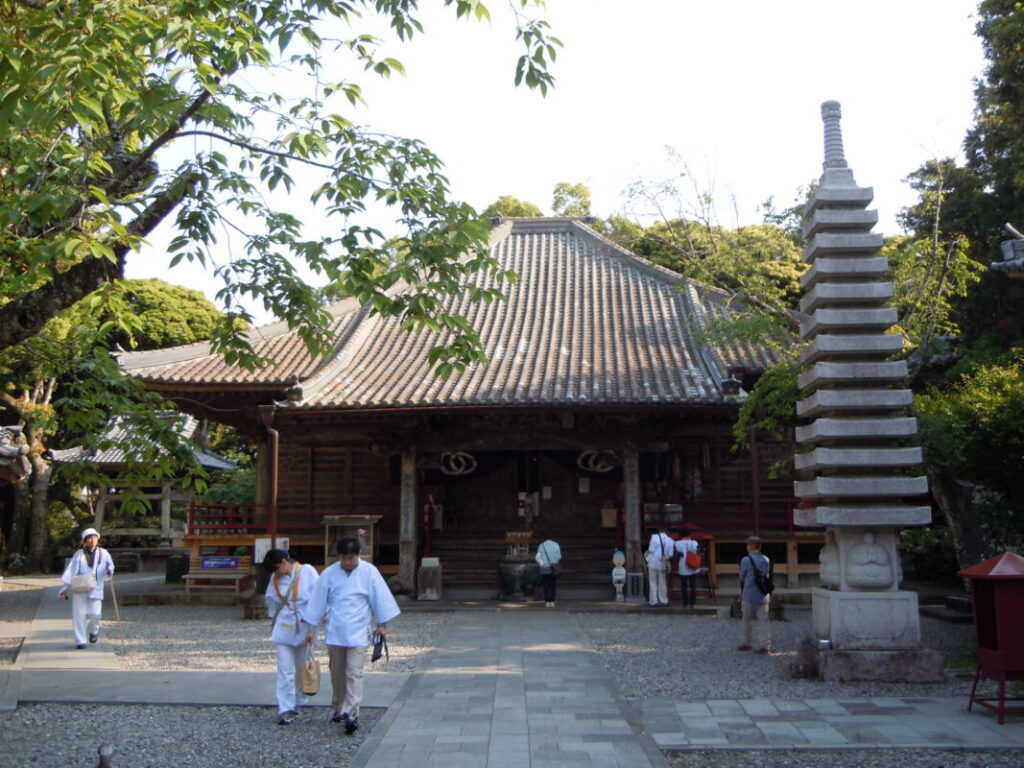
Despite it being early in the morning, there were already several visitors in the temple grounds. Perhaps they were guests staying at Hotsumisaki-ji’s temple lodging.
What left the strongest impression on me was a mysterious stone known as the “Bell Stone.” When struck against another stone, it produces a ringing sound like metal.
The principal deity of Hotsumisaki-ji is Kokuzo Bosatsu. The temple is also closely connected to Kobo Daishi Kukai’s practice of Kokuzo Gumonji-ho, which he is said to have performed at nearby Mikurodo Cave.
Yesterday, I visited Mikurodo Cave, and today I was visiting Hotsumisaki-ji. As I made my way around places associated with Kukai, I increasingly felt that I had truly entered Tosa, the “Training Ground of Ascetic Practice.”
Temple No. 25, Shinsho-ji | Walking Through Muroto’s Port Town
It was 8 a.m. The next temple, Temple No. 25, Shinsho-ji, was about 7 kilometers away—a walk of just under two hours.
It felt a little early to stop, but I had decided to end this section of my pilgrimage at Shinsho-ji. With that in mind, I set off from Hotsumisaki-ji.
The sky was completely clear, without a single cloud. It was still cool in the morning, making the walk pleasant.
Knowing that the next temple would be my last stop for this leg of the journey put me at ease. I walked a little more slowly than usual and arrived at Shinsho-ji around 10 a.m.
The Vermilion Temple Gate and Tropical Grounds
Shinsho-ji is located near the port of Muroto.
The roads leading to the temple are somewhat winding, with many narrow streets. It might be difficult to find for first-time visitors, but as long as you keep an eye out for the signs, you should be able to reach it.
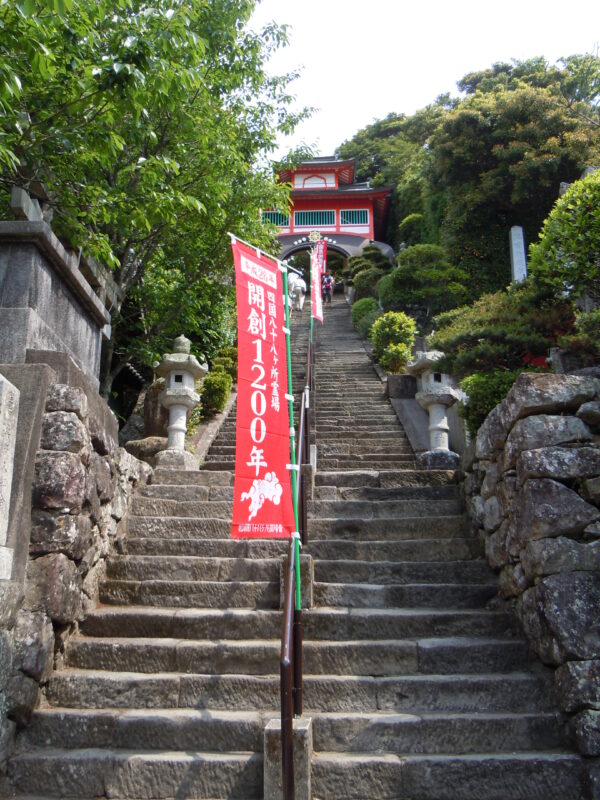
Passing through the vermilion temple gate, I found cycad trees growing in the grounds, creating a distinctly tropical atmosphere.
Climbing 120 Steps to the Main Hall
The Daishi Hall is near the entrance. To reach the main hall, however, you have to climb about 120 steps.
Partway up the stairs, I came across a bell tower with an unusual design that caught my attention.
From the main hall at the top, I could look out over the port town below and the Pacific Ocean. I felt that this must have long been an important temple for people praying for safe voyages.
At the Daishi Hall, I quietly reflected on how I had completed this section of my pilgrimage as planned, and on how I would begin walking again from here next time.
Completing My First Pilgrimage Section | Lunch Near Shinsho-ji
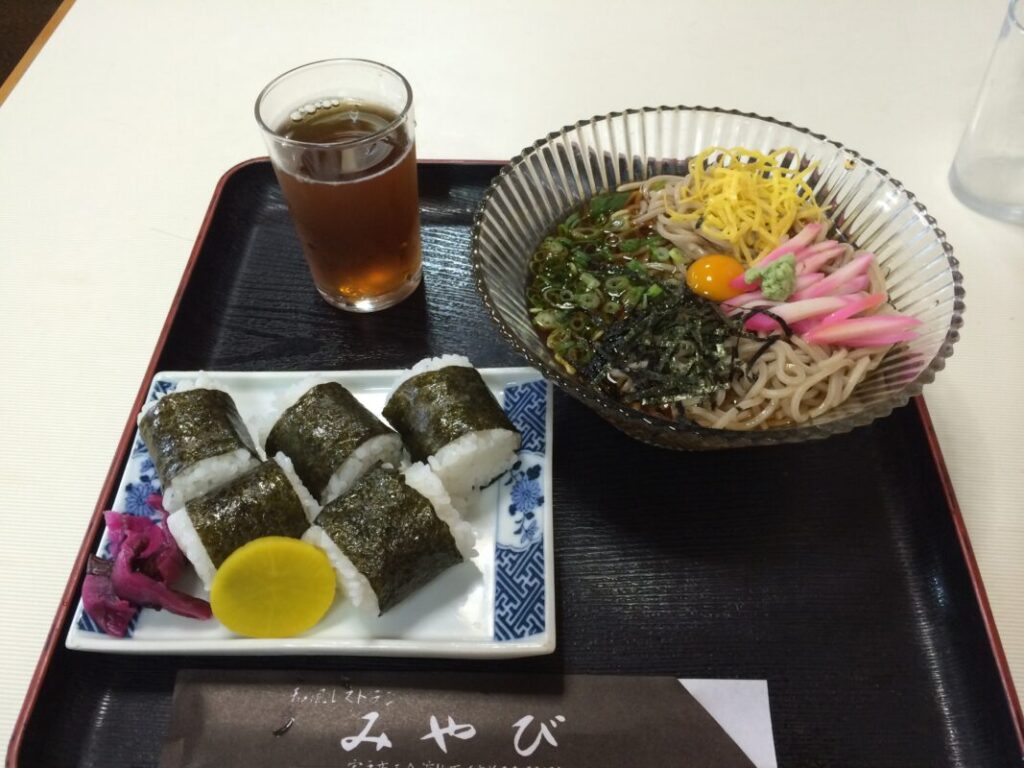
After finishing my visit to the temple, I started to feel a little hungry. I stopped at a restaurant near the temple for an early lunch.
I ordered chilled udon noodles and rice balls.
This marked the end of this section of my pilgrimage. On my first walking pilgrimage, I had made my way from Tokushima Prefecture into Kochi Prefecture and reached the temples around Muroto.
Returning to Tokushima by Bus and Train
For the return trip, I took a bus toward Kannoura, near the border between Kochi and Tokushima Prefectures. From there, I planned to transfer to a train and make my way back to Tokushima.
This time, I traveled by bus along the Muroto coastline that I had spent two days walking.
Perhaps because it had been about a week since I last used public transportation, the speed at which the scenery passed by felt a little strange.
While walking, the coastline seemed to change very little, making the destination feel far away. But from the bus, the same scenery rushed past in no time.
I suddenly wondered whether walking speed might actually be more natural, considering the long history of humankind.
And so, my first section of the Shikoku Pilgrimage came to a successful end. Next time, I would set off on foot again from Shinsho-ji.
Temple Information
- No. 24
- No. 25
Comments