
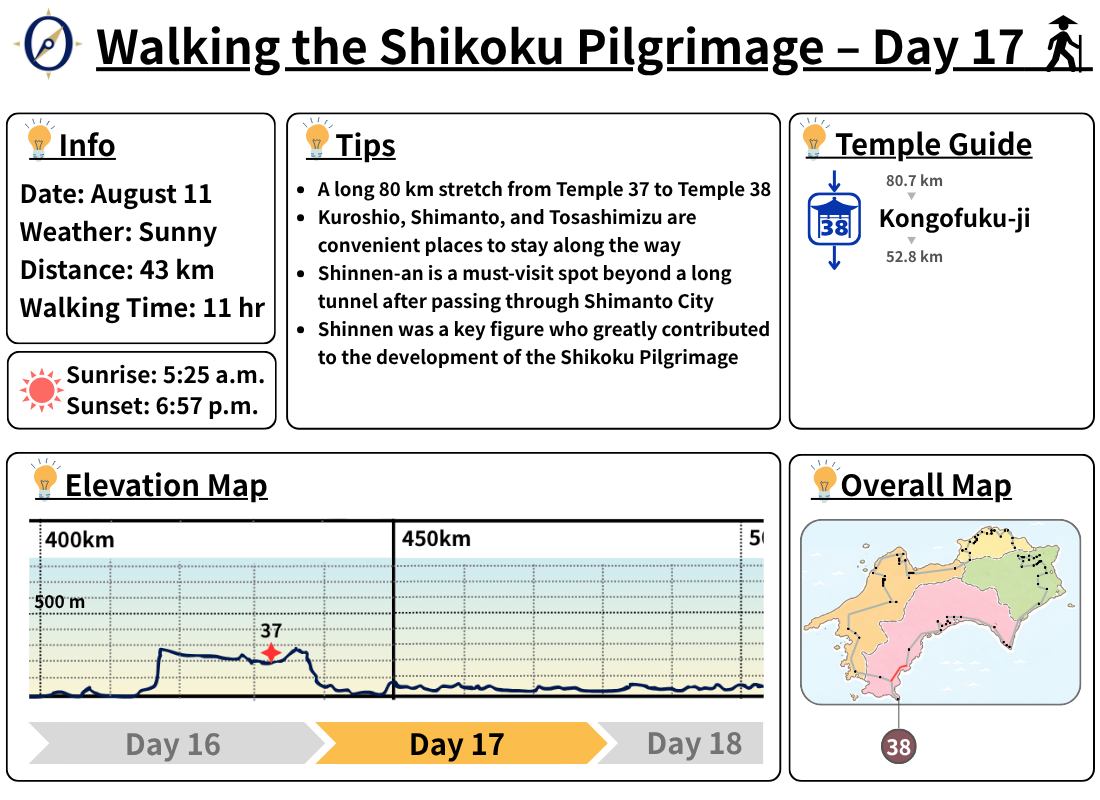
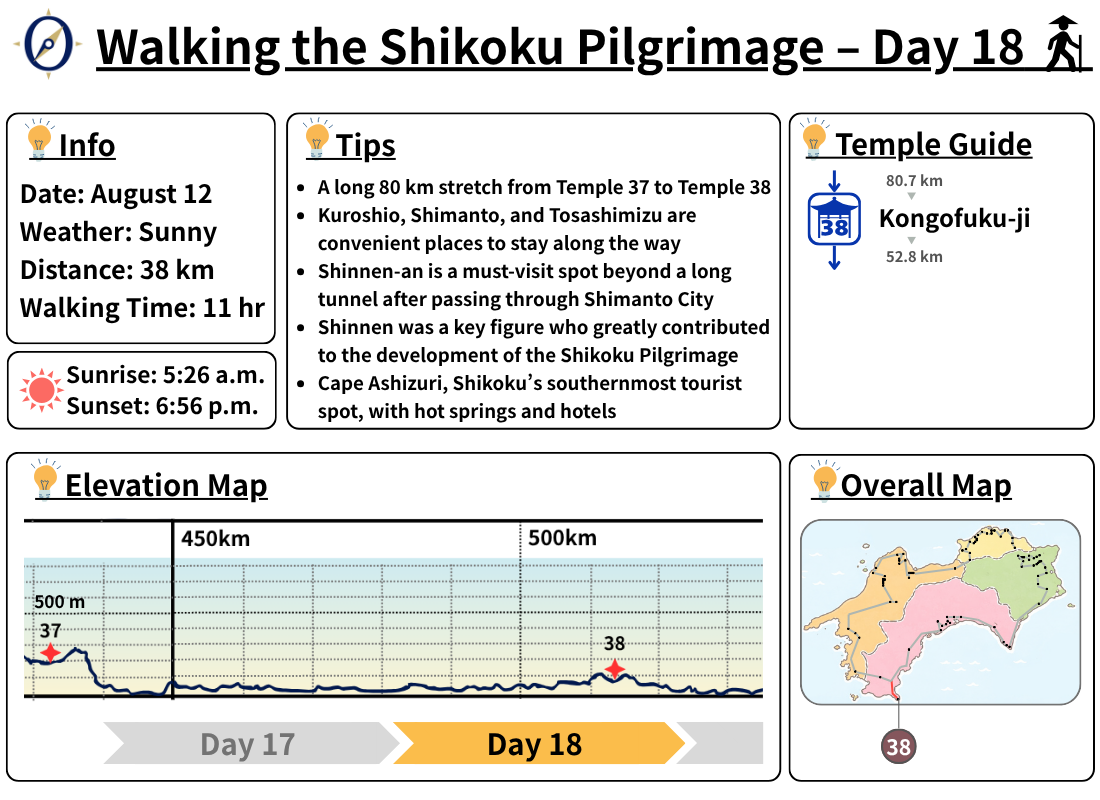
The section from Temple 37, Iwamoto-ji, to Temple 38, Kongofuku-ji, stretches for about 80 km, making it one of the longest sections of the Shikoku Pilgrimage.
On Day 17, I left Tosa Saga Onsen and followed the coastal road toward the Shimanto River. The intense summer heat and strong sunlight made the walk challenging, but I kept going. In the evening, I crossed the Shimanto Ohashi Bridge and reached Drive-in Suisha, where I spent the night outdoors after walking more than 40 km.
- Itinerary
- Preparing to Leave in the Morning
- From Temple 37 Iwamoto-ji to Temple 38 Kongofuku-ji
- From Tosa Saga to the Coast
- Taking a Break at Saga Park
- Battling the Heat
- From Okata to the Shimanto River
- Crossing the Shimanto Ohashi Bridge and Heading to Drive-in Suisha
- Walking Through the Shin-Izuta Tunnel
- Spending the Night Outdoors at Drive-in Suisha
- Temple Information
Itinerary
- 6:30Departure
- Tosa Saga Onsen
- Tosa Saga
- Kamikawaguchi
- Okata
- Shimanto Ohashi Bridge
- Shin-Izuta Tunnel
- 18:30Drive-in Suisha
Overnight stay
Preparing to Leave in the Morning
August 11, sunny. Although this was Day 17 of my overall pilgrimage, it was only the third day of this section hike. I felt that my body was gradually getting used to the demands of the Shikoku Pilgrimage.
The previous day, I had walked from Awa to Iwamoto-ji and then continued on to Tosa Saga Onsen, where I spent the night outdoors. The weather looked promising today, and it seemed like it would be a beautiful day following the typhoon. The temperature was also expected to rise considerably.
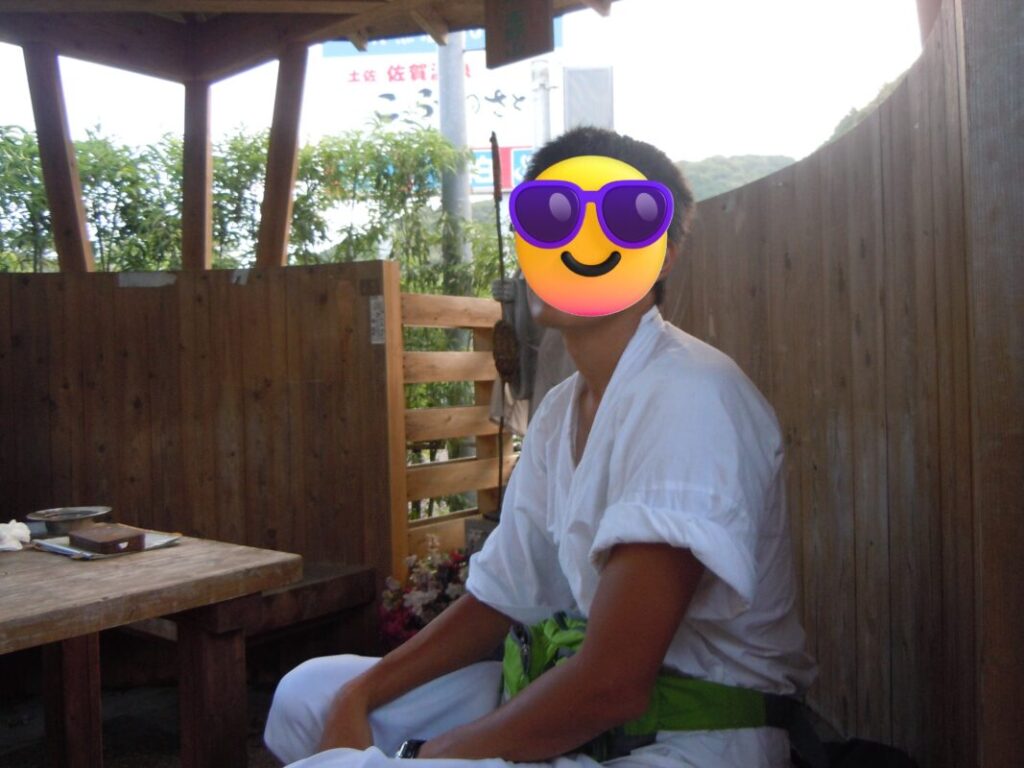
Early in the morning, as I was getting ready to leave, the young pilgrim I had met at the pilgrim hut the night before also woke up. We might cross paths again somewhere along the way. We wished each other a safe journey, and at 6:30 a.m., I left Tosa Saga Onsen.
From Temple 37 Iwamoto-ji to Temple 38 Kongofuku-ji
The distance from Temple 37, Iwamoto-ji, to Temple 38, Kongofuku-ji, is approximately 80 km, making it an exceptionally long stretch. It is even longer than the route to Temple 24, Hotsumisaki-ji, and is the longest section among the 88 temples.
To make matters more challenging, Temple 38, Kongofuku-ji, is located at Cape Ashizuri, the southernmost point of Shikoku. Even by car, it takes considerable time to reach, so getting there on foot requires a fair amount of determination.
I am once again struck by a sense of awe and respect when I think about how Kobo Daishi traveled all the way to such a remote and rugged place for his ascetic training.
That said, for pilgrims who have walked all the way from Tokushima, this section should still be manageable as long as nothing unexpected happens.
For today, my goal was simply to cover as much distance as possible. Rather than deciding on a place to stay in advance, I would keep walking and decide where to spend the night based on how things went.
From Tosa Saga to the Coast
After leaving Tosa Saga Onsen, the road continued through the mountains for a while.
In the early morning, the national highway along the Iyoki River was a scenic route surrounded by lush greenery. However, the humidity was high, and I soon began to sweat despite having only just started walking.
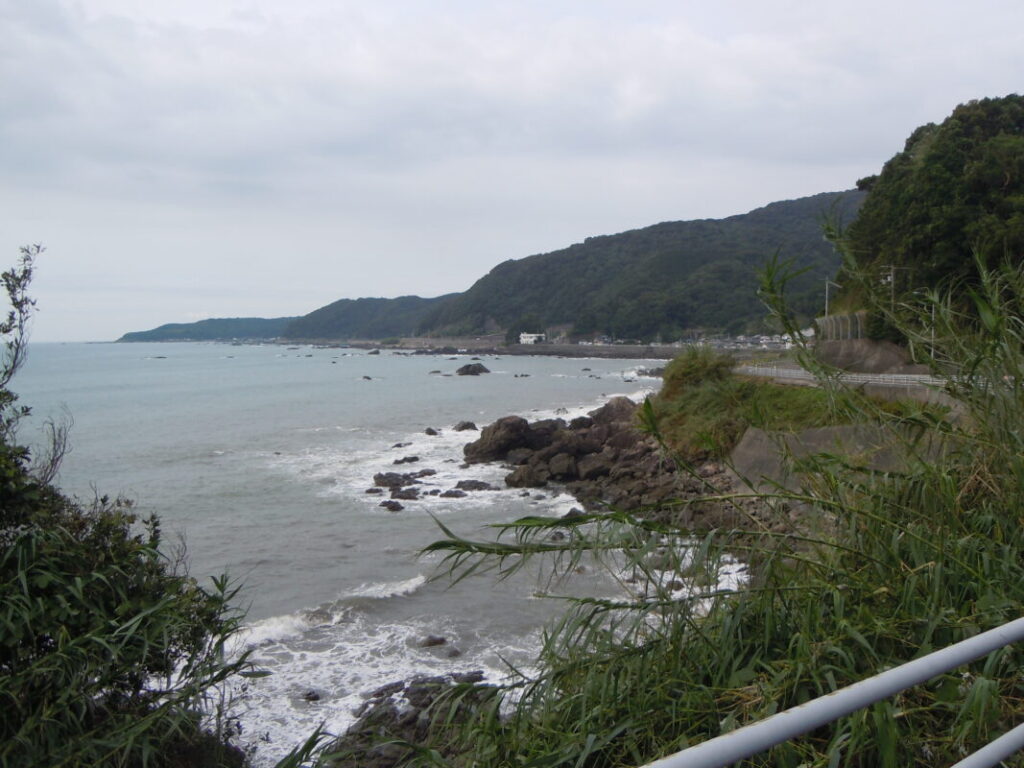
After about two hours, the scenery gradually changed from mountains to the coast.
Across the water, I could see Kashima Island, covered in a rounded mass of trees. Given the island’s name, I wondered if it was home to a lot of deer. Thinking about this, I continued along the coastal road.
Taking a Break at Saga Park
After walking along the coastal national highway for a while, I passed through Saga Park.
The spacious park is located right by the sea, with restrooms and an open grassy area. If the weather is good, it looked like it could also be a suitable place to pitch a tent and spend the night.
9:30 a.m. — Break at Shirahama Rest Area
There were several places around here where I could take a break while enjoying views of the sea, which was a welcome convenience for a walking pilgrim. With the temperature and humidity both high, heat was beginning to build up between my back and backpack.
I regularly took off my backpack to cool down, and I also removed my socks and massaged my feet to keep them from overheating.
During a summer pilgrimage, I realized that it is not just about covering the distance. It is also important to find ways to prevent your body temperature from rising too much.
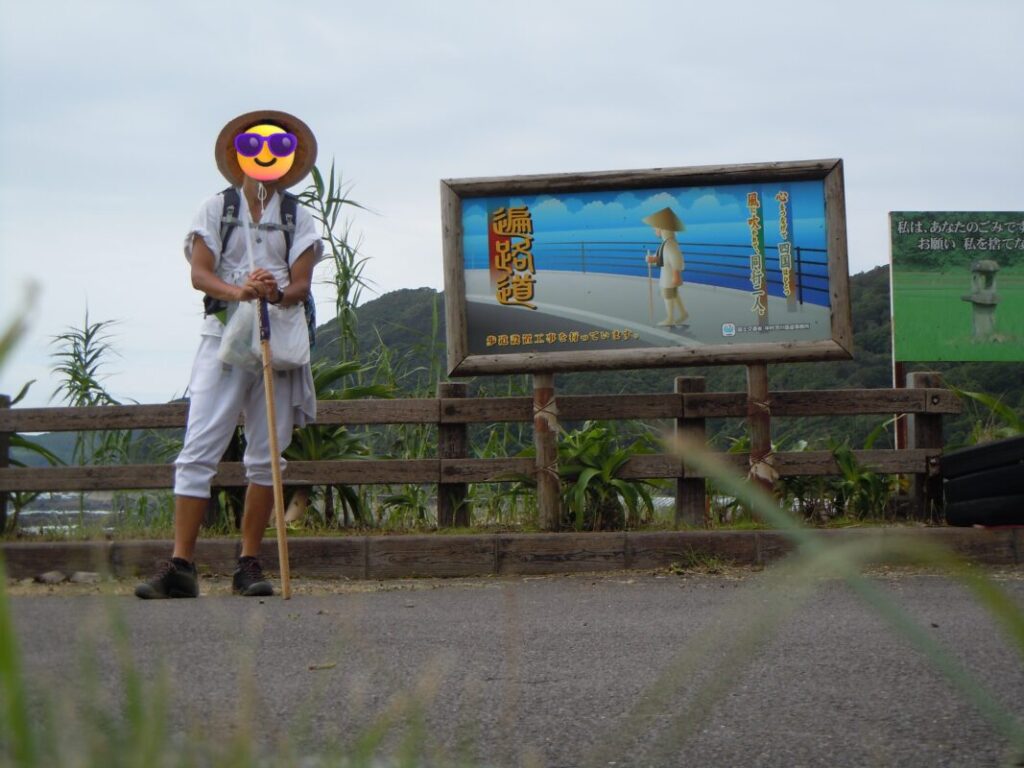
Battling the Heat
By 11 a.m., the temperature had risen even further. The sunlight was so intense that it almost felt painful on my skin.
For lunch, I bought a rice ball and a sandwich at a convenience store I found along the way and ate them while walking.
Convenience stores are truly a lifesaver in the middle of summer. The moment I stepped inside, it felt like entering a completely different, wonderfully cool world.
Taking a Break at a Park in Kamikawaguchi
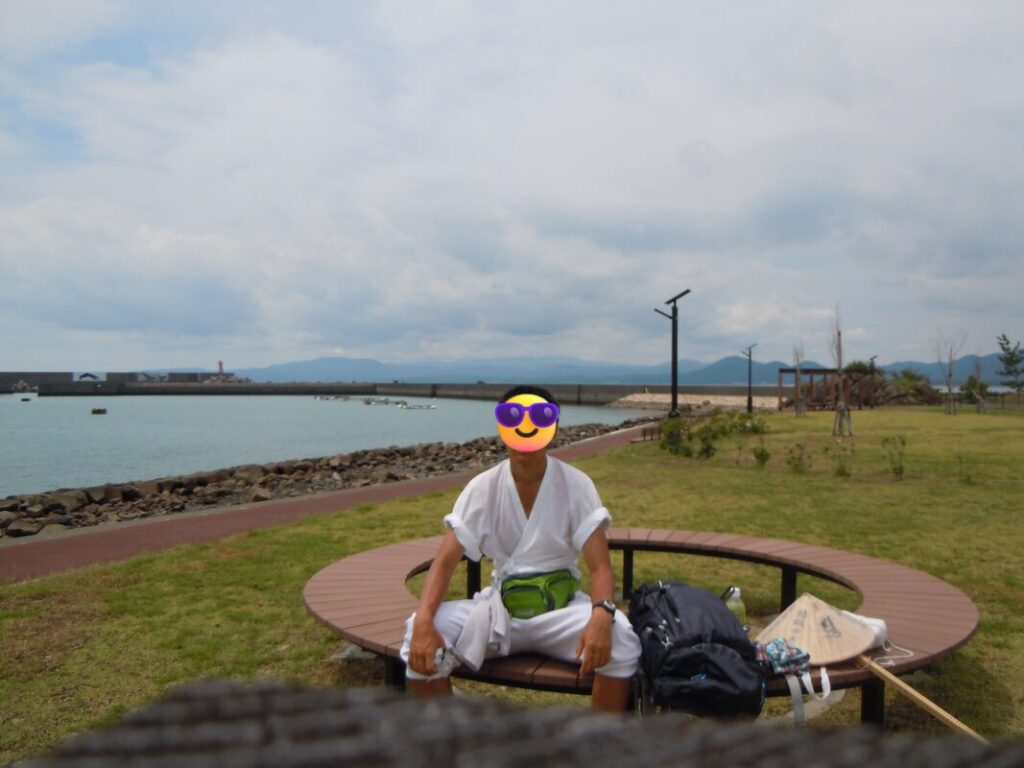
In Kamikawaguchi, I found a seaside park and stopped for some water and a bathroom break.
I poured tap water over my head and rinsed the sweat-soaked white pilgrimage clothes. When I put them back on while they were still soaked with cold water, I could feel my overheated body temperature dropping rapidly.
From Okata to the Shimanto River
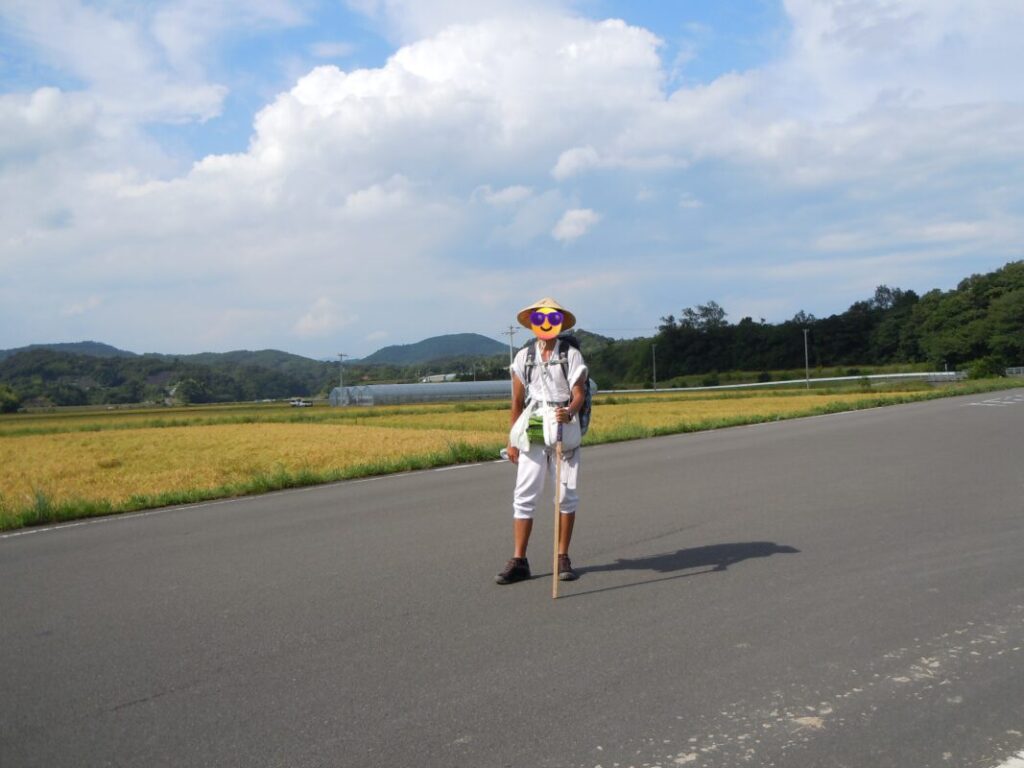
At Okata, about 32 km from Iwamoto-ji, it is recommended to leave the national highway and follow the pilgrimage trail along the coast.
The pine forest, which also serves as a windbreak, provided good ventilation and shade from the intense sunlight. In addition, choosing the dirt path alongside the road helped reduce the strain on my feet compared with walking on asphalt.
Whenever I came across a water faucet, I poured water over my head to cool down.
When walking the pilgrimage in summer, keeping your body temperature down is essential.
After Okata, there are two routes to choose from on the map
One route follows National Route 56 toward Nakamura, the center of Shimanto City. Although it is somewhat longer, Nakamura has plenty of accommodation and restaurants, making it a convenient place to rest a tired body.
The other route follows the prefectural road farther south. This route allows you to cross the Shimanto River by the shortest distance, but there are fewer options for accommodation and places to eat.
Which route you choose depends on your stamina and walking style.
I wanted to make as much progress as possible, so I chose the shorter prefectural road route.
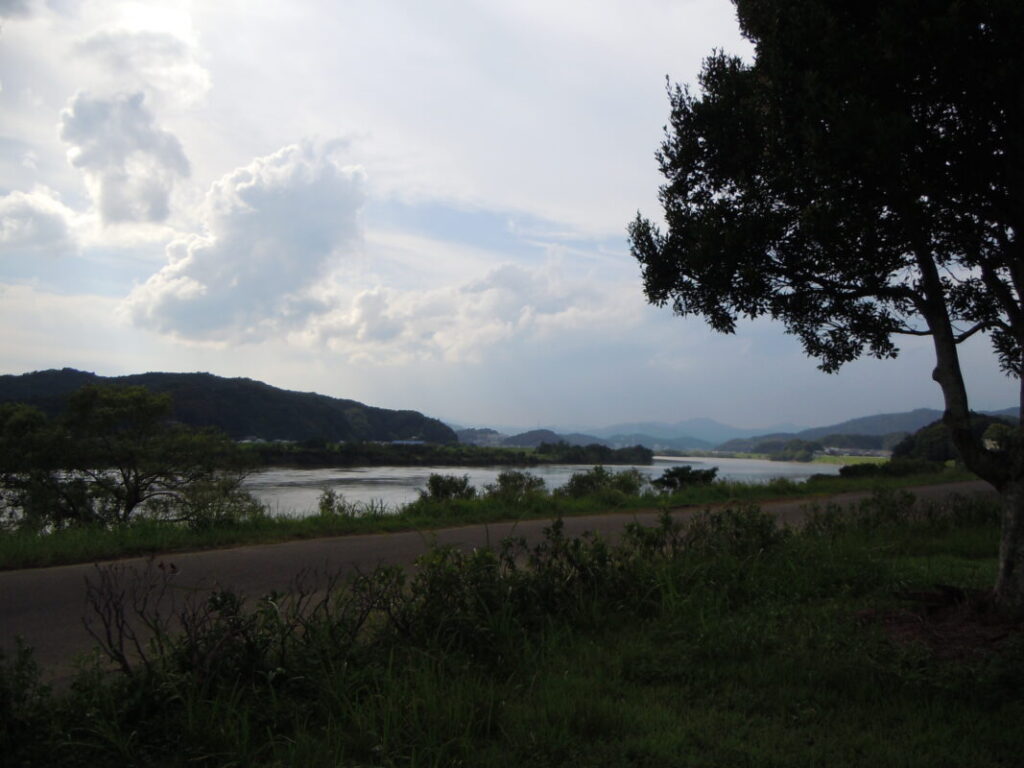
Just before 4 p.m., I finally reached the Shimanto River
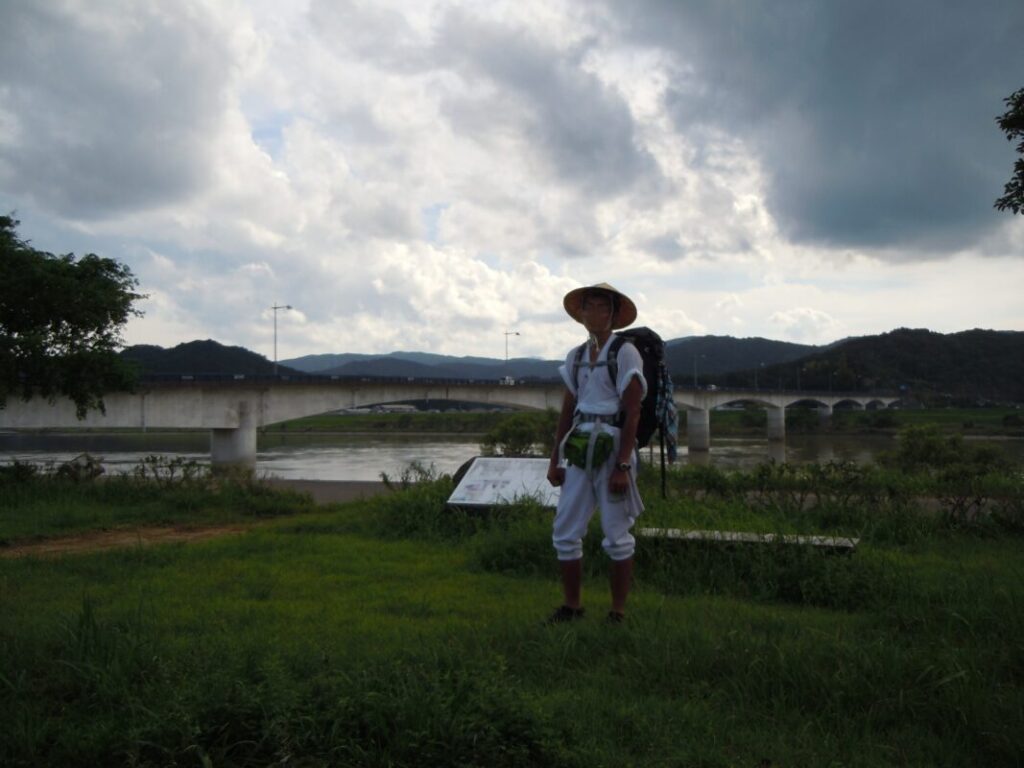
The Shimanto River is one of the most famous clear-flowing rivers in Shikoku. I sat down on the grassy riverbank and took a short break while admiring the vast natural surroundings.
The bridge in front of me was the Shimanto Ohashi Bridge.
Perhaps because of the recent typhoon, the river appeared to be running considerably higher than usual. Fortunately, there were no signs of flooding, which was a relief.
I had walked about 30 km so far today, and I was understandably quite tired.
It was time to decide where to spend the night. As I spread out my map and looked for a suitable place, I noticed Drive-in Suisha, located just beyond Shimanto City.
That would be my destination.
It was about another 10 km to Drive-in Suisha. Since the sun would not set until around 7 p.m. in Kochi during summer, I still had some time.
I gathered what energy I had left and set off toward Drive-in Suisha for one final push.
Crossing the Shimanto Ohashi Bridge and Heading to Drive-in Suisha
The most convenient way to cross the Shimanto River is via the Shimanto Ohashi Bridge on the southern side.
There is also a convenience store near the bridge, making it easy to stock up on food and drinks.
As I reached the middle of the bridge, the view opened up completely. The magnificent Shimanto River stretched out before me, with the mountains of Kochi rising in the distance.
My body was exhausted after walking such a long distance, but the spectacular view made me feel a little lighter.
After crossing the Shimanto Ohashi Bridge, I continued along National Route 321.
National Route 321 continues all the way to Tosashimizu City, where Temple 38, Kongofuku-ji, is located. If you are worried about finding your way from here, you can essentially follow National Route 321 and you won’t get lost.
After walking about 2 km along the river beyond the bridge, the road gradually began to wind into the mountains.
And waiting ahead was the Shin-Izuta Tunnel.
Walking Through the Shin-Izuta Tunnel
The Shin-Izuta Tunnel is approximately 1,600 meters long. It is one of the long tunnels that leaves a particularly strong impression on those walking the Shikoku Pilgrimage.
For those who have walked the pilgrimage, simply hearing the words “long tunnel” may bring this tunnel to mind.
The sidewalk is reasonably wide, so walking through it itself is not particularly frightening.
However, there is a lot of traffic. Whenever a car passed close by, the resulting blast of wind was quite strong, so I had to hold my sugegasa firmly to keep it from being blown away.
After about 20 minutes of walking, I finally made it through the tunnel.
Once outside, I was greeted by a landscape surrounded by tall mountains.
Perhaps because the area was enclosed by mountains, the sunlight had already disappeared completely. It was beginning to get dark.
“How much farther is the rest area?”
Trying not to let my anxiety get the better of me, I continued walking.
Then, just after exiting the tunnel, I finally saw Drive-in Suisha ahead.
Spending the Night Outdoors at Drive-in Suisha
I arrived at 6:30 p.m.
Drive-in Suisha had a fairly large parking area, along with restrooms, a gazebo, and vending machines. It was a convenient place for people traveling by car to stop and take a break, but it also had facilities that were very helpful for pilgrims.
There was also a restaurant on the premises where I could get a light meal.
As its name suggests, a small stream flowed down from the mountains, and there was even a waterwheel beside it. It was a peaceful place where I could hear the gentle sound of flowing water.
Today, the stream has apparently been filled in, and the waterwheel that was once a symbol of the place has also been removed.
I found a gazebo on a slightly elevated grassy area.
I decided this would be my campsite for the night.
I quickly set up my tent and prepared my sleeping area.
After sweating all day, I washed myself briefly in the nearby stream. The water was remarkably clean and cold. As the cold water touched my overheated body, it felt as though all the accumulated heat was being washed away at once.
After 7 p.m., it was completely dark.
I looked up at the sky, and countless stars stretched out above me.
As I sat quietly beside my tent, reflecting on the day’s journey, I suddenly heard the sound of fireworks coming from beyond the mountains.
“Maybe there’s a fireworks festival somewhere in Shimanto.”
I gazed up at the night sky, wondering about the distant sounds.
I had walked more than 40 km today.
Tomorrow, I would have about 30 km to go to reach Temple 38, Kongofuku-ji. The challenging pilgrimage route was still far from over.
It had been a long day, but above all, I felt relieved that I had made it this far safely.
Temple Information
- No. 38
Comments