
Across the 88 temples on the Shikoku 88 Temple Pilgrimage, various Buddhist deities are enshrined as the principal deity. Among them, Kokuzo Bosatsu has long been worshipped as a Buddhist figure associated with vast wisdom and virtue.
Kokuzo Bosatsu is known as a Buddhist figure who grants wisdom and strengthens memory. He is particularly closely associated with Kokuzo Gumonji-ho, a Buddhist practice that Kobo Daishi is said to have undertaken when he was young. For this reason, Kokuzo Bosatsu is also worshipped by people praying for success in their studies and improved memory.
On the Shikoku 88 Temple Pilgrimage, there are three temples where Kokuzo Bosatsu is enshrined as the principal deity: Temple No. 12, Shosan-ji; No. 21, Tairyu-ji; and No. 24, Hotsumisaki-ji. Tairyu-ji and Hotsumisaki-ji are also known as places where Kobo Daishi practiced Kokuzo Gumonji-ho.
In this article, we will explain in an easy-to-understand way who Kokuzo Bosatsu is, what he looks like, the benefits of worship, his connection with Kokuzo Gumonji-ho, his mantra, and the three temples on the Shikoku 88 Temple Pilgrimage where Kokuzo Bosatsu is enshrined as the principal deity.
What Is Kokuzo Bosatsu?
Kokuzo Bosatsu is a bodhisattva associated with vast wisdom and virtue and has long been worshipped as a Buddhist figure who supports people in their pursuit of knowledge and spiritual practice.
The word “kokuzo” can be understood as “space” or “vast emptiness,” while “zo” refers to a storehouse or treasury.
As the name suggests, Kokuzo Bosatsu is said to hold vast wisdom and virtue within himself, like the endless expanse of the sky.
He has long been worshipped as a Buddhist figure who grants wisdom and strengthens memory, while supporting people in their studies and Buddhist practice.
In Japan, faith in Kokuzo Bosatsu became particularly well known through Kokuzo Gumonji-ho, a Buddhist practice that Kobo Daishi Kukai is traditionally said to have undertaken.
What Does Kokuzo Bosatsu Look Like?
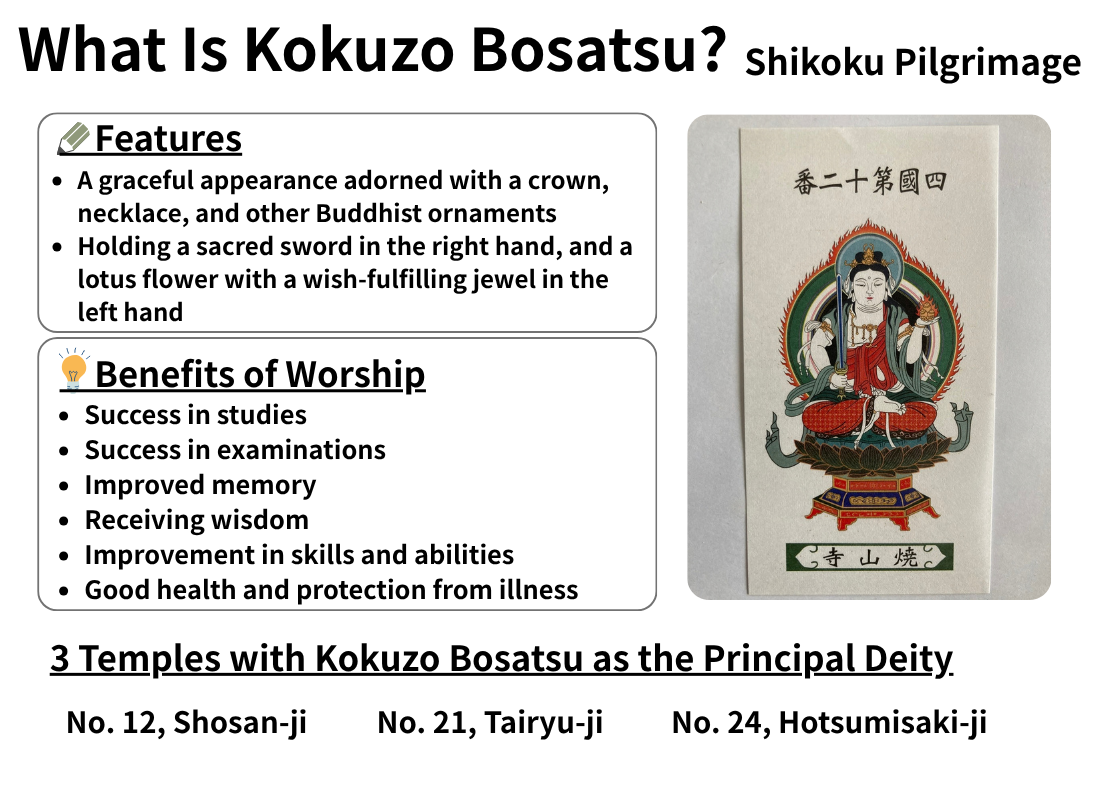
Kokuzo Bosatsu is generally depicted as an elegant bodhisattva wearing Buddhist ornaments such as a crown and necklace.
He is often shown holding a sacred sword in his right hand and a lotus flower with a wish-fulfilling jewel resting on it in his left hand.
The sacred sword symbolizes cutting through confusion and worldly desires with the power of wisdom, while the wish-fulfilling jewel represents the virtue of fulfilling people’s wishes.
However, the objects Kokuzo Bosatsu holds and his appearance can vary depending on the Buddhist statue.
Because Kokuzo Bosatsu is regarded as a Buddhist figure who symbolizes wisdom, he is also widely worshipped in connection with learning and memory.
Omie


Nobo Akyasha Kyarabaya On Arikya Maribori Sowaka
- Success in studies
- Success in examinations
- Improved memory
- Receiving wisdom
- Improvement in skills and abilities
- Good health and protection from illness
What Is Kokuzo Gumonji-ho?
One of the most important practices associated with Kokuzo Bosatsu is Kokuzo Gumonji-ho.
It is known as a Buddhist practice in which the mantra of Kokuzo Bosatsu is recited one million times.
Kobo Daishi is traditionally said to have practiced Kokuzo Gumonji-ho when he was young.
At Temple No. 21, Tairyu-ji, Kobo Daishi is said to have practiced Kokuzo Gumonji-ho for 100 days at Shashin-ga-take. According to the temple’s official tradition, this practice had a significant influence on the development of his thought and teachings.
Cape Muroto, where Temple No. 24, Hotsumisaki-ji, is located, is also known as a place where Kobo Daishi practiced Kokuzo Gumonji-ho. It is said that he described this practice in Sangoshiki, a work he wrote at the age of 24.
In this way, Kokuzo Bosatsu has a deep connection not only with Kobo Daishi’s Buddhist practice, but also with the history and traditions of the Shikoku Pilgrimage.
Benefits of Worshipping Kokuzo Bosatsu
Kokuzo Bosatsu has long been worshipped as a Buddhist figure who grants wisdom and strengthens memory.
Some of the traditional benefits associated with worshipping Kokuzo Bosatsu include:
- Success in studies
- Success in examinations
- Improved memory
- Receiving wisdom
- Improvement in skills and abilities
- Good health and protection from illness
In particular, the benefits associated with learning and memory are closely connected to the worship of Kokuzo Bosatsu.
At the Okunoin of Temple No. 73, Shusshaka-ji, Kobo Daishi is said to have practiced Gumonji-ho by reciting the mantra of Kokuzo Bosatsu one million times. For this reason, the temple is traditionally believed to offer benefits for memory, academic success, and protection against forgetfulness.
What Does Kokuzo Bosatsu Save People From?
Kokuzo Bosatsu is worshipped as a Buddhist figure who grants wisdom and strengthens memory, helping people in their studies and Buddhist practice.
For this reason, Kokuzo Bosatsu is not only worshipped by people who want to gain knowledge or improve their skills for school or work, but also by those who are facing uncertainty or difficult decisions in life, seeking the wisdom to find their way forward.
Because Kokuzo Bosatsu is associated with wisdom as vast as the sky, he is also worshipped as a Buddhist figure who bestows boundless wisdom and virtue upon people.
Temples Where Kokuzo Bosatsu Is the Principal Deity on the Shikoku 88 Temple Pilgrimage
Among the 88 temples on the Shikoku 88 Temple Pilgrimage, there are three temples where Kokuzo Bosatsu is enshrined as the principal deity.
All three are located in Tokushima and Kochi Prefectures and have a deep connection with traditions about Kobo Daishi’s Buddhist practice.
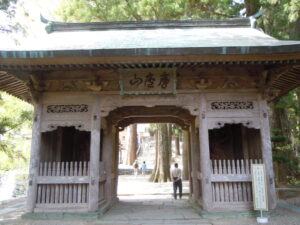
Temple No. 12, Shosan-ji
Shosan-ji is located near the eighth station of Mount Shosanji, which rises to 938 meters, making it one of the higher mountain temples on the Shikoku 88 Temple Pilgrimage.
According to temple tradition, a giant serpent with supernatural powers lived on this mountain and tormented local people by breathing fire.
When Kobo Daishi visited the area, he confronted the serpent and is said to have received the protection of Kokuzo Bosatsu and sealed the serpent inside a rocky cave.
Afterward, Kobo Daishi is said to have carved and enshrined a statue of Sanmen Daikokuten and prayed for the peace and well-being of the people and abundant harvests. The temple’s name, “Shosan-ji,” is also said to have originated from this legend.
Shosan-ji is also known for one of the steep and challenging sections of the pilgrimage route called the Henro Korogashi (“pilgrim tumbler”). For centuries, it has welcomed pilgrims as a sacred place of Buddhist practice.
Temple No. 21, Tairyu-ji
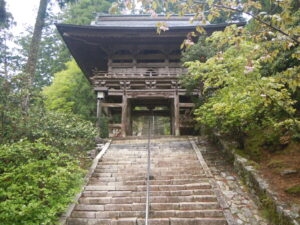
Tairyu-ji is a mountain temple located near the summit of Mount Tairyuji, which rises to 618 meters. It is also known as the “Koya of the West.”
When Kobo Daishi was 19 years old, he is said to have practiced Kokuzo Gumonji-ho for 100 days at Shashin-ga-take, a site near the temple.
According to temple tradition, Kobo Daishi carved a statue of Kokuzo Bosatsu himself and founded Tairyu-ji.
Today, visitors can take a ropeway to the temple grounds on the mountaintop.
From the temple grounds, a walking trail leads to Shashin-ga-take, where a statue of Kobo Daishi commemorating his Gumonji-ho practice stands. The site is known as an important place associated with Kobo Daishi’s Buddhist practice.
Temple No. 24, Hotsumisaki-ji
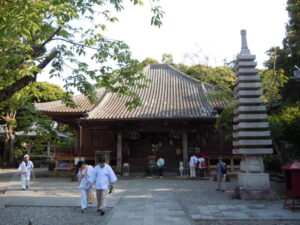
Located at the tip of Cape Muroto, Hotsumisaki-ji is the first sacred site in Tosa Province and a temple with a deep connection to Kobo Daishi’s Buddhist practice.
When Kobo Daishi was 19 years old, he is said to have practiced Kokuzo Gumonji-ho at Mikurodo Cave, located at Cape Muroto.
According to temple tradition, after returning from Tang China, Kobo Daishi visited this area again. Having completed his practice of Kokuzo Gumonji-ho here, he is said to have carved a statue of Kokuzo Bosatsu and built the main hall at the site.
Mikurodo Cave remains one of the major highlights of Cape Muroto and is known as the place where Kobo Daishi practiced when he was young.
Hotsumisaki-ji is a temple where visitors can experience both the magnificent natural scenery of Cape Muroto and the history of Kobo Daishi’s Buddhist practice.
Three Temples Where Kokuzo Bosatsu Is the Principal Deity
On the Shikoku 88 Temple Pilgrimage, there are three temples where Kokuzo Bosatsu is enshrined as the principal deity.
They are Temple No. 12, Shosan-ji; No. 21, Tairyu-ji; and No. 24, Hotsumisaki-ji.
All three temples have a deep connection with Kobo Daishi and Kokuzo Bosatsu. In particular, Tairyu-ji and Hotsumisaki-ji are known as places where Kobo Daishi practiced Kokuzo Gumonji-ho.
Although all three temples enshrine Kokuzo Bosatsu as their principal deity, each has its own distinctive history and highlights, including the legend of the great serpent at Shosan-ji, Shashin-ga-take at Tairyu-ji, and Mikurodo Cave at Hotsumisaki-ji.
When visiting these temples as part of the Shikoku Pilgrimage, paying attention not only to the principal deity but also to the history of Kobo Daishi’s practices associated with Kokuzo Bosatsu can help you gain a deeper appreciation of the Shikoku 88 Temple Pilgrimage.
Comments