
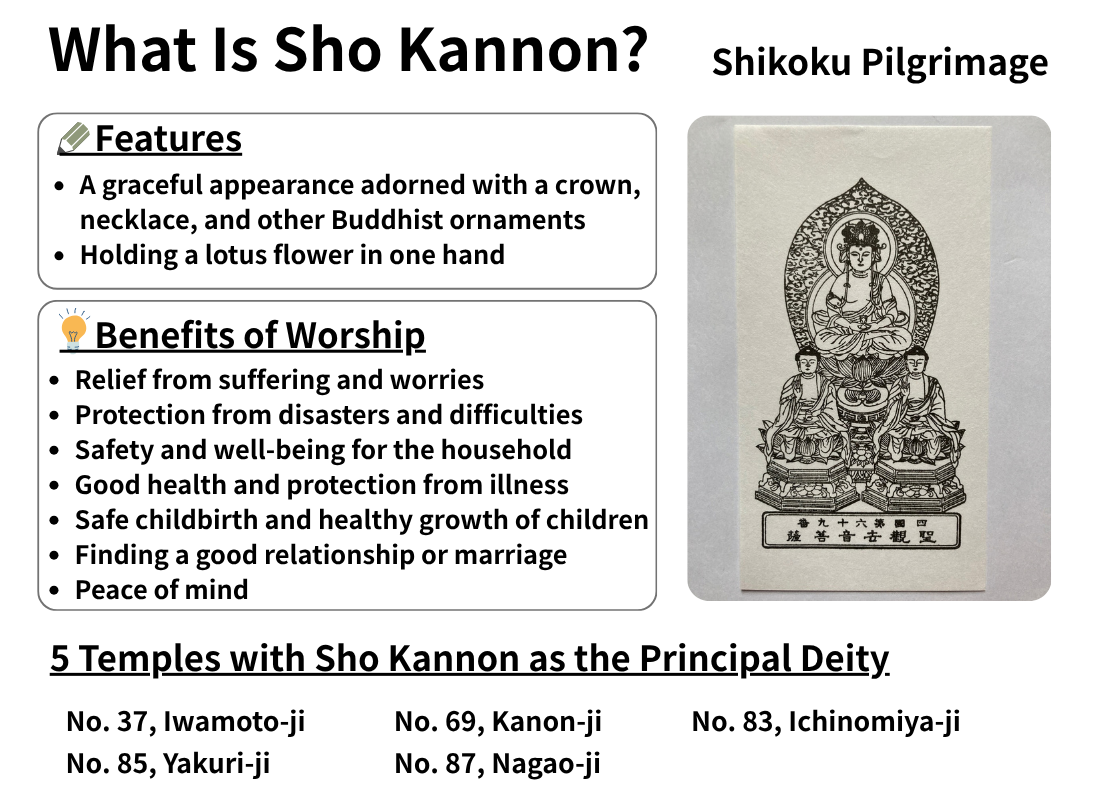
The 88 temples on the Shikoku 88 Temple Pilgrimage enshrine various Buddhist deities as their principal deities. Among them, Kannon Bosatsu has long been widely worshipped as a compassionate Buddhist figure who saves people from suffering.
Sho Kannon (Sho Kannon Bosatsu) is considered the fundamental form of Kannon among the many forms of Kannon Bosatsu. Sho Kannon is worshipped as a Buddhist figure who listens to the suffering and concerns of people and appears in different forms to save them.
On the Shikoku 88 Temple Pilgrimage, Sho Kanzeon Bosatsu is enshrined as the principal deity at Temple No. 69, Kannon-ji; No. 83, Ichinomiya-ji; No. 85, Yakuri-ji; and No. 87, Nagao-ji. In addition, Kannon Bosatsu is enshrined as one of the five principal deities at Temple No. 37, Iwamoto-ji. Therefore, when counting temples where Sho Kannon is enshrined as the principal deity, including Iwamoto-ji, there are five temples.
In this article, we will explain in an easy-to-understand way what Sho Kannon is, what he looks like, his relationship with Kannon Bosatsu, what he is worshipped for, his mantra, and the five temples on the Shikoku 88 Temple Pilgrimage where Sho Kannon is enshrined as the principal deity.
What Is Sho Kannon?
Sho Kannon represents the fundamental form of Kannon Bosatsu.
Kannon Bosatsu is formally known as Kanzeon Bosatsu or Kanjizai Bosatsu.
The name “Kannon” carries the meaning of perceiving the voices and suffering of people and offering them salvation.
In Buddhism, Kannon Bosatsu has long been worshipped as a compassionate Buddhist figure who hears the voices of people when they are suffering and reaches out to help them.
Kannon Bosatsu appears in many different forms, including Senju Kannon (Kannon with a Thousand Arms), Juichimen Kannon (Eleven-Faced Kannon), and Bato Kannon (Horse-Headed Kannon).
Among these various forms, Sho Kannon is the basic form of Kannon Bosatsu, without transforming into any of these distinctive forms.
What Does Sho Kannon Look Like?
Sho Kannon is generally depicted as a bodhisattva with a calm and gentle expression.
Unlike a Nyorai, Sho Kannon often wears ornaments such as a crown and necklace, giving the figure an elegant appearance.
Sho Kannon is also commonly depicted holding a lotus flower in one hand.
Because the lotus blooms beautifully from muddy water, it is regarded in Buddhism as a symbol of a pure heart and enlightenment.
Sho Kannon is often portrayed not as a powerful or imposing figure, but as a figure that conveys compassion and gentleness.
Omie

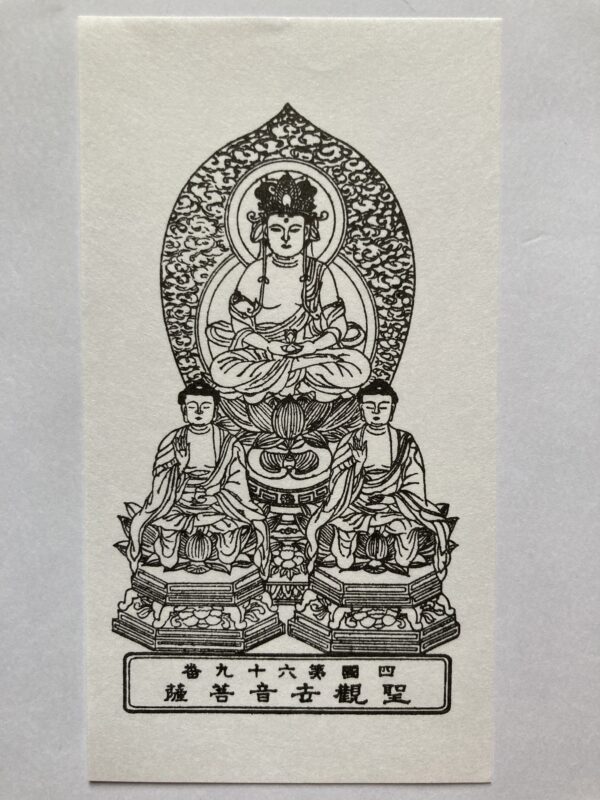


On Arorikya Sowaka
- Relief from suffering and worries
- Protection from disasters and difficulties
- Safety and well-being for the household
- Good health and protection from illness
- Safe childbirth and healthy growth of children
- Finding a good relationship or marriage
- Peace of mind
Sho Kannon and Kannon Bosatsu
Sho Kannon can sometimes refer to Kannon Bosatsu itself, while in other contexts, it is treated as one of the many forms of Kannon Bosatsu.
Kannon Bosatsu is believed to appear in various forms in order to save people from suffering.
For example, there is Senju Kannon, who has a thousand arms; Juichimen Kannon, who has eleven faces; and Bato Kannon, who has a horse’s head.
Although these forms have different appearances, they all represent the compassion of Kannon Bosatsu and his role in saving people who are suffering.
Among these various forms, Sho Kannon is regarded as the fundamental form of Kannon Bosatsu.
Benefits of Worshipping Sho Kannon
Sho Kannon is worshipped as a compassionate Buddhist figure who saves people from suffering and troubles.
Some of the commonly associated benefits include:
- Relief from suffering and worries
- Protection from disasters and difficulties
- Safety and well-being for the household
- Good health and protection from illness
- Safe childbirth and healthy growth of children
- Finding a good relationship or marriage
- Peace of mind
Rather than being a Buddhist figure who grants only specific wishes, Kannon Bosatsu is widely worshipped as a compassionate presence who stays close to people in all kinds of suffering and guides them toward salvation.
What Does Sho Kannon Save People From?
Sho Kannon is worshipped not as a Buddhist figure who saves only certain people, but as one who offers salvation to all people experiencing suffering or worries.
Kannon Bosatsu is believed to hear the voices of people and appear in a form suited to their needs in order to save them.
For this reason, Sho Kannon is thought to offer a wide range of relief—not only from specific forms of suffering such as illness and disasters, but also from uncertainty in life, anxiety, and emotional distress.
Temples Where Sho Kannon Is the Principal Deity on the Shikoku 88 Temple Pilgrimage
Among the 88 temples on the Shikoku 88 Temple Pilgrimage, there are five temples where Sho Kannon is enshrined as the principal deity.
Temple No. 37 Iwamoto-ji
Temple No. 37, Iwamoto-ji, is one of the more distinctive temples on the Shikoku 88 Temple Pilgrimage.
Iwamoto-ji enshrines five Buddhist figures as its principal deities: Fudo Myoo, Kannon Bosatsu, Amida Nyorai, Yakushi Nyorai, and Jizo Bosatsu.
Among these five, Kannon Bosatsu corresponds to Sho Kannon.
According to temple tradition, when Kobo Daishi visited Iwamoto-ji, he divided the sacred object of Niida Myojin among five shrines and enshrined Fudo Myoo, Kannon Bosatsu, Amida Nyorai, Yakushi Nyorai, and Jizo Bosatsu as their respective Buddhist manifestations.
Today, all five of these Buddhist figures are enshrined together at Iwamoto-ji as the temple’s principal deities.
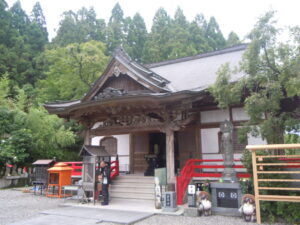
Temple No. 69 Kannon-ji
According to temple tradition, when Kobo Daishi visited this area, he enshrined Amida Nyorai as the Buddhist manifestation of Kotohiki Hachimangu and also carved a statue of Sho Kanzeon Bosatsu, which he enshrined in the central hall.
It is said that the temple was later renamed Shippozan Kannon-ji after Kobo Daishi performed a ground-purification ritual by burying the Seven Treasures beneath the site.
Kannon-ji shares the same temple grounds with Temple No. 68, Jinne-in. It is well known as a unique pilgrimage site where two of the 88 temples are located within the same grounds.
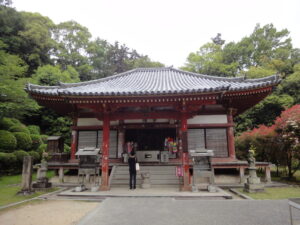
Temple No. 83, Ichinomiya-ji
According to temple tradition, when Kobo Daishi visited this area, he carved a Sho Kannon statue about 106 cm tall with his own hands and restored the temple buildings.
It is said that Ichinomiya-ji converted to the Shingon school of Buddhism at this time, marking the beginning of the temple’s history as it continues today.
Ichinomiya-ji also has a small shrine known as the “Hell’s Cauldron,” which is one of the highlights for visitors to the temple.
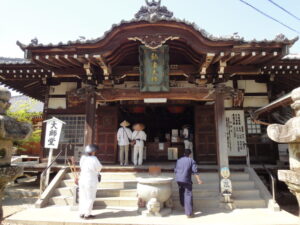
Temple No. 85, Yakuri-ji
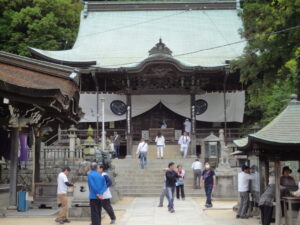
Yakuri-ji is a temple on the mountainside of Mount Gokenzan. According to temple tradition, its history began when Kobo Daishi climbed Mount Gokenzan.
Later, during the Edo period, the main hall was rebuilt by Matsudaira Yorishige, lord of the Takamatsu Domain. It is said that he enshrined Sho Kanjizai Bosatsu, traditionally attributed to Kobo Daishi, as the temple’s principal deity.
Yakuri-ji is a temple where visitors can experience the atmosphere of a sacred mountain site while taking in the scenery of Mount Gokenzan.
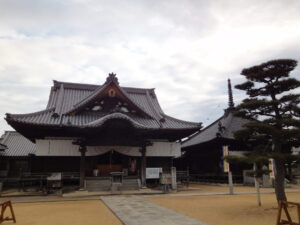
Temple No. 87, Nagao-ji
According to temple tradition, when Gyoki Bosatsu visited this area, he had a spiritual dream involving a willow tree. He used the tree to carve a statue of Sho Kannon Bosatsu, which he enshrined as the temple’s principal deity. This is said to mark the beginning of Nagao-ji.
Later, Kobo Daishi also visited Nagao-ji and is said to have prayed for a successful journey to Tang China.
Nagao-ji is affectionately known by local people as “Kannon-san of Nagao.” In addition to the main hall, the temple grounds also contain historic sites associated with Shizuka Gozen.
Five Temples Where Sho Kannon Is the Principal Deity
On the Shikoku 88 Temple Pilgrimage, there are five temples where Sho Kannon is enshrined as the principal deity.
They are Temple No. 37, Iwamoto-ji; No. 69, Kannon-ji; No. 83, Ichinomiya-ji; No. 85, Yakuri-ji; and No. 87, Nagao-ji.
Among these, Iwamoto-ji is slightly different from the other four, as Kannon Bosatsu is enshrined as one of its five principal deities.
At Temple No. 69, Kannon-ji; No. 83, Ichinomiya-ji; No. 85, Yakuri-ji; and No. 87, Nagao-ji, the principal deity is enshrined under names such as Sho Kanzeon Bosatsu and Sho Kanjizai Bosatsu.
Although these temples all enshrine Sho Kannon as their principal deity, each has its own unique history and legends. When visiting them on the Shikoku Pilgrimage, paying attention not only to the principal deity but also to the origins and highlights of each temple can make your pilgrimage experience even more meaningful.
Comments