
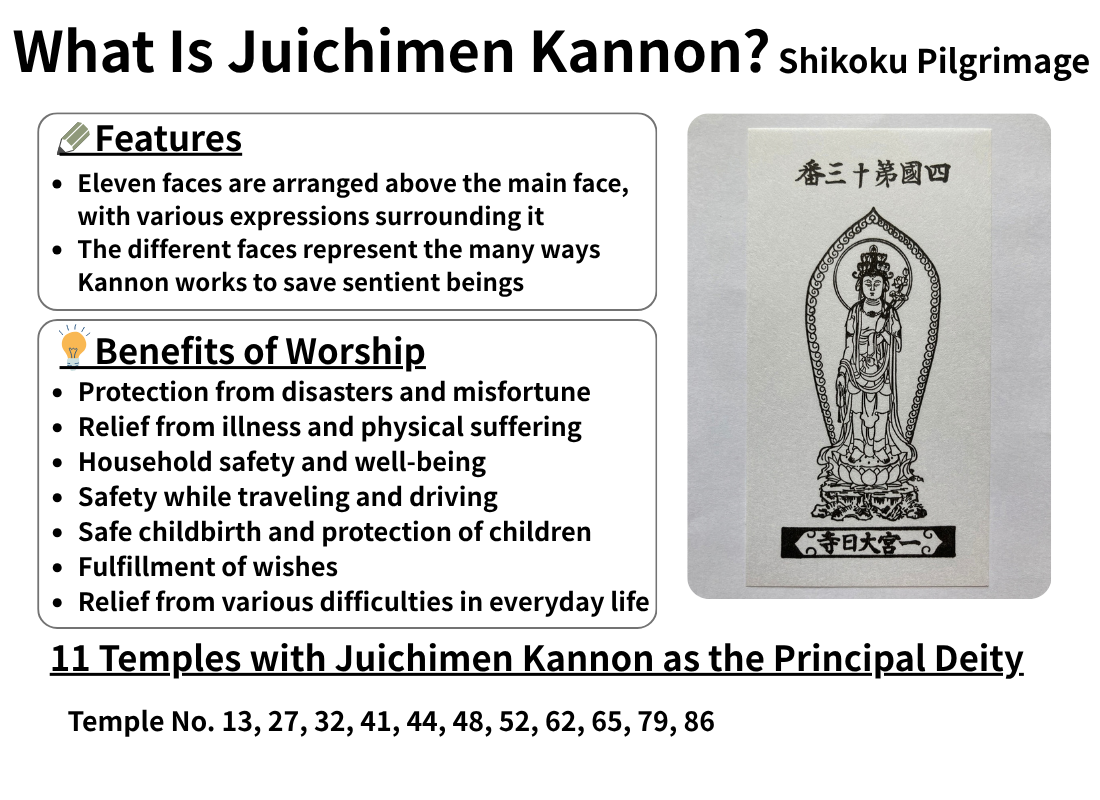
Across the 88 temples on the Shikoku 88 Temple Pilgrimage, various Buddhist deities are enshrined as the principal deity. Among them, Juichimen Kannon (Eleven-Faced Kannon) is one of the forms that Kannon Bosatsu takes to save sentient beings. One of its most distinctive features is the eleven faces arranged above the main face.
Juichimen Kannon has long been worshipped as a Buddhist figure who looks in different directions, ensuring that no suffering or prayer goes unnoticed and reaching out to save people. Each of the eleven faces has its own expression and meaning, representing the many ways Kannon Bosatsu works to save people from different kinds of suffering and guide them toward enlightenment.
On the Shikoku 88 Temple Pilgrimage, there are 11 temples where Juichimen Kannon is enshrined as the principal deity: Temple No. 13, Dainichi-ji; No. 27, Konomine-ji; No. 32, Zenjibu-ji; No. 41, Ryuko-ji; No. 44, Daiho-ji; No. 48, Sairin-ji; No. 52, Taisan-ji; No. 62, Hoju-ji; No. 65, Sankaku-ji; No. 79, Tenno-ji; and No. 86, Shido-ji.
In this article, we will explain in an easy-to-understand way who Juichimen Kannon is, its distinctive features and the meaning of its eleven faces, its relationship with Kannon Bosatsu, the benefits of worship, and the 11 temples on the Shikoku 88 Temple Pilgrimage where Juichimen Kannon is enshrined as the principal deity.
What Is Juichimen Kannon?
Juichimen Kannon (Eleven-Faced Kannon) is one of the many forms of Kannon Bosatsu.
Kannon Bosatsu is believed to hear the voices of people who are suffering and take on different forms to save them according to their needs. For this reason, Kannon appears in various forms, including Juichimen Kannon, Senju Kannon (Kannon with a Thousand Arms), and Bato Kannon (Horse-Headed Kannon).
The most distinctive feature of Juichimen Kannon is the eleven faces above the main face.
By having eleven faces looking in different directions rather than just one, Juichimen Kannon represents the compassion of Kannon Bosatsu, who watches over people in all directions, notices their suffering, and reaches out to save them.
What Does Juichimen Kannon Look Like?
Juichimen Kannon is generally depicted in the form of a bodhisattva. Above the main face are eleven additional faces, each with different expressions arranged around it.
In a typical depiction of Juichimen Kannon, the face at the front expresses compassion, while the faces on the left and right may have fierce expressions or show their fangs. At the back is a face with a great laughing expression, while the top of the head may feature a Buddha face.
Each expression has its own meaning. Together, they represent the many ways Kannon works to save sentient beings, including compassion, the sternness needed to admonish evil, and the joy of celebrating goodness.
The Buddha face at the top may depict Amida Nyorai as a manifestation of the Buddha. This reflects the deep connection between Juichimen Kannon and Amida Nyorai.
Omie
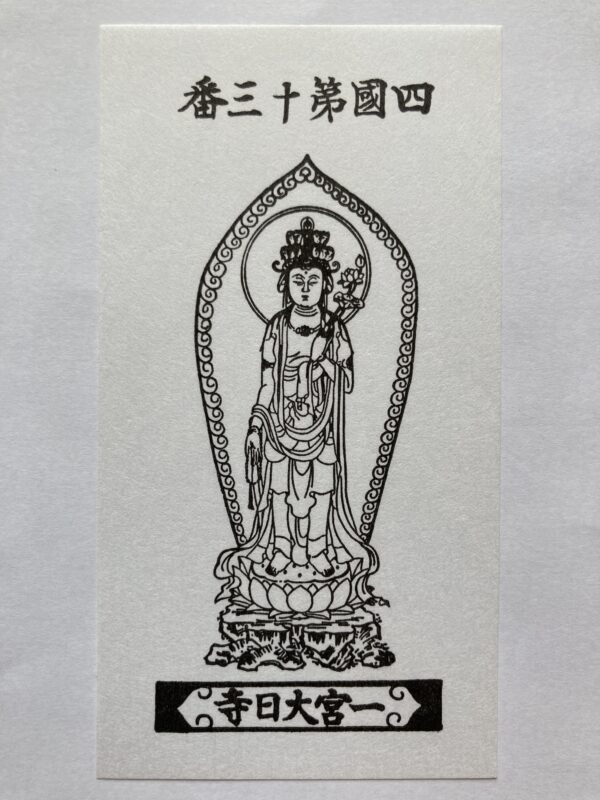


On Maka Kyaronikya Sowaka
- Protection from disasters and misfortune
- Relief from illness and physical suffering
- Household safety and well-being
- Safety while traveling and driving
- Safe childbirth and protection of children
- Fulfillment of wishes
- Relief from various difficulties in everyday life
What Do the Eleven Faces Mean?
The eleven faces of Juichimen Kannon do not simply represent eleven different facial expressions.
Each face symbolizes a different aspect of Kannon Bosatsu’s role in saving sentient beings.
The compassionate expressions represent the desire to save people who are suffering. In contrast, the fierce expressions represent the sternness needed to admonish wrongdoing and overcome worldly desires.
In this way, Juichimen Kannon is not simply a “gentle Buddhist figure.” When necessary, Kannon is also believed to guide people firmly toward the right path.
The image of Juichimen Kannon with eleven faces can therefore be understood as a representation of Kannon’s nature: responding to each person’s suffering and saving them according to their individual needs.
The Relationship Between Juichimen Kannon and Kannon Bosatsu
Kannon Bosatsu is believed to take on different forms according to the suffering and circumstances of each person.
Juichimen Kannon is one of these forms of Kannon Bosatsu.
On the Shikoku 88 Temple Pilgrimage, there are temples where various forms of Kannon are enshrined as the principal deity, including Juichimen Kannon, Senju Kannon (Kannon with a Thousand Arms), Sho Kannon, and Bato Kannon (Horse-Headed Kannon).
The different appearances of Kannon Bosatsu represent the various ways in which Kannon saves people according to their needs.
Among these forms, Juichimen Kannon can be easily understood as “Kannon who looks in many directions and saves people from many kinds of suffering.”
Benefits of Worshipping Juichimen Kannon
Juichimen Kannon has long been worshipped as a Buddhist figure who saves people from various kinds of suffering.
Some of the traditional benefits associated with worshipping Juichimen Kannon include:
- Protection from disasters and misfortune
- Relief from illness and physical suffering
- Household safety and well-being
- Safety while traveling and driving
- Safe childbirth and protection of children
- Fulfillment of wishes
- Relief from various difficulties in everyday life
Rather than being a Buddhist figure who grants only one particular type of wish, Juichimen Kannon has long been worshipped as a compassionate form of Kannon who watches over many kinds of suffering and reaches out to save people.
For this reason, people can entrust Juichimen Kannon with a wide range of prayers, such as when facing difficulties in life or wishing for the safety and well-being of their family.
Temples Where Juichimen Kannon Is the Principal Deity on the Shikoku 88 Temple Pilgrimage
On the Shikoku 88 Temple Pilgrimage, there are 11 temples where Juichimen Kannon is enshrined as the principal deity.
They are spread across the pilgrimage route from Tokushima Prefecture to Kagawa Prefecture, allowing pilgrims to encounter Juichimen Kannon at various points along the Shikoku Pilgrimage.
Temple No. 13, Dainichi-ji
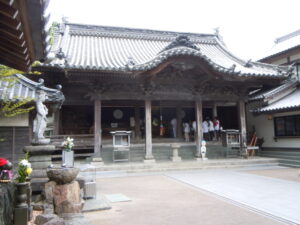
Located among the temples in Tokushima, known as the “Training Ground of Aspiration,” Dainichi-ji offers pilgrims an opportunity to connect with Juichimen Kannon early in their Shikoku Pilgrimage.
Although the temple’s name includes “Dainichi,” its current principal deity is Juichimen Kannon, not Dainichi Nyorai. The difference between the temple’s name and its principal deity is one of the distinctive features of this temple.
No. 27, Konomine-ji
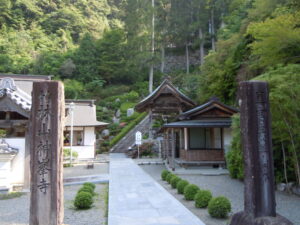
Temple No. 27, Konomine-ji, in Kochi Prefecture, is located deep in the mountains along the Tosa section of the pilgrimage route.
Its principal deity is Juichimen Kannon, and the temple has long been worshipped as a sacred site associated with Kannon.
Located in the mountains, Konomine-ji is also one of the temples where the experience of walking the pilgrimage route to reach the temple itself is an important part of the pilgrimage.
No. 32, Zenjibu-ji
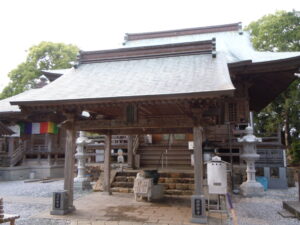
Located overlooking Tosa Bay, the temple has long been worshipped as a form of Kannon associated with safety at sea.
Because it stands on elevated ground with views across the ocean, it is also one of the temples on the Shikoku Pilgrimage where visitors can enjoy particularly memorable scenery.
No. 41, Ryuko-ji
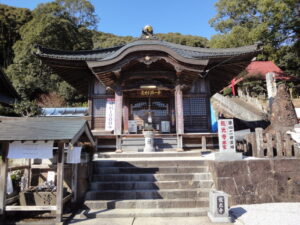
Located in the “Training Ground of Bodhi,” which begins at Temple No. 40, Kanjizai-ji, the first temple in Ehime Prefecture, Ryuko-ji sits in the mountainous area of the Uwa region.
As a sacred site dedicated to Kannon and enshrining Juichimen Kannon, it is one of the important temples on the Shikoku Pilgrimage.
No. 44, Daiho-ji
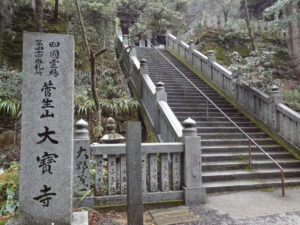
Daiho-ji is one of the important temples on the Shikoku Pilgrimage and is also known as a “middle temple” along the pilgrimage route. Because it is located at a high elevation, it has long been considered one of the more challenging sections for pilgrims.
Surrounded by the quiet mountain landscape, Daiho-ji offers pilgrims a peaceful place to worship Juichimen Kannon.
No. 48, Sairin-ji
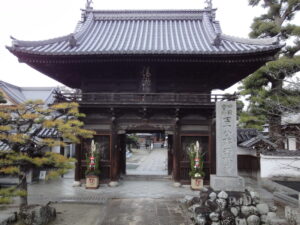
Although Sairin-ji is located relatively close to an urban area along the Shikoku Pilgrimage route, its grounds retain a long history as a sacred site dedicated to Kannon.
As a temple enshrining Juichimen Kannon, it is a place where pilgrims can worship during their journey through Matsuyama.
No. 52, Taisan-ji
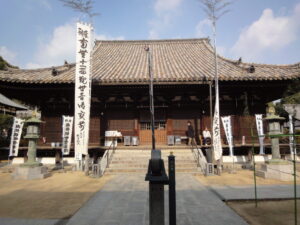
The principal deity of Taisan-ji is Juichimen Kannon. According to temple tradition, the temple’s origins are connected to a story in which Mano Choro encountered a violent storm at sea and prayed to Kannon for a safe voyage.
The current main hall is designated as a National Treasure of Japan, making Taisan-ji one of the temples on the Shikoku 88 Temple Pilgrimage with particularly high historical and cultural value.
No. 62, Hoju-ji
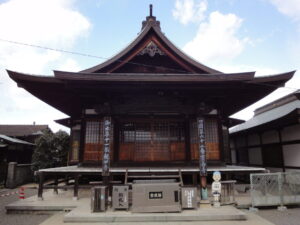
Hoju-ji is an old temple said to have been founded during the Nara period. According to temple tradition, a woman suffering from a difficult childbirth was able to give birth safely after drinking sacred water that Kobo Daishi had prayed over before the principal deity. The temple is therefore also worshipped as a place of Kannon associated with safe childbirth.
Because of its connection with the broad compassionate nature of Juichimen Kannon, Hoju-ji has long been visited by people praying for a safe delivery.
No. 65, Sankaku-ji
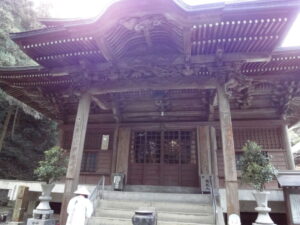
Sankaku-ji is located toward the end of the pilgrimage route through the former province of Iyo and is known as a mountain temple situated at a high elevation.
The quiet temple grounds in the mountains provide a peaceful setting for worshipping Juichimen Kannon, making Sankaku-ji one of the memorable temples on the Shikoku Pilgrimage.
No. 79, Tenno-ji
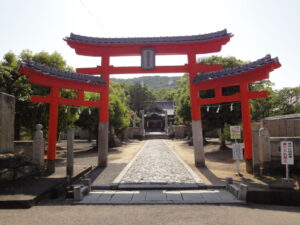
The temple’s official name is Kinkazan Kosho-in Tenno-ji. It is said to have been founded by Gyoki Bosatsu and later restored by Kobo Daishi.
The temple’s principal deity, Juichimen Kannon, has the characteristic features of an Eleven-Faced Kannon, including a manifestation of Amida Nyorai above the head. The Shikoku 88 Temple Association also identifies Juichimen Kannon as the temple’s principal deity.
No. 86, Shido-ji
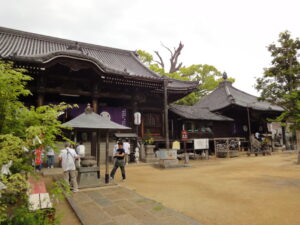
The principal deity of Shido-ji is a standing statue of Juichimen Kannon, carved from a single piece of Japanese cypress. The statue stands 146 cm tall and has eleven faces above its head. It is said to represent the virtue of saving sentient beings from eleven kinds of suffering and guiding them toward Buddhahood. The statue is also designated as an Important Cultural Property of Japan.
Shido-ji also preserves cultural properties connected with Kannon worship, including paintings depicting Juichimen Kannon. It is a particularly interesting temple on the Shikoku Pilgrimage for visitors who want to see a traditional depiction of Juichimen Kannon in person.
Conclusion
Juichimen Kannon is one of the forms that Kannon Bosatsu takes to save people suffering from various difficulties.
Its most distinctive feature is the eleven faces above its head. Each face represents a different aspect of Kannon’s work in saving sentient beings, including compassion and the sternness needed to guide people away from wrongdoing.
Even among temples that enshrine Juichimen Kannon, each has its own unique history, origin stories, cultural properties, and traditions of worship.
When visiting these temples on the Shikoku Pilgrimage, understanding the meaning behind Juichimen Kannon—looking in many directions and reaching out to save people from suffering—can help you feel a closer connection to the principal deity during your visit.
Comments