
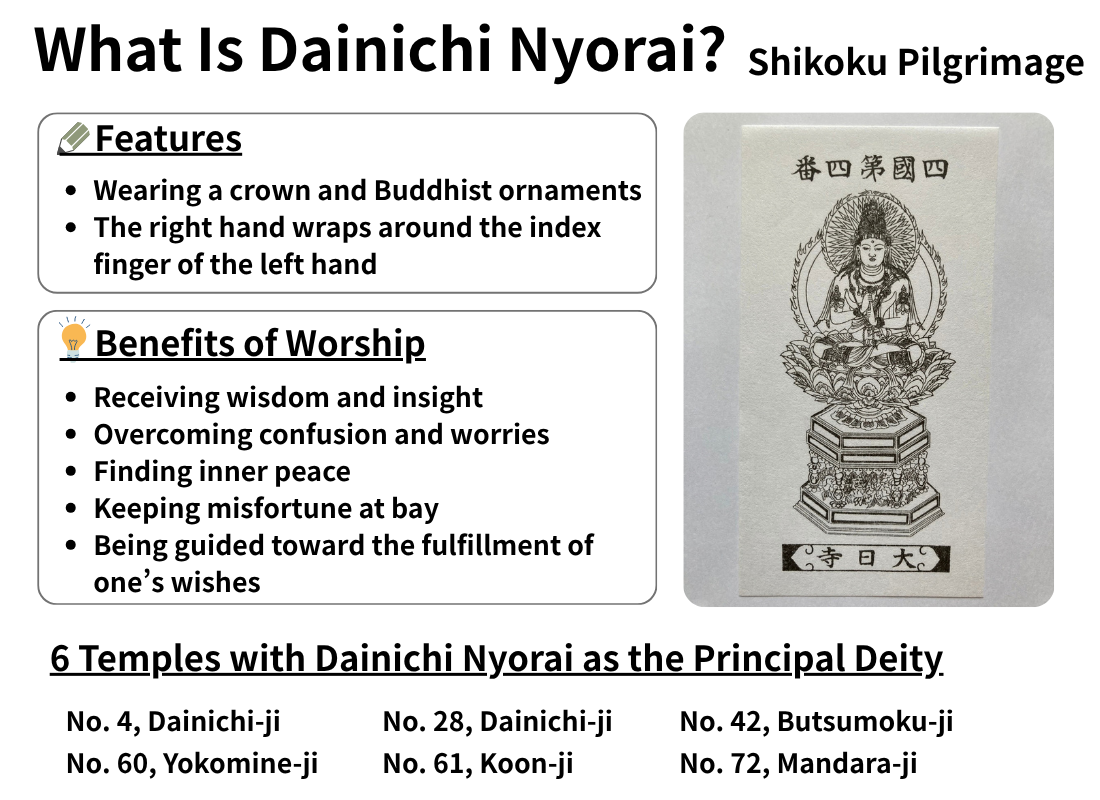
Among the many Buddhist deities enshrined as the principal deities at the temples of the Shikoku 88 Temple Pilgrimage, Dainichi Nyorai (Vairocana Buddha) is one of the most important figures in Esoteric Buddhism.
On the Shikoku 88 Temple Pilgrimage, Dainichi Nyorai is enshrined as the principal deity at six temples: Temple No. 4, Dainichi-ji; No. 28, Dainichi-ji; No. 42, Butsumoku-ji; No. 60, Yokomine-ji; No. 61, Koon-ji; and No. 72, Mandara-ji.
In this article, we will explain in an easy-to-understand way who Dainichi Nyorai is, what he looks like, what he is worshipped for, his mantra, and the six temples on the Shikoku 88 Temple Pilgrimage where Dainichi Nyorai is enshrined as the principal deity.
What Is Dainichi Nyorai?
Dainichi Nyorai (Vairocana Buddha) is a central figure in Esoteric Buddhism.
The name “Dainichi,” meaning “Great Sun,” expresses the idea that, just as the light of the sun illuminates the entire world, the wisdom and compassion of Dainichi Nyorai extend to all people.
In Buddhism, the term Nyorai generally refers to a Buddha who has attained enlightenment. In Esoteric Buddhism, Dainichi Nyorai is described as a being who is one with the universe itself.
In Shingon Esoteric Buddhism, Dainichi Nyorai is regarded as the fundamental Buddha from whom all other Buddhas arise.
For this reason, Dainichi Nyorai is understood not simply as an individual Buddha, but also as the source of the wisdom and compassion embodied by various Buddhas and Bodhisattvas.
What Does Dainichi Nyorai Look Like?
Statues of Dainichi Nyorai are depicted somewhat differently from typical statues of Nyorai.
Buddhas such as Shaka Nyorai and Amida Nyorai are often depicted wearing simple robes with little or no jewelry. Dainichi Nyorai, however, may be shown wearing a crown and various ornaments.
This is because Dainichi Nyorai is depicted as a special figure who can be thought of as the “King of the Buddhas.”
Dainichi Nyorai is also often depicted forming mudras unique to Esoteric Buddhism, such as the Chiken-in (Wisdom Fist Mudra). Chiken-in is a mudra in which the right hand wraps around the index finger of the left hand, and is one of the gestures most closely associated with Dainichi Nyorai.
Omie
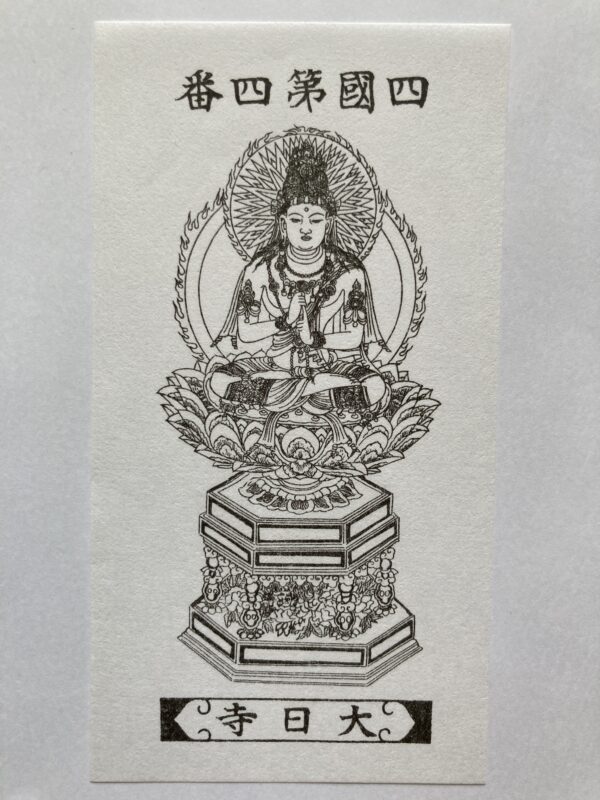
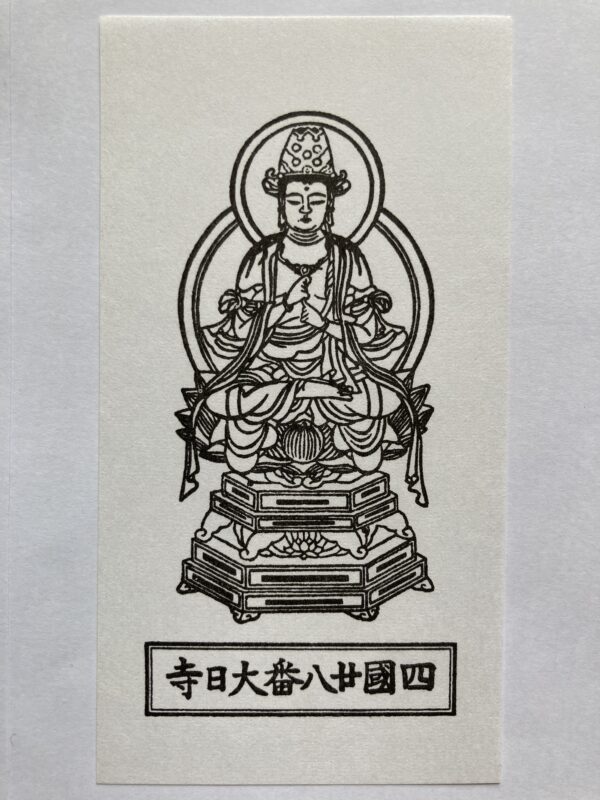


On Abiraunken Bazara Datoban
- Receiving wisdom and insight
- Overcoming confusion and worries
- Finding inner peace
- Keeping misfortune at bay
- Being guided toward the fulfillment of one’s wishes
The Relationship Between Dainichi Nyorai and Esoteric Buddhism
To understand Dainichi Nyorai, it is essential to understand Esoteric Buddhism.
In Esoteric Buddhism, the wisdom and compassion of the Buddha are not simply studied as teachings. Instead, practitioners emphasize putting them into practice through body, speech, and mind: sanmitsu, or the “three mysteries.”
Practices such as reciting mantras, forming mudras, and visualizing Buddhas are also connected to these teachings of Esoteric Buddhism.
Dainichi Nyorai is associated with two important aspects of the Esoteric Buddhist worldview.
Dainichi Nyorai of the Diamond Realm
The Diamond Realm (Kongokai) represents the wisdom of Dainichi Nyorai.
It symbolizes the wisdom that breaks through delusion and worldly desires and allows us to see the true nature of things.
Dainichi Nyorai of the Womb Realm
The Womb Realm (Taizokai) represents the compassion of Dainichi Nyorai.
It symbolizes great compassion that embraces and nurtures all things.
Together, the Diamond Realm and Womb Realm are known as the Two Realms Mandala (Ryo-kai Mandala), which depicts the Esoteric Buddhist universe with Dainichi Nyorai at its center.
Benefits of Worshipping Dainichi Nyorai
Dainichi Nyorai is regarded as a Buddha who symbolizes wisdom and compassion, and has therefore long been associated with various spiritual benefits.
Some of the most commonly sought benefits include:
- Receiving wisdom and insight
- Overcoming confusion and worries
- Finding inner peace
- Keeping misfortune at bay
- Being guided toward the fulfillment of one’s wishes
- Receiving the wisdom to follow the right path
In particular, people may turn to the wisdom of Dainichi Nyorai when they feel uncertain about a decision or want to reconsider the path they should take in life.
However, the benefits of worship are not simply about having one’s wishes granted.
Relying on the wisdom and compassion of Dainichi Nyorai, looking inward at one’s own mind, and moving forward in a better direction can also be understood as an important part of what it means to have faith in Dainichi Nyorai.
Temples Where Dainichi Nyorai Is the Principal Deity on the Shikoku 88 Temple Pilgrimage
Among the 88 temples on the Shikoku 88 Temple Pilgrimage, there are six temples where Dainichi Nyorai is enshrined as the principal deity.
Tokushima Prefecture
Temple No. 4 Dainichi-ji
Temple No. 4, Dainichi-ji, is aptly named after Dainichi Nyorai, who is enshrined as the temple’s principal deity.
According to temple tradition, in 815, Kobo Daishi encountered Dainichi Nyorai at this site and carved a statue of the Buddha. This is said to be the origin of the temple’s name.
Kochi Prefecture
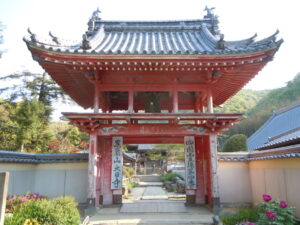
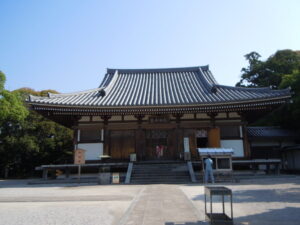
Temple No. 28 Dainichi-ji
Temple No. 28, Dainichi-ji, in Konan City, Kochi Prefecture, also enshrines Dainichi Nyorai as its principal deity.
The seated statue of Dainichi Nyorai is traditionally attributed to Gyoki Bosatsu. However, the actual statue is believed to have been made using the yosegi-zukuri technique during the late Heian period and is designated as an Important Cultural Property of Japan.
The statue is currently not open to the public. Instead, a maedachi statue of Dainichi Nyorai is enshrined in the main hall for worship.
Ehime Prefecture
Temple No. 42 Butsumoku-ji
Temple No. 42, Butsumoku-ji, is located in Uwajima City, Ehime Prefecture.
As one of the temples on the Shikoku 88 Temple Pilgrimage where Dainichi Nyorai is enshrined as the principal deity, it offers pilgrims an opportunity to experience the tradition of worshipping Dainichi Nyorai along their journey.
Temple No. 60 Yokomine-ji
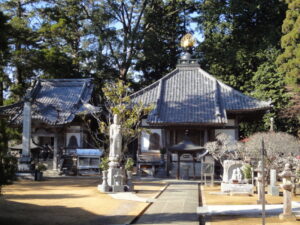
Temple No. 60, Yokomine-ji, is another temple on the Shikoku 88 Temple Pilgrimage where Dainichi Nyorai is enshrined as the principal deity.
Located at a high elevation, Yokomine-ji is one of the more distinctive temples on the Shikoku Pilgrimage.
Among the six temples where Dainichi Nyorai is enshrined as the principal deity, the visit to Yokomine-ji is likely to be especially memorable, as the temple is known as one of the more challenging sections of the Shikoku Pilgrimage.
Kagawa Prefecture
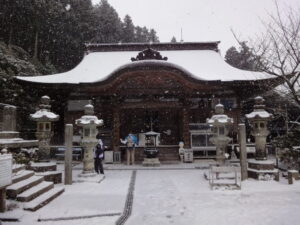
Temple No. 61 Koon-ji
Temple No. 61, Koon-ji, is located in Saijo City, Ehime Prefecture.
For pilgrims visiting the temples where Dainichi Nyorai is enshrined as the principal deity, the route continues from Temple No. 60, Yokomine-ji, to Temple No. 61, Koon-ji.
Temple No. 72 Mandara-ji
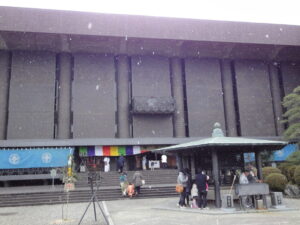
Temple No. 72, Mandara-ji, is located in Zentsuji City, Kagawa Prefecture.
The temple’s name, “Mandara-ji,” reflects its deep connection with Esoteric Buddhism.
Conclusion
Dainichi Nyorai is a central Buddha in Esoteric Buddhism and is worshipped as a being who illuminates all things through wisdom and compassion.
On the Shikoku 88 Temple Pilgrimage, six temples enshrine Dainichi Nyorai as their principal deity: Temple No. 4, Dainichi-ji; No. 28, Dainichi-ji; No. 42, Butsumoku-ji; No. 60, Yokomine-ji; No. 61, Koon-ji; and No. 72, Mandara-ji.
When visiting these temples on the Shikoku Pilgrimage, take some time to appreciate not only the appearance of Dainichi Nyorai as the principal deity, but also his connection with Esoteric Buddhism and his mantra.
Comments