
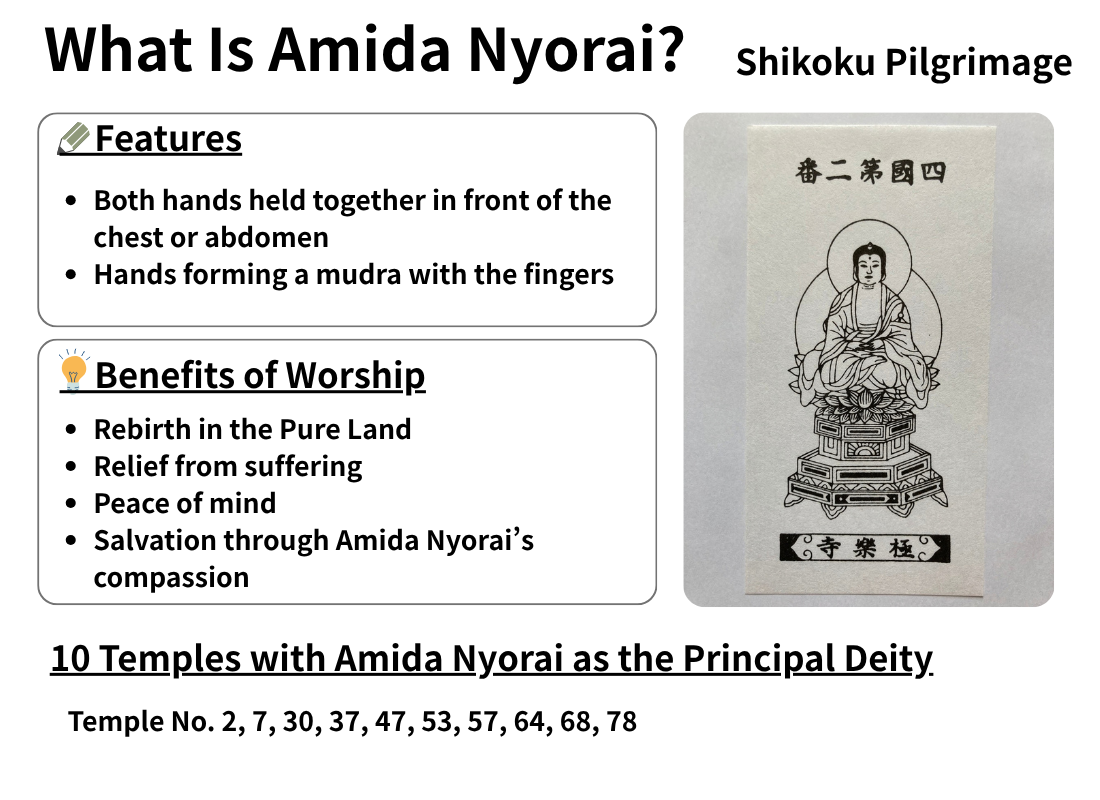
As you travel around the Shikoku 88 Temple Pilgrimage, you will notice that various Buddhist deities are enshrined as the principal deity at different temples.
Among them, one of the deities enshrined as the principal deity at many temples on the Shikoku Pilgrimage is Amida Nyorai (Amitabha Buddha).
Amida Nyorai is known as the Buddha of the Pure Land of Ultimate Bliss, said to be located far to the west. He has long been worshipped as a Buddha who saves people living in confusion and suffering and guides them to the Pure Land.
On the Shikoku 88 Temple Pilgrimage, there are 10 temples where Amida Nyorai is enshrined as the principal deity.
In this article, we will explore who Amida Nyorai is, his distinctive features and meaning, the benefits of worship, his mantra, and the temples on the Shikoku Pilgrimage where Amida Nyorai is enshrined as the principal deity.
What Is Amida Nyorai?
Amida Nyorai (Amitabha Buddha) is regarded as the Buddha who presides over the Pure Land of Ultimate Bliss in the west.
The name “Amida” is said to derive from the Sanskrit names Amitabha and Amitayus, meaning “Infinite Light” and “Infinite Life.”
For this reason, Amida Nyorai is also known as:
- Buddha of Infinite Light
- Buddha of Infinite Life
Amida Nyorai has long been widely worshipped as a Buddha who made vows to save all people and guide them to the Pure Land.
In Japan, Pure Land Buddhism became particularly widespread, with followers reciting the nenbutsu, “Namu Amida Butsu,” as an expression of devotion to Amida Nyorai. This practice has become familiar to many people throughout Japan.
What Does Amida Nyorai Look Like?
Amida Nyorai is often depicted as a Buddhist statue seated with a calm and peaceful expression, although standing statues are also common. In these statues, Amida Nyorai may be shown with both hands held together in front of the chest or abdomen, or with the fingers forming a mudra.
In depictions of Raigo, the scene in which Amida Nyorai comes to welcome people to the Pure Land, Amida Nyorai is sometimes shown standing.
Amida Nyorai is sometimes accompanied by Kannon Bosatsu (Avalokiteshvara) and Seishi Bosatsu (Mahasthamaprapta). Together, these three figures are known as the Amida Triad.
On the Shikoku 88 Temple Pilgrimage, Temple No. 7, Juraku-ji, enshrines Kannon Bosatsu and Seishi Bosatsu on either side of Amida Nyorai, forming an Amida Triad.
Omie


On Amirita Teisei Kara Un
- Rebirth in the Pure Land
- Relief from suffering
- Peace of mind
- Salvation through Amida Nyorai’s compassion
What Is Amida Nyorai’s “Pure Land of Ultimate Bliss”?
An important concept for understanding Amida Nyorai is the Pure Land of Ultimate Bliss.
The Pure Land of Ultimate Bliss is the realm where Amida Nyorai presides and teaches the Dharma. It is regarded as a world free from suffering and delusion.
Amida Nyorai is believed to have made vows to save all people and has long been worshipped as a Buddha who guides people to the Pure Land through those vows.
For this reason, devotion to Amida Nyorai carries the hope:
“May I be freed from the suffering of this world and be guided to the Pure Land where Amida Nyorai resides.”
Who Does Amida Nyorai Save?
Amida Nyorai is worshipped as a Buddha who saves all people and guides them to the Pure Land of Ultimate Bliss.
Amida Nyorai’s vows are said to extend widely to people regardless of their social status or circumstances.
For this reason, Amida Nyorai has been worshipped by many people throughout history.
In Pure Land Buddhism, one of the important practices is to place faith in Amida Nyorai’s salvation and recite the nenbutsu, “Namu Amida Butsu.”
When visiting temples on the Shikoku 88 Temple Pilgrimage where Amida Nyorai is enshrined as the principal deity, you can also take a moment to reflect on the Pure Land of Ultimate Bliss and Amida Nyorai’s vows as you pray.
Benefits of Worshipping Amida Nyorai
Amida Nyorai is worshipped as a Buddha who saves people from suffering and delusion and guides them to the Pure Land of Ultimate Bliss.
For this reason, people have traditionally prayed to Amida Nyorai for things such as:
- Rebirth in the Pure Land
- Relief from suffering
- Peace of mind
- Salvation through Amida Nyorai’s compassion
In devotion to Amida Nyorai, the focus is not only on wishes in this present life. Being reborn in the Pure Land after death is also an important aspect of Amida Nyorai’s faith.
Temples Where Amida Nyorai Is the Principal Deity on the Shikoku 88 Temple Pilgrimage
On the Shikoku 88 Temple Pilgrimage, there are 10 temples where Amida Nyorai is enshrined as the principal deity.
Tokushima Prefecture
No. 2 Gokuraku-ji
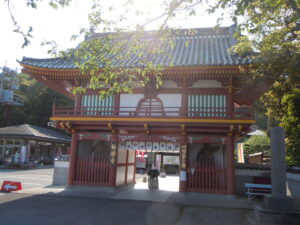
It is one of the temples where Amida Nyorai is enshrined as the principal deity, located relatively close to the beginning of the Shikoku Pilgrimage.
According to the temple’s tradition, the statue of Amida Nyorai enshrined as the principal deity was carved by Kobo Daishi.
Reflecting its connection with Amida Nyorai, the temple’s name itself includes the word “Gokuraku,” meaning “Pure Land of Ultimate Bliss.”
No. 7 Juraku-ji
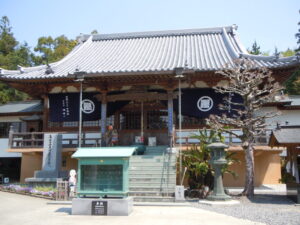
Kobo Daishi is traditionally said to have encountered Amida Nyorai when he visited this area, carved a statue of the Buddha, and enshrined it as the temple’s principal deity.
The name “Juraku-ji” is said to express the wish that people may be freed from the suffering of birth, aging, illness, and death and attain ten forms of light and spiritual joy.
Kannon Bosatsu and Seishi Bosatsu are enshrined on either side of the principal deity, Amida Nyorai, forming an Amida Triad.
Kochi Prefecture
No. 30 Zenraku-ji
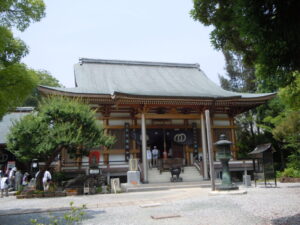
Zenraku-ji is traditionally said to have been founded by Kobo Daishi as the betto-ji temple serving Tosa Province’s Ichinomiya, Takagamo Daimyojin.
The temple has a history of Shinbutsu Shugo, the traditional blending of Buddhist and Shinto beliefs and practices. Today, it continues to welcome many pilgrims as one of the 88 temples of the Shikoku Pilgrimage located in Kochi City.
No. 37 Iwamoto-ji
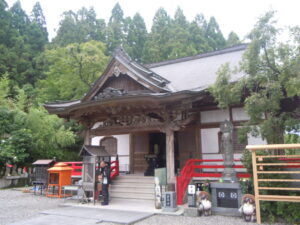
Iwamoto-ji is one of the more distinctive temples among the 88 temples of the Shikoku Pilgrimage. Rather than having a single principal deity, the temple enshrines five Buddhist deities as its principal deities:
- Fudo Myoo
- Kannon Bosatsu
- Amida Nyorai
- Yakushi Nyorai
- Jizo Bosatsu
For this reason, Amida Nyorai is also one of the five principal deities enshrined at Iwamoto-ji.
Ehime Prefecture
No. 47 Yasaka-ji
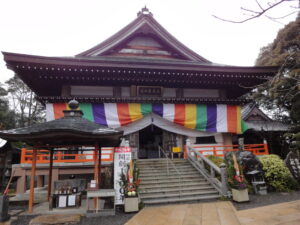
The seated statue of Amida Nyorai enshrined as the principal deity is traditionally attributed to Genshin, also known as Eshin Sozu.
Yasaka-ji is known for its “Path to Paradise” and “Path to Hell,” places where visitors can experience a sense of the Pure Land of Ultimate Bliss, where Amida Nyorai resides, as well as the world of hell described in Buddhist teachings.
In the basement beneath the main hall, approximately 8,000 statues of Amida Nyorai, donated by devotees from across Japan, are enshrined.
No. 53 Enmyo-ji
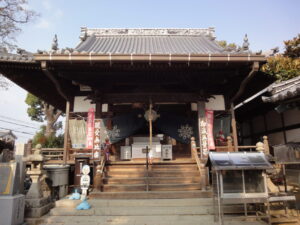
According to the temple’s tradition, Enmyo-ji was founded when Gyoki Bosatsu, at the imperial request of Emperor Shomu, carved and enshrined statues of Amida Nyorai, Kannon Bosatsu, and Seishi Bosatsu.
Enmyo-ji also preserves a votive pilgrim plaque known as the oldest copper pilgrim plaque in the Shikoku Pilgrimage. It bears an inscription dating to 1650, making it a valuable historical artifact for understanding the history of the Shikoku Pilgrimage.
No. 57 Eifuku-ji
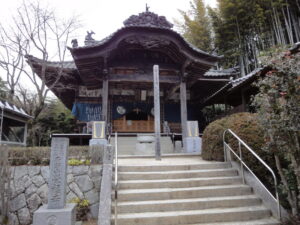
According to the temple’s tradition, Kobo Daishi performed a Goma fire ritual to pray for safe travel at sea. On the day the ritual was completed, Amida Nyorai is said to have appeared over the sea, and the image was enshrined as a sacred statue, marking the origin of the temple.
Located along the Seto Inland Sea, Eifuku-ji has long been a place of worship where people pray for safety on land and sea and for a long and prosperous life.
Kagawa Prefecture
No. 64 Maegami-ji
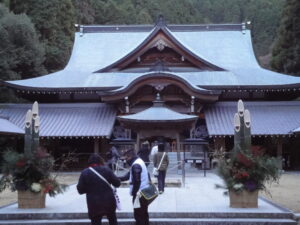
The principal deity of Maegami-ji is Amida Nyorai.
The temple has a deep connection with the worship of Mount Ishizuchi and enshrines Amida Nyorai as its principal deity.
No. 68 Jinne-in
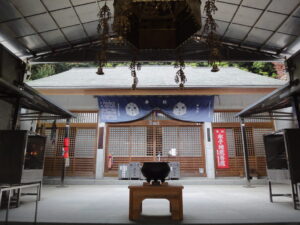
Temple No. 68, Jinne-in, shares the same grounds with Temple No. 69, Kannon-ji, making it a rare pilgrimage site where two of the 88 temples are located within a single temple complex.
In a single visit, pilgrims can pray at Jinne-in, whose principal deity is Amida Nyorai, and Kannon-ji, whose principal deity is Sho Kanzeon Bosatsu.
No. 78 Gosho-ji
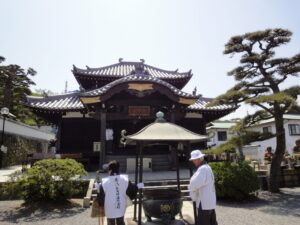
Gosho-ji is known as one of the temples on the Shikoku 88 Temple Pilgrimage that has attracted devotion from ordinary people since relatively early times.
Amida Nyorai is enshrined as the principal deity, and the temple continues to welcome many pilgrims today.
Conclusion
Amida Nyorai has long been worshipped as the Buddha who presides over the Pure Land of Ultimate Bliss in the west, saves all people, and guides them to the Pure Land.
His name means “Infinite Light” and “Infinite Life,” and in Japan, he has been widely worshipped alongside the recitation of the nenbutsu, “Namu Amida Butsu.”
On the Shikoku 88 Temple Pilgrimage, there are 10 temples where Amida Nyorai is enshrined as the principal deity.
Among them are temples such as Temple No. 37, Iwamoto-ji, which enshrines five Buddhist deities as its principal deities, and Temple No. 7, Juraku-ji, which enshrines the Amida Triad.
Even when Amida Nyorai is enshrined as the principal deity, each temple has its own unique history, origins, and traditions of worship.
When visiting temples on the Shikoku Pilgrimage where Amida Nyorai is enshrined as the principal deity, why not take some time to reflect on the Pure Land of Ultimate Bliss and Amida Nyorai’s vows as you pray?
Comments